ISO 22000, HACCP and BRCGS Explained for Indonesian Rice Buyers
For Indonesian rice buyers, ISO 22000 provides the broadest food safety management framework, HACCP controls production hazards directly, and BRCGS provides the strongest retailer-oriented certification structure. The right choice depends on the buyer’s import requirements, private-label strategy, retail channel, and level of supplier verification.
What are ISO 22000, HACCP and BRCGS?
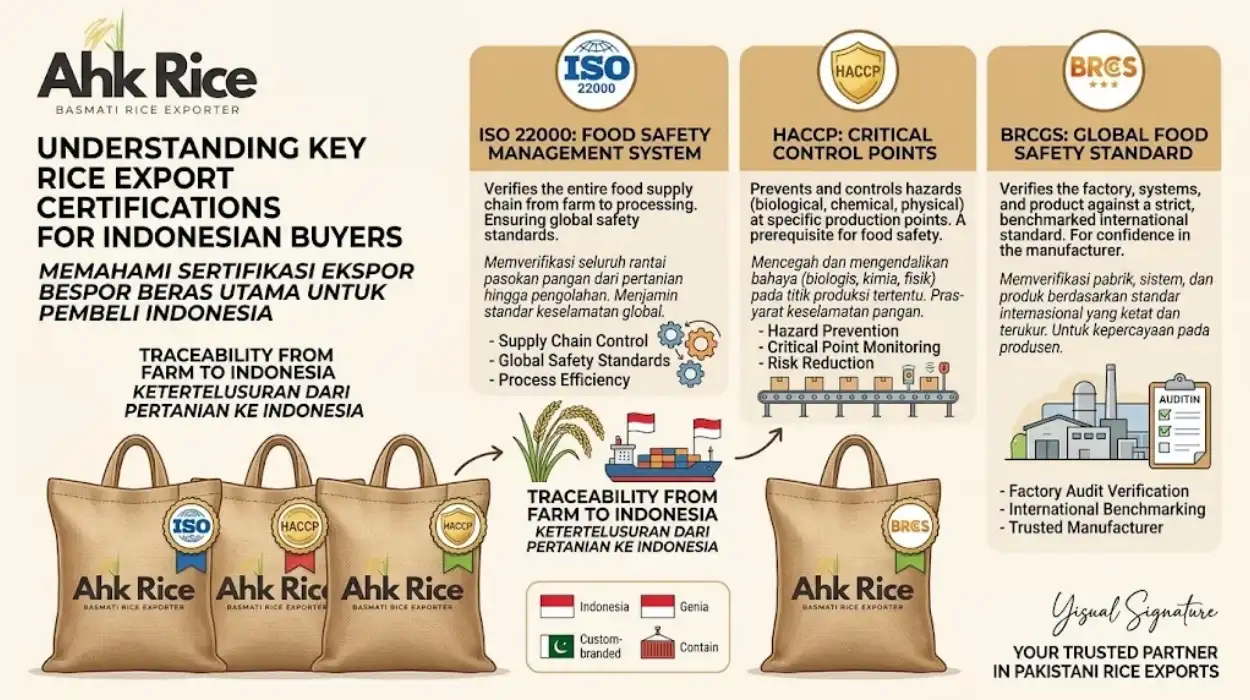
ISO 22000 is a food safety management system standard, HACCP is a preventive hazard-control method, and BRCGS is a detailed certification standard focused on food safety, product integrity, site controls, and retailer expectations across the supply chain.
ISO 22000 is developed by the International Organization for Standardization. It establishes a structured Food Safety Management System, commonly called an FSMS. The framework connects management responsibility, hazard analysis, operational controls, communication, verification, and continual improvement.
HACCP means Hazard Analysis and Critical Control Points. It identifies biological, chemical, and physical hazards and establishes controls at specific stages where those hazards require prevention or reduction. HACCP is therefore a control methodology rather than a complete management system.
BRCGS, originally associated with the British Retail Consortium, is a Global Standard for Food Safety used widely by food manufacturers, retailers, brand owners, and international supply chains. Its certification model places strong emphasis on site standards, food safety culture, traceability, supplier management, product authenticity, process control, and documented corrective action.
For an Indonesian rice importer, these distinctions matter because a certificate alone does not prove that every shipment meets the buyer’s specification. The buyer still needs product specifications, laboratory results, traceability records, export documentation, packaging controls, and shipment-level verification.
How do ISO 22000, HACCP and BRCGS compare for rice imports?
ISO 22000 offers the broad management framework, HACCP provides the operational hazard-control foundation, and BRCGS adds a more detailed certification structure for food manufacturing and retail supply chains. Their value increases when documentation and product verification work together.
| Attribute | ISO 22000 | HACCP | BRCGS |
|---|---|---|---|
| Primary purpose | Food safety management system | Hazard prevention and control | Comprehensive food safety certification |
| Main focus | Management + food safety processes | Critical food safety hazards | Site, product, process and supply-chain controls |
| Hazard analysis | Required | Core requirement | Required within the standard |
| Management system | Comprehensive | Limited by itself | Comprehensive and highly detailed |
| Retailer acceptance | Strong | Basic foundation | Very strong for retail supply chains |
| Audit structure | Management-system certification | HACCP system verification/certification | Detailed third-party certification |
| Best use | Exporter with structured FSMS | Essential production control | Retail/private-label/high-assurance sourcing |
The comparison shows why Indonesian buyers should avoid treating the three systems as interchangeable. HACCP establishes the food safety control logic. ISO 22000 places that logic inside a wider management system. BRCGS extends the control environment into detailed site, product, process, authenticity, traceability, and supplier-management requirements.
A buyer evaluating Pakistani Basmati rice should therefore examine the certificate scope, issuing certification body, production site, product category, certificate validity, and audit status rather than relying on the certificate name alone.
Which certification approach works best for Indonesian rice buyers?
The best approach depends on the commercial channel: HACCP supports basic hazard control, ISO 22000 suits structured international exporters, and BRCGS is strongest when Indonesian buyers require advanced supplier assurance for retail, private-label, or high-volume food distribution.
A traditional wholesale buyer purchasing bulk rice has different requirements from an Indonesian supermarket importing branded retail packs. A foodservice distributor also evaluates suppliers differently from a private-label brand owner.
For bulk wholesale procurement, HACCP-backed production controls combined with product testing and export documentation provide a practical baseline. The buyer needs evidence covering moisture, broken grains, foreign matter, pesticide residues, heavy metals where required, microbiological controls, fumigation, packaging, and traceability.
For a structured importer building a long-term supply program, ISO 22000 adds stronger management controls. It gives the buyer a framework for evaluating how the exporter identifies hazards, manages operational controls, documents corrective actions, and maintains food safety responsibilities.
For supermarket supply and private-label programs, BRCGS provides greater depth. The standard is designed around a highly controlled food production environment. Indonesian retailers and brand owners can use this level of certification when supplier assurance, traceability, product authenticity, and site controls are central to procurement.
The certification should match the risk and commercial model. More certification is not automatically better if the buyer does not require it. The objective is a verifiable food safety system that matches the product, market, packaging format, and sales channel.
What food safety controls should Indonesian buyers check beyond certification?
Indonesian buyers should evaluate certification together with product specifications, laboratory testing, traceability, phytosanitary documentation, Certificate of Origin, packaging controls, and shipment verification because certification describes the management system rather than the exact condition of every rice shipment.
For Pakistani Basmati rice, product-level verification is essential. A certified facility can produce different grades, pack different specifications, and handle different crop lots. The buyer must therefore connect the certificate to the actual facility and product being purchased.
A useful supplier file should contain the food safety certificate, product specification sheet, recent laboratory reports, Certificate of Origin, phytosanitary documentation where applicable, packing details, lot identification, and traceability information.
The laboratory report should match the buyer’s agreed specification. Depending on the destination and commercial program, this can include moisture, broken percentage, grain length, foreign matter, pesticide residues, heavy metals, microbiological parameters, and other tests specified by the buyer.
Packaging also requires verification. Indonesian retail buyers can require specific bag weights, Bahasa Indonesia labelling, importer details, nutritional information, product identity, origin information, halal requirements, and other applicable regulatory information.
This is why certification should be treated as one layer of supplier qualification rather than the entire qualification process.
How do the solutions compare for different Indonesian market regions?
Java and major retail markets generally require stronger documentation, consistent retail specifications, and dependable supplier verification, while secondary wholesale and foodservice markets place greater emphasis on price, grade consistency, packing flexibility, and reliable bulk supply.
Indonesia is a large and geographically distributed rice market. Procurement requirements differ according to buyer type, distribution channel, and destination logistics.
Java and major retail distribution
Jakarta, West Java, Central Java, and East Java contain major retail, foodservice, distribution, and manufacturing demand. Buyers operating private-label or premium retail programs generally place greater emphasis on traceability, food safety documentation, consistent grain specifications, packaging controls, and supplier auditability.
For these buyers, 1121 Basmati and Super Kernel can serve premium positioning when grain length, aroma, appearance, and cooking performance are central to the product proposition.
Price should be compared on a specification-adjusted basis. A lower FOB price is not necessarily the lower procurement cost when it comes with higher broken percentage, inconsistent grading, weaker packaging, or additional quality-control requirements.
For premium retail programs, an indicative planning range can be structured around the contracted specification rather than a fixed public market price. A buyer should request the current FOB Karachi or CIF Indonesian-port quotation for the exact grade, packing, quantity, and Incoterm.
Sumatra, Kalimantan and regional wholesale markets
Regional wholesale markets often prioritize commercial efficiency, stable supply, pack-size flexibility, and competitive landed cost. 1509 Basmati can become attractive where buyers need long-grain presentation and commercial price positioning without moving fully into the highest premium segment.
Super Kernel also works well where buyers want Pakistani Basmati aroma and elongated grain characteristics while maintaining a competitive sourcing position.
Shelf life depends on the product condition, moisture, packaging, storage temperature, humidity, warehouse hygiene, and whether the rice is aged or newly harvested. The certification standard does not determine shelf life by itself.
For this reason, buyers should compare declared shelf life and storage requirements alongside price per metric ton. A supplier offering a lower price with unsuitable storage or shorter commercial usability can create a higher total cost.
What are the pros and cons of ISO 22000, HACCP and BRCGS?
HACCP delivers focused hazard control at lower system complexity, ISO 22000 adds structured food safety management, and BRCGS provides deeper retail-oriented assurance but requires greater documentation, implementation discipline, and audit readiness from the certified facility.
HACCP
The main advantage of HACCP is its direct focus on food safety hazards. It is easy for procurement teams to understand because the system connects hazards with preventive controls and monitoring.
Its limitation is scope. HACCP alone does not provide the same complete management-system structure as ISO 22000 or the detailed site and product controls associated with BRCGS.
For a bulk rice importer, HACCP is a strong foundation when combined with laboratory testing and shipment-level documentation.
ISO 22000
ISO 22000 connects HACCP principles with management responsibilities, communication, verification, and continual improvement. This creates a stronger framework for exporters serving multiple markets.
Its advantage is scalability. A Pakistani exporter supplying Indonesian, UAE, European, African, and other markets can use a structured FSMS across different customer requirements.
Its limitation is that certification does not automatically satisfy every retailer or buyer-specific standard. Additional product testing, customer specifications, and audit requirements still apply.
BRCGS
BRCGS provides extensive requirements for food safety, site standards, traceability, authenticity, supplier approval, process control, and product protection. It is particularly useful for retail and private-label supply chains.
Its main disadvantage is implementation complexity. A facility must maintain detailed records, controls, verification procedures, and audit readiness.
For an Indonesian supermarket or private-label importer, that additional assurance can justify the higher supplier-control requirement.
How should Indonesian buyers choose a Pakistani rice supplier?
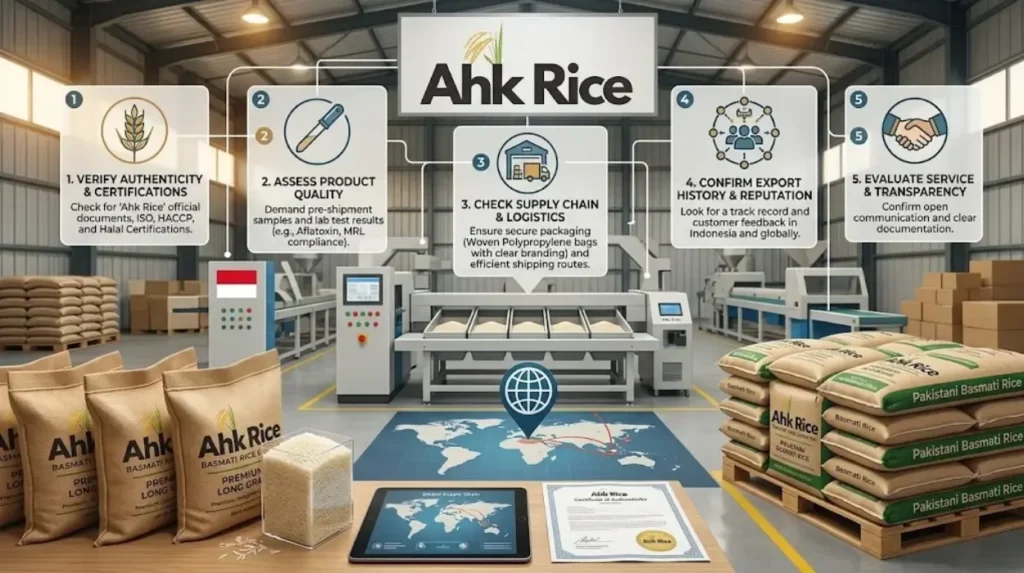
Indonesian buyers should select suppliers by matching certification level with product risk, sales channel, documentation requirements, product consistency, and commercial objectives rather than selecting the exporter with the longest certification list.
| Decision factor | What the buyer should verify |
|---|---|
| 1. Certification scope | Facility, product category, certificate validity and certification body |
| 2. Product control | Grade, grain length, moisture, broken percentage and laboratory testing |
| 3. Traceability | Lot identification from processing through container loading |
| 4. Market compliance | Indonesian import, labelling, quarantine and halal requirements |
| 5. Commercial fit | FOB/CIF price, MOQ, packaging, lead time and shipment reliability |
The first factor is certification scope. A certificate must relate to the actual processing facility supplying the rice. A company-level claim without facility-level evidence is insufficient.
The second factor is product control. Buyers should define measurable specifications before requesting quotations. For example, a 1121 Basmati requirement should identify grade, grain characteristics, broken percentage, moisture, packing, crop status, and testing requirements.
The third factor is traceability. Each shipment should connect the commercial invoice, packing list, lot information, laboratory results, and production records.
The fourth factor is Indonesian market compliance. Importers should verify the applicable requirements before commercial shipment because food registration, halal, labelling, quarantine, and import documentation depend on the product and sales format.
The fifth factor is commercial fit. A technically excellent supplier still needs to provide workable MOQ, packing, pricing, lead time, payment terms, and shipping arrangements.
Why does certification matter for private-label Indonesian rice?
Private-label rice programs require stronger control because the importer carries the market-facing brand responsibility, making traceability, specification consistency, packaging compliance, supplier verification, and documented food safety controls more important than certification alone.
A private-label importer is not simply buying rice. The importer is buying a controlled product specification that will appear under a consumer-facing brand.
This changes the supplier evaluation process. The buyer must confirm whether the exporter can maintain the same grain specification across repeated shipments, reproduce approved packaging, provide lot-level documentation, and support corrective action when a shipment fails specification.
For this model, BRCGS can provide strong supplier assurance, while ISO 22000 establishes a structured food safety management framework. HACCP remains the underlying hazard-control discipline.
The strongest procurement model combines certification with commercial sample approval. The buyer approves the physical rice against agreed specifications before the bulk order proceeds. The final production lot is then tested against the approved specification before shipment.
AHK Rice supplies Pakistani Basmati varieties including 1121, Super Kernel, and 1509 and supports export processing, custom packaging, documentation, and international shipment preparation. Its Basmati export service can be reviewed when evaluating supplier capabilities.
What should Indonesian buyers request before placing a rice order?
Before confirming a Pakistani Basmati order, Indonesian buyers should request the relevant certification, product specification, sample, laboratory report, packaging details, export documents, commercial terms, and shipment plan so quality and compliance are agreed before production and loading.
A practical pre-order file should include the following:
- Certification copy and scope.
- Product specification sheet.
- Commercial sample approval.
- Laboratory test requirements.
- Packaging artwork and pack size.
- Certificate of Origin requirements.
- Phytosanitary documentation requirements.
- Lot and traceability information.
- FOB or CIF quotation.
- Production and shipment schedule.
This approach prevents certification from becoming a checkbox exercise. It connects food safety management with the actual rice entering Indonesia.
For buyers comparing 1121, Super Kernel, and 1509, the final decision should also include grain performance, target retail price, packaging format, buyer segment, and expected turnover.
The strongest supplier relationship is based on repeatable specifications. When the same specification, testing method, packaging format, documentation process, and shipment controls are used for every order, procurement becomes easier to audit and forecast.
What is the best overall strategy for Indonesian rice procurement?
The strongest strategy is a layered compliance model: HACCP-based hazard control, ISO 22000 or BRCGS certification where commercially appropriate, shipment-level laboratory verification, complete export documentation, approved samples, and traceability from processing facility to Indonesian destination.
No single certification replaces the complete procurement process.
HACCP answers the question of how food safety hazards are controlled. ISO 22000 answers how those controls operate within a managed food safety system. BRCGS adds detailed requirements suited to demanding retail and private-label supply chains.
For Indonesian importers, the practical objective is supplier verification rather than certificate collection. The exporter should demonstrate control over the rice specification, processing environment, testing, packaging, documentation, and shipment process.
That framework also makes price comparison more accurate. Instead of comparing only US$/MT, buyers can compare specification, certification, testing, packaging, shelf life, shipment reliability, and landed cost together.
The decision becomes especially important when selecting between premium 1121, aromatic Super Kernel, and commercially positioned 1509 Basmati. Each grade can serve a different Indonesian buyer segment when the specification and procurement objective are clearly defined.
For buyers moving from evaluation to supplier selection, the next stage is a detailed assessment of exporter capability, compliance documentation, sample approval, and shipment execution. The BOFU article, “Partner with a Certified Pakistani Basmati Exporter for Indonesian Food Safety Compliance,” is the appropriate next-stage resource for that decision.
Suggested BOFU Link Placement
Insert the BOFU link in the final section, immediately after the paragraph explaining the move from certification evaluation to supplier selection. Use a contextual anchor such as “evaluate a certified Pakistani Basmati exporter for Indonesian compliance” rather than repeating the exact BOFU title as keyword-stuffed anchor text.
Recommended placement:
For buyers moving from evaluation to supplier selection, evaluate a certified Pakistani Basmati exporter for Indonesian compliance to compare certification, documentation, product testing, sampling, packaging, and shipment controls before final procurement.
This placement works because the reader has already completed the informational and comparison stage and is now ready for supplier-level evaluation.