How Many Pounds of Basmati Rice Fit in a 20ft Container?
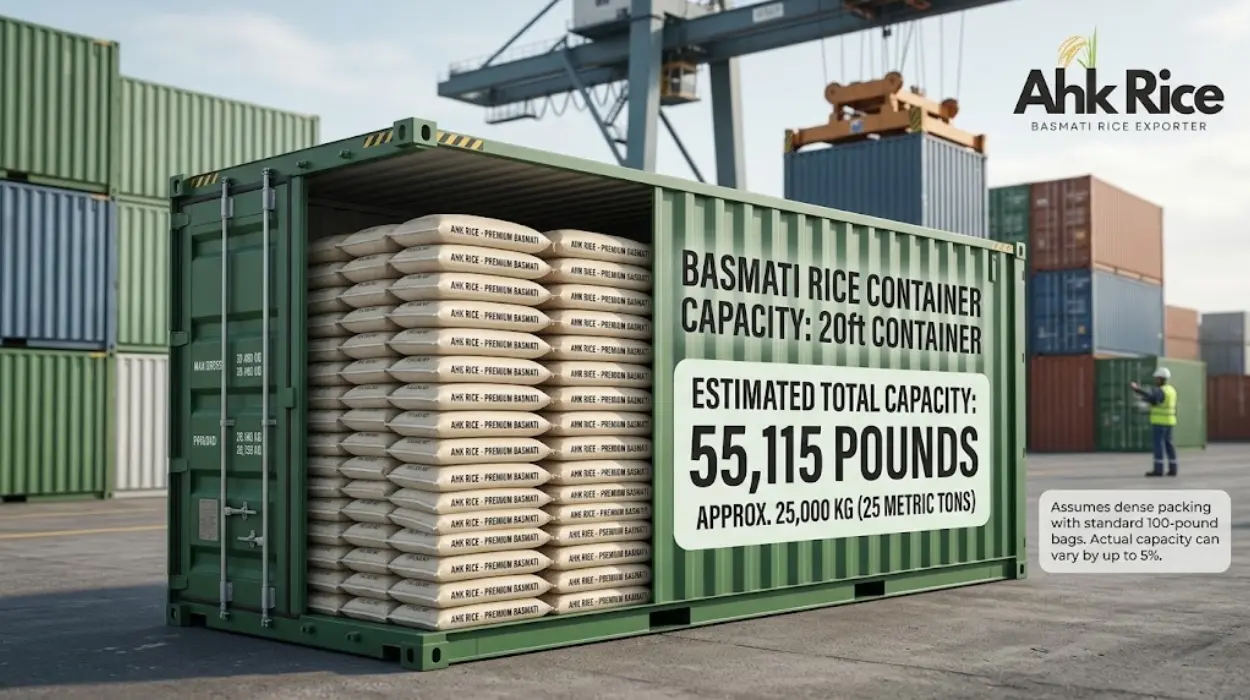
A standard 20-foot shipping container typically holds approximately 44,000 to 48,000 pounds of bagged Basmati rice, depending on the container’s payload limit, packaging weight, loading method, and transport regulations. The exact quantity depends on the rice grade, bag size, and shipment configuration.
What Is the Capacity of a 20ft Container for Basmati Rice?
A standard 20-foot dry container generally accommodates around 20 to 22 metric tonnes of bagged rice, equivalent to approximately 44,092 to 48,502 pounds. The final loading weight must remain within the container’s maximum payload and applicable road transport limits.
A 20-foot container is a common option for transporting Pakistani Basmati rice from export facilities to international ports. It measures approximately 20 feet long, 8 feet wide, and 8 feet 6 inches high externally. Internal dimensions vary by container manufacturer and equipment type.
The container’s payload capacity determines the maximum cargo weight. The payload is the maximum permitted weight of goods inside the container, excluding the container’s own tare weight.
For example, a container with a verified payload of 28,000 kilograms has a theoretical cargo limit of approximately 61,729 pounds. However, this does not mean every rice shipment can reach that weight. The truck chassis, axle limits, route restrictions, packaging, and shipping line requirements also determine the permitted load.
For most export planning, a working estimate of 20,000 to 22,000 kilograms of bagged rice provides a practical starting point. The shipper must confirm the actual container specifications before loading.
How Does Basmati Rice Container Loading Work?
Container loading begins with confirming the rice specification, packaging format, container payload, and destination requirements. Workers inspect the container, arrange the bags, distribute the weight evenly, secure the cargo, and verify the final shipment weight before dispatch.
The process follows a defined sequence.
1. Confirm the Rice Grade and Order Quantity
The exporter identifies the Basmati variety, processing type, grain specifications, and required quantity. Common Pakistani varieties include 1121 Basmati, Super Kernel Basmati, and 1509 Basmati.
The order also specifies whether the rice is white, steamed, golden Sella, creamy Sella, or brown. Each processing type has different commercial requirements, but the permitted container weight depends primarily on cargo mass and packaging rather than the variety alone.
2. Select the Packaging Format
Exporters commonly use 5 kg, 10 kg, 20 kg, 25 kg, and 50 kg bags. Retail shipments often require smaller packs, while wholesalers and foodservice distributors frequently purchase larger bags.
The packaging material adds weight to the shipment. A 50 kg net rice bag weighs more than 50 kg when its packaging is included, although the difference is usually small relative to the total cargo.
3. Inspect the Container
The loading team checks the floor, walls, roof, doors, and seals. The container must be clean, dry, free from pests, and suitable for food cargo.
Moisture, damaged flooring, or contamination can compromise the shipment. Workers document the container’s condition before placing rice bags inside.
4. Load and Secure the Bags
Workers arrange bags in stable rows and distribute the weight across the container floor. They avoid concentrated loads and unstable stacks. Dunnage, suitable liners, and other approved materials help protect the cargo when required.
The team verifies the number of bags, net rice weight, packaging weight, and total cargo weight before closing the doors.
How Many Pounds Fit Based on Rice Bag Size?
The number of bags in a 20-foot container depends on the selected net bag weight and the shipment’s permitted cargo mass. At a 22,000-kilogram net rice target, a shipment contains 440 bags of 50 kg, 880 bags of 25 kg, or 2,200 bags of 10 kg.
The following table shows theoretical bag counts for 20,000 kg and 22,000 kg of net rice.
| Net Weight per Bag | Pounds per Bag | Bags at 20,000 kg | Bags at 22,000 kg |
|---|---|---|---|
| 5 kg | 11.02 lb | 4,000 | 4,400 |
| 10 kg | 22.05 lb | 2,000 | 2,200 |
| 20 kg | 44.09 lb | 1,000 | 1,100 |
| 25 kg | 55.12 lb | 800 | 880 |
| 50 kg | 110.23 lb | 400 | 440 |
These figures represent net rice quantities, not guaranteed loading plans. Actual bag counts depend on gross cargo weight, container payload, packaging, stacking arrangements, and transport restrictions.
For example, 440 bags containing 50 kg each provide 22,000 kg of rice. The rice alone weighs approximately 48,502 pounds. The packaging adds to the gross cargo weight, so the final shipment manifest must account for that additional mass.
What Factors Determine the Actual Loading Capacity?
Actual capacity depends on the container’s rated payload, packaging weight, cargo distribution, and applicable transport restrictions. The physical space inside a container does not establish its safe loading limit. Exporters must verify both weight capacity and the available loading space.
Five factors determine the final quantity.
Container Payload
The container’s data plate specifies its maximum gross mass and tare weight. Subtracting tare weight from maximum gross mass gives the rated payload.
Packaging Weight
Polypropylene woven bags, laminated bags, vacuum packaging, and retail pouches contribute to gross cargo weight. Pallets, liners, and dunnage also consume part of the available payload when used.
Loading Method
Loose bag loading uses the container floor directly, subject to the approved stacking plan. Palletized loading places bags on pallets for easier handling, but pallets occupy space and add weight. This reduces the number of rice bags carried in some configurations.
Transport Regulations
A container that satisfies its equipment rating can still exceed a truck’s legal road weight. Port access, axle distribution, chassis limits, and local regulations affect the permitted shipment.
Cargo Protection
Rice must remain dry and protected from contamination. Appropriate liners, moisture-control measures, and secure stacking protect product quality during transit.
Which Pakistani Basmati Rice Varieties Are Exported in 20ft Containers?
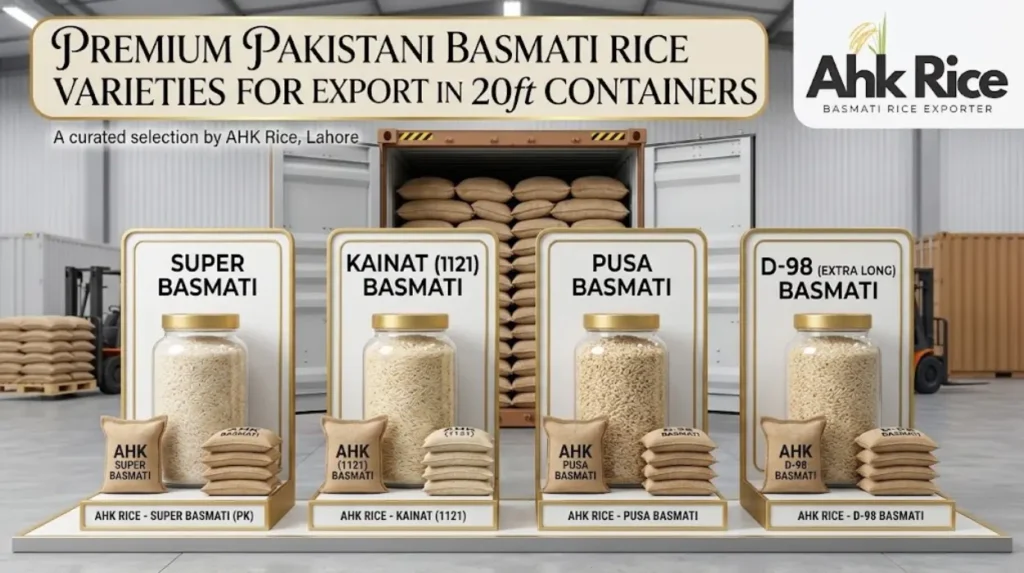
Pakistani exporters commonly ship 1121, Super Kernel, and 1509 Basmati rice in 20-foot containers. Buyers select each variety according to grain length, aroma, processing type, price positioning, and intended use in retail, wholesale, catering, and foodservice markets.
1121 Basmati Rice
1121 Basmati is known for its long, slender grains and substantial cooked-grain elongation. Exporters supply white, steamed, golden Sella, creamy Sella, brown, and broken grades according to buyer specifications.
Premium retail brands, restaurants, and catering businesses select 1121 for dishes that require long, separate grains, including biryani and pilaf.
Super Kernel Basmati Rice
Super Kernel is a traditional Pakistani Basmati variety associated with aromatic cooked rice and a distinctive grain profile. Buyers purchase it for ethnic grocery distribution, private-label packaging, and foodservice applications.
Export specifications define grain length, moisture, broken percentage, foreign matter, and other quality parameters.
1509 Basmati Rice
1509 is an early-maturing Basmati variety valued for its long grain and commercial yield characteristics. Exporters supply white, steamed, and parboiled forms for wholesale distribution, catering, and price-conscious retail markets.
The processing type and grade determine the order specification. The variety itself does not automatically determine the number of pounds that fit inside a container.
How Is Basmati Rice Processed Before Container Loading?
Export Basmati rice passes through cleaning, grading, milling, sorting, quality inspection, and packaging before shipment. Processing removes unwanted material, separates grain fractions, and prepares the product to meet the buyer’s agreed specifications and applicable food safety requirements.
The typical processing sequence includes the following stages.
1. Paddy Reception and Cleaning
Paddy rice arrives from agricultural supply chains in Punjab and other producing areas. Cleaning equipment removes straw, dust, stones, and other foreign material before further processing.
2. Dehusking and Milling
Dehusking removes the outer husk. Milling removes the bran layers when the buyer orders white rice. Brown rice retains its bran layer, while parboiled products undergo a controlled soaking, steaming, and drying process before milling.
3. Grading and Length Separation
Grading equipment separates whole grains, head rice, and broken rice. The buyer’s specification establishes acceptable grain dimensions and broken percentages.
4. Optical Sorting
Optical sorting equipment identifies and removes discoloured grains and selected defects. Single or double Sortex processing is specified according to the required purity and appearance standards.
5. Quality Testing and Packaging
Quality control checks the agreed parameters, including moisture, grain length, broken percentage, and foreign matter. Additional laboratory testing addresses relevant food safety and destination requirements.
The rice is packed into approved bag sizes, labelled according to the order, and prepared for loading.
Which Markets Import Pakistani Basmati Rice?
Pakistani Basmati rice serves international markets across the Middle East, Europe, North America, Africa, and Asia. Importers select grades and packaging according to local demand, retail formats, foodservice requirements, import rules, and customer preferences.
Important destination markets include the United Arab Emirates, Saudi Arabia, the United Kingdom, the United States, Malaysia, and other countries that import Pakistani rice.
In the Gulf region, distributors supply Basmati rice to supermarkets, wholesalers, restaurants, and catering operators. Larger bags support foodservice and wholesale demand, while smaller retail packs serve household consumers.
In the United States, importers purchase Basmati rice for ethnic grocery stores, mainstream supermarkets, private-label brands, and restaurants. Shipments must comply with applicable US food import requirements, including relevant FDA requirements, customs documentation, and product labelling rules.
European buyers assess applicable food safety, pesticide residue, contaminant, traceability, and labelling requirements. Requirements differ by destination and product, so importers verify them before shipment.
The destination market affects packaging, documentation, inspection, and cargo handling. It does not change the container’s rated payload.
What Certifications and Documents Apply to Basmati Rice Exports?
Basmati rice export documentation depends on the origin, destination, buyer contract, and applicable regulations. Common documents include the commercial invoice, packing list, bill of lading, certificate of origin, and relevant phytosanitary or inspection documents when required.
The commercial invoice identifies the seller, buyer, product, price, and transaction terms. The packing list records bag counts, net weight, gross weight, and package details. The bill of lading documents the sea shipment.
A certificate of origin identifies the product’s declared country of origin. Phytosanitary documentation applies when required by the importing country’s plant health rules. Laboratory reports and certificates of analysis support agreed quality and food safety specifications.
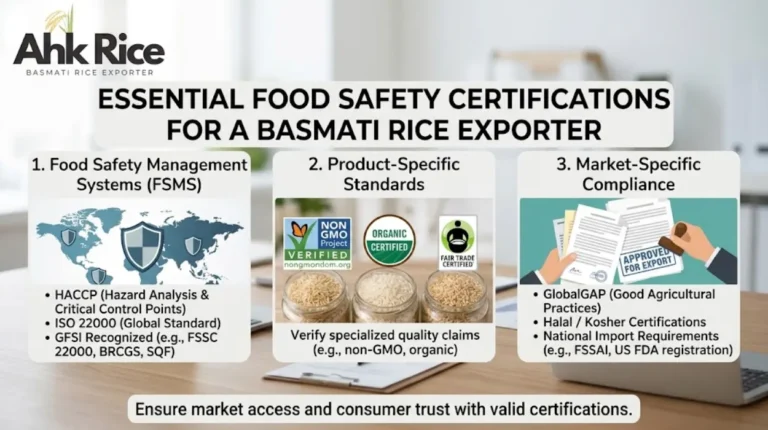
Food safety certifications, such as HACCP or ISO 22000, demonstrate aspects of a facility’s food safety management system when valid and applicable. They do not replace mandatory import permissions or government documentation.
For US-bound shipments, importers must assess applicable FDA facility registration, Prior Notice, Foreign Supplier Verification Program, and US Customs and Border Protection requirements. The specific obligations depend on the parties, product, and shipment circumstances.
What Are the Benefits of Using a 20ft Container for Basmati Rice?
A 20-foot container provides a practical shipping unit for bagged rice, manageable cargo quantities, and international distribution. It supports wholesale orders, trial shipments, and regular replenishment while allowing exporters and importers to calculate bag counts and freight requirements.
Its principal benefits include:
- Manageable shipment size: Importers can order a defined quantity without committing to a larger container.
- Flexible packaging: The cargo can contain 5 kg, 10 kg, 25 kg, or 50 kg bags, subject to the loading plan.
- Cargo protection: An intact, dry container protects properly packaged rice from direct exposure to weather during transport.
- Simplified inventory planning: A known bag count helps importers estimate warehouse space, sales volume, and stock replenishment.
- Defined shipment documentation: Net weight, gross weight, bag count, and container identification can be recorded consistently.
The most suitable container depends on order volume, freight economics, product requirements, and destination logistics.
What Common Problems Affect Basmati Rice Container Loading?
Common loading problems include exceeding payload limits, inaccurate bag counts, moisture exposure, uneven weight distribution, and incorrect shipment documents. Accurate calculations, container inspections, appropriate cargo protection, and final weight verification prevent avoidable delays and reduce the risk of cargo damage.
Overloading is a major operational risk. The shipper must compare the planned gross cargo weight with the container’s rated payload and the legal road transport limit.
Poor stacking can cause bags to shift or collapse during movement. Uneven distribution creates concentrated floor loads and affects handling safety. Wet containers and unsuitable packaging expose rice to moisture damage.
Documentation errors also create problems. A packing list showing 440 bags must match the actual loaded quantity. The declared net and gross weights must agree with the shipment records.
Another misconception is that every 20-foot container carries the same rice quantity. Container specifications, packaging formats, pallets, and route restrictions differ. A reliable loading plan uses the specific equipment’s ratings rather than a universal weight assumption.
For importers planning shipments to the United States, container weight is only one part of logistics planning. Packaging, palletization, fumigation requirements where applicable, and port handling also affect shipment preparation. These considerations are explained in a guide to container loading, palletizing, and fumigation for rice shipments to US ports.
Frequently Asked Questions
How many pounds of Basmati rice fit in a 20ft container?
A 20-foot container commonly carries approximately 44,000 to 48,500 pounds of bagged rice when the shipment contains 20 to 22 metric tonnes. The actual quantity depends on the container’s payload rating, packaging, and transport restrictions.
How many 50 kg bags fit in a 20ft container?
At a net rice quantity of 20,000 kg, a shipment contains 400 bags of 50 kg each. At 22,000 kg, it contains 440 bags. The final quantity must account for packaging weight and applicable loading limits.
How many 25 kg rice bags fit in a 20ft container?
A shipment containing 20,000 kg of rice holds 800 bags of 25 kg each. A 22,000 kg shipment holds 880 bags. These figures represent net rice weight rather than total cargo weight.
What is the maximum payload of a 20ft shipping container?
The payload varies by container model. Some standard 20-foot dry containers have payload ratings around 28,000 kg, but the container’s actual data plate determines its permitted cargo weight. Road transport restrictions can impose a lower practical limit.
Does palletizing reduce the quantity of rice loaded?
Yes. Pallets occupy container space and add weight. Depending on the pallet dimensions, stacking arrangement, and payload limit, palletized shipments can contain fewer bags than floor-loaded shipments.