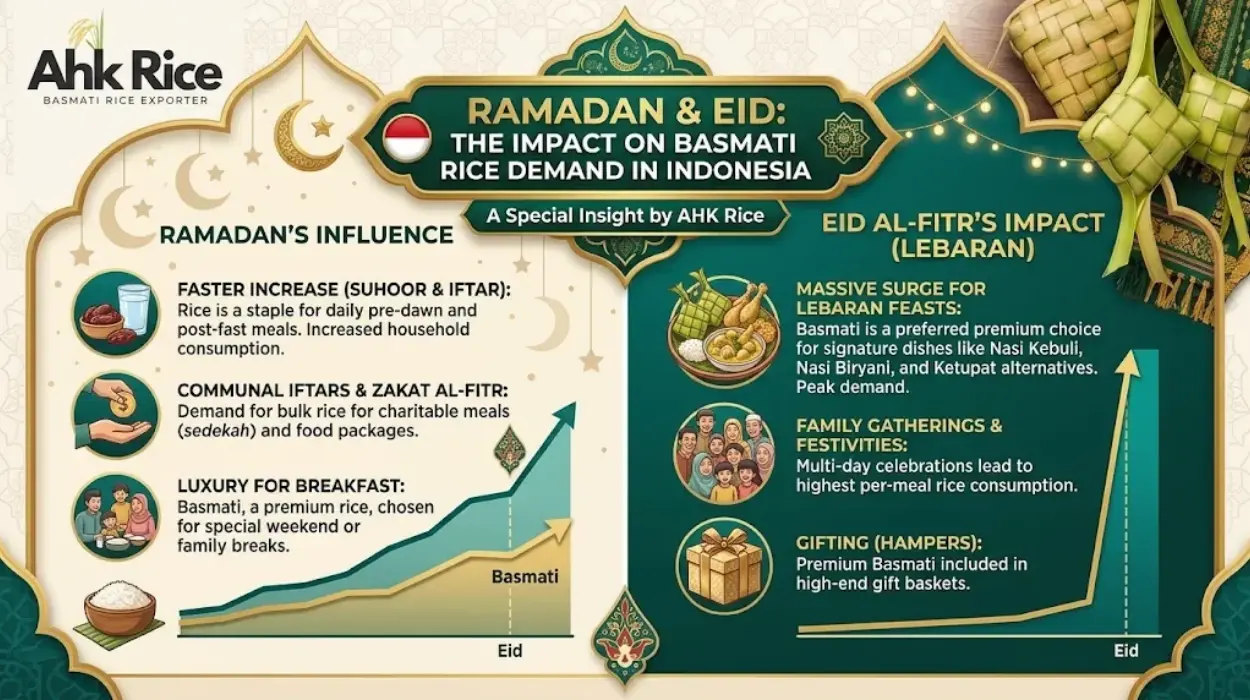
How Does Ramadan and Eid Affect Basmati Rice Demand in Indonesia?
Ramadan and Eid create a recurring seasonal pattern in Indonesian food demand. Basmati rice demand rises through household cooking, restaurants, hotels, catering businesses, and community meals. The strongest demand comes from foodservice and consumers seeking long-grain aromatic rice for biryani, mandi, pilaf, and other festive dishes.
The demand cycle also extends beyond Ramadan. Eid al-Fitr increases household food purchases after the fasting month, while Eid al-Adha increases demand around communal meals and religious gatherings. Hajj and Umrah catering creates another foodservice channel because Indonesian pilgrims consume rice-based meals through organized accommodation and catering services.
What happens to Basmati rice demand during Ramadan in Indonesia?
Ramadan increases Basmati rice demand because Indonesian households, restaurants, caterers, hotels, and community kitchens prepare larger quantities of rice-based meals for iftar, sahur, gatherings, and religious events throughout the month.
Ramadan changes the timing and volume of food consumption. Muslims fast from dawn to sunset, then consume the main evening meal during iftar. Rice remains a central staple in Indonesian cuisine, so increased meal preparation directly affects rice purchasing patterns.
Basmati rice occupies a specific segment within this market. Its long grains, aroma, and cooked appearance make it suitable for dishes where rice presentation and texture matter. Examples include biryani, rice platters, pilaf-style dishes, mandi, and mixed rice meals.
Restaurants and catering operators also increase production during Ramadan. Many businesses offer special iftar menus, buffet meals, family packages, and corporate food programs. These operations require predictable rice quality because large batches are cooked within defined service periods.
The seasonal increase therefore involves more than household consumption. It includes commercial food preparation, institutional catering, hotels, restaurants, and event suppliers.
Why do Ramadan meals increase demand for long-grain aromatic rice?
Long-grain aromatic rice fits Ramadan foodservice because its appearance, aroma, cooked separation, and portion structure suit biryani, mandi, pilaf, buffet meals, and large catering trays served during iftar and religious gatherings.
Rice used in festive meals must provide a consistent cooked result. Long grains create a different visual presentation from short or medium-grain varieties. Aromatic characteristics also contribute to the identity of dishes such as biryani and mandi.
Basmati rice is traditionally associated with the Indian subcontinent and is available in several commercial grades. Indonesian buyers distinguish products according to grain length, processing method, broken percentage, moisture, purity, packaging, and cooking performance.
The most relevant Pakistani Basmati varieties include 1121, Super Kernel, and 1509. These varieties serve different commercial requirements.
1121 is known for its extra-long grain and strong cooked elongation. It fits premium rice dishes and foodservice applications where grain length is a visible quality attribute.
Super Kernel is a premium Pakistani Basmati type with strong aroma and long grain characteristics. It serves retail, restaurant, and South Asian foodservice requirements.
1509 is another long-grain Pakistani variety. It provides a balance between long grain presentation, commercial availability, and foodservice efficiency.
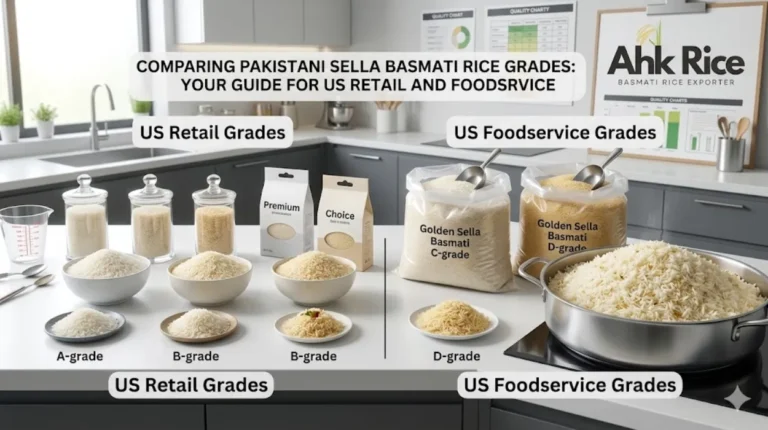
Processing also changes the final product. Steam, Golden Sella, and Creamy Sella represent different parboiling and processing styles. These products have different cooking characteristics and applications.
How does the Ramadan demand cycle work in Indonesia?
The Indonesian Ramadan demand cycle starts with advance purchasing, reaches stronger foodservice activity during Ramadan, continues through Eid al-Fitr, and shifts toward Eid al-Adha and Hajj-related catering requirements later in the Islamic calendar.
Importers and distributors do not purchase rice only when consumers begin shopping. Commercial supply planning starts before the demand peak because imported rice requires international transportation, customs clearance, inspection, warehousing, and domestic distribution.
The cycle contains several stages.
Pre-Ramadan preparation
Retailers and foodservice operators build inventory before Ramadan begins. Importers evaluate existing warehouse stocks, expected restaurant orders, distributor requirements, and retail promotions.
Ramadan foodservice demand
Restaurants and caterers increase meal production. Iftar programs create concentrated evening demand, while sahur services create another daily meal period.
Eid al-Fitr purchasing
Eid al-Fitr follows the completion of Ramadan. Household spending changes again because families prepare larger meals, visit relatives, and host guests.
Post-Eid normalization
Demand eventually returns toward normal levels. However, institutional and restaurant demand continues according to local business activity.
Eid al-Adha and Hajj catering
Eid al-Adha creates another period of communal meals. Hajj and Umrah catering also creates structured demand for rice among Indonesian pilgrims and travel-related foodservice operations.
This calendar-based pattern is important for import planning because procurement must match the time between purchase, shipment, clearance, storage, and final consumption.
Which Basmati rice grades are used for Ramadan and Eid meals?

Ramadan and Eid foodservice uses multiple Basmati grades, with 1121, Super Kernel, and 1509 serving premium, restaurant, catering, retail, and institutional applications according to grain length, processing type, price, and cooking requirements.
1121 generally fits premium applications requiring long grain presentation. Its cooked grains provide a prominent appearance in biryani and large rice platters.
Super Kernel serves buyers seeking Pakistani Basmati aroma and long-grain characteristics. It fits ethnic retail, South Asian restaurants, caterers, and premium foodservice.
1509 supports commercial foodservice where long grain performance and procurement economics are important. It is available in Steam and Sella processing formats.
Processing creates additional product categories.
Steam rice retains a white appearance and serves fresh-cooking applications.
Golden Sella is parboiled and has a firmer cooked structure. It is suitable for catering and dishes requiring holding time.
Creamy Sella provides another parboiled presentation and is used in commercial rice preparation.
Broken rice represents a different commercial category. It contains shorter grain pieces and is generally selected for applications where whole-grain presentation is not the primary requirement.
How does Basmati rice processing affect Ramadan foodservice?
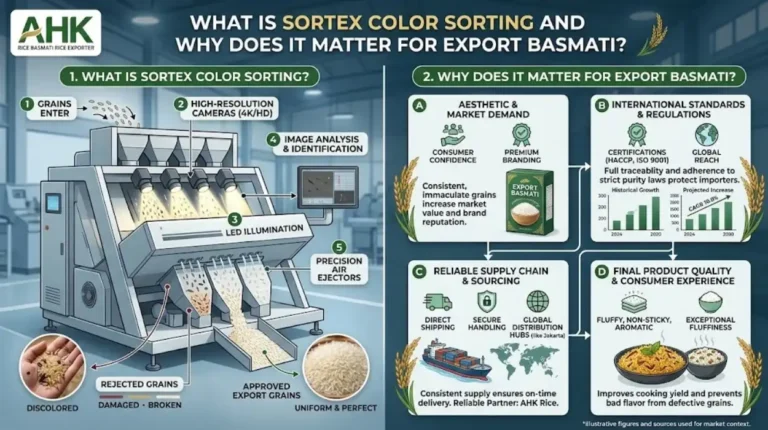
Basmati rice processing controls cleanliness, grain uniformity, moisture, broken percentage, milling quality, and cooking performance, making consistent processing essential for restaurants and caterers handling large Ramadan meal volumes.
Processing starts with paddy received from agricultural production areas. Pakistani Basmati is associated with Punjab, including areas such as Gujranwala, Hafizabad, Sheikhupura, Narowal, and Sialkot.
The process begins with cleaning. Foreign material, dust, stones, and other unwanted particles are removed.
Paddy then passes through milling operations. Husks are removed, and the edible rice is separated for further processing.
Grading separates grains according to size and quality characteristics. Sortex systems remove discoloured and defective grains using optical sorting technology.
Some export facilities use double Sortex processing for tighter visual uniformity. DNA purity testing provides another quality-control method for verifying varietal identity.
Moisture is also controlled. A commercial specification can define maximum moisture, broken percentage, grain length, and other quality parameters.
Parboiled products follow an additional processing route. Steam and Sella processes change the physical characteristics of rice and influence cooking behaviour.
The final product is packed according to buyer requirements. Common commercial formats include 5 kg, 10 kg, 25 kg, and 50 kg bags, depending on the market and sales channel.
Which Indonesian markets use Basmati rice during Ramadan and Eid?
Basmati demand is concentrated in Indonesian retail, restaurants, hotels, caterers, South Asian foodservice, premium grocery channels, and institutional meal programs, with Jakarta and other major urban markets providing important commercial distribution points.
Jakarta represents a major commercial and foodservice market because of its large population, restaurant sector, hotels, corporate activity, and international community.
Other urban centres also support specialty rice demand. Surabaya, Bandung, Medan, and Bali contain foodservice and hospitality businesses that purchase imported specialty rice.
The market is not limited to individual households. Restaurants purchase rice for menu production. Catering companies purchase larger quantities for recurring meal contracts. Hotels use rice for buffets and events.
Premium grocery stores and specialty food distributors also serve consumers who specifically seek long-grain aromatic rice.
The strongest use cases therefore come from businesses that require consistent cooking results rather than from general rice consumption alone.
What are the main benefits of Basmati rice for Ramadan catering?
Basmati rice provides long grain appearance, aroma, separated cooked grains, and several processing options, giving Ramadan caterers flexibility for biryani, pilaf, rice platters, buffets, family meals, and large-volume food preparation.
The first benefit is presentation. Long grains create a distinctive appearance on serving trays.
The second is aroma. Aromatic Basmati contributes a recognizable fragrance to dishes containing spices, meat, vegetables, or sauces.
The third is product choice. Buyers can select among 1121, Super Kernel, and 1509 according to their specifications.
The fourth is processing flexibility. Steam and Sella products support different cooking and holding requirements.
The fifth is packaging flexibility. Retailers can purchase smaller consumer packs, while restaurants and caterers can purchase larger commercial bags.
These characteristics make Basmati a specialized rice category rather than a direct substitute for every Indonesian rice application.
What problems affect Basmati rice imports before Ramadan?
The main problems are late procurement, inconsistent specifications, insufficient stock planning, unclear import documentation, unsuitable packaging, variable grain quality, and failure to match the rice grade with the intended Indonesian foodservice application.
Timing is one of the largest risks. International shipments require planning before the consumption peak.
Specification errors create another problem. A buyer requesting “Basmati rice” without defining grain length, broken percentage, moisture, processing type, packaging, and quantity leaves the product specification incomplete.
Processing type also matters. A caterer requiring firmer rice for buffet service needs a product suited to that cooking system.
Packaging must match the distribution channel. Retail products require consumer-oriented packaging and labeling, while foodservice operators generally require larger commercial packs.
Import documentation must also be prepared correctly. Indonesian import requirements apply to the product, importer, packaging, labeling, quarantine procedures, and applicable food regulations.
A practical procurement plan therefore connects the Islamic calendar with product specifications, shipment timing, inventory requirements, and regulatory preparation.
How should buyers plan Basmati rice imports for Ramadan, Eid and Hajj?
Buyers should forecast consumption by event, define the exact Basmati grade, confirm processing and packaging specifications, schedule shipment before peak demand, prepare import documents, and maintain sufficient warehouse stock for each catering period.
The first step is demand forecasting. Separate Ramadan, Eid al-Fitr, Eid al-Adha, and Hajj-related requirements instead of treating them as one season.
The second step is product specification. Define variety, grain length, processing type, moisture, broken percentage, packaging, quantity, and required quality documentation.
The third step is supplier coordination. Commercial samples should represent the same specification planned for bulk shipment.
The fourth step is logistics scheduling. The buyer must account for production, loading, ocean freight, port handling, customs clearance, inspection, and inland transportation.
The fifth step is inventory management. Stock should arrive early enough to absorb shipping or clearance delays without disrupting restaurant and catering operations.
Frequently Asked Questions
Does Ramadan increase Basmati rice demand in Indonesia?
Yes. Ramadan increases demand from restaurants, caterers, hotels, households, and community meal programs. Basmati is used for biryani, rice platters, pilaf, and other festive meals.
Which Basmati varieties are relevant to Indonesian buyers?
1121, Super Kernel, and 1509 are major Pakistani Basmati varieties. Buyers select among them according to grain length, aroma, processing, cooking performance, price, and foodservice requirements.
Is Basmati rice used for Eid al-Fitr meals?
Yes. Eid al-Fitr increases family gatherings, guest meals, restaurant activity, and catering. These occasions support demand for specialty long-grain rice used in festive dishes.
Does Eid al-Adha affect rice demand?
Yes. Eid al-Adha generates communal meals, family gatherings, religious-event catering, and increased food preparation. Basmati is used where long-grain appearance and aromatic cooking are preferred.
Why is processing important for Ramadan catering?
Processing affects grain uniformity, cleanliness, moisture, broken percentage, cooking behaviour, and holding performance. These characteristics are important when caterers cook large quantities of rice.
Which Basmati processing types are available?
Common commercial processing types include Steam, Golden Sella, and Creamy Sella. Each has different physical and cooking characteristics and serves different foodservice requirements.
When should Indonesian buyers plan Ramadan Basmati imports?
Planning should begin before Ramadan because international procurement requires time for specification approval, sampling, production, shipping, customs clearance, inspection, and domestic distribution.