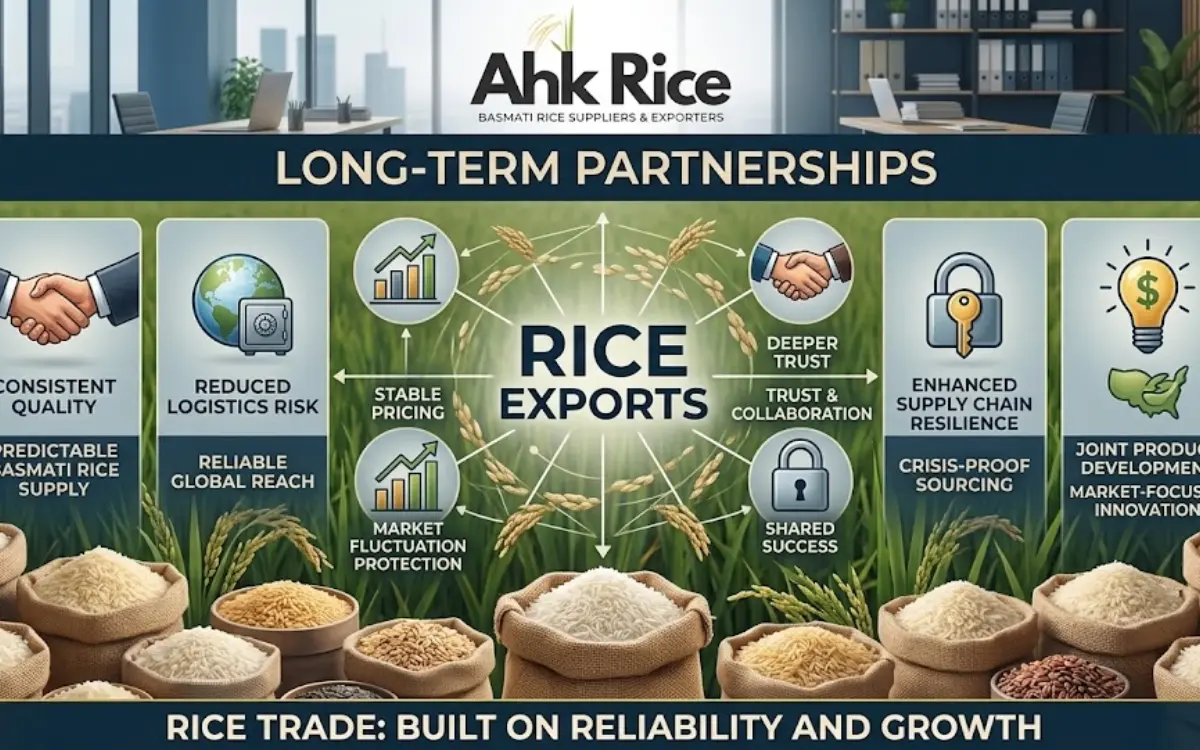
Why Do Importers Build Long-Term Partnerships with Rice Exporters?
Importers build long-term rice exporter partnerships to secure consistent quality, predictable specifications, reliable shipment planning, documented compliance, and stable procurement. A trusted exporter becomes a supply-chain partner that reduces repeated qualification work, quality disputes, shipment risks, and operational costs.
Rice procurement involves more than buying a commodity at the lowest quoted price. An importer needs a defined variety, grade, moisture specification, broken percentage, packaging format, milling standard, inspection procedure, and delivery schedule.
Long-term relationships create a common operating standard. The exporter learns the buyer’s product specification and market requirements. The importer gains historical performance data from previous shipments.
This relationship becomes especially important for Pakistani Basmati rice. Pakistan supplies varieties such as 1121 Basmati, Super Kernel Basmati, and 1509 Basmati from the Punjab rice-growing region. Each variety has different grain characteristics, aroma, cooking performance, and commercial positioning.
A procurement team also evaluates documentation. Export documents, certificates, laboratory reports, inspection records, packing lists, invoices, and shipping documents need to match the agreed transaction.
Pakistan’s Trade Development Authority identifies rice as one of the country’s major agro-food exports and lists markets including China, Bangladesh, Afghanistan, the UAE, Saudi Arabia, and Kenya among important export destinations.
How does a long-term rice exporter relationship work?
A long-term relationship works through repeated transactions based on agreed specifications, supplier qualification, quality verification, production planning, shipment coordination, documentation, performance review, and corrective action. Each completed shipment creates operational data for the next procurement cycle.
The process starts with supplier qualification. The importer reviews the exporter’s product range, processing capability, quality-control system, export history, certifications, and target-market experience.
The next stage is specification alignment. Both parties define the exact rice required.
For example, a buyer purchasing 1121 Basmati can specify:
- Rice variety
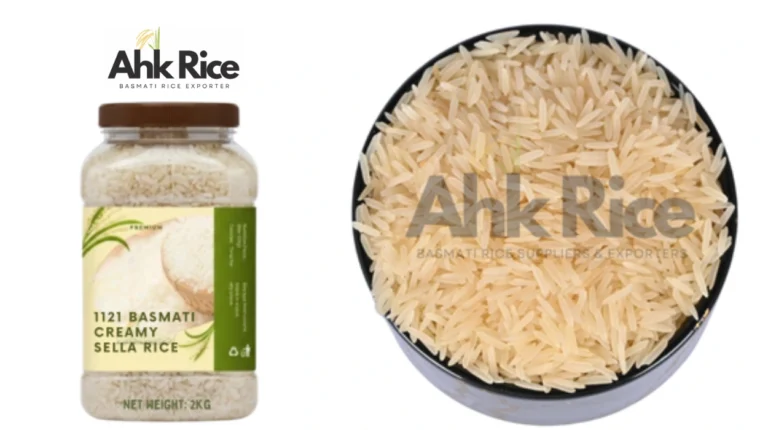
- White, Steam, or Sella processing
- Grain length
- Broken percentage
- Moisture level
- Foreign matter tolerance
- Damaged or discoloured grain tolerance
- Sortex requirement
- Packaging material
- Bag weight
- Labelling requirements
- Destination port
- Incoterm
- Inspection procedure
A sample is then evaluated before commercial production. The approved sample becomes a physical reference for production and shipment inspection.
The exporter processes the agreed batch and performs quality checks. The importer receives documentation and inspection results before or during shipment according to the contract.
After delivery, both sides compare actual performance against the agreed specification. Issues such as excess broken grains, moisture variation, packaging damage, delayed documents, or shipment delays become corrective-action items.
The next purchase order then uses the previous shipment as a reference. This reduces uncertainty because both parties understand the product and operating process.
What are the key components of a long-term rice supply partnership?
The key components are product consistency, transparent specifications, quality assurance, traceability, regulatory compliance, communication, shipment reliability, documentation accuracy, commercial planning, and structured performance reviews. Together, these elements convert individual rice purchases into a repeatable procurement system.
Product consistency
Consistency means each shipment matches the agreed commercial specification.
For Basmati rice, consistency includes grain appearance, aroma, cooking characteristics, moisture, broken percentage, and processing type.
An importer supplying retail customers needs this consistency because consumers compare the same product across multiple purchases.
Quality assurance
Quality assurance covers controls before, during, and after processing.
Rice processing typically includes cleaning, de-stoning, husking where applicable, paddy separation, whitening, grading, polishing, sorting, optical sorting, blending where specified, weighing, and packing.
The exact sequence depends on the processing configuration and product type.
Traceability
Traceability connects a shipment with production and documentation records.
A traceable shipment has identifiable information covering the lot, production records, laboratory testing, packaging, inspection, and shipping documents.
This information helps an importer investigate a quality complaint without treating the entire supplier relationship as uncertain.
Regulatory compliance
Compliance differs by destination market.
Codex Standard for Rice, CXS 198-1995, provides an international framework covering rice classification, quality factors, contaminants, hygiene, packaging, labelling, sampling, and analysis. The Codex standard was adopted in 1995 and amended in 2019.
European buyers face additional requirements. The European Commission maintains pesticide Maximum Residue Levels, or MRLs, for food and feed. These limits apply to imported products entering the EU market as well as products produced within the EU.
This area requires active monitoring in 2026. EU Regulation 2026/147 applies from 12 August 2026 and changes specific pesticide MRL provisions under Regulation 396/2005.
Documentation
Documentation is part of product quality in international trade.
Typical export documentation includes the commercial invoice, packing list, certificate of origin, bill of lading, phytosanitary documentation where required, fumigation documentation where required, inspection certificates where contracted, and product or laboratory certificates required by the destination.
Communication
Long-term suppliers establish defined communication points for forecasts, purchase orders, production status, inspections, documentation, and shipping.
This reduces the number of people making independent decisions about the same shipment.
Which rice varieties and grades matter in long-term procurement?
Rice varieties define the underlying grain type, while commercial grades define measurable quality and processing characteristics. Pakistani Basmati procurement commonly distinguishes 1121, Super Kernel, and 1509 varieties, with specifications covering processing style, grain quality, broken percentage, moisture, sorting, and packaging.
1121 Basmati
1121 Basmati is a long-grain Basmati variety known for its elongated kernel and cooking characteristics.
Commercial buyers commonly source it as white, Steam, or Sella/parboiled rice. The required specification depends on the destination market and consumer segment.
Super Kernel Basmati
Super Kernel Basmati is another established Pakistani Basmati category.
Importers use it for retail, foodservice, wholesale, and ethnic-food markets where traditional Basmati characteristics are required.
1509 Basmati
1509 Basmati is a Basmati variety used in international trade.
Its procurement specification still needs to define processing type, grain quality, broken percentage, moisture, packaging, and inspection requirements.
Commercial quality grades
A rice contract does not become precise by naming the variety alone.
A buyer also defines measurable quality parameters. Examples include 100% sortex, 5% broken, 2% broken, or other contracted broken percentages. These terms only have commercial meaning when the complete specification defines the relevant tolerances and testing method.
Codex also distinguishes rice classifications through kernel length-to-width ratios. For example, its long-grain classification uses a ratio of at least 3.0 for milled or parboiled milled rice under one classification option.
The buyer therefore needs a complete product specification rather than relying only on a variety name.
What certifications and compliance documents apply to rice exports?
Rice export certification depends on the destination market, buyer contract, product claims, and regulatory requirements. Common controls include food-safety certification, HACCP-based systems, ISO 22000, buyer-required schemes, Halal certification, phytosanitary documentation, laboratory analysis, and shipment-specific inspection records.
Certification and documentation are not interchangeable.
A food-safety certification demonstrates conformity with a defined management or certification standard. Examples include ISO 22000 or a buyer-specified GFSI-recognised scheme.
HACCP is a preventive food-safety system based on identifying hazards and controlling critical points in production.
Halal certification applies when the buyer or destination market requires documented Halal conformity. Pakistan’s Halal Authority regulations establish requirements for the use of the Pakistan Halal Certification Mark and require licensing before the Authority’s Halal logo is used on products or services.
A phytosanitary certificate relates to plant-health requirements and is used when required by the importing country’s plant-protection authority.
Laboratory testing provides evidence for parameters such as moisture, pesticide residues, microbiological criteria where applicable, contaminants, or other contractual specifications.
An importer should therefore ask one practical question: Which documents are legally required, and which documents are contractually required?
That distinction prevents unnecessary certification costs while protecting market access.
How do long-term partnerships improve rice procurement?
Long-term partnerships improve procurement by reducing supplier search costs, shortening qualification cycles, improving forecast coordination, reducing specification errors, supporting consistent quality, strengthening documentation control, and creating historical performance data for purchasing decisions.
Lower qualification costs
A new supplier requires due diligence, sample testing, documentation review, commercial negotiation, and initial shipment monitoring.
A qualified supplier that performs consistently reduces the need to repeat the entire process for every purchase.
Better production planning
An importer with predictable demand can provide forecasts to an established exporter.
The exporter can then plan paddy sourcing, milling capacity, packaging materials, laboratory testing, and container allocation around expected orders.
Better quality control
Previous shipments create a quality baseline.
If the first approved shipment contains a specific grain appearance, moisture range, broken percentage, and packaging format, subsequent production can be compared against that reference.
Faster problem resolution
Disputes are easier to investigate when both parties have shipment history.
For example, if an importer identifies excessive broken grains, the parties can compare the approved sample, inspection report, production lot, loading records, and destination findings.
The objective becomes identifying the process failure rather than simply assigning blame.
More predictable logistics
Rice exports involve production readiness, container booking, port handling, customs documentation, vessel schedules, and destination clearance.
A supplier with established procedures can coordinate these activities against an agreed shipment calendar.
Which markets benefit most from long-term rice exporter relationships?
Long-term relationships are particularly valuable in markets with recurring retail demand, strict food-safety controls, established Basmati consumption, private-label programs, and complex import documentation. Examples include Gulf markets, the United Kingdom, European markets, North America, and selected African and Asian destinations.
The Gulf region has strong demand for Basmati rice and includes markets such as Saudi Arabia and the UAE.
European procurement places strong emphasis on food safety, pesticide residues, traceability, labelling, and documentation. The EU MRL framework requires imported food to meet applicable residue limits.
The United Kingdom also requires importers to manage food safety, labelling, customs, and market-specific requirements.
North American buyers frequently focus on product specifications, food-safety documentation, packaging compliance, and reliable supply schedules.
African and Asian markets contain diverse consumer segments. Buyers can require different combinations of Basmati, non-Basmati, parboiled, broken, or long-grain specifications.
The strategic principle remains the same: the longer the procurement cycle and the higher the cost of quality failure, the greater the value of supplier continuity.
What are the common problems and misconceptions about long-term rice partnerships?
Long-term supplier relationships do not mean accepting every price increase, ignoring quality failures, or purchasing without market comparison. A strong partnership uses measurable specifications, periodic supplier reviews, competitive benchmarking, documented corrective actions, and clear contractual responsibilities.
Misconception 1: A long-term supplier always offers the lowest price
Price is only one procurement variable.
A lower quotation becomes expensive when it creates rejected shipments, inconsistent quality, repacking costs, delayed delivery, customer complaints, or additional inspection expenses.
Misconception 2: Long-term relationships remove quality inspections
Established suppliers still require quality control.
Inspection frequency can change according to performance and risk, but the specification remains enforceable.
Misconception 3: A variety name is enough
“1121 Basmati” does not define an entire commercial specification.
The contract still needs processing type, broken percentage, moisture, purity, sorting, packaging, tolerances, and inspection terms.
Misconception 4: Certifications guarantee every shipment
A certification applies to the defined scope of the certified organisation or product.
Shipment-specific requirements still require appropriate documentation and testing.
Misconception 5: Partnership means avoiding supplier benchmarking
Professional procurement teams continue benchmarking market prices, freight conditions, quality performance, and alternative supply sources.
The purpose is not to replace a reliable supplier automatically. The purpose is to confirm that the relationship remains commercially and operationally competitive.
How should importers evaluate a rice exporter for a long-term partnership?
Importers should evaluate exporters through product capability, specification consistency, processing controls, documentation accuracy, certification scope, laboratory testing, shipment performance, communication, corrective-action history, and commercial transparency before committing to recurring procurement.
A practical evaluation starts with product capability. The exporter needs to supply the required variety and processing type consistently.
The second step is factory and process assessment. The importer reviews cleaning, milling, grading, sorting, packing, storage, quality control, and traceability.
The third step is sample approval. The sample establishes the physical reference for the purchase order.
The fourth step is documentation review. Certificates and reports need to match the destination and contractual requirements.
The fifth step is shipment evaluation. The importer records delivery timing, product condition, packaging, documentation, and destination inspection results.
The sixth step is performance review. A supplier scorecard can measure quality, delivery, documentation, responsiveness, complaints, and corrective actions.
This creates a measurable basis for continuing, expanding, or restructuring the supplier relationship.
What does a strategic rice procurement relationship achieve over time?
A strategic rice procurement relationship converts repeated commodity purchases into a controlled supply process. The importer gains predictable specifications, supplier knowledge, documented performance, stronger planning, and lower operational uncertainty across recurring international rice shipments.
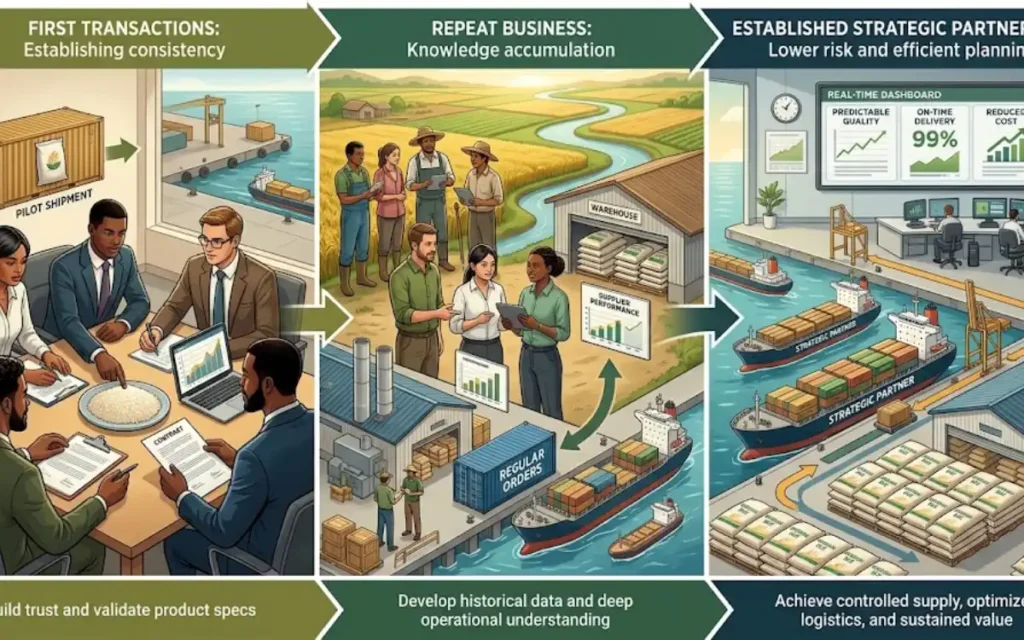
The commercial value develops through repetition.
The first transaction establishes the supplier. The second validates consistency. Subsequent shipments create historical performance data.
Over time, both parties understand the required product specification, inspection method, packaging format, documentation sequence, shipping requirements, and market destination.
For importers moving from occasional purchases to structured procurement, the next step is understanding how supplier relationships affect forecasting, cost control, supplier selection, risk management, and purchasing decisions. That broader procurement framework is covered in:
How strategic supplier relationships improve rice procurement.
Frequently Asked Questions
What is a long-term rice exporter partnership?
A long-term rice exporter partnership is a recurring business relationship between an importer and exporter based on consistent product specifications, quality standards, pricing, documentation, shipment planning, and performance reviews.
Why do rice importers prefer long-term suppliers?
Importers prefer long-term suppliers because established relationships improve quality consistency, shipment planning, documentation accuracy, communication, and procurement efficiency while reducing repeated supplier qualification work.
Which Pakistani Basmati rice varieties do importers commonly source?
Common Pakistani Basmati varieties include 1121 Basmati, Super Kernel Basmati, and 1509 Basmati. Buyers select varieties according to grain characteristics, processing type, target market, price positioning, and consumer demand.
What factors should importers check before choosing a rice exporter?
Importers should check product specifications, processing facilities, quality-control procedures, certifications, laboratory testing, packaging capability, export documentation, shipment performance, traceability, and experience supplying the destination market.
Does a long-term partnership guarantee consistent rice quality?
A long-term relationship supports consistency but does not replace quality control. Importers still need approved samples, defined specifications, inspections, laboratory testing, and documented acceptance criteria for recurring shipments.