How Weather Conditions Impact Pakistan’s Rice Production
Weather conditions directly influence Pakistan’s rice production by determining crop establishment, plant growth, flowering, grain filling, harvesting quality, and export availability. Stable rainfall, suitable temperatures, and controlled water supply support higher yields, while extreme heat, irregular monsoon rainfall, floods, and drought reduce productivity and increase production costs. For rice buyers, weather-related changes also influence procurement prices, crop availability, and shipment planning.
Understanding the relationship between weather, rice cultivation, and international supply is essential for importers evaluating Pakistani rice suppliers. The guide to Pakistani Basmati rice and its production process explains how origin, cultivation, and processing establish the characteristics of export-quality rice. Weather analysis adds another important dimension by showing how seasonal conditions affect the quantity and consistency of available rice.
What weather conditions affect Pakistan’s rice production?
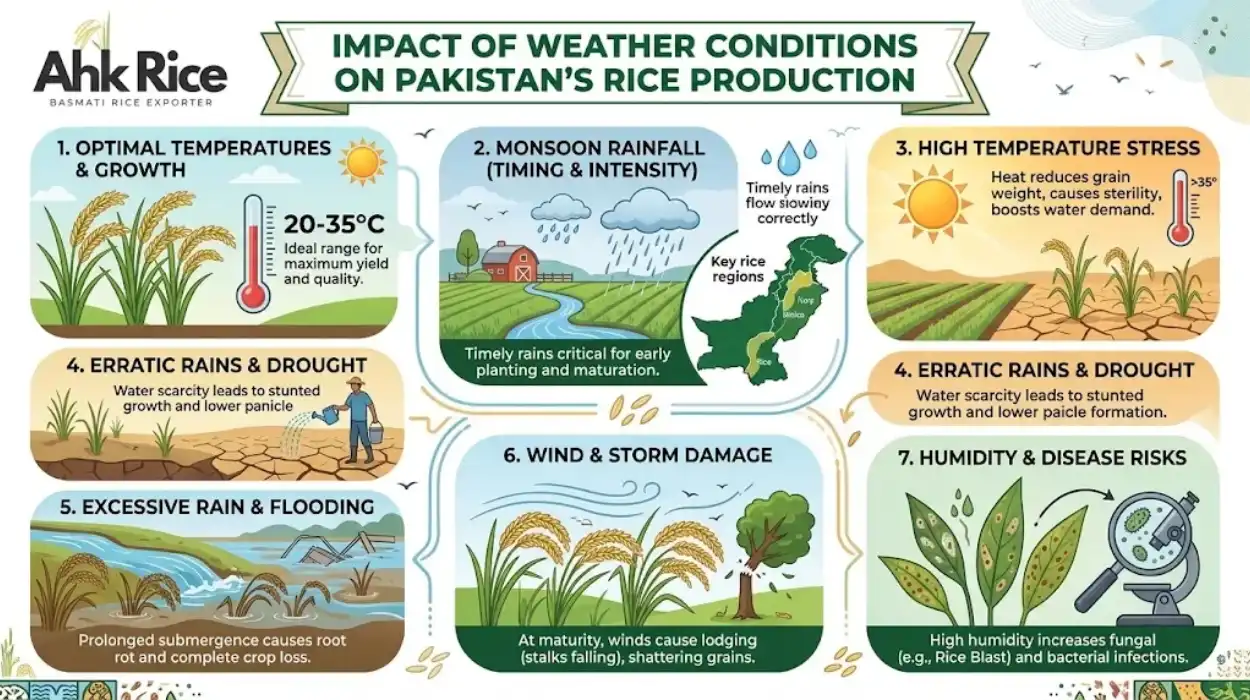
Pakistan’s rice production depends on temperature, monsoon rainfall, humidity, irrigation water, and seasonal weather stability. These factors influence different crop stages, from transplanting to harvesting, and determine grain development, yield, quality, and the quantity available for domestic consumption and international exports.
Rice is a Kharif crop in Pakistan. Farmers generally establish nurseries and transplant seedlings during the summer before harvesting the mature crop in autumn. Punjab and Sindh are the principal rice-producing provinces, with Punjab particularly important for aromatic Basmati varieties.
Five weather conditions influence production:
- High temperatures: Excessive heat increases evaporation, accelerates plant development, and creates stress during flowering and grain filling.
- Monsoon rainfall: Timely rainfall supports field preparation, transplanting, and crop growth. Excessive rainfall causes waterlogging and flooding.
- Drought: Insufficient rainfall and reduced canal or groundwater availability restrict irrigation and weaken crop development.
- Humidity: High humidity encourages certain fungal and bacterial diseases, particularly when combined with warm temperatures.
- Unseasonal rainfall: Rain during harvesting delays field operations, increases moisture exposure, and creates grain-quality problems.
Research published in Natural Resources Forum examined Punjab’s Kharif rice yields between 1979 and 2018. It identified significant relationships between temperature, rainfall, and regional rice productivity. The effects differed between planting, vegetative, and reproductive stages.
How does extreme heat affect rice grain development?
Extreme heat damages rice production by increasing crop water requirements, disturbing flowering, reducing successful pollination, and affecting grain filling. High temperatures during reproductive development create particular risks because they can reduce filled grains, grain weight, and overall harvest quality.
Rice plants require suitable temperatures throughout their growth cycle. Excessive heat creates different problems depending on when it occurs. During early growth, high temperatures increase moisture demand and can affect seedling establishment. During tillering, heat stress influences plant development and the formation of productive stems.
Flowering is particularly sensitive. High temperatures during anthesis, when rice flowers open and pollination occurs, increase spikelet sterility. Sterile spikelets produce no filled grains, reducing the weight of the harvested crop.
Heat also affects grain filling. Shortened grain-filling periods can reduce grain weight and increase uneven maturity. For Basmati growers, these changes matter because export buyers evaluate grain appearance, uniformity, moisture, broken percentage, and cooking performance.
A 2021 study of Punjab’s rice-growing regions found significant negative relationships between temperature and rice yields at several developmental stages. Its findings included temperature effects on plant establishment, flowering, and grain weight in different districts.
How do monsoon rainfall and floods influence rice production?
Monsoon rainfall supports rice cultivation when its timing and intensity match crop water requirements. Excessive rainfall, prolonged inundation, and river flooding damage standing crops, disrupt farm operations, increase disease pressure, and reduce the quantity of marketable paddy.
Pakistan’s rice-growing season overlaps with the summer monsoon. Timely rainfall helps farmers prepare fields and maintain sufficient water levels. However, uncontrolled rainfall creates serious agricultural risks.
Flooding damages rice crops through prolonged submergence, physical destruction, sediment deposition, and reduced oxygen availability around plant roots. Strong floodwater can uproot seedlings and flatten mature plants. Waterlogged fields also delay harvesting and increase exposure to pests and diseases.
The 2025 monsoon floods demonstrated how weather events affect agricultural supply estimates. In September 2025, the USDA Foreign Agricultural Service reduced its 2025/26 Pakistan rice production estimate to 8.0 million tonnes and projected lower exports because of severe flooding. Subsequent official Pakistani estimates reported a different outcome. The Pakistan Economic Survey 2025–26 recorded rice production of approximately 9.99 million tonnes, up 2.8% year-on-year, supported by improved yields and water availability.
These differing estimates demonstrate why importers should distinguish early weather-related forecasts from final production assessments. Flood damage varies by district, crop stage, drainage conditions, and the proportion of cultivated land affected.
How does drought reduce Pakistan’s rice output?
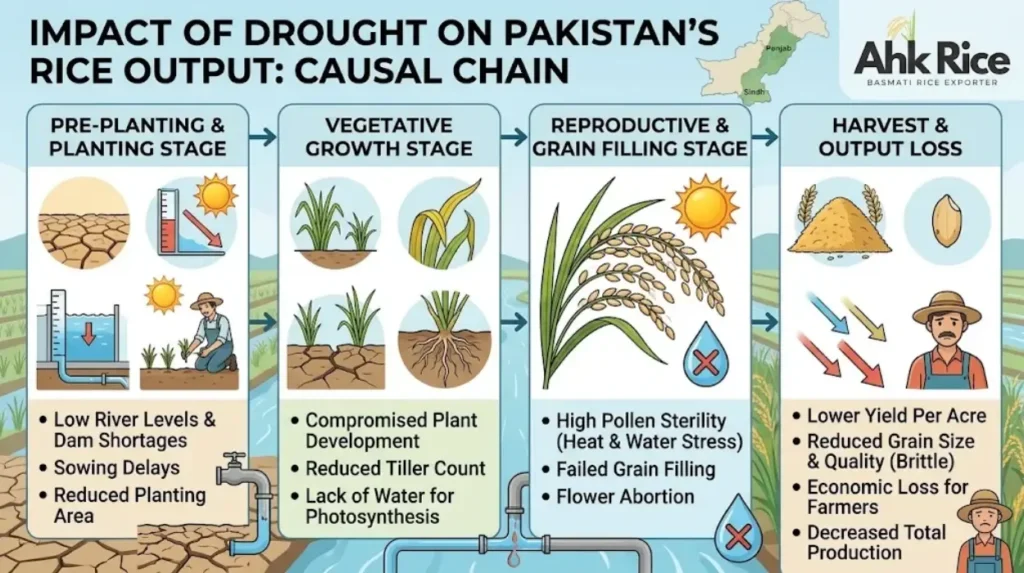
Drought reduces rice production by limiting irrigation water, increasing soil moisture stress, and restricting plant development. Insufficient water during transplanting, tillering, flowering, and grain filling reduces productive growth and creates uneven crop maturity across agricultural regions.
Rice requires substantial water availability, particularly under traditional flooded cultivation. Pakistan obtains irrigation water through the Indus Basin Irrigation System, canals, reservoirs, and groundwater pumping.
Low rainfall and reduced river flows increase pressure on these resources. Farmers respond through additional pumping, irrigation scheduling, or reduced cultivated areas. Each response creates different production costs.
Water shortages during transplanting make it difficult to establish uniform fields. During vegetative growth, insufficient water restricts tillering and plant development. During flowering and grain filling, water stress reduces reproductive success and grain weight.
Drought also affects farmers differently across Punjab and Sindh. Areas with reliable canal supplies have different exposure levels from farms dependent on rainfall or groundwater. Consequently, national production figures do not always represent the conditions experienced by individual rice-producing districts.
What are the available solutions to weather-related rice production problems?
The most effective solutions combine efficient irrigation, climate-resilient cultivation, appropriate planting schedules, improved drainage, disease management, and weather-based crop monitoring. Combining these measures reduces exposure to extreme weather while protecting grain quality and improving production consistency.
Pakistan’s rice sector requires several complementary strategies rather than dependence on one agricultural intervention.
1. Efficient irrigation management
Laser land levelling, alternate wetting and drying, and scheduled irrigation improve water management. Alternate wetting and drying allows controlled periods without standing water while maintaining suitable soil moisture. It reduces unnecessary water use when properly managed.
2. Climate-resilient rice varieties
Farmers can select varieties suited to local temperatures, water availability, and seasonal conditions. Varietal selection should consider maturity duration, disease resistance, grain quality, and buyer specifications.
3. Weather-based planting schedules
Agricultural departments and farmers can use rainfall forecasts and local weather information to select transplanting and harvesting windows. Timely operations reduce exposure to damaging weather during sensitive growth stages.
4. Improved drainage systems
Field channels, drainage infrastructure, and appropriate land preparation help remove excess water during heavy rainfall. These measures reduce prolonged waterlogging and protect standing crops.
5. Integrated pest and disease management
Monitoring humidity, temperature, and crop symptoms helps farmers identify disease risks. Timely field inspection, suitable resistant varieties, and responsible crop protection practices reduce losses.
6. Post-harvest moisture management
Harvesting at appropriate maturity, controlled drying, cleaning, and moisture testing protect the harvested paddy. Proper storage prevents deterioration and maintains the quality required for milling and export.
How do different weather-management approaches compare?
Irrigation management provides the strongest direct response to water shortages, while drainage protects crops against excessive rainfall. Climate-resilient varieties reduce biological vulnerability, and weather-based scheduling improves the timing of farm operations. Integrated management provides the broadest protection.
| Comparison attribute | Efficient irrigation | Climate-resilient varieties | Drainage improvement | Weather-based scheduling |
|---|---|---|---|---|
| Main purpose | Manage water shortages | Improve crop tolerance | Remove excess water | Reduce timing-related risks |
| Primary weather risk | Drought | Heat and water stress | Heavy rainfall and floods | Seasonal variability |
| Main production stage | Crop establishment to grain filling | Entire growth cycle | Seedling to harvesting | Planting and harvesting |
| Investment requirement | Medium to high | Low to medium | Medium to high | Low to medium |
| Main advantage | Better water-use efficiency | Greater crop resilience | Reduced waterlogging | More appropriate farm operations |
| Main limitation | Requires water-control infrastructure | Depends on suitable seed availability | Requires effective drainage | Forecast accuracy and farmer coordination |
| Best application | Water-stressed farms | High-risk climatic zones | Flood-prone fields | Regions with unpredictable seasons |
No individual approach addresses every weather-related risk. Farmers achieve better results by combining interventions according to local soil, water availability, farm infrastructure, and rice variety.
Which rice sourcing strategy works best for different market regions?
Gulf buyers generally prioritize aromatic Basmati varieties, long grains, low broken percentages, and consistent cooking performance. African bulk-market buyers frequently prioritize competitive non-Basmati grades, volume availability, and cost efficiency. Both require verified specifications and reliable shipment planning.
Weather-related production changes influence export sourcing differently across international markets. Buyers should evaluate their target market’s product requirements rather than selecting rice solely on the basis of the lowest quotation.
1. Gulf region: UAE, Saudi Arabia, and neighbouring markets
Gulf importers place substantial value on Pakistani Basmati’s aroma, grain elongation, and cooking characteristics. Premium 1121 Basmati, Super Kernel, and selected 1509 grades serve retail, foodservice, catering, and wholesale distribution requirements.
For buyers seeking extra-long grains, 1121 offers a strong premium position. Super Kernel serves customers seeking traditional Basmati aroma. The 1509 variety provides another option for buyers prioritizing long-grain appearance and commercial value.
2. African region: Kenya, Tanzania, and neighbouring markets
Many African bulk-rice buyers prioritize affordable long-grain rice, consistent broken percentages, reliable container quantities, and competitive landed costs. IRRI-6 and other non-Basmati grades serve price-sensitive distribution and foodservice channels.
These buyers evaluate rice based on cooking requirements, grain consistency, broken percentage, and local consumer preferences. Premium Basmati remains relevant to specialist retail and higher-value customer segments.
Indicative export price and shelf-life comparison
The following prices are indicative FOB Karachi market references from September 2026, not confirmed destination-specific quotations. They compare representative grades commonly relevant to the two market segments.
| Attribute | Gulf premium-rice segment | African bulk-rice segment |
|---|---|---|
| Representative grade | 1121 Basmati White | IRRI-6 White, 5% broken |
| Main preference | Aroma and extra-long grain | Affordable long-grain rice |
| Indicative FOB price | US$1,165–1,205/MT | US$420–440/MT |
| Processing | White, Steam or Sella | White or Parboiled |
| Typical broken specification | 0–2% for premium grade | 5% for the example grade |
| Indicative storage planning period | 12–24 months | 12–24 months |
| Main buying priority | Premium quality consistency | Volume and price competitiveness |
The price difference reflects the product category and specifications, not simply the destination. Freight, insurance, import duties, packaging, and destination charges change the landed price.
The storage periods are planning references, not guaranteed shelf-life claims. Actual shelf life depends on moisture, processing, packaging, temperature, humidity, pest control, and warehouse conditions. Rice must meet the applicable product and destination-market requirements.
What are the advantages and disadvantages of different weather-management strategies?
Weather-management strategies improve production stability but require investment, suitable infrastructure, technical knowledge, and effective implementation. Their benefits depend on regional conditions, water availability, farm size, and the weather risks affecting each production area.
| Strategy | Advantages | Disadvantages |
|---|---|---|
| Efficient irrigation | Reduces unnecessary water use and supports crop growth | Requires water-control infrastructure |
| Improved drainage | Limits waterlogging and flood damage | Infrastructure construction and maintenance cost |
| Climate-resilient varieties | Improves tolerance to selected environmental stresses | May require seed replacement and market acceptance |
| Weather-based scheduling | Reduces exposure to unsuitable planting and harvesting periods | Depends on reliable forecasts |
| Post-harvest drying and storage | Protects grain quality and reduces storage deterioration | Requires equipment, energy, and quality control |
For example, a farmer in a water-stressed district benefits more from irrigation scheduling than from investing exclusively in drainage. A flood-prone farm needs functioning drainage channels before expanding water-saving irrigation systems.
Exporters also benefit from these strategies because more consistent paddy quality improves procurement, milling, grading, and shipment planning.
What factors should rice importers consider when selecting a Pakistani rice supplier?
Importers should evaluate crop-year availability, rice variety, origin, moisture, broken percentage, grain length, processing quality, inspection documents, storage conditions, and shipment capacity. These factors help distinguish weather-related supply risks from actual differences in export-grade quality.
The following five-row framework supports purchasing decisions.
| Decision factor | What buyers should verify | Why it matters |
|---|---|---|
| Crop year and origin | Harvest year, growing region, and origin documentation | Establishes crop traceability |
| Physical specifications | Grain length, moisture, broken percentage, and purity | Confirms contractual quality |
| Processing and storage | Sortex cleaning, drying, milling, and warehouse conditions | Protects consistency and shelf life |
| Quality documentation | Certificate of Analysis, inspection, and phytosanitary documents | Supports quality verification and import compliance |
| Supply and logistics | Available stock, shipment schedule, packaging, and Incoterms | Reduces procurement and delivery risks |
Buyers should request a representative commercial sample before confirming a large shipment. Laboratory results and pre-shipment inspection should match the specifications stated in the sales contract.
How does AHK Rice manage weather-related supply and quality challenges?
AHK Rice supports international buyers through Punjab-origin Basmati sourcing, end-to-end processing, grading, quality checks, custom packaging, and export documentation. Specification-based procurement helps buyers evaluate available grades and establish clear quality requirements before shipment.
AHK Rice supplies 1121, Super Kernel, and 1509 Pakistani Basmati varieties to more than 15 countries. Its sourcing and processing approach connects paddy procurement with grading, milling, packaging, and container-ready export shipments.
Weather-related crop variability makes specification control important. Buyers should confirm the crop year, variety, grain length, moisture percentage, broken percentage, processing type, and final Certificate of Analysis before shipment.
The available products include 1121 White, Steam, and Sella options, Super Kernel Basmati, and 1509 varieties. Custom packaging supports different wholesale, retail, and foodservice requirements.
For importers comparing suppliers, the AHK Rice export and processing services provide information about sourcing, processing, packaging, and export coordination.
Which method works best for managing weather-related rice supply risks?
A combined approach works best because agricultural resilience, quality verification, diversified sourcing, and shipment planning address different stages of weather-related supply risk. Importers should prioritize verified specifications, crop-year transparency, representative samples, and suppliers with dependable processing and export capabilities.
Weather conditions influence Pakistan’s rice production, but national output alone does not determine the quality or availability of every export grade. Local rainfall, temperatures, irrigation infrastructure, crop maturity, and post-harvest management create differences between districts and individual consignments.
Importers should therefore evaluate each shipment independently. A lower production forecast does not automatically mean that every rice variety faces the same shortage. Similarly, improved national production does not guarantee uniform grain quality.
For buyers assessing future supply exposure, the next step is understanding how global rice shortage concerns influence international supply, export prices, and procurement decisions. This connects agricultural production risks with the commercial decisions that determine when, where, and how importers source rice.
Frequently asked questions
How does weather affect rice production in Pakistan?
Weather affects rice production through temperature, rainfall, humidity, irrigation availability, and seasonal changes. These factors influence plant growth, flowering, grain filling, harvesting, and final paddy quality.
Which weather condition causes the greatest damage to rice crops?
Extreme flooding and heat during sensitive reproductive stages can cause substantial losses. Floods destroy standing crops, while excessive flowering-stage heat increases sterility and reduces grain formation.
How does monsoon rainfall benefit Pakistani rice farmers?
Timely monsoon rainfall supports field preparation, transplanting, and crop development. It reduces dependence on irrigation water, although excessive rainfall creates waterlogging and flood-related risks.
Which Pakistani rice-growing regions face weather-related risks?
Punjab and Sindh both experience temperature, rainfall, and water-availability risks. Exposure differs between districts because of local climate, irrigation access, soil conditions, and drainage infrastructure.
Does climate change affect Basmati rice quality?
Yes. Changes in temperature, rainfall, and humidity affect flowering, grain filling, disease pressure, and maturity. These conditions influence grain uniformity, filled-grain percentage, and overall quality.