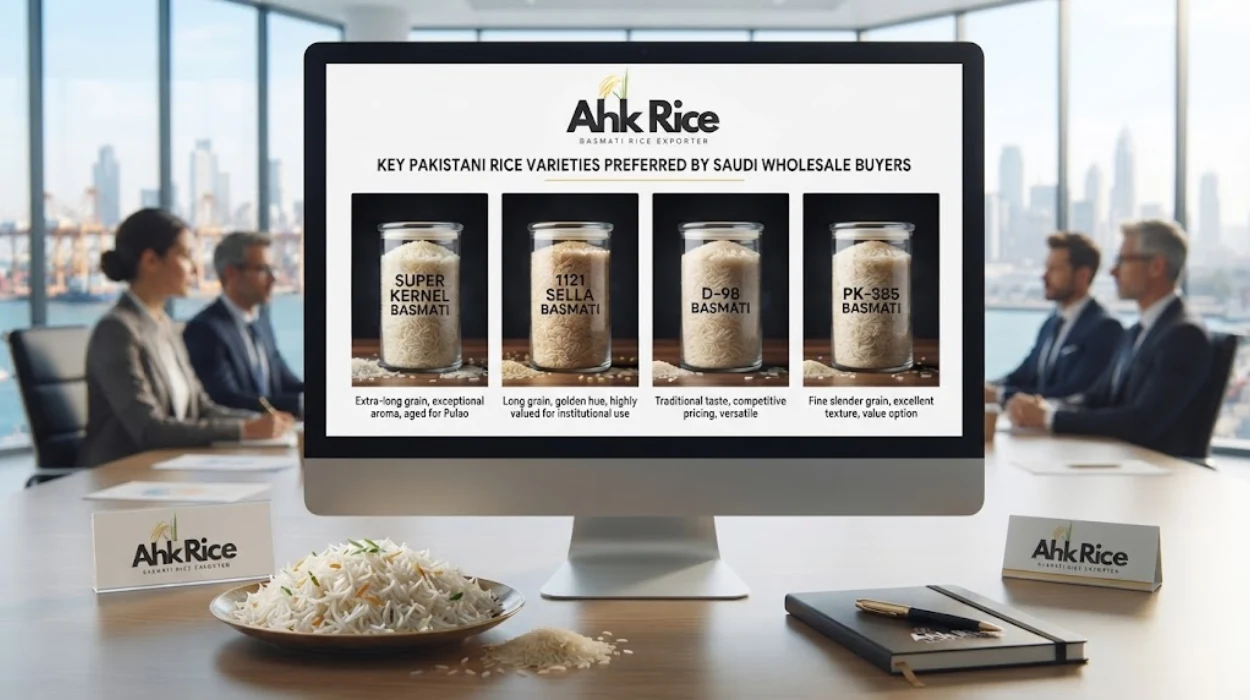
Key Pakistani Rice Varieties Preferred by Saudi Wholesale Buyers in 2026
1121 Basmati, Super Kernel, and 1509 are the key Pakistani varieties for Saudi wholesale procurement, with 1121 leading premium Basmati demand. Here is why: Saudi buyers evaluate grain length, processing grade, cooking performance, price, shelf life, and end-market use before selecting a shipment. Pakistan supplied about 169,000 tons of rice to Saudi Arabia in 2025, valued at approximately US$163 million, showing a substantial bilateral rice trade. (source: Saudi Ministry of Environment, Water and Agriculture)
Saudi wholesale procurement also reflects a wider import market. Saudi Arabia imported 1.846 million tonnes of rice in 2024, worth about US$2.013 billion. Pakistan supplied 217,028 tonnes, worth US$225.18 million. (source: World Bank WITS, 2024 trade data) Saudi importers therefore compare Pakistani varieties against Indian and other origins based on specification, commercial price, cooking characteristics, and supply reliability.
For buyers starting with the product fundamentals, the complete guide to Pakistani Basmati rice explains the varieties, cultivation regions, processing stages, grades, and export characteristics before procurement decisions begin.
What are the available Pakistani rice varieties for Saudi wholesale buyers?
1121 Basmati, Super Kernel, and 1509 Basmati provide three distinct procurement positions: premium long-grain quality, aromatic commercial Basmati, and cost-efficient long-grain supply. Each variety serves a different relationship between price, appearance, cooking performance, and distribution channel.
1121 Basmati Rice
1121 Basmati is the premium long-grain option, with strong visual elongation, aromatic character, and multiple processing grades for Saudi retail, catering, and foodservice. Its processing formats include White, Steam, Golden Sella, Creamy Sella, Brown, and broken grades.
Saudi shipment records provide direct evidence of 1121 demand. Recent Saudi import records include Pakistani 1121 Sella, 1121 Basmati, and 1121 White shipments in commercial quantities. One recorded shipment contained 75,000 kg of 1121 Basmati, while another contained 51,280 kg of Pakistani 1121 Sella. (source: Volza shipment data, 2025)
1121 White suits buyers seeking a traditional white appearance and premium cooked presentation. 1121 Steam suits buyers seeking white grains with firmer cooking characteristics. Golden Sella suits bulk cooking and distribution where grain resilience and storage performance matter.
Super Kernel Basmati
Super Kernel provides an aromatic Pakistani Basmati option positioned between premium 1121 specifications and lower-cost commercial rice. The variety combines traditional Basmati aroma with long-grain presentation and supports retail, wholesale, and foodservice applications.
Saudi shipment data also records Pakistani Super Basmati products in commercial packaging. A May 2025 shipment included 22,000 kg of Super Basmati packed for Saudi distribution. (source: Volza shipment data, 2025)
Super Kernel suits distributors targeting South Asian consumers and buyers seeking aromatic rice without using the highest-priced 1121 specification. Its commercial value depends on grain length, broken percentage, moisture, crop year, processing grade, and packaging.
1509 Basmati
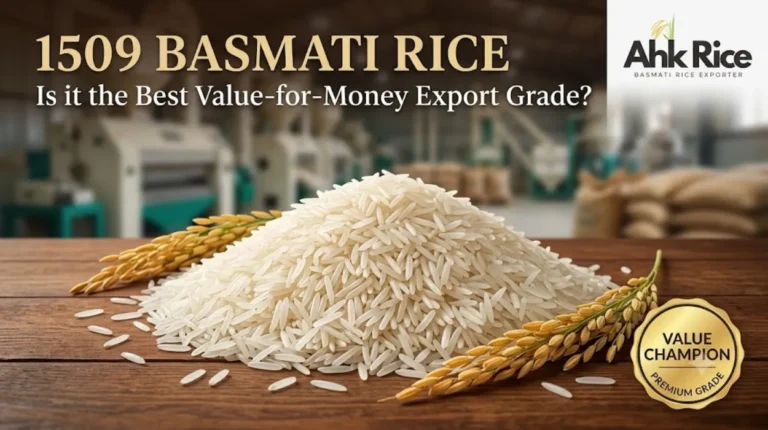
1509 Basmati provides a long-grain Basmati alternative focused on yield efficiency, commercial pricing, and high-volume foodservice applications. Its grain length commonly reaches about 8.10–8.40 mm before cooking, while cooked elongation can reach approximately 2.5 times.
1509 matures faster than traditional Basmati varieties and provides a different procurement economics from 1121. This makes it relevant for distributors balancing grain presentation with acquisition cost.
Saudi buyers can specify 1509 White or 1509 Steam according to cooking requirements. White provides the conventional white appearance. Steam provides stronger grain structure after parboiling and supports bulk cooking.
The three varieties establish the basic solution set. The next comparison shows how their specifications translate into Saudi procurement decisions.
How do 1121, Super Kernel, and 1509 compare?
1121 leads premium positioning, Super Kernel balances aroma and commercial value, while 1509 emphasizes cost efficiency and high-volume applications. The correct comparison uses specification rather than variety name alone.
| Attribute | 1121 Basmati | Super Kernel | 1509 Basmati |
|---|---|---|---|
| Market position | Premium Basmati | Aromatic commercial Basmati | Value-focused Basmati |
| Grain specification | Longest premium profile | Long aromatic grain | 8.10–8.40 mm typical |
| Main grades | White, Steam, Golden Sella, Creamy Sella, Brown, Broken | White, Steam, Sella formats | White, Steam |
| Aroma | Strong | Strong | Aromatic |
| Cooking use | Premium retail, HORECA, catering | Retail, wholesale, foodservice | Catering, wholesale, bulk foodservice |
| Price position | Highest | Mid-to-premium | Lower than 1121 |
| Shelf-life strategy | White and Steam require controlled storage; Sella supports longer commercial storage | Grade and packaging determine storage performance | Steam and Sella formats support bulk distribution |
Pakistan’s overall Basmati export economics also support this quality segmentation. Pakistan exported 808,643 tonnes of Basmati in 2024–25, worth US$830.57 million, with an average export value of US$1,027.11 per tonne. (source: Rice Exporters Association of Pakistan)
A shipment-level price must still use the exact grade and delivery term. A September 2026 Saudi market reference lists 1121 White at approximately US$1,165–1,205/MT FOB Karachi, with indicative CNF Jeddah or Dammam pricing around US$1,343–1,383/MT after the stated freight reference. (source: Pakistan Rice market reference, September 2026) These figures are market indicators rather than a firm shipment quotation.
The specification table shows why variety selection alone cannot determine procurement value. The next question is how regional Saudi demand changes that choice.
Which Pakistani rice grades suit different Saudi market regions?
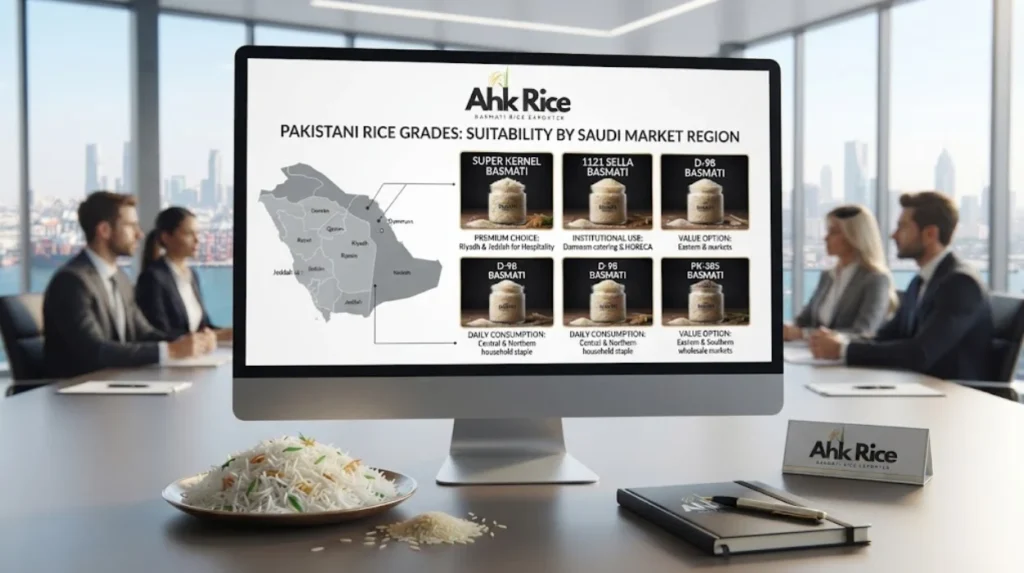
Western Saudi Arabia favors premium Basmati and foodservice specifications around Jeddah, while Riyadh and central distribution favor scalable wholesale grades with controlled landed cost. Buyer requirements still vary by distributor, customer segment, and packaging program.
Western Saudi Arabia: Jeddah and Makkah distribution
1121 Sella and Golden Sella fit premium wholesale and catering channels where long grain, cooked separation, and holding performance influence purchasing. Jeddah is a major receiving point for imported food products and serves western-region distribution.
Saudi import records show Pakistani 1121 Sella shipments entering the market in substantial quantities. A May 2025 shipment contained 50,000 kg of long-grain Sella Basmati with less than 2% broken grain stated in the shipment description. (source: Volza shipment data)
Golden Sella also supports catering operations requiring consistent grain structure during bulk cooking. Steam provides a different visual profile for buyers seeking white cooked rice.
Indicative September 2026 pricing places 1121 Sella around US$1,135–1,175/MT FOB Karachi, while 1121 Golden Sella is listed around US$1,145–1,185/MT FOB Karachi. (source: Pakistan Rice market reference, September 2026)
Central Saudi Arabia: Riyadh and wholesale distribution
Riyadh-oriented wholesale distribution benefits from comparing 1121, Super Kernel, and 1509 against target retail price and foodservice volume. Central distributors commonly require standardized specifications that can be repeated across multiple shipments.
1121 suits premium retail and established Basmati brands. Super Kernel fits distributors seeking aromatic Pakistani rice at a more accessible procurement position. 1509 fits high-volume foodservice and price-sensitive distribution.
Saudi rice importers also maintain strategic stocks. USDA reporting notes that Saudi importers maintain rice reserves and that major importers market aged rice for periods before introducing newer crop products. (source: USDA Foreign Agricultural Service, Saudi Arabia Grain and Feed Annual)
That purchasing behavior makes shelf-life planning part of procurement rather than a secondary storage issue.
How does shelf life compare between Pakistani rice grades?
Sella and aged Basmati formats support longer commercial storage strategies, while White and Steam require stronger inventory rotation and storage control. Actual shelf life depends on moisture, packaging, warehouse temperature, humidity, sanitation, and crop condition.
| Storage consideration | 1121 Sella / Golden Sella | 1121 White / Steam | Super Kernel | 1509 |
|---|---|---|---|---|
| Commercial storage | Strong | Moderate | Moderate to strong | Moderate to strong |
| Aging suitability | High | High for controlled aging | Moderate | Moderate |
| Heat exposure sensitivity | Controlled warehouse required | Higher control requirement | Controlled storage required | Controlled storage required |
| Wholesale rotation | Long-cycle suitable | Faster rotation preferred | Flexible | Flexible |
| Main storage priority | Moisture and packaging integrity | Moisture, heat, pest control | Moisture and packaging | Moisture and packaging |
Saudi market behavior gives aging special importance. USDA reporting states that major Saudi importers market aged rice for several months and that rice can remain stored for several years in Saudi households for aging and reserve purposes. (source: USDA Foreign Agricultural Service)
Shelf life therefore cannot be reduced to a single number. Buyers should approve the crop year, moisture specification, packaging, warehouse conditions, and intended storage period within the purchase specification.
The regional comparison identifies the commercial context. The next section turns that context into a practical purchasing framework.
Which method works best for different Saudi wholesale cases?
1121 works for premium retail and HORECA, Super Kernel works for balanced wholesale positioning, and 1509 works for cost-controlled bulk distribution. The selection depends on the buyer’s customer profile rather than a universal grade preference.
| Buyer requirement | Suitable variety | Reason |
|---|---|---|
| Premium retail | 1121 | Long grain and premium Basmati positioning |
| Catering and HORECA | 1121 Sella or Golden Sella | Grain resilience and bulk cooking |
| Aromatic wholesale | Super Kernel | Aroma with commercial positioning |
| Cost-controlled foodservice | 1509 | Yield efficiency and competitive procurement |
| Private-label premium | 1121 White, Steam, or Sella | Flexible grade and packaging options |
A distributor selling premium Basmati under a recognized retail brand needs stronger visual specifications. A catering supplier serving large kitchens needs consistent cooking performance and predictable landed cost. A wholesale operator serving price-sensitive customers needs procurement efficiency without losing the Basmati category identity.
The practical solution is specification-based procurement. Buyers define grain length, broken percentage, moisture, processing grade, crop year, packing format, quantity, destination, and Incoterm before comparing supplier quotations.
This approach also creates comparable samples. Two suppliers quoting “1121 Basmati” can offer different broken percentages, moisture levels, milling quality, packing, or crop years. A variety name alone does not create an equivalent commercial specification.
What are the pros and cons of each Pakistani rice variety?
1121 offers the strongest premium specification but carries a higher procurement position; Super Kernel balances aroma and value; 1509 reduces cost pressure for volume-driven buyers. Each option creates a different trade-off.
1121 Basmati
Advantages: Premium grain appearance, multiple processing grades, strong Basmati identity, and suitability for retail and HORECA.
Limitations: Higher procurement cost and stronger specification control requirements.
A premium Saudi retailer can justify 1121 through packaging, grain presentation, and brand positioning. A cost-focused catering distributor may instead compare 1121 against 1509 on landed cost per serving.
Super Kernel
Advantages: Strong aroma, commercial Basmati positioning, flexible wholesale applications, and a useful middle position between premium and value segments.
Limitations: Less suitable than top 1121 specifications for buyers whose selling proposition depends primarily on maximum grain length.
Super Kernel becomes useful for distributors needing aromatic Pakistani rice across mainstream South Asian retail channels.
1509 Basmati
Advantages: Efficient cultivation cycle, long grain, competitive commercial positioning, and suitability for bulk foodservice.
Limitations: Lower premium positioning than 1121 and less suitable for brands built around the highest-end Basmati presentation.
1509 works when procurement economics carry greater weight than premium grain differentiation.
The pros and cons show that the product decision depends on the commercial use case. The final step is converting those differences into measurable purchasing criteria.
What factors should Saudi wholesale buyers use before placing an order?
Saudi buyers should evaluate seven factors: grade, grain length, broken percentage, moisture, crop year, packaging, and landed cost. These factors convert a general rice requirement into a repeatable procurement specification.
1. Processing grade
Choose White, Steam, Golden Sella, Creamy Sella, or another defined grade according to the cooking and presentation requirement. Avoid comparing different processing formats as equivalent products.
2. Grain length
Define the required raw grain specification before requesting quotations. 1121 and 1509 use different commercial grain profiles, so the variety name should accompany the measured specification.
3. Broken percentage
Set the maximum broken percentage within the purchase specification. Lower broken content improves visual uniformity and changes the commercial value of the shipment.
4. Moisture
Set a controlled moisture specification and verify it through testing. Moisture affects storage stability, milling performance, and shipment quality.
5. Crop year
Record the crop year on the commercial specification. Saudi buyers using aging strategies need crop-year visibility before purchasing.
6. Packaging
Define bag material, net weight, inner packing, outer packing, printing, labeling, and private-label requirements before production. Saudi food imports also require compliance with applicable SFDA requirements. (source: Saudi Food and Drug Authority)
7. Landed cost
Compare FOB, freight, insurance where applicable, destination charges, and customs-related costs. A lower FOB price does not automatically create a lower landed cost.
Saudi importers must also ensure that their food products meet applicable Saudi regulations. SFDA states that importers must register their food items and meet the Kingdom’s applicable regulations, technical requirements, and standards. (source: Saudi Food and Drug Authority)
For procurement planning, the decision should therefore move from variety selection to specification approval, sample evaluation, quotation comparison, documentation, inspection, loading, and shipment.
What should Saudi buyers request from a Pakistani rice supplier?
Saudi buyers should request a product specification, representative sample, commercial quotation, packing details, quality documents, and shipment documentation before approving bulk procurement. This sequence makes supplier comparisons more transparent.
A specification sheet should identify variety, processing grade, grain length, broken percentage, moisture, foreign matter, crop year, packing, quantity, and destination.
A representative sample should match the proposed commercial specification. Buyers should cook-test the sample and compare aroma, grain separation, elongation, color, broken content, and overall presentation.
A quotation should identify the Incoterm and destination. FOB Karachi and CNF Jeddah represent different cost structures, so buyers should not compare them as identical offers.
Documentation should align with Saudi import requirements. SFDA identifies food registration, applicable regulations, commercial registration, certified original invoices, and required certificates among the import-control requirements. (source: SFDA)
AHK Rice supplies 1121, Super Kernel, and 1509 from Punjab with end-to-end processing, custom packaging, and export logistics. The procurement model connects sourcing, milling, grading, packing, inspection, loading, and dispatch into one export workflow.
The decision framework now connects variety, specification, market, storage, and landed cost into one procurement process.
What is the final decision framework for Saudi wholesale rice procurement?
Start with customer segment, then select variety, processing grade, specification, storage strategy, and delivery term. This sequence prevents price from becoming the only purchasing criterion.
| Decision stage | Buyer question | Procurement action |
|---|---|---|
| Customer segment | Who will consume the rice? | Define retail, HORECA, catering, or wholesale use |
| Variety | Which grain profile fits? | Compare 1121, Super Kernel, and 1509 |
| Processing | How should it cook? | Select White, Steam, Golden Sella, or another grade |
| Quality | What specification is required? | Set grain, broken, moisture, purity, and crop-year limits |
| Logistics | What landed cost is acceptable? | Compare FOB/CNF terms, packing, freight, and destination |
This framework separates product quality from commercial price. It also makes supplier quotations easier to compare across Saudi distribution channels.
Saudi demand for Pakistani rice is already substantial. Pakistan’s 2025 supply reached approximately 169,000 tonnes, while 2024 Saudi import data recorded 217,028 tonnes from Pakistan across the broader rice category. (source: Saudi Ministry of Environment, Water and Agriculture; World Bank WITS)
For premium buyers, 1121 provides the broadest premium-grade choice. For aromatic mainstream distribution, Super Kernel provides a balanced specification. For cost-controlled bulk applications, 1509 provides a commercially efficient alternative.
The correct procurement decision comes from matching the variety to the customer’s selling channel, then fixing the technical specification before comparing price.
FAQs About Pakistani Rice Varieties for Saudi Buyers
Which Pakistani rice variety is most suitable for Saudi wholesale buyers?
1121 Basmati suits premium wholesale, retail, and HORECA channels, while Super Kernel and 1509 address different commercial price and volume requirements. The final selection depends on grade, specification, customer segment, and landed cost.
Is 1121 Basmati popular in Saudi Arabia?
Yes, Pakistani 1121 Basmati appears repeatedly in Saudi commercial shipment records. Recent records include 1121 Basmati, 1121 Sella, and 1121 White shipments in quantities ranging from tens to seventy-five tonnes. (source: Volza shipment data)
Which 1121 grade suits Saudi catering?
1121 Sella and Golden Sella suit many bulk-cooking applications because parboiling supports firm grain structure and holding performance. White and Steam serve different presentation and cooking requirements.
Is Super Kernel suitable for Saudi wholesale distribution?
Super Kernel suits aromatic wholesale distribution where buyers want Pakistani Basmati character with a commercial price position. The final specification should define grain length, broken percentage, moisture, processing grade, and packing.
Is 1509 cheaper than 1121 Basmati?
1509 generally occupies a more cost-efficient commercial position than premium 1121. The actual price depends on grade, crop year, milling yield, broken percentage, packing, quantity, destination, freight, and Incoterm.
How long can Pakistani Basmati rice be stored in Saudi Arabia?
Saudi buyers use controlled aging and reserve-stock strategies, with some Basmati stored for extended periods. USDA reporting confirms that aged rice remains an established feature of the Saudi market.
What documents do Saudi rice importers need?
Saudi importers must meet applicable SFDA requirements and register imported food products. Requirements can include certified invoices, certificates of origin, and other documents according to the food product and applicable regulations.
What should buyers compare in a Pakistani rice quotation?
Compare grade, grain length, broken percentage, moisture, crop year, packaging, quantity, Incoterm, freight, and destination charges. This creates a comparable landed-cost calculation rather than a simple FOB price comparison.