1121 White Basmati Grain Elongation and Aroma Explained for Vietnamese Chefs
1121 White Basmati Rice delivers superior linear grain elongation of 2.2x to 2.5x and higher 2-acetyl-1-pyrroline aroma intensity than local Mekong Delta fragrant rice, making it the definitive choice for authentic South Asian hospitality in Vietnam. Commercial kitchens across Ho Chi Minh City and Hanoi face a recurring technical failure when substituting domestic ST25 or Dai Thom 8 varieties into traditional biryani and pulao recipes. High amylopectin ratios in Southeast Asian cultivars cause starch gelatinisation and clumping under high-heat dum steaming.
Understanding the culinary dynamics driving Vietnam’s growing demand for authentic long-grain basmati requires examining the starch chemistry and volatile organic compounds inside aged Pakistani kernels. Culinary directors and executive chefs evaluate grain performance through measurable physical metrics rather than subjective visual checks. Moisture percentage, amylose-to-amylopectin ratios, and controlled paddy ageing dictate whether a rice dish achieves individual grain separation or collapses into a dense mass.
What Are the Available Solutions for High-Elongation Aromatic Rice in Vietnamese Kitchens?
Commercial kitchens in Vietnam choose between four distinct long-grain rice processing solutions: 1121 White Raw Basmati, 1121 Steam Basmati, 1121 White Sella Parboiled Basmati, and domestic Vietnamese ST25 fragrant rice, each engineered for specific thermal stress and aroma retention requirements.
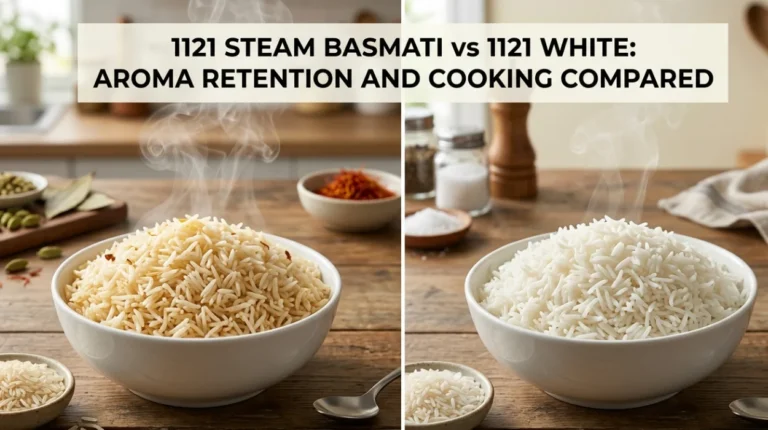
1121 White Raw Basmati is an un-parboiled, extra-long-grain Oryza sativa cultivar grown in the fertile alluvial plains of Punjab, Pakistan. Processors mill the paddy after a mandatory 12-to-24-month ageing cycle without applying hydrothermal steam. This preservation of the raw endosperm yields the highest concentration of natural volatile aromatics and achieves the maximum linear expansion during boiling.
1121 Steam Basmati undergoes a controlled, low-pressure steaming process while still in the husk before milling. This hydrothermal treatment partially gelatinises surface starches and hardens the outer kernel layer. Chefs utilise this variant when kitchen workflows require extended holding times in chafing dishes without grain breakage.
1121 White Sella Basmati is a fully parboiled variant created by soaking, pressure-steaming, and drying the paddy prior to husking. The parboiling process drives B vitamins and soluble starches deep into the endosperm, turning the raw grain translucent ivory and turning it pure white upon cooking. It resists mechanical agitation during heavy commercial batch mixing.
Domestic Vietnamese Fragrant Rice, specifically ST25 and Dai Thom 8, represents the local benchmark cultivated in the Mekong Delta. These cultivars possess medium-to-long slender grains with soft, cohesive textures tailored for East Asian chopstick dining. While prized for sweet pandan notes, they lack the rigid amylose matrix required for layered Indian rice preparations.
How Do Different Approaches Compare Across Technical Specifications and Regional Markets?
1121 White Basmati outperforms steam, parboiled, and local fragrant varieties in raw grain length (8.30–8.40 mm) and cooked elongation (up to 22 mm), while commanding a 2026 FOB export price of $1,165–$1,205 per metric ton compared to $470–$480 for Vietnamese white rice.
Evaluating these solutions requires comparing physical kernel metrics side by side. The following specification matrix outlines the exact laboratory parameters measured at the mill gate before container loading.
| Technical Attribute | 1121 White (Raw) Basmati | 1121 Steam Basmati | 1121 White Sella (Parboiled) | Domestic Vietnamese ST25 / 5% White |
| Average Raw Grain Length | 8.30 – 8.40 mm | 8.25 – 8.35 mm | 8.25 – 8.35 mm | 6.80 – 7.20 mm |
| Cooked Grain Elongation | 20.0 – 22.0 mm (2.5x) | 19.0 – 20.5 mm (2.3x) | 18.5 – 20.0 mm (2.2x) | 10.5 – 12.0 mm (1.6x) |
| Moisture Content Limit | Maximum 12.0% – 12.5% | Maximum 12.5% – 13.0% | Maximum 13.0% | Maximum 14.0% |
| Broken Grain Tolerance | Less than 1.0% – 2.0% | Less than 1.0% – 2.0% | Less than 1.0% | Up to 5.0% |
| Amylose Content Profile | High (22% – 25%) | High (22% – 25%) | High (23% – 26%) | Low-Intermediate (14% – 18%) |
| Primary Aroma Compound (2-AP) | Peak Natural Concentration | Moderate (Heat-Attenuated) | Low (Masked by Parboiling) | High Fresh Pandan Note |
| Kett Whiteness Index | 38 – 42 (Bright Chalky White) | 34 – 37 (Creamy Off-White) | 30 – 33 (Translucent Ivory) | 40 – 44 (Glossy White) |
How Does Grain Elongation Work at the Cellular Level?
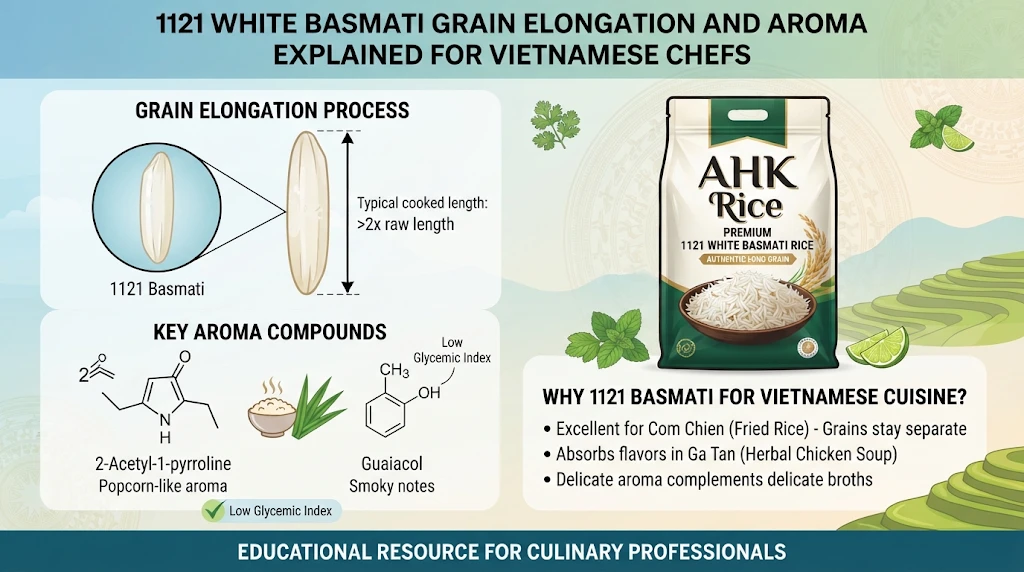
Linear grain elongation is the physical expansion of the rice kernel along its longitudinal axis without a proportional increase in girth. Inside 1121 White Basmati, starch granules are arranged in tightly packed, elongated polyhedral structures high in linear amylose chains. When chefs soak the raw grains in room-temperature water for 30 minutes, micro-fissures form uniformly across the endosperm.
Upon immersion in boiling water at 100°C, water molecules penetrate these fissures and hydrate the amylose chains. The rigid cell walls restrict lateral swelling, forcing the starch matrix to expand lengthwise like a telescoping cylinder. This mechanism doubles or triples the uncooked 8.35 mm kernel into a slender, 21 mm needle-like strand.
What Drives the Chemistry of 2-Acetyl-1-Pyrroline (2-AP)?
2-Acetyl-1-pyrroline (2-AP) is the primary volatile organic compound responsible for the signature nutty, popcorn-like fragrance of authentic basmati rice. A genetic mutation in the BADH2 gene of Pakistani basmati cultivars halts the conversion of gamma-aminobutyraldehyde into GABA, causing 2-AP to accumulate inside the grain.
Ageing raw 1121 paddy in climate-controlled silos for 12 to 18 months transforms this chemical profile. During storage, lipid oxidation occurs slowly, and free fatty acids bind with amylose molecules. This ageing process stabilises volatile 2-AP retention during cooking while reducing grain stickiness, producing distinct, separated grains that release concentrated fragrance when the pot lid is lifted.
Regional Market Comparison: Vietnam Foodservice vs. GCC Hospitality
Procurement teams importing into Southeast Asia operate under entirely different commercial benchmarks than buyers in the Gulf Cooperation Council (GCC). Comparing these two major import corridors clarifies why Vietnamese importers must specify exact processing grades rather than ordering generic basmati.
- Grade Preferences: Vietnamese fine-dining Indian restaurants, five-star hotel banquets in Da Nang, and boutique hospitality groups overwhelmingly prefer 1121 White (Raw) Basmati. These chefs prioritise bright white visual contrast against rich, saffron-tinted gravies and demand maximum natural 2-AP aroma. Conversely, GCC hospitality markets across Saudi Arabia and the UAE favour 1121 Golden Sella and White Sella. Middle Eastern banquet halls cook massive 50-kilogram cauldrons of kabsa and mandi, requiring the structural rigidity of parboiled sella to prevent breakage under heavy spiced meats.
- 2026 Price per Metric Ton (FOB Karachi): Global export quotations in late 2026 reflect tightening supply chains and distinct processing costs. Premium double-polished, colour-sorted 1121 White Basmati trades at $1,165 to $1,205 per metric ton (FOB Karachi). 1121 Steam Basmati prices slightly lower at $1,160 to $1,200 per metric ton, while 1121 White Sella commands $1,135 to $1,175 per metric ton. In contrast, domestic Vietnamese 5% broken white rice trades at $470 to $480 per metric ton, establishing a 2.5x price premium for authentic Pakistani 1121 White Basmati.
- Shelf Life and Tropical Humidity Performance: Vietnam’s tropical monsoon climate maintains ambient relative humidity above 75% to 85% throughout the year. 1121 White (Raw) Basmati carries a commercial shelf life of 12 to 18 months when milled at 12% moisture and packed in moisture-barrier BOPP laminated bags. Unprotected raw grains risk fungal spoilage or weevil infestation in coastal warehouses like Hai Phong and Cat Lai. By comparison, 1121 White Sella offers a 24+ month shelf life because parboiling seals the outer bran layer against ambient moisture absorption.
Which Method Works Best for Different Culinary Cases in Vietnam?
1121 White Raw Basmati works best for traditional dum biryani and aromatic jeera rice, 1121 Steam Basmati excels in high-volume buffet service, and 1121 White Sella fits heavy-duty catering and fusion wok applications.
Traditional Hyderabadi & Mughlai Dum Biryani
Dum pukht cooking seals parboiled rice and marinated meat inside a dough-luted, heavy-bottomed handi over low radiant heat. Chefs must use aged 1121 White Raw Basmati soaked for exactly 30 minutes and par-cooked to 70% doneness. During the 25-minute steam seal, the raw grains absorb rising meat vapours, elongating to 21 mm while trapping saffron and cardamom aromatics inside the porous starch structure.
Five-Star Hotel Buffets and All-Day Dining
International hotels in Ho Chi Minh City and Phu Quoc hold steamed rice in heated bain-maries for three to four hours per service shift. 1121 Steam Basmati provides the optimal solution for this workflow. The pre-milling steam treatment reinforces the grain perimeter, preventing the bottom layer in hotel pans from compressing into paste under its own weight while retaining 85% of the natural basmati fragrance.
High-Heat Wok Tossing and Indo-Chinese Fusion
Vietnamese diners frequently order Indo-Chinese fusion dishes such as Schezwan fried rice and burnt garlic rice. Tossing cooked rice in a carbon-steel wok at 220°C shatters delicate raw basmati kernels. 1121 White Sella withstands aggressive metal spatula agitation without snapping, maintaining clean, discrete grains coated evenly in soy and chilli oils.
Everyday Steamed Accompaniments (Jeera & Matar Pulao)
When serving cumin-tempered jeera rice alongside butter chicken or dal makhani, the rice acts as a primary aromatic carrier rather than a structural base. 1121 White Raw Basmati cooked via the absorption method (1:1.5 rice-to-water ratio) delivers unmatched fluffiness and pure white visual appeal that elevates à la carte table presentation.
What Are the Pros and Cons of Adopting 1121 White Basmati in Commercial Kitchens?
1121 White Basmati increases plate yield by up to 35% through superior volume expansion and commands higher menu pricing, though it requires precise soaking protocols and climate-controlled dry storage in Vietnam’s humid climate.
Operational Advantages
- Higher Cooked Volume Yield: Because 1121 White Basmati elongates up to 2.5 times its raw length, one kilogram of dry rice yields approximately 3.2 to 3.5 kilograms of cooked rice. A standard 50-kilogram sack produces roughly 220 full restaurant portions, lowering per-plate food cost despite the higher import price per ton.
- Zero Starch Clumping: High amylose content prevents amylopectin leaching during boiling. Chefs eliminate the need to rinse cooked rice with cold water or coat grains in excessive clarified butter (ghee) to force separation.
- Distinct Menu Differentiation: Serving authentic, extra-long Pakistani basmati allows restaurants to command a 20% to 30% menu price premium over competitors using blended or local rice varieties.
Operational Disadvantages and Mitigation
- Sensitivity to Over-Soaking: Soaking raw 1121 grains beyond 45 minutes saturates the endosperm, causing grains to snap in half during boiling. Kitchens must enforce strict digital timer protocols for pre-service soaking.
- Hygroscopic Moisture Absorption: In Vietnam’s coastal cities, open 50-kilogram polypropylene bags absorb ambient humidity within 72 hours, altering the water absorption ratio during cooking. Chefs must transfer opened sacks into airtight food-grade polycarbonate bins immediately.
- Higher Upfront Working Capital: Importing a minimum order quantity (MOQ) of one 20-foot container (24 to 26 metric tons) requires roughly $28,000 to $31,000 FOB plus ocean freight, demanding accurate demand forecasting from procurement managers.
What Decision Factors Should Guide Procurement and Culinary Teams?
Chefs and importers should evaluate five measurable procurement factors: crop ageing duration, raw grain length certification, broken kernel percentage, moisture barrier packaging, and landed CIF Ho Chi Minh City pricing.
Selecting a reliable Pakistani mill partner determines whether every container performs identically in the kitchen. AHK Rice processes 1121, Super Kernel, and 1509 varieties in Punjab using Buhler optical colour sorters and moisture-controlled ageing silos to guarantee batch consistency across 15+ export destinations.
| Decision Factor | Target Benchmark for Vietnam | Testing / Verification Method | Operational Impact on Kitchen |
| Stabilises quarterly food cost budgets against currency fluctuations. | Minimum 12–18 Months Old Crop | Stabilises quarterly food cost budgets against currency fluctuations. | Prevents stickiness; maximizes 2-AP aroma and 2.5x elongation. |
| 2. Average Grain Length (AGL) | Minimum 8.30 mm Raw | Digital Vernier Caliper / Satake Grain Scanner | Ensures uniform cooking times and luxury plate presentation. |
| 3. Broken & Chalky Kernels | Broken less than 1.0%; Chalky less than 4.0% | Pre-Shipment SGS / Intertek Lab Inspection | Eliminates mushy pockets caused by rapid starch gelatinization in broken tips. |
| 4. Moisture & Packaging | Moisture below 12.0% in BOPP / Vacuum Bags | Digital Moisture Meter & Drop-Test Bag Audit | Protects shelf life up to 18 months in Vietnam’s 80% humidity. |
| 5. Landed CIF Port Cost | $1,240 – $1,310 / MT (CIF Cat Lai / Hai Phong) | Proforma Invoice with Container Freight Lock | Stabilizes quarterly food cost budgets against currency fluctuations. |
Before locking in an import contract, executive chefs should request a 2-kilogram pre-shipment courier sample from the exact milled lot. Conduct a standardised blind boil test: soak 100 grams of rice for 30 minutes, boil in 500 millilitres of water for 7 minutes, and measure twenty random cooked grains on a millimetre grid. Authentic, properly aged 1121 White Basmati will average over 20 millimetres in length with zero lateral splitting.
Once your culinary team validates the sample’s elongation and aroma profile, procurement managers can review current container freight rates and request 1121 White Basmati rice price quotes for Vietnam importers from AHK Rice to secure locked-in seasonal pricing.