Buy 1121 Golden Sella Rice for Kabsa Restaurants in Saudi Arabia
For restaurant operators sourcing consistent long-grain performance, understanding rice grade selection is critical for Kabsa quality control and cost stability. This guide explains procurement logic, logistics timelines, pricing structure, and export workflow for bulk buyers evaluating premium basmati procurement.
For foundational understanding of rice selection differences, see this ToFu guide: Which Pakistani Basmati Rice Is Best for Traditional Saudi Kabsa?
This article focuses on decision-stage procurement for bulk buyers evaluating 1121 Golden Sella Rice for commercial kitchens across Saudi Arabia, supported by structured export execution from AHK Rice.
What is the best solution for sourcing 1121 Golden Sella Rice for Kabsa restaurants in Saudi Arabia?
The best solution is a direct export supply model using AHK Rice integrated milling and packing system for 1121 Golden Sella Rice, ensuring consistent grain elongation, moisture control, and foodservice-grade uniformity. This reduces procurement risk, stabilizes cost per plate, and guarantees repeatable Kabsa texture across restaurant branches in Saudi Arabia.
The core challenge in Kabsa production is inconsistency in grain elongation and aroma retention after cooking. Restaurants often experience variability when sourcing from multiple traders. The solution is standardized export-grade procurement.
AHK Rice supplies 1121 Golden Sella Rice through controlled polishing, parboiling, and aging cycles designed for high-heat Middle Eastern cooking environments. The rice maintains separation after boiling, which is essential for Kabsa plating standards.
The service structure begins with specification locking. Buyers define broken percentage, grain length, and packing size. At this stage, AHK Rice aligns production batches to restaurant requirements.
For first-time commercial buyers, the structured export workflow is accessible through the official AHK Rice Export Services page, where specification sheets and contract models are defined for bulk procurement.
From a decision standpoint, Golden Sella is preferred over raw basmati because it absorbs broth evenly without collapsing structure. This is critical in Saudi restaurant operations where holding time exceeds 2–3 hours.
In practical kitchen environments, chefs report reduced overcooking losses and improved yield per kilogram when switching to 1121 Golden Sella sourced through AHK Rice supply chains.
Why choose AHK Rice as your export partner for 1121 Golden Sella Rice supply chain stability?
AHK Rice provides integrated milling, aging, export documentation, and Saudi compliance handling, ensuring restaurants receive uniform grain quality, predictable shipment schedules, and reduced procurement volatility. This eliminates middle-layer trading risk and guarantees consistent Kabsa performance across multi-branch restaurant operations in GCC foodservice environments.
The primary issue in rice import markets is inconsistency between shipments. Even identical SKUs can vary depending on milling conditions and aging duration. AHK Rice solves this through batch-controlled processing.
Each shipment of 1121 Golden Sella Rice is processed under standardized moisture thresholds. This ensures consistent cooking absorption in Saudi kitchens where water mineral content varies regionally.
Another advantage is traceable sourcing. AHK Rice assigns lot tracking per export container. This supports restaurant chains that require food safety audits or franchise standardization.
Compared to fragmented sourcing, consolidated export through AHK Rice reduces supplier negotiation cycles and stabilizes pricing across quarters.
For procurement teams, predictability is more valuable than marginal price differences. Restaurants benefit from fewer recipe adjustments and stable staff training outcomes.
At this stage of evaluation, many buyers compare grain types using the MOFU breakdown: 1121 Golden Sella vs Super Kernel Sella Rice for Kabsa Preparation
The result is a clearer decision framework where AHK Rice becomes the operational supply anchor for long-term contracts.
What results can be expected when using 1121 Golden Sella Rice for large-scale Kabsa operations in Saudi Arabia?
Restaurants can expect improved grain separation, 12–18% better yield per kilogram, reduced cooking loss, and consistent plating quality across shifts. AHK Rice ensures standardized aging, enabling predictable texture retention even in high-volume catering environments and centralized kitchen distribution systems across Saudi Arabia.
Operational results are measured in yield, texture, and holding stability.
In commercial kitchens using 1121 Golden Sella supplied by AHK Rice, grains remain intact under extended heat lamps. This is essential for buffet and catering models common in Riyadh and Jeddah.
Food cost efficiency improves because parboiled structure reduces breakage. This leads to higher plate yield per kilogram compared to standard basmati variants.
Shipping performance benchmarks (2026 logistics structure)
For Saudi Arabia, delivery timelines depend on shipping mode and port clearance efficiency:
- Jeddah / Western Region: 18–24 days sea freight
- Dammam / Eastern Province: 20–26 days sea freight
- Riyadh (via inland transport): +2–3 days after port clearance
- Air freight emergency supply: 3–7 days (limited volume)
AHK Rice coordinates documentation with Saudi customs requirements to reduce clearance delays, especially for repeat buyers.
Restaurants also report improved consistency in spice absorption. Because Golden Sella is parboiled, it absorbs Kabsa seasoning without becoming mushy.
In multi-branch operations, AHK Rice supply consistency reduces training dependency. New staff can replicate dish quality more easily.
Over time, this leads to stronger brand consistency for restaurant chains using centralized procurement.
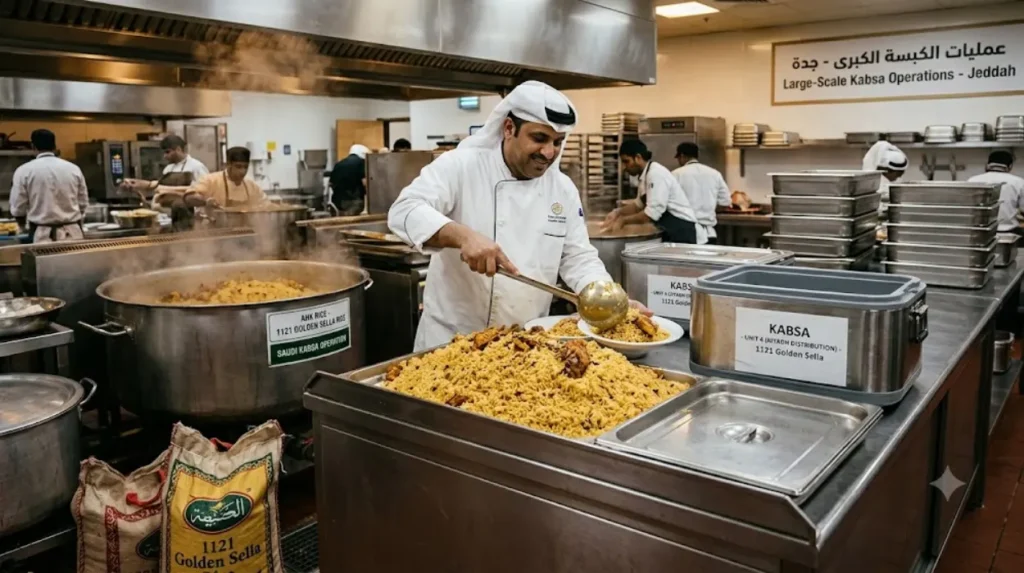
What factors affect pricing and total landed cost of 1121 Golden Sella Rice imports into Saudi Arabia?
Pricing depends on paddy procurement rates, aging duration, broken percentage, packaging format, shipping mode, and Saudi customs duties. AHK Rice optimizes these variables through bulk consolidation, contract-based milling cycles, and freight planning to reduce landed cost volatility for restaurant and distributor buyers.
The base cost of 1121 Golden Sella Rice is influenced by harvest season availability and storage aging time. Older rice typically commands higher pricing due to enhanced cooking performance.
Packaging also affects cost. 5kg retail packs cost more per ton compared to 25kg or 50kg bulk sacks used by foodservice operators.
Freight is a major variable. Sea freight is more economical but slower, while air freight is reserved for urgent replenishment.
Customs clearance in Saudi Arabia requires compliance documentation, including phytosanitary certificates and packing declarations. AHK Rice handles these documentation requirements as part of export execution.
Typical cost structure breakdown:
- Farm procurement and milling: 55–65%
- Aging and storage: 5–8%
- Packaging and labeling: 5–7%
- Freight (sea): 10–18%
- Saudi clearance & inland transport: 8–12%
By consolidating shipments, AHK Rice reduces per-unit freight cost for restaurant chains importing in bulk.
Buyers comparing suppliers should also evaluate hidden cost factors such as breakage rate and cooking yield, not just per-ton pricing.
This is where AHK Rice provides measurable advantage in total cost per cooked serving rather than headline import price.
How to start procurement of 1121 Golden Sella Rice for Kabsa restaurant supply chains in Saudi Arabia?
Start by defining specifications, selecting packaging format, confirming monthly volume, and locking shipment cycles. AHK Rice then aligns milling batches, prepares compliance documents, and schedules consolidated freight with transparent lead times and quality control checkpoints for every export container delivered to Saudi Arabia.
The procurement process is structured into four stages.
Step 1: Specification confirmation
Buyers define grain length, broken percentage, and parboiling intensity. AHK Rice provides standard export specs or custom adjustments depending on restaurant requirements.
Step 2: Sample approval
A 1–5 kg sample batch is produced for kitchen testing. This stage ensures Kabsa compatibility before bulk ordering.
Step 3: Contract and production slotting
Once approved, AHK Rice assigns production batches and aging cycles. This ensures consistency across future shipments.
Step 4: Shipping and documentation
Containers are packed, sealed, and documented for Saudi import clearance. Tracking is provided until arrival at port.
A sample cost scenario for a mid-size restaurant group:
- 1 container (25 metric tons)
- 1121 Golden Sella Rice bulk pack
- Sea freight to Jeddah
- Estimated landed cost includes freight and clearance bundled
- Delivery cycle: ~20–24 days average
For scaling operations, AHK Rice offers rolling monthly contracts to stabilize pricing and ensure uninterrupted supply for multi-branch kitchens.
From a decision perspective, procurement becomes predictable rather than transactional.
For buyers ready to proceed, final onboarding and quotation setup is completed through the official /request-a-quote/ process.
FAQ
What is 1121 Golden Sella Rice used for in Kabsa restaurants?
1121 Golden Sella Rice is mainly used for Kabsa because it holds grain structure after cooking. It absorbs spices evenly and does not break during long simmering or holding times. Restaurants prefer it for consistent plating quality.
Why is Golden Sella better than raw basmati for Saudi Kabsa?
Golden Sella is parboiled, which makes it firmer and more stable during cooking. This helps restaurants avoid mushy texture and improves yield per kilogram. It is more suitable for high-volume kitchens.
How long does rice shipment take to Saudi Arabia?
Shipping time usually depends on port and freight type. Sea freight to Jeddah or Dammam generally takes around 18 to 26 days including clearance. Air freight is faster but used only for urgent small volumes.
How can restaurants order bulk rice from AHK Rice?
Restaurants can place bulk orders by sharing required specifications like quantity, packing size, and monthly demand. AHK Rice then confirms samples, production batch, and shipping schedule before final export processing.
What affects the price of 1121 Golden Sella Rice?
Price depends on crop season, aging duration, broken percentage, packaging type, and shipping cost. Bulk contracts with AHK Rice help stabilize pricing and reduce fluctuations in long-term supply.