1121 Sella Basmati Rice: How the Parboiling Process Affects Cooking Quality
1121 sella basmati rice achieves firmer texture, longer grain elongation, and non-sticky cooking because parboiling hardens the starch structure before milling. Here is why: heat and moisture gelatinize starch inside the husk, locking grain integrity during cooking.
What is 1121 sella basmati rice and its parboiling process?
1121 sella basmati rice is parboiled basmati processed at 70–80°C with controlled soaking and steaming, producing stronger grains, golden or creamy color, and higher cooking stability.
1121 sella basmati rice is a long-grain aromatic rice variety cultivated in Punjab’s irrigated plains. Farmers grow and harvest paddy using controlled irrigation cycles. The grain length measures 8.05–8.30 mm before cooking.
Sella refers to parboiling. Parboiling treats paddy before milling. The process changes internal starch composition. The result is harder grains that resist breakage.
How sella differs from raw basmati
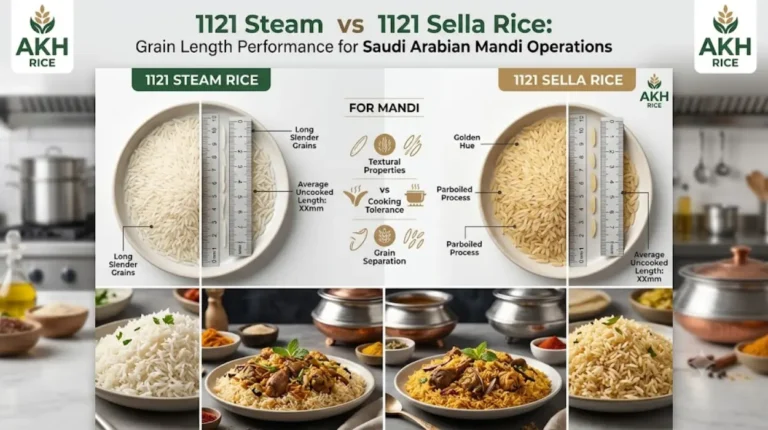
Raw basmati skips parboiling. Steam basmati applies light steaming after milling. Sella basmati processes paddy before milling.
Sella rice structure becomes compact. Raw rice remains soft. Steam rice sits between both.
Types of 1121 sella basmati
1121 sella basmati includes multiple grades:
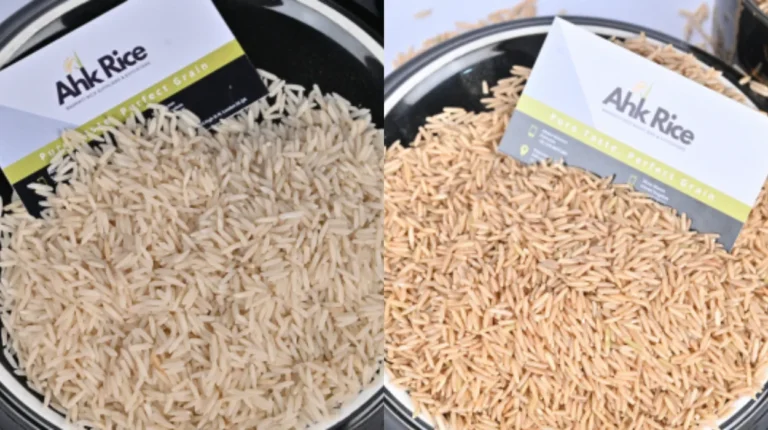
Creamy sella uses minimal heat. Golden sella uses higher steaming intensity. White sella removes outer color during polishing. With the definition established, the next question is how the parboiling process works step by step.
How does the sella parboiling process work step by step?
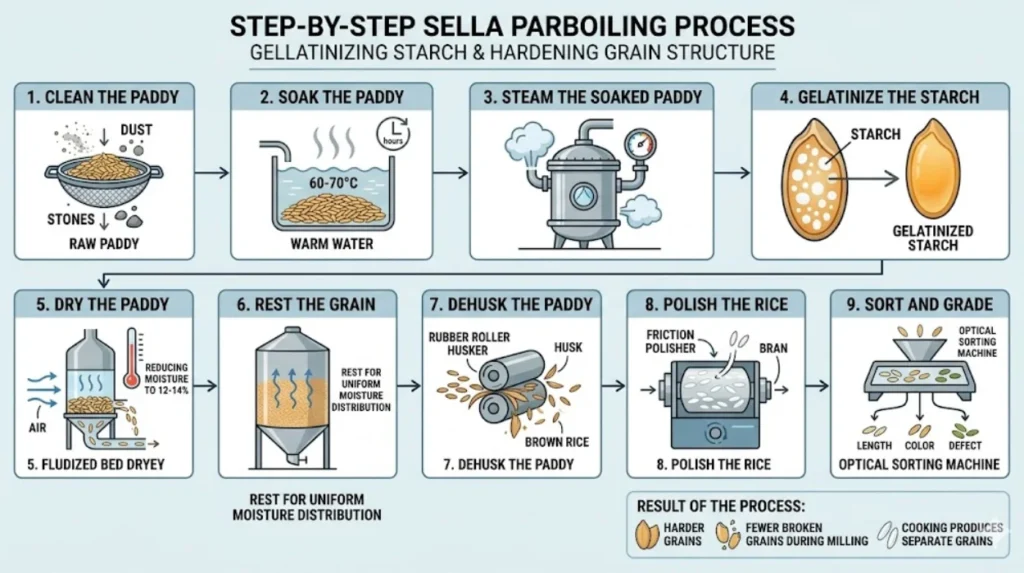
The sella parboiling process uses soaking, steaming, and drying to gelatinize starch and harden grain structure before milling, improving cooking quality and reducing breakage.
The process follows 9 precise steps. Each step controls moisture and temperature.
Step-by-step sella parboiling process
- Clean the paddy to remove dust and stones
- Soak the paddy at 60–70°C for 6–8 hours
- Steam the soaked paddy under pressure
- Gelatinize the internal starch completely
- Dry the paddy to 12–14% moisture
- Rest the grain for uniform moisture distribution
- Dehusk the dried paddy
- Polish the rice to required finish
- Sort and grade by length and defects
Why each step matters
Soaking allows water penetration. Steaming triggers starch gelatinization. Drying fixes the structure.
When soaking reaches uniform hydration, starch transforms evenly. When drying reaches correct moisture, grains avoid cracks during milling.
Result of the process
Parboiled grains become harder. Milling produces fewer broken grains. Cooking produces separate grains.
With the process explained, the next question focuses on the internal components that define cooking quality.
What key components define sella rice cooking quality?
Starch structure, moisture content, grain length, and protein level define sella rice cooking quality, controlling elongation, firmness, and stickiness.
Cooking quality depends on measurable components.
Starch composition
Sella rice contains gelatinized starch. This structure prevents excessive swelling.
Amylose content ranges 22–27%. Higher amylose produces non-sticky grains.
Moisture content
Moisture controls storage and cooking.
- Export moisture: 12–14%
- Cooking absorption: 2.5x water ratio
When moisture exceeds 14%, grains lose stability. When moisture drops below 11%, grains become brittle.
Grain length and elongation
1121 basmati elongates significantly.
- Raw length: 8.05–8.30 mm
- Cooked length: 16–18 mm
Elongation ratio reaches 2.0–2.2x.
Protein content
Protein strengthens grain structure.
- Average protein: 7–8%
Higher protein supports firm texture after cooking.
With key components defined, the next question examines how these translate into real cooking benefits.
What benefits does parboiling give to cooking quality?
Parboiling improves cooking quality by increasing grain firmness, reducing stickiness, enhancing elongation, and improving nutrient retention.
Parboiling creates functional advantages.
Improved grain separation
Sella rice grains remain separate after cooking. The hardened starch prevents clumping.
Examples include biryani and pulao, where separate grains define quality.
Higher elongation
Sella rice elongates more than raw rice. The internal structure expands lengthwise instead of widthwise.
Reduced breakage during cooking
Parboiled grains resist cracking. Cooking stress does not split grains.
Nutrient retention
Parboiling pushes nutrients from bran into the endosperm.
- Vitamin B retention increases
- Mineral retention improves
Better shelf stability after cooking
Cooked sella rice remains stable for longer hours. Texture remains firm in buffet conditions.
With benefits explained, the next question explores where this rice performs best.
What are the main use cases of 1121 sella basmati rice?
1121 sella basmati rice is used in high-heat cooking, bulk catering, and long-holding dishes where grain separation and durability are required.
Use cases depend on cooking conditions.
Commercial catering
Large-scale kitchens use sella rice because it tolerates bulk cooking.
Examples include wedding catering, airline meals, and institutional kitchens.
Traditional dishes
Sella rice performs well in structured dishes:
- Biryani
- Pulao
- Kabsa
These dishes require long grains and non-sticky texture.
Export markets
Different regions prefer specific sella types:
- Middle East prefers golden sella
- Africa prefers creamy sella
- Europe prefers white sella
Each market selects based on cooking style and storage conditions.
Long holding applications
Buffet systems require rice that holds shape for 4–6 hours. Sella rice maintains structure under heat lamps.
With use cases defined, the next question addresses common misconceptions about sella rice.
What common problems or misconceptions exist about sella rice?
Sella rice is often misunderstood as over-processed or lower quality, but controlled parboiling improves durability, consistency, and cooking performance without reducing grade value.
Misconceptions affect buying decisions.
Misconception 1: Sella rice is overcooked before use
Parboiling does not cook the rice fully. It only gelatinizes starch. Final cooking still requires boiling.
Misconception 2: Sella rice has lower aroma
Sella rice retains aroma. Proper processing preserves basmati fragrance. Golden sella shows slightly reduced aroma due to higher heat.
Misconception 3: Sella rice is harder to cook
Cooking requires measured water ratio.
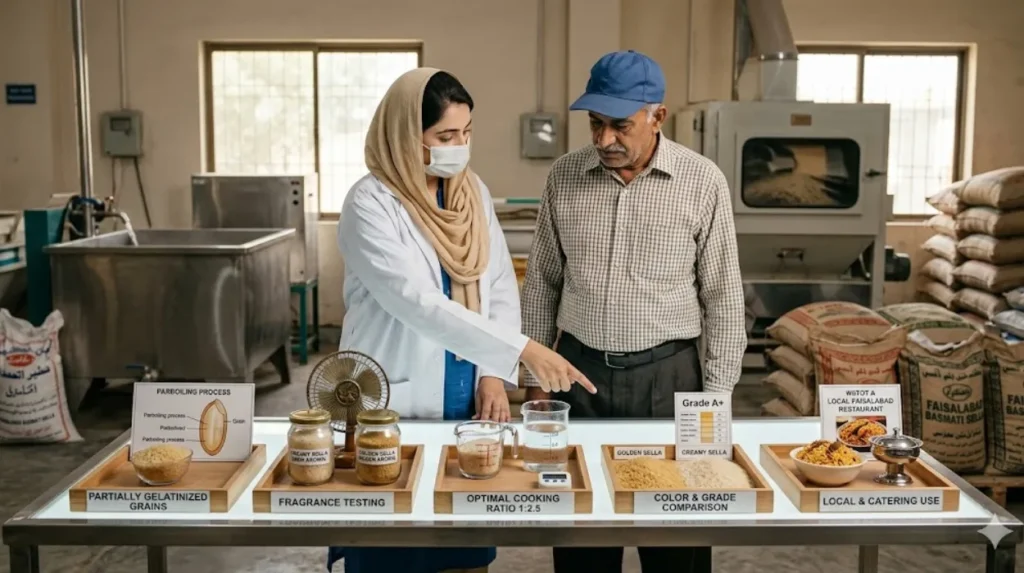
- Recommended ratio: 1:2.5 rice to water
- Cooking time: 12–15 minutes
Correct ratios produce optimal results.
Misconception 4: Color indicates lower quality
Golden color comes from steaming intensity. Creamy color comes from mild processing. Both represent valid grades.
Misconception 5: Sella rice is only for export
Domestic markets also use sella rice in restaurants and catering.
With misconceptions clarified, the next question connects cooking quality with storage and shelf life.
How does parboiling affect shelf life and storage quality?
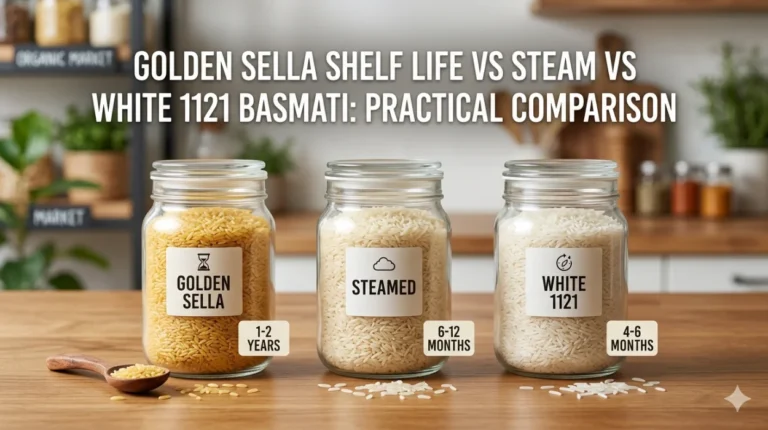
Parboiling extends shelf life to 18–24 months by reducing moisture variation and increasing resistance to pests and breakage during storage.
Storage performance improves after parboiling.
Shelf life comparison
- Sella basmati: 18–24 months
- Raw basmati: 12–18 months
Higher durability supports long-distance shipping.
Pest resistance
Parboiled grains resist insect damage. Hardened outer structure limits infestation.
Storage stability
Sella rice tolerates temperature fluctuations.
When stored at 25–35°C, grain integrity remains stable. When humidity exceeds 70%, sealed packaging prevents moisture absorption.
For a detailed comparison of storage behavior, read this guide:
1121 sella vs non-sella basmati shelf life storage.
With storage explained, the final question evaluates how all factors combine to define cooking quality.
How does parboiling directly impact final cooking performance?
Parboiling directly controls cooking performance by stabilizing starch, increasing elongation ratio, and ensuring consistent grain separation across batch cooking conditions.
Cooking performance results from combined factors.
Texture outcome
Sella rice produces firm grains. The texture remains consistent across different cooking volumes.
Water absorption behavior
Sella rice absorbs water evenly. Uniform hydration prevents uneven cooking.
Heat tolerance
Parboiled grains withstand high heat.
When cooking exceeds 100°C boiling, grains remain intact without splitting.
Batch consistency
Sella rice delivers consistent results across multiple batches. Industrial kitchens depend on this consistency.
Examples include airline catering and hotel chains where uniform output is required.
Frequently Asked Questions
Does parboiling change the taste of 1121 basmati rice?
Parboiling slightly reduces raw aroma intensity but preserves the core basmati fragrance. Golden sella may have a milder aroma than raw rice, while creamy sella retains more natural notes. Proper cooking restores balanced flavor.
What is the exact water ratio for cooking 1121 sella rice?
Use 1:2.5 rice-to-water ratio for optimal results. This ensures full hydration of the hardened starch structure and produces firm, separate grains without stickiness.
Why does sella rice take longer to cook than raw basmati?
Sella rice takes 12–15 minutes because the starch is pre-gelatinized and hardened during parboiling. This requires additional water absorption time during final cooking.
Can sella rice be used for biryani and pulao?
Yes. Sella rice is ideal for biryani and pulao because it maintains grain separation, elongates up to 2.2x, and resists breaking during layered or bulk cooking.
How should 1121 sella rice be stored for maximum shelf life?
Store in airtight packaging at 25–35°C with moisture below 14%. Under these conditions, sella rice maintains quality for 18–24 months without texture or aroma degradation.