Why Are Welsh Brands Exploring Private Label Basmati Rice Products?
Welsh brands are exploring private label Basmati rice to control product specifications, packaging, pricing, and brand positioning. Here is why: private label sourcing connects a retailer or food business directly with an origin supplier and defined rice specification.
What Is Private Label Basmati Rice?
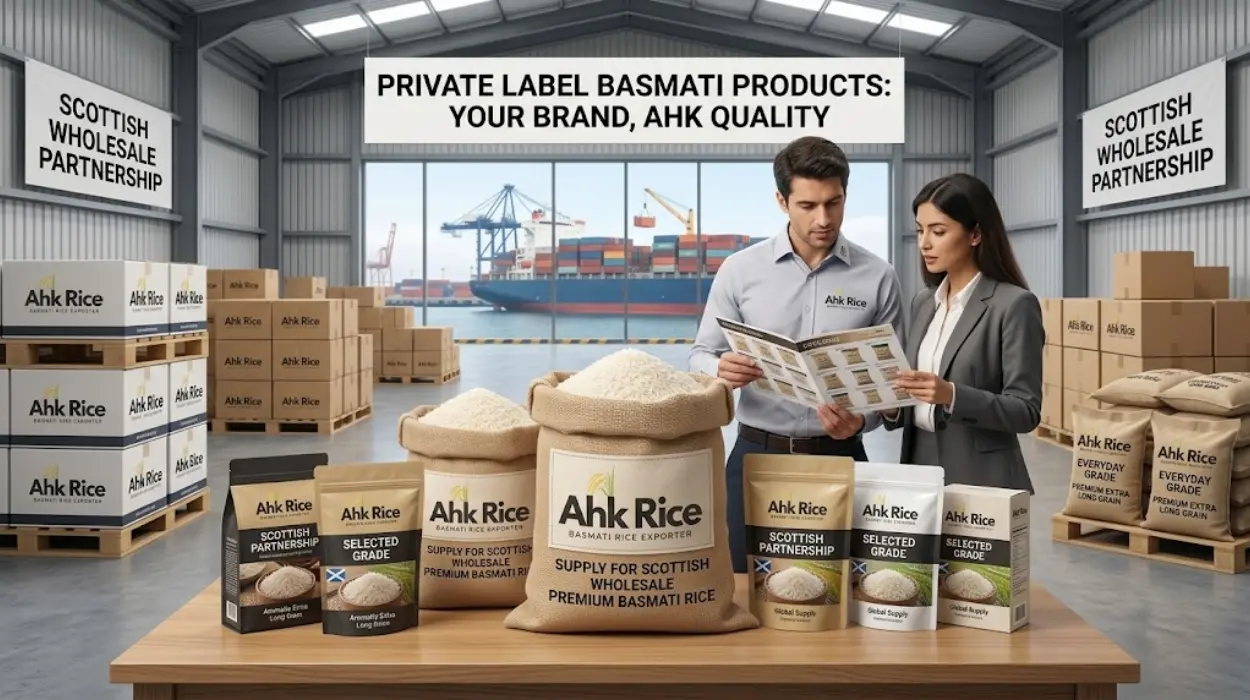
Private label Basmati rice is rice sourced by one business and sold under another business’s brand name, with agreed variety, grade, packaging, specifications, and compliance controls.
A private label product separates the brand owner from the rice producer. The Welsh brand owns the customer-facing identity. The exporter or processor handles cultivation sourcing, milling, grading, testing, packing, and export preparation.
Private label Basmati rice differs from ordinary wholesale rice. Wholesale supply usually uses an established supplier brand. Private label supply uses the buyer’s own packaging, brand identity, product description, and agreed specification.
Welsh businesses already operate within a wider UK own-label food environment. FEI Foods, founded in Swansea, describes itself as a UK private-label ready-to-eat rice producer serving major British retailers.
The model also exists across ambient retail rice. UK suppliers offer private-label packs in formats ranging from smaller retail bags to larger food-service packs.
For Welsh brands, the attraction is straightforward. A company can define its rice product instead of simply reselling another company’s finished brand.
Why Are Welsh Brands Exploring This Model?
Welsh brands are exploring private label because own-brand rice gives them greater control over positioning, pack format, specifications, pricing structure, and customer experience across retail and food-service channels.
Brand control
Brand control starts with the product specification. A business defines the variety, processing type, broken percentage, grain appearance, moisture requirement, pack weight, artwork, and country-of-origin statement.
A 1kg retail pouch serves a different customer than a 10kg food-service bag. A premium 1121 specification also communicates a different value proposition from a standard long-grain product.
UK wholesale listings show established demand for multiple Basmati brands and pack sizes. A Cardiff-area wholesaler, for example, lists 20kg Basmati products from several established brands.
Product differentiation
Product differentiation gives a Welsh brand control over how customers understand its rice. A brand can build a range around long-grain appearance, cooking performance, processing method, pack size, or target cuisine.
Private label also supports separate product tiers. A retailer can develop a premium 1121 SKU, a Super Kernel SKU, and a value-oriented 1509 SKU.
Margin structure
Private label changes the commercial structure by removing another branded layer from the customer relationship. The brand owner negotiates directly around specification, packaging, volume, and supply terms.
This does not automatically create a lower retail price. Packaging, testing, freight, customs, warehousing, certification, and import costs remain part of the landed product cost.
The commercial advantage comes from controlling those variables as one product system.
With the commercial reasons established, the next question is how the rice itself moves from cultivation to a Welsh retail pack.
How Is Private Label Basmati Rice Produced?
Private label Basmati production follows a defined chain: cultivate the rice, harvest paddy, mill the grain, grade it, test quality, pack it, document export, and dispatch it.
How is Basmati rice cultivated and harvested?

Pakistani Basmati rice is cultivated primarily in Punjab’s rice-growing areas. Agricultural conditions, irrigation, soil, seed selection, and crop management influence the harvested paddy.
Harvested paddy contains husk and requires controlled post-harvest handling. The processor receives paddy and begins the milling sequence.
How is Basmati rice processed?
The core processing sequence uses several controlled stages:
- Clean the paddy to remove stones, dust, straw, and other foreign material.
- De-husk the grain to remove the outer husk.
- Polish the grain to achieve the required white-rice appearance.
- Parboil the rice for Sella and parboiled specifications.
- Dry the grain to reach the required moisture level.
- Grade the rice by grain length, broken percentage, and physical quality.
- Sort the rice through mechanical and colour-sorting systems.
- Inspect the finished rice against the agreed specification.
- Pack the rice into the buyer’s approved retail or food-service packaging.
UK customs guidance classifies rice according to processing state and grain characteristics. Basmati is defined as an aromatic, fragrant, slender long-grain rice that expands mainly lengthwise during cooking.
Which Basmati grades are available?
Pakistani Basmati private-label programs use several processing and variety combinations.
| Variety | Available processing grades |
|---|---|
| 1121 Basmati | White, Steam, Golden Sella, Creamy Sella, Brown |
| Super Kernel | White, Steam, Sella, Parboiled |
| 1509 | White, Steam, Golden Sella |
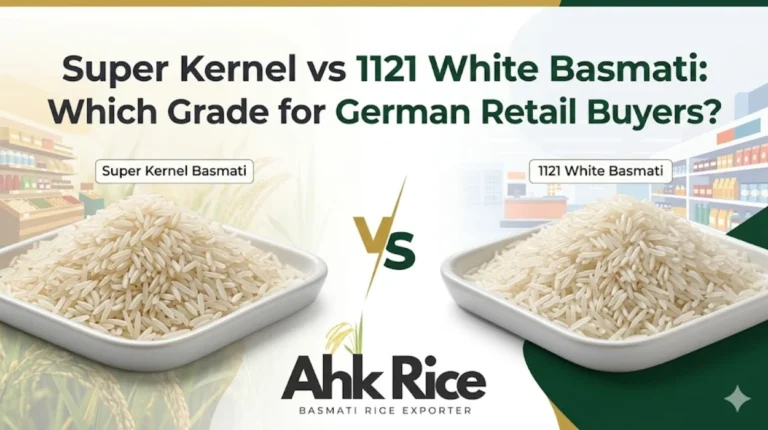
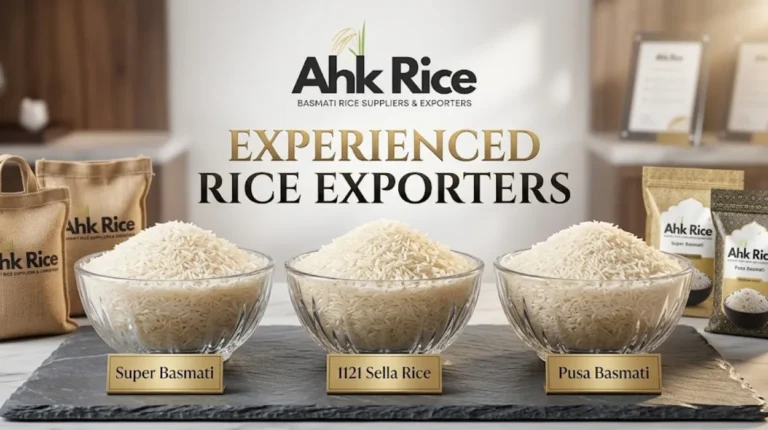
1121 White provides long white grains with a conventional polished appearance. 1121 Steam uses steam processing for a firmer cooked texture.
1121 Golden Sella uses parboiling and produces a characteristic golden appearance. 1121 Creamy Sella uses parboiling while retaining a lighter creamy appearance.
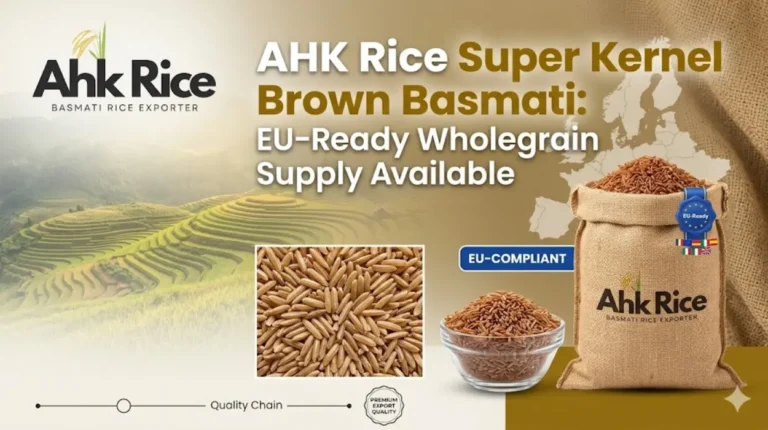
1121 Brown retains more of the grain’s outer layers than polished white rice. Brown rice therefore serves a different product positioning.
Super Kernel White provides a traditional Pakistani Basmati specification. Super Kernel Steam uses steam processing. Super Kernel Sella and Super Kernel Parboiled target applications requiring parboiled processing.
1509 White provides a polished white-rice option. 1509 Steam uses steam processing. 1509 Golden Sella provides a golden parboiled format.
The exact grade name, grain specification, broken percentage, moisture requirement, and packaging format belong in the product specification agreed before production.
What Are the Key Components of a Welsh Private Label Rice Product?
A complete private label rice product combines rice variety, processing grade, physical specification, packaging, labelling, food-safety controls, traceability, export documents, and shipment management.
Which product specifications matter?
A buyer specification normally defines:
- Variety: 1121, Super Kernel, or 1509.
- Processing: White, Steam, Sella, Golden Sella, Creamy Sella, or Brown.
- Grain length: The agreed average and tolerance.
- Broken percentage: The permitted broken-grain level.
- Moisture: The maximum agreed moisture percentage.
- Foreign matter: The permitted physical contamination level.
- Packaging: The approved material, size, artwork, and net weight.
- Crop year: The specified harvest period.
- Shelf life: The validated period printed on the pack.
These specifications prevent the term “premium Basmati” from becoming an undefined marketing phrase.
Which certifications and controls apply?
Food businesses use several certification and verification systems across the supply chain. HACCP provides a structured approach to identifying and controlling food-safety hazards.
ISO 22000 defines requirements for a food-safety management system across the food chain. The standard integrates HACCP principles, prerequisite programs, system management, and communication.
BRCGS certification is a widely recognised commercial food-safety standard used within retail supply chains. Buyers can also require laboratory certificates, pesticide-residue testing, microbiological testing, heavy-metal testing, fumigation records, and pre-shipment inspection.
Certification does not replace legal compliance. The importer remains responsible for meeting applicable UK requirements.
UK guidance states that certain grains, including rice, enter Great Britain without a phytosanitary certificate under the specified plant-health rules.
Food labelling also requires accurate product information. UK Food Standards Agency guidance covers origin information and circumstances where packaging creates an impression about food origin.
For private label rice, the country of origin, importer details, net quantity, storage information, product name, and required food information need controlled artwork approval.
Where Can Welsh Brands Use Private Label Basmati Rice?
Welsh brands can use private label Basmati rice across supermarkets, independent shops, ethnic retailers, online stores, wholesalers, restaurants, caterers, and food-service operations.
Retail applications
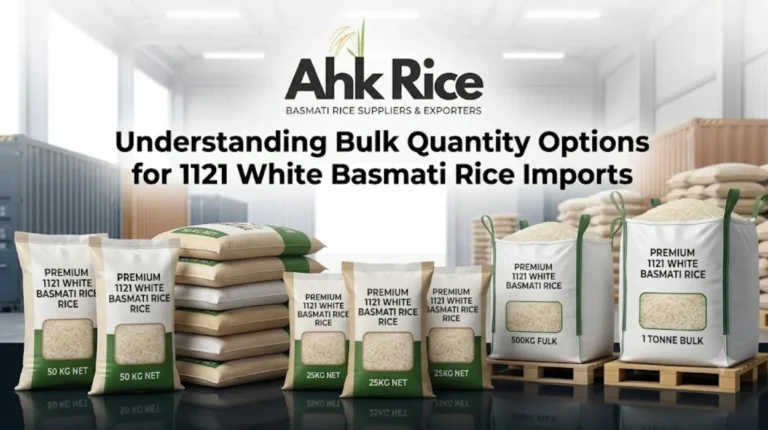
Retail packaging usually focuses on consumer-friendly formats. Common examples include 500g, 1kg, 2kg, 5kg, and 10kg packs.
A premium retail range can use 1121 Basmati as its lead product. A food-service range can use larger bags designed for restaurants and catering operations.
Wholesale applications
Wholesale customers require consistent specifications and repeat availability. A private label wholesaler can sell the same brand across independent retailers, restaurants, takeaways, and catering businesses.
UK suppliers already advertise private-label rice for retail, wholesale, restaurant, cash-and-carry, and distributor channels.
Online applications
Online brands require packaging that communicates the product clearly through product photography and descriptions. Grain type, processing grade, pack weight, origin, and cooking characteristics become important digital product attributes.
This creates a direct connection between product specification and search visibility. A retailer can build separate pages for 1121 Steam, 1121 Golden Sella, or Super Kernel Basmati instead of presenting one generic rice product.
With the main use cases established, the remaining issue is understanding the problems that cause private-label rice projects to fail.
What Problems Do Private Label Basmati Rice Projects Commonly Face?
The main problems involve unclear specifications, incorrect labelling, inconsistent grading, weak traceability, inadequate testing, packaging errors, and misunderstanding the difference between certification and legal compliance.
Specification problems
A vague specification creates disputes during production and shipment. “Long-grain premium Basmati” does not define broken percentage, moisture, grain length, foreign matter, crop year, or processing method.
A proper specification replaces broad descriptions with measurable requirements.
Packaging problems
Packaging errors create retail compliance problems. Artwork needs verification before printing because a wrong origin statement, weight declaration, product name, or importer detail affects the finished product.
Quality problems
Quality variation often starts with inconsistent procurement or weak grading controls. A private label program therefore requires a retained reference sample, approved specification, laboratory testing, and shipment inspection.
Certification misconceptions
Certification is not the same as product quality testing. ISO 22000 demonstrates conformity of a food-safety management system. A laboratory certificate verifies specific analytical results.
The buyer therefore needs both management-system controls and product-level evidence.
Origin misconceptions
Private label does not mean locally grown rice. A Welsh brand can own the consumer brand while the rice remains cultivated, milled, packed, and exported from Pakistan.
UK labelling rules require accurate origin information where origin presentation affects consumer understanding.
A clear specification therefore connects the Welsh brand, Pakistani origin, processing facility, packaging system, testing program, and import documentation.
What Should Welsh Brands Understand Before Developing Private Label Rice?
Welsh brands should treat private label Basmati as a specification-led supply chain rather than a simple packaging exercise, covering product selection, processing, compliance, testing, logistics, and brand presentation.
The first decision is the rice variety. The second is the processing grade. The third is the physical specification. The fourth is the pack format. The fifth is the compliance and testing framework.
A business then defines its target channel. A supermarket SKU requires consumer packaging. A restaurant SKU requires larger food-service packaging. An online SKU requires strong product information and consistent fulfilment.
The next stage is supplier evaluation. Buyers review processing capability, quality systems, testing records, traceability, packaging capability, export documentation, and shipment experience.
Private label therefore connects agriculture with retail strategy. The rice starts as cultivated paddy and ends as a branded consumer product with a defined specification.
For companies moving from research into brand development, the next logical subject is how companies develop their own imported rice brand, including supplier selection, specification development, packaging, testing, and import planning.
Frequently Asked Questions
What is private label Basmati rice?
Private label Basmati rice is produced or sourced for one business and sold under that business’s own brand. The buyer controls the specification, packaging, product presentation, and agreed commercial requirements.
Why are Welsh brands interested in private label rice?
Welsh brands use private label to control product specifications, packaging, positioning, and customer experience. The model also supports dedicated retail, wholesale, catering, and online product ranges.
Which Pakistani Basmati varieties support private label products?
The main varieties include 1121, Super Kernel, and 1509. Each variety supports different processing formats, including White, Steam, Sella, Golden Sella, Creamy Sella, Brown, and Parboiled grades.
What certifications apply to private label Basmati rice?
Food-safety programs commonly include HACCP and ISO 22000. Commercial retail supply chains also use certification schemes such as BRCGS. Product testing and UK legal compliance remain separate requirements.
Does private label rice need UK-compliant packaging?
Yes. The finished packaging must contain the required food information and accurate origin information. UK Food Standards Agency guidance covers food labelling and origin presentation.
Can a Welsh company sell Pakistani rice under its own brand?
Yes. The Welsh company can own the consumer-facing brand while the rice is cultivated, processed, tested, packed, and exported from Pakistan. The packaging must accurately communicate the product and origin.