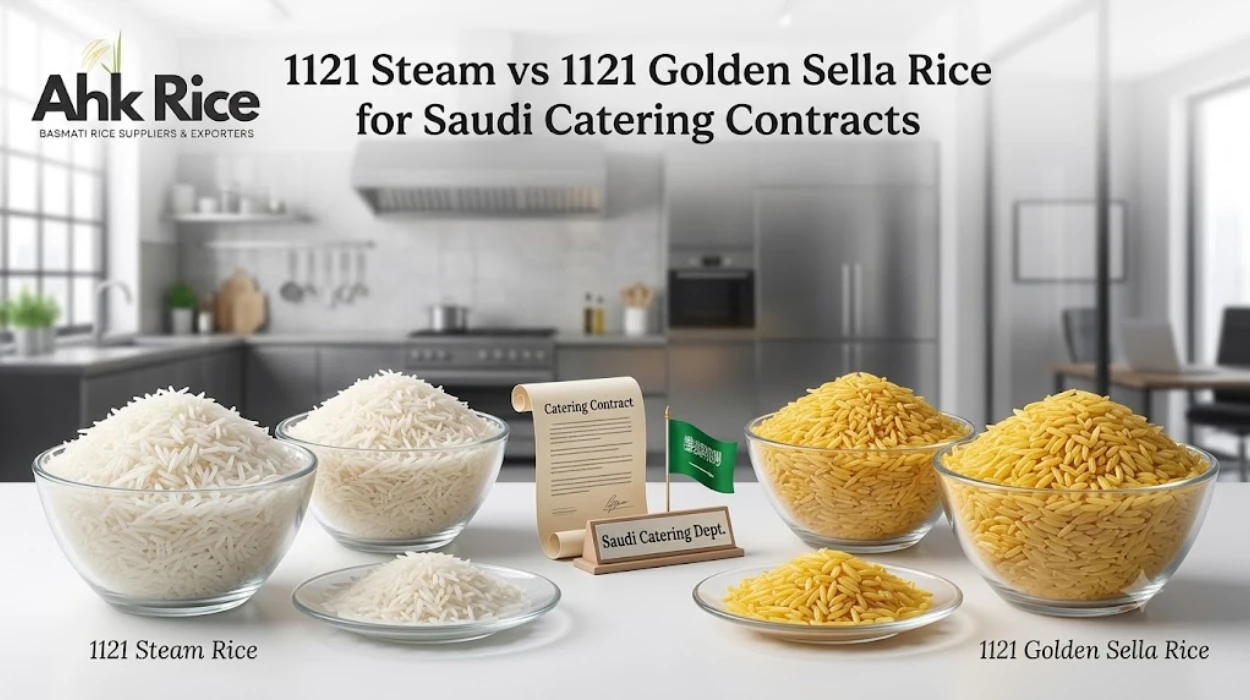
1121 Steam vs 1121 Golden Sella Rice for Saudi Catering Contracts
1121 Steam and 1121 Golden Sella serve different catering priorities, and Golden Sella wins for long storage stability while Steam dominates in aroma and softness for premium fresh-serving menus. Here is why: both are processed from 1121 basmati paddy, but parboiling, polishing intensity, and starch structure create different performance in large-scale catering environments.
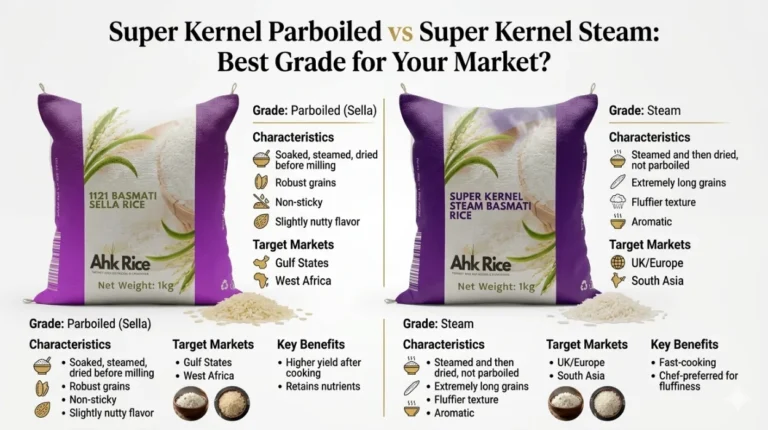
1121 Steam Basmati rice is milled, dehusked, and lightly steamed without full parboiling, which preserves aroma and grain elongation after cooking. 1121 Golden Sella rice is parboiled under high pressure, then dried, polished, and sorted to lock starch inside the grain. This structural difference directly changes shelf life, cooking tolerance, and bulk catering efficiency.
In Saudi Arabia’s catering industry, especially for kabsa and mandi contracts, procurement teams prioritize consistency, transport durability, and reheat stability. For this reason, the comparison between Steam and Golden Sella defines procurement strategy, not just cooking preference.
Internal reference for fundamentals: the TOFU guide explains why Saudi kitchens prefer 1121 Steam for traditional dishes and baseline cooking performance in bulk catering operations.
What are the available solutions for Saudi catering procurement?
1121 Steam, 1121 Golden Sella, and blended parboiled export grades represent the main procurement solutions for Saudi catering buyers, each defined by processing intensity, starch structure, and storage resilience. Steam focuses on aroma retention, Golden Sella focuses on durability, and blends balance cost with cooking consistency for large-volume contracts.
Solution categories in export supply
Steam processing solution: Steam rice is dehusked, steamed, milled, and sorted, preserving natural fragrance and elongation potential. It supports high-end catering menus where aroma defines customer perception.
Golden Sella solution: Golden Sella is parboiled, dried, milled, and color-sorted under high heat pressure. It stabilizes grain structure for long-distance shipping and hot climate storage.
Blended export solution: Blended grades combine Steam and Sella lots, standardized through grading and sorting systems for cost efficiency in large institutional tenders.
Specification comparison table (7 attributes)
| Attribute | 1121 Steam | 1121 Golden Sella |
|---|---|---|
| Processing method | Light steaming, milling, sorting | Parboiling, drying, milling, polishing |
| Grain color | Cream-white natural | Golden amber tone |
| Cooking expansion | High elongation, soft texture | Firm elongation, non-sticky texture |
| Aroma retention | Strong natural basmati aroma | Moderate aroma, stabilized starch |
| Breakage rate | 1–2% under export grading | Below 1% under export grading |
| Storage stability | 12 months in hot climates | 18–24 months in controlled storage |
| Catering use case | Fresh serving, premium menus | Bulk catering, transport-heavy contracts |
With solution types defined, the next step is understanding how each processing method compares under real catering logistics conditions.
How do different processing approaches compare in real catering logistics?
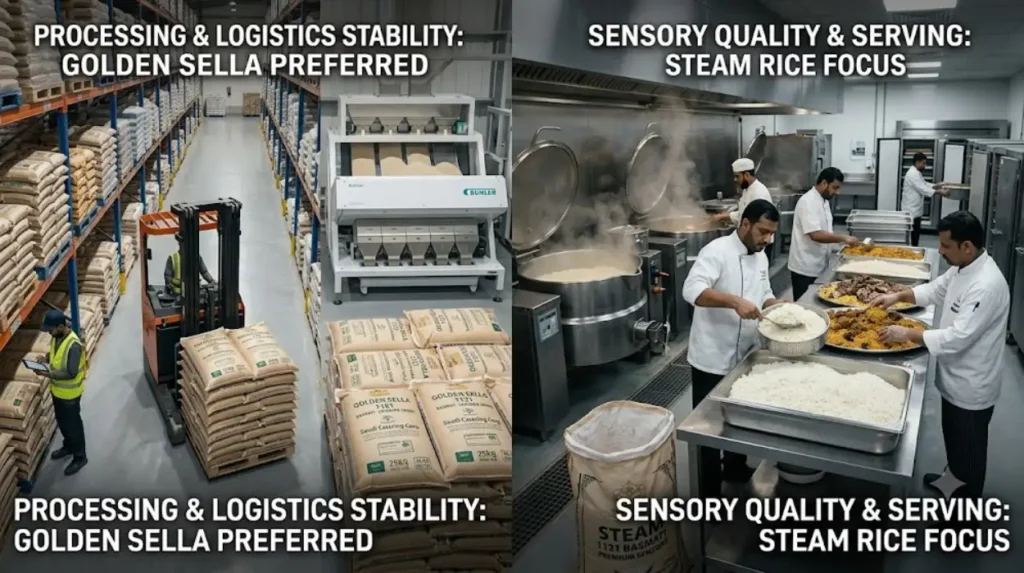
Golden Sella outperforms Steam in logistics stability, while Steam outperforms Golden Sella in sensory quality, and this trade-off determines procurement decisions across Saudi and Gulf catering contracts with different storage conditions, transport distances, and serving formats.
Processing impact on logistics performance
Steam processing effect: Steam rice retains natural starch activity, which increases sensitivity to humidity fluctuations during dispatch and storage.
Golden Sella processing effect: Parboiling gelatinizes starch, locking grain integrity and reducing moisture sensitivity during long-distance shipping.
Sorting systems effect: Advanced color sorting and length grading reduce defect rates, ensuring uniform cooking across catering batches exceeding 5–10 MT per shipment.
Regional comparison: Saudi Arabia vs UAE catering markets
Saudi Arabia demand pattern: Saudi catering contracts prioritize high-volume kabsa and mandi distribution, requiring rice that withstands reheating and bulk serving cycles. Golden Sella gains preference in institutional contracts due to stability.
UAE demand pattern: UAE catering operations focus on hospitality, hotels, and fine dining where aroma and presentation dominate. Steam rice is more commonly selected for premium dining environments.
Price per MT comparison (2026 market averages)
Saudi procurement pricing: Steam 1121 typically ranges between USD 920–1050 per MT, depending on grain length and purity level.
Saudi procurement pricing: Golden Sella 1121 ranges between USD 980–1120 per MT, reflecting additional parboiling and stabilization cost.
UAE procurement pricing: Steam commands slightly higher premiums at USD 1000–1150 per MT due to hospitality-driven demand.
UAE procurement pricing: Golden Sella remains stable at USD 990–1130 per MT due to bulk import balancing.
Shelf life comparison under Gulf conditions
Golden Sella stability: Golden Sella maintains quality for 18–24 months in 35–45°C storage conditions due to starch gelatinization.
Steam stability: Steam maintains quality for 10–14 months in similar environments due to higher moisture sensitivity.
Operational impact: Golden Sella reduces stock rotation frequency, while Steam requires faster turnover in warehousing systems.
With logistics differences clear, procurement teams must evaluate which method performs best for specific catering scenarios.
Which method works best for different catering cases?
Golden Sella works best for long-term storage and high-volume institutional catering, while Steam works best for aroma-driven menus and premium hospitality service, and hybrid procurement models work best for mixed Saudi catering contracts requiring both stability and quality differentiation.
Use case segmentation in catering contracts
High-volume institutional catering: Golden Sella dominates due to extended shelf life and reduced spoilage risk during large-scale storage.
Premium hospitality catering: Steam dominates due to fragrance retention and softer texture preferred in plated service environments.
Mixed contract catering: Hybrid procurement uses both grades to optimize cost efficiency and menu segmentation across different service tiers.
Example operational deployment
Saudi army catering contracts: Golden Sella is used for bulk meal preparation where consistency across thousands of servings is required.
Hotel banquet operations: Steam is used in freshly cooked buffet lines where aroma release is part of customer experience.
Catering logistics hubs: Hybrid usage allows centralized warehouses to dispatch different grades based on client type and event specification.
Performance outcome comparison
Golden Sella performance: Golden Sella reduces wastage by 15–20% in high-heat storage environments due to structural stability.
Steam performance: Steam increases perceived quality scores by 10–15% in sensory evaluations due to aroma intensity.
Hybrid performance: Combined usage improves procurement efficiency by balancing cost and quality across contract portfolios.
With use cases defined, the next step is to evaluate advantages and disadvantages of each processing type.
What are the pros and cons of Steam and Golden Sella rice?
Steam rice delivers superior aroma and culinary appeal but has shorter storage stability, while Golden Sella delivers maximum logistical efficiency and shelf life but slightly reduced aromatic intensity in cooked applications across large catering environments.
Advantages of 1121 Steam
Aroma strength: Steam preserves natural basmati fragrance, enhancing sensory appeal in freshly served dishes.
Cooking softness: Steam produces softer grain texture suitable for plated dining and buffet service.
Market positioning: Steam aligns with premium hospitality branding and higher perceived food quality.
Disadvantages of 1121 Steam
Storage limitation: Steam requires faster consumption cycles due to moisture sensitivity in hot climates.
Transport risk: Steam is more vulnerable to breakage under long-haul logistics stress.
Inventory rotation: Steam increases warehouse turnover frequency, raising operational planning complexity.
Advantages of 1121 Golden Sella
Storage durability: Golden Sella supports long-term warehousing in non-climate-controlled environments.
Cooking consistency: Golden Sella produces firm, non-sticky grains ideal for bulk catering.
Transport resilience: Golden Sella reduces breakage and maintains uniform grain quality during export shipping.
Disadvantages of 1121 Golden Sella
Aroma reduction: Parboiling slightly reduces natural fragrance intensity compared to Steam.
Color variation: Golden tone may not align with all premium plating expectations.
Perception gap: Some hospitality buyers associate Golden Sella with institutional rather than luxury use.
With pros and cons established, procurement teams must apply structured decision criteria for final selection.
What decision factors determine Steam vs Golden Sella selection?
Procurement decisions depend on storage conditions, contract duration, catering format, cost sensitivity, and climate exposure, with Golden Sella preferred for durability-heavy contracts and Steam preferred for sensory-driven hospitality applications across Gulf catering ecosystems.
Decision framework table (5 factors)
| Decision factor | Steam preference | Golden Sella preference |
|---|---|---|
| Storage duration | Short-term (<12 months) | Long-term (12–24 months) |
| Climate exposure | Controlled warehouses | Hot, non-controlled storage |
| Catering type | Hospitality, fine dining | Institutional, bulk catering |
| Transport distance | Short regional delivery | Long-distance export shipping |
| Cost optimization | Quality-first budgeting | Stability-first budgeting |
Procurement strategy mapping
Cost-sensitive contracts: Golden Sella reduces wastage and improves inventory predictability in large tenders.
Quality-sensitive contracts: Steam increases customer satisfaction in premium dining environments.
Balanced procurement: Hybrid allocation ensures flexibility across fluctuating demand cycles in Saudi catering operations.
Conclusion: strategic sourcing alignment for 2026 catering contracts
1121 Golden Sella and 1121 Steam serve complementary roles in Saudi catering procurement, with Golden Sella leading logistics stability and Steam leading sensory quality, and hybrid procurement models delivering the most balanced operational outcome across diverse contract environments. Read our Bofu guide: How to Source 1121 Steam Basmati Rice for Catering Businesses in Riyadh and Jeddah.
FAQs
How is 1121 Steam rice different from 1121 Golden Sella rice?
1121 Steam rice is lightly steamed during processing, which helps retain natural aroma and produces softer grains after cooking. Golden Sella rice is parboiled under high pressure, making the grains firmer and more stable for long storage and transport.
Which rice is better for catering contracts?
Golden Sella rice is generally better for large catering contracts because it offers stronger shelf stability, lower breakage, and better performance during long-distance transport. Steam rice is preferred for premium dining where aroma and softness matter more.
What is the shelf life difference between Steam and Golden Sella rice?
Golden Sella rice has a longer shelf life of around 18–24 months under hot climate conditions. Steam rice typically lasts around 10–14 months because it is more sensitive to humidity and storage conditions.
Which rice has better aroma and taste?
Steam rice has a stronger natural basmati aroma and softer texture after cooking. Golden Sella rice has a milder aroma due to parboiling but offers a firmer, non-sticky texture ideal for bulk serving.
Where is each rice type commonly used in Saudi catering?
Golden Sella is widely used in institutional catering, army contracts, and bulk meal services in Saudi Arabia. Steam rice is more common in hotels, banquet halls, and premium catering where food presentation and aroma are important.