Why Is Import Compliance Essential for Rice Purchasing Decisions?
Import compliance is the process of ensuring that rice meets the destination country’s food-safety, labelling, documentation, phytosanitary, customs, and traceability rules before shipment and entry. Compliance protects buyers from rejected consignments, regulatory delays, financial losses, and supply-chain disruption.
For rice buyers, purchasing decisions involve more than grain variety, price, aroma, or milling quality. A shipment also has to satisfy the legal requirements of its destination market. The compliance standard applies to the rice itself, its packaging, its documentation, the exporting facility, and the importer’s verification system.
This is especially important for Pakistani Basmati rice. Punjab is a major production area for aromatic Basmati varieties. Commercial varieties include 1121 Basmati, Super Kernel Basmati, Super Basmati, and 1509. These varieties enter international markets in white, steam, and parboiled forms. Trade Development Authority of Pakistan export material also identifies products such as 1121 Steam, 1121 Parboiled, 1509 Steam, and 1509 Sella among Pakistani rice export offerings.
What is import compliance in rice purchasing?
Import compliance means matching a rice shipment with the legal requirements of its destination market, including food safety, facility registration, prior notification, labelling, phytosanitary controls, customs documentation, testing, traceability, and importer verification obligations.
Import compliance begins before the purchase order. The buyer identifies the destination-country rules and then checks whether the supplier, product, packaging, and shipment documents satisfy those rules.
In the United States, imported food is subject to FDA requirements. FDA states that imported food must be safe, sanitary, and truthfully labelled in English. Food facilities involved in manufacturing, processing, packing, or holding regulated food also face registration requirements when applicable.
The U.S. system also places responsibility on the importer. Under the Foreign Supplier Verification Program, or FSVP, the importer verifies that imported food meets applicable U.S. food-safety requirements and is not adulterated or misbranded. Rice is specifically included within FDA guidance covering imported grain raw agricultural commodities.
This means a rice buyer cannot treat compliance as a final customs step. It forms part of supplier selection, purchase specifications, quality assurance, and shipment planning.
How does rice import compliance work from farm to destination?
Rice import compliance follows a chain that starts with cultivation and continues through harvesting, milling, testing, packaging, documentation, export clearance, import filing, inspection, and market release. Each stage creates records that support product identity, safety, quality, and traceability.
1. Rice is cultivated and harvested
Pakistani Basmati rice is strongly associated with Punjab’s agricultural regions. Farmers cultivate rice under climatic and soil conditions suited to long-grain aromatic varieties. The crop is harvested after reaching the required maturity.
At this stage, agricultural practices influence later quality characteristics. Moisture, foreign material, pest exposure, pesticide use, and grain condition all affect the suitability of the harvested paddy for export processing.
2. Paddy is cleaned and processed
Harvested paddy enters the milling chain. Cleaning removes stones, soil, straw, dust, and other foreign material. Destoning and separation improve physical purity.
The rice then passes through husking and milling operations. Paddy becomes brown rice after husk removal. Further milling produces white rice. Grading equipment separates grains according to length, broken percentage, colour, and other commercial specifications.
For parboiled rice, paddy undergoes controlled soaking, steaming, and drying before milling. Steam rice follows a controlled steaming process that changes grain characteristics while retaining the long-grain structure.
3. Rice is graded and tested
Commercial specifications define the product that the importer purchases. A specification can identify variety, grain length, broken percentage, moisture level, foreign matter, damaged grains, milling degree, crop year, packaging format, and other quality parameters.
Laboratory testing adds another layer. Buyers commonly request certificates of analysis or laboratory reports covering parameters relevant to the destination market and purchase contract. Examples include microbiological testing, pesticide-residue testing, heavy-metal testing, moisture analysis, and physical quality analysis.
The exact testing programme depends on the product, destination, customer specification, and applicable regulation.
4. Rice is packaged and labelled
Packaging protects rice during storage, transportation, handling, and retail distribution. Common formats include 5 kg, 10 kg, 20 kg, 25 kg, 40 kg, and 50 kg bags, although commercial pack sizes vary by market and buyer.
Labelling becomes a regulatory issue when rice enters a consumer market. In the United States, FDA identifies informative and truthful English-language labelling among the requirements checked at importation.
The buyer therefore needs to approve the label before production rather than discovering a labelling problem after the container reaches the destination port.
5. Export documents are prepared
Export documentation connects the physical shipment with its legal identity. Typical documents include the commercial invoice, packing list, bill of lading, certificate of origin, phytosanitary certificate where required, treatment or fumigation certificate where required, and laboratory or quality documents specified by the buyer.
Pakistan’s Department of Plant Protection states that export procedures involve meeting the importing country’s phytosanitary requirements, followed by inspection, sampling or treatment where applicable, and issuance of a phytosanitary certificate under ISPM 12.
Pakistan’s Single Window system also supports electronic processing of Department of Plant Protection export certificates. For rice exports, electronic phytosanitary certification has been integrated into the export process.
6. Import entry is completed
The importer or customs representative submits the required entry information. For U.S. food imports, Prior Notice is a central requirement unless an exemption applies. FDA requires advance notification of food shipments before arrival in the United States.
The timing depends on transportation mode. For shipments arriving by water, FDA’s published guidance states that Prior Notice must be received at least 8 hours before arrival. Air and rail shipments have different minimum timeframes.
7. Regulatory checks determine release
At the destination, authorities can review documentation, inspect the shipment, examine the product, or take samples. Non-compliant food faces regulatory action.
FDA states that imported food can be detained when it does not comply with U.S. requirements.
That makes compliance a purchasing criterion rather than an administrative afterthought.
What are the key components of rice import compliance?
The key components are product identification, food safety, supplier verification, phytosanitary documentation, labelling, traceability, testing, facility registration, customs records, prior notice, and destination-specific certifications. Each component addresses a different regulatory or commercial risk.
Product specifications
The buyer defines the exact rice before ordering. A specification identifies variety, processing method, grade, grain characteristics, packaging, quantity, and quality tolerances.
For example, a contract for 1121 Basmati Steam Rice needs a clearer product definition than simply stating “premium Basmati rice.”
Food safety controls
Food safety controls address biological, chemical, and physical hazards. Rice purchasing programmes often include controls for pesticide residues, contaminants, foreign material, moisture, pests, and microbiological conditions.
FSVP adds a structured U.S. importer responsibility. The importer evaluates known or reasonably foreseeable hazards, assesses supplier performance, approves suppliers, conducts verification activities, and maintains records.
Facility registration and importer information
The U.S. food system requires applicable food facilities to register with FDA. FDA also requires FSVP importers to provide an FDA-accepted unique facility identifier, with DUNS recognised for this purpose.
FDA issued a July 2026 reminder that businesses need to handle food facility registration information carefully and avoid unnecessary third-party requests for registration credentials.
Phytosanitary controls
A phytosanitary certificate confirms that an agricultural commodity meets the plant-health requirements established by the importing country. Pakistan’s Department of Plant Protection issues such certificates according to importing-country requirements and international phytosanitary standards.
Commercial certifications
Certifications and audits can support buyer requirements, retailer standards, food-safety systems, and market access. Examples include HACCP-based food-safety systems, ISO 22000, BRCGS, Halal certification, organic certification where applicable, and customer-specific audit programmes.
These certifications do not automatically replace government import requirements. A commercial certification and a statutory import document serve different purposes.
Why does compliance affect rice purchasing decisions?
Import compliance reduces the risk that a legally or commercially unsuitable rice shipment reaches the port. It also improves supplier evaluation by connecting product specifications, laboratory evidence, documentation, traceability, and destination-country requirements before the purchase becomes a shipment.
Price remains important, but the lowest quotation does not represent the lowest landed cost when a shipment requires rework, inspection, relabelling, storage, testing, detention, or disposal.
Compliance also affects supplier comparison. Two suppliers can quote the same price for 25 tonnes of Basmati rice while offering different levels of documentation, testing, traceability, packaging control, and regulatory readiness.
For U.S. buyers, supplier verification is particularly important because FSVP assigns defined responsibilities to the U.S. importer. FDA describes activities such as supplier evaluation, record review, sampling and testing, and audits as parts of the verification framework according to risk and applicable circumstances.
Buyers planning U.S. imports can connect this compliance framework with a detailed process guide on:
How rice importers meet USA regulatory requirements.
Which rice grades and products require compliance controls?
Compliance applies across rice varieties and processing types, not only premium Basmati. Buyers need specifications for 1121, Super Kernel, 1509, other Basmati varieties, non-Basmati rice, white rice, steam rice, and parboiled rice according to the destination market.
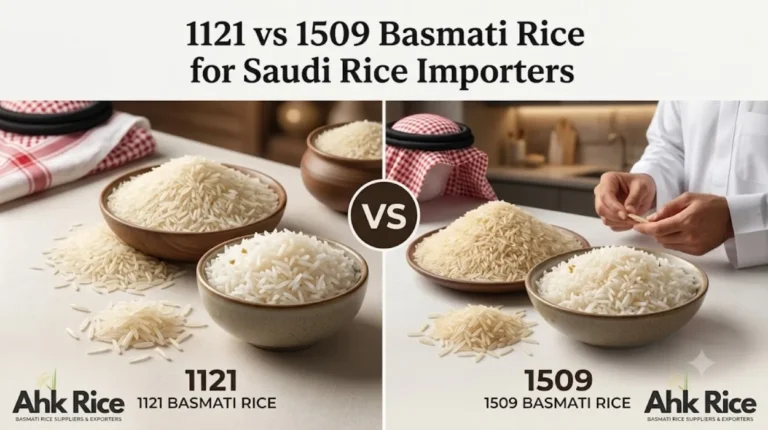
1121 Basmati
1121 is recognised for its exceptionally long grain and strong cooking elongation. Commercial forms include white, steam, and parboiled rice.
Super Kernel Basmati
Super Kernel Basmati is a premium Pakistani Basmati category valued for long grains, aroma, and cooking performance. Buyers define quality through measurable specifications rather than the variety name alone.
1509 Basmati
1509 is another long-grain Basmati variety used in export markets. It is sold in forms such as white, steam, and parboiled rice.
White, steam, and parboiled grades
Processing changes the physical and cooking characteristics of rice. It also changes the product specification that appears on commercial documents and labels. The declared product must match the actual shipment.
Which markets require rice import compliance?
Rice exporters face destination-specific requirements in markets such as the United States, United Kingdom, European Union, Gulf countries, Canada, Australia, and other importing regions. The exact documents, testing limits, labels, and certificates depend on the importing jurisdiction.
The United States uses FDA food controls, Prior Notice, applicable facility registration, FSVP, and customs procedures.
European markets apply EU food-safety, contaminant, pesticide-residue, traceability, and labelling frameworks. Gulf markets apply national food-control and import procedures. The United Kingdom operates its own post-Brexit food and import-control framework.
This variation explains why a shipment compliant for one destination does not automatically satisfy another. Importers need to specify the destination before approving the product.
What certifications apply to rice imports?
Rice certifications fall into regulatory certificates, food-safety certifications, product certifications, and commercial assurance documents. The required set depends on destination-country law, product characteristics, buyer specifications, and the intended sales channel.
A phytosanitary certificate addresses plant-health requirements where the importing country requires it. A certificate of origin establishes the declared country of origin. A laboratory certificate provides analytical evidence for specified quality or safety parameters.
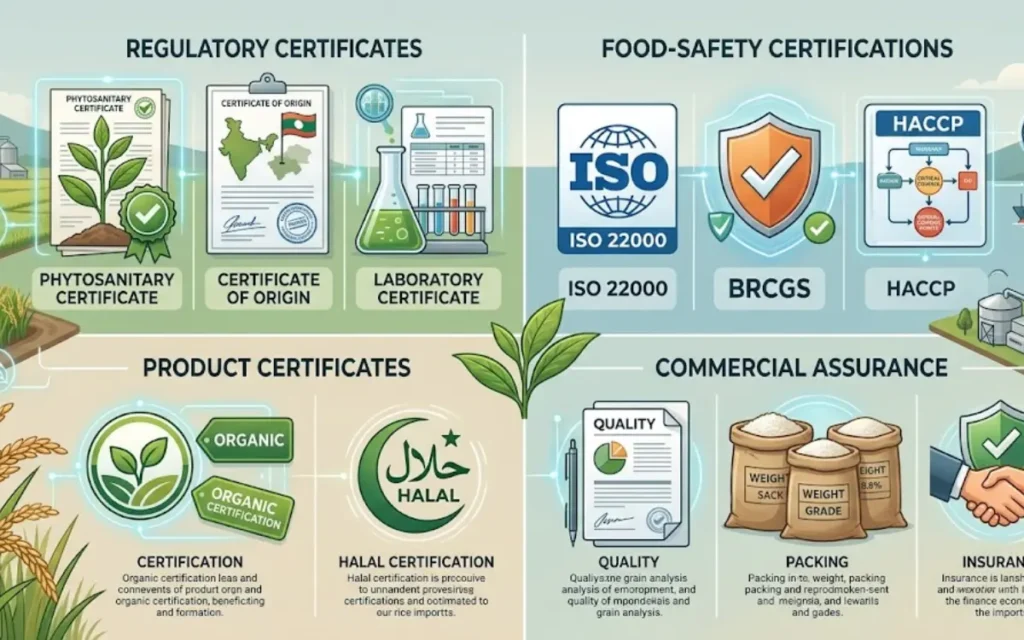
Food-safety certifications such as ISO 22000 or BRCGS demonstrate the operation of recognised management or food-safety systems. HACCP provides a hazard-control framework. Halal certification addresses Islamic dietary requirements where buyers or markets require it.
Organic certification applies only when the product is sold under an organic claim governed by the destination market’s organic rules.
The important distinction is that certification supports compliance, but certification does not equal complete import compliance.
What are the common problems and misconceptions in rice importing?
Common compliance problems include treating certifications as substitutes for regulations, using incorrect labels, missing Prior Notice, weak supplier verification, incomplete traceability, mismatched documents, and assuming one country’s requirements apply to every destination.
“A quality certificate means the shipment is automatically compliant”
It does not. A quality certificate addresses defined parameters. Import compliance covers the complete regulatory framework.
“The exporter handles every U.S. requirement”
The responsibility is divided. FDA requirements involve foreign facilities, exporters, importers, filers, brokers, and other parties. FSVP specifically assigns verification duties to the applicable U.S. importer.
“Prior Notice is only a customs form”
Prior Notice is an FDA requirement for applicable imported food shipments. FDA uses the information to assess incoming food before arrival.
“The same specification works in every market”
Destination rules differ. A buyer needs a country-specific compliance checklist before confirming the purchase.
“Compliance starts when the container reaches the port”
Compliance starts before production. The buyer needs to confirm product specifications, supplier eligibility, testing, packaging, labels, certificates, and import documentation before shipment.
Frequently Asked Questions
What is rice import compliance?
Rice import compliance is the process of ensuring that rice meets the destination country’s food safety, labelling, documentation, phytosanitary, testing, customs, and traceability requirements.
Why is import compliance important when purchasing rice?
Import compliance reduces the risk of shipment rejection, customs delays, additional costs, regulatory penalties, relabelling, and supply-chain disruption.
What documents are required for rice imports?
Common documents include a commercial invoice, packing list, bill of lading, certificate of origin, phytosanitary certificate where required, laboratory reports, and other destination-specific certificates.
Does rice require a phytosanitary certificate?
A phytosanitary certificate is required when the importing country establishes plant-health certification requirements for the rice shipment. Pakistan’s Department of Plant Protection issues certificates according to applicable importing-country requirements.
What rice varieties are commonly exported from Pakistan?
Common Pakistani export varieties include 1121 Basmati, Super Kernel Basmati, Super Basmati, and 1509 Basmati. These varieties are available in processing forms such as white, steam, and parboiled rice.