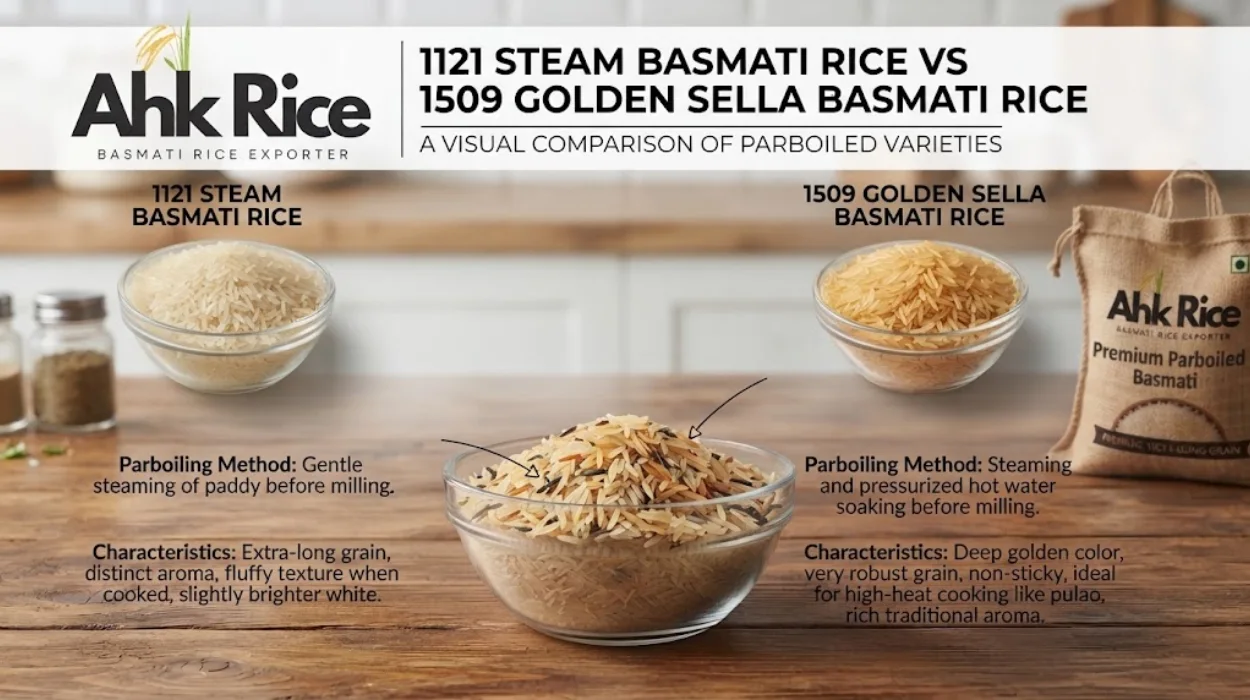
1121 Steam vs Golden Sella: Which Grade Performs Better?
1121 Steam performs better for aroma, near-white appearance, and fresh premium dishes, while 1121 Golden Sella performs better for firmness, bulk cooking, extended holding, and longer storage. Here is why: both grades use 1121 Basmati, but steaming and parboiling create different cooking and storage characteristics.
1121 Basmati is an extra-long aromatic rice variety cultivated mainly in Punjab, Pakistan. Its raw grain commonly measures around 8.2–8.4 mm. Proper processing produces cooked grains exceeding 22 mm. Buyers comparing processing options should first understand why Pakistan 1121 Basmati is a premium choice for Indonesian hotels.
The main commercial solutions are 1121 Steam and 1121 Golden Sella. Both belong to the same 1121 variety. Their processing method changes color, firmness, texture, holding behavior, and storage performance.
What are the available solutions for 1121 Basmati buyers?
The two main solutions are 1121 Steam and 1121 Golden Sella, with Steam emphasizing aroma and presentation and Golden Sella emphasizing firmness and operational stability. Here is why: both begin with 1121 paddy, but controlled steaming and full parboiling produce different physical properties.
What is 1121 Steam Basmati?
1121 Steam Basmati receives controlled steam treatment before drying and milling. The process strengthens the grain while maintaining a white to light-cream appearance.
Steam rice retains a pronounced Basmati aroma. Its cooked texture remains firm, fluffy, and separate. This profile suits premium restaurants, hotels, retail packs, biryani, pulao, and freshly prepared rice dishes.
Published Pakistani commercial specifications place 1121 Steam around 8.30–8.40 mm raw grain length. Cooked grain commonly reaches 22 mm or more. Commercial specifications also commonly set moisture around 13% maximum and broken grains around 2% maximum.
What is 1121 Golden Sella Basmati?
1121 Golden Sella is a parboiled Basmati grade. The paddy undergoes soaking, steaming, drying, dehusking, polishing, grading, and sorting.
Parboiling changes the grain structure and produces a golden to amber appearance. The resulting grain has greater firmness and resistance during cooking.
Golden Sella suits bulk biryani production, catering, banquet kitchens, institutional foodservice, and distribution systems requiring longer storage. Its firm structure also supports better separation during extended holding.
The two processing methods establish the basic difference, so the next step is comparing their measurable specifications.
How do 1121 Steam and Golden Sella compare?
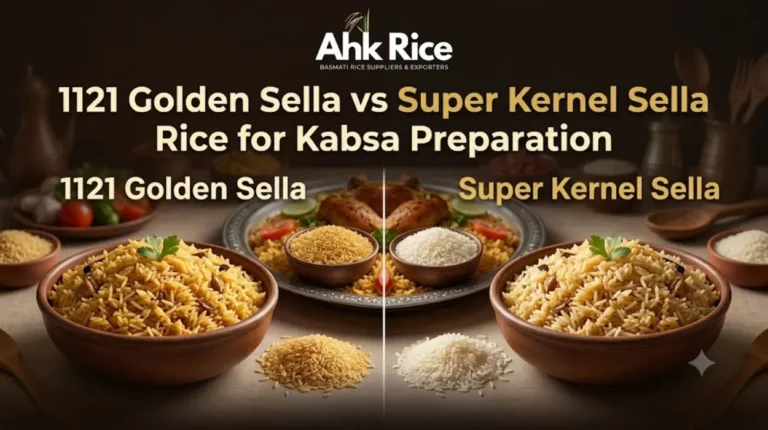
1121 Steam leads in aroma and white presentation, while Golden Sella leads in firmness, holding stability, and storage life. Here is why: the same 1121 variety receives different thermal processing, producing different grain structures and commercial uses.
| Attribute | 1121 Steam | 1121 Golden Sella |
|---|---|---|
| Processing method | Controlled steaming | Full parboiling |
| Raw grain length | 8.30–8.40 mm | Around 8.30–8.40 mm |
| Cooked grain length | 22 mm+ | 22 mm+ |
| Appearance | White to light cream | Golden to amber |
| Cooking texture | Firm, fluffy, separate | Firm, dry, highly separate |
| Holding performance | Around 2–3 hours | Around 4–5 hours |
| Shelf life | Around 12 months | 18–24 months |
Grain length remains broadly similar because both products originate from 1121 Basmati. Processing creates the major performance difference. Steam retains a lighter appearance and stronger aromatic profile. Golden Sella develops a harder structure through parboiling.
Holding performance matters in commercial kitchens. Golden Sella maintains separation for longer periods during buffet and catering service. Steam performs better when the kitchen prepares rice closer to serving time.
Shelf life also affects procurement planning. Published commercial specifications commonly place Steam around 12 months. Golden Sella specifications commonly extend to 18–24 months, depending on processing, packaging, storage, and contract specification.
The specification comparison shows the technical distinction, and the next question is how markets apply these differences.
Which grade do Gulf and European buyers prefer?
Gulf buyers commonly favor Golden Sella for storage and foodservice, while European buyers commonly favor Steam for aroma and premium retail presentation. Here is why: Gulf distribution faces demanding storage and catering conditions, while European channels emphasize controlled retail presentation and sensory quality.
How does 1121 perform in Gulf markets?
Gulf buyers frequently prioritize Golden Sella for catering and institutional applications. The grade provides firm grains and strong separation during high-volume cooking.
UAE, Saudi Arabia, Qatar, Kuwait, Oman, and neighboring markets use Basmati across restaurant, catering, hotel, and household channels. Gulf procurement therefore places significant value on storage stability and cooking resilience.
A 2026 AHK market comparison identifies Golden Sella as a strong Gulf specification because buyers prioritize shelf stability and bulk catering performance. Steam remains relevant where aroma and lighter appearance receive greater weight.
Golden Sella also provides a longer stated storage window. Published AHK specifications place Golden Sella around 18–24 months compared with approximately 12 months for Steam.
How does 1121 perform in European markets?
European buyers commonly place greater emphasis on aroma retention, grain elongation, packaging presentation, and controlled retail distribution. Steam therefore fits applications where white appearance and aromatic character remain central.
European importers also purchase both Steam and Sella grades. The final specification depends on the retail segment, restaurant application, package format, and consumer expectation.
A 2026 AHK comparison identifies Steam as particularly relevant to European demand because of aroma retention and cooking consistency under controlled retail distribution.
The regional comparison shows that market preference follows operating conditions rather than a universal quality hierarchy. The next factor is commercial price.
What is the price difference between 1121 Steam and Golden Sella?
August 2026 indicative FOB Karachi pricing placed 1121 Steam at $1,160–$1,200 per MT and Golden Sella at $1,145–$1,185 per MT. Here is why: processing costs, specification, crop conditions, quantity, packaging, inspection, and shipment terms influence the final export quotation.
| Grade | Indicative FOB Karachi price per MT | Price position |
|---|---|---|
| 1121 Steam | $1,160–$1,200/MT | Higher |
| 1121 Golden Sella | $1,145–$1,185/MT | Lower |
The indicative difference is approximately $15 per MT at comparable specifications. A 25 MT shipment therefore represents approximately $375 in indicative product-price difference before freight, insurance, destination charges, duties, taxes, and other landed-cost components.
Price alone does not establish value. A catering buyer holding rice for several hours evaluates waste, breakage, yield, and service consistency. A premium restaurant serving fresh rice evaluates aroma, appearance, and texture.
Buyers should therefore compare FOB price against the operational value of each processing grade rather than comparing the quotation alone.
Which method works best for different buyer cases?
Steam works best for premium fresh service, while Golden Sella works best for bulk preparation, extended holding, and longer inventory cycles. Here is why: each processing method solves a different operational requirement, so procurement should begin with the cooking environment.
When does 1121 Steam work better?
1121 Steam works well for premium restaurants requiring a lighter appearance and pronounced Basmati aroma. Its cooked texture supports plated biryani, pulao, steamed rice, and mixed international menus.
Steam also fits retail channels where consumers associate Basmati with white, slender, aromatic grains. Controlled packaging and faster inventory turnover support this specification.
Fresh-service kitchens gain another advantage. The softer cooked profile works well when rice moves from cooking vessel to plate within a short service window.
When does Golden Sella work better?
Golden Sella works well for catering kitchens producing large batches. Its firmer grain structure supports handling, reheating, buffet service, and extended holding.
Golden Sella also suits buyers with longer inventory cycles. Its commonly specified 18–24-month shelf life provides a longer commercial window than typical Steam specifications.
The golden appearance also suits biryani, mandi, pulao, kabsa, and other dishes where firm, visually distinct grains form part of the finished presentation.
The use-case distinction makes the comparison more practical, and the next section examines the advantages and limitations of each grade.
What are the pros and cons of 1121 Steam and Golden Sella?
1121 Steam offers aroma and white presentation, while Golden Sella offers structural strength and longer holding; each advantage creates a corresponding trade-off. Here is why: processing determines the grain behavior that buyers experience after cooking, storage, and service.
What are the advantages of 1121 Steam?
Aroma retention supports premium dishes where fragrance contributes directly to consumer perception.
White appearance fits menus requiring clean, bright rice presentation.
Soft texture provides a pleasant mouthfeel for freshly prepared dishes.
Menu flexibility allows use across biryani, pulao, steamed rice, and premium plated dishes.
What are the limitations of 1121 Steam?
Shorter storage window creates greater pressure on inventory turnover.
Shorter holding performance makes it less suitable for prolonged buffet service.
Higher indicative price places Steam around $15 per MT above Golden Sella in the cited August 2026 FOB comparison.
What are the advantages of Golden Sella?
Firm structure reduces the risk of grain collapse during large-batch cooking.
Strong separation supports buffet, catering, and banquet service.
Longer shelf life supports inventory planning across longer distribution cycles.
Operational durability makes the grade suitable for high-volume kitchens.
What are the limitations of Golden Sella?
Golden appearance does not match menus requiring near-white rice.
Firmer texture may not suit consumers seeking softer cooked Basmati.
Parboiled character creates a different sensory profile from lightly steamed rice.
The advantages and limitations show why procurement should use measurable operating criteria instead of a single grade preference.
What decision factors should buyers use before ordering?
Buyers should compare application, appearance, texture, holding time, shelf life, price, and inventory turnover before approving either grade. Here is why: these factors connect product specifications directly to kitchen performance and total procurement value.
| Decision factor | Choose 1121 Steam when… | Choose 1121 Golden Sella when… |
|---|---|---|
| Menu | Fresh premium dishes dominate | Biryani and bulk dishes dominate |
| Appearance | White or light-cream grain is required | Golden grain fits the menu |
| Texture | Soft and fluffy texture is preferred | Firm and highly separate texture is required |
| Service | Short holding is standard | Extended buffet holding is required |
| Inventory | Fast turnover is available | Longer storage is required |
This framework turns the comparison into a procurement specification. Buyers can also test both grades using the same cooking method, water ratio, cooking equipment, holding period, and serving temperature.
Sample approval should measure raw grain length, cooked elongation, broken percentage, moisture, appearance, texture, aroma, and holding performance. The approved sample should then become the reference specification for commercial shipments.
AHK Rice supplies 1121, Super Kernel, and 1509 Basmati varieties from Punjab with end-to-end processing, custom packaging, and export handling. Its specification-led approach allows buyers to compare processing grades according to application rather than variety name alone.
The decision framework connects grade selection to actual operations, and the final step is converting the approved specification into a repeatable supply program.
How should buyers choose between 1121 Steam and Golden Sella?
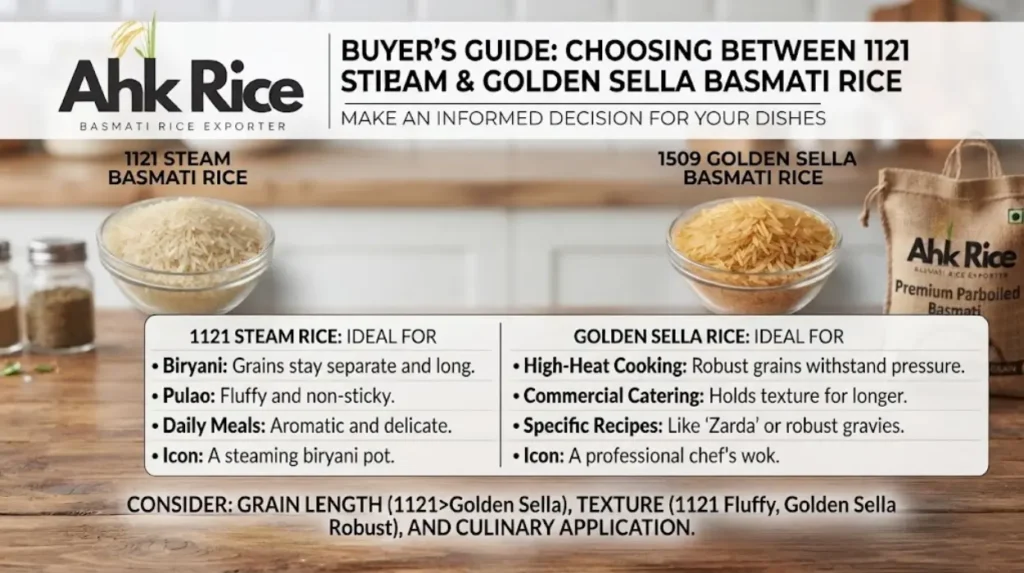
Choose 1121 Steam for aroma, white presentation, and fresh premium service; choose Golden Sella for firmness, extended holding, longer storage, and high-volume cooking. Here is why: both grades share 1121 Basmati genetics, but their processing creates different commercial performance.
A restaurant serving premium plated rice can prioritize Steam. A catering company preparing several hundred portions can prioritize Golden Sella. A distributor with long inventory cycles can also benefit from Golden Sella’s longer stated shelf-life range.
The best procurement specification therefore depends on measurable requirements. Grain length alone does not determine the correct grade.
A buyer should approve the processing method, grain length, moisture, broken percentage, appearance, packaging, shelf life, inspection requirements, and shipment terms before placing a recurring order.
AHK Rice provides Pakistani Basmati supply across 15+ countries and supports processing, packaging, quality control, documentation, and export logistics. The same specification-led approach can be applied to 1121 Steam and 1121 Golden Sella procurement.
With the grade decision established, the next step is connecting the approved specification with a direct wholesale purchasing process.
Frequently Asked Questions
Is 1121 Steam better than Golden Sella?
1121 Steam performs better for aroma, white appearance, and fresh service. Golden Sella performs better for firm texture, extended holding, bulk cooking, and longer storage.
What is the main difference between 1121 Steam and Golden Sella?
1121 Steam receives controlled steam treatment before milling. Golden Sella receives a fuller parboiling process. This changes color, firmness, texture, holding behavior, and storage performance.
Which has a longer shelf life, 1121 Steam or Golden Sella?
Golden Sella commonly has a longer stated shelf life. Commercial references place Steam around 12 months and Golden Sella around 18–24 months, subject to packaging and storage conditions.
Which grade is better for catering?
Golden Sella generally suits catering operations requiring bulk cooking, firm grains, extended holding, and repeated handling.
Which grade is better for premium restaurants?
1121 Steam suits premium restaurants that prioritize aroma, near-white appearance, softer texture, and freshly prepared service.
Which grade costs more per metric ton?
August 2026 indicative FOB Karachi pricing placed 1121 Steam at approximately $1,160–$1,200 per MT and Golden Sella at approximately $1,145–$1,185 per MT.
Do both grades have the same grain length?
Both grades originate from 1121 Basmati and commonly measure around 8.30–8.40 mm before cooking. Processing creates the larger difference in texture, color, and cooking behavior.
Can buyers compare both grades using samples?
Yes. Buyers should cook both samples using the same water ratio, cooking equipment, cooking time, and holding period. The comparison should record elongation, separation, texture, aroma, breakage, and appearance.
SEO Metadata
Primary keyword: 1121 Steam vs Golden Sella
Secondary keyword: 1121 Golden Sella vs Steam Basmati Rice
Meta title: 1121 Steam vs Golden Sella: Grade Comparison
Meta description: Compare 1121 Steam vs Golden Sella by processing, grain length, texture, shelf life, price per MT, holding performance, and market suitability.
Recommended BOFU Link Placement
Insert the BOFU article “Buy 1121 Basmati Rice Wholesale Direct from Mill” immediately after the section “How should buyers choose between 1121 Steam and Golden Sella?”
Use a natural decision-focused anchor such as “buy 1121 Basmati rice wholesale direct from the mill” in the final two paragraphs. This placement follows the consideration-to-decision journey because the reader has already compared specifications, price, shelf life, market fit, and procurement factors.