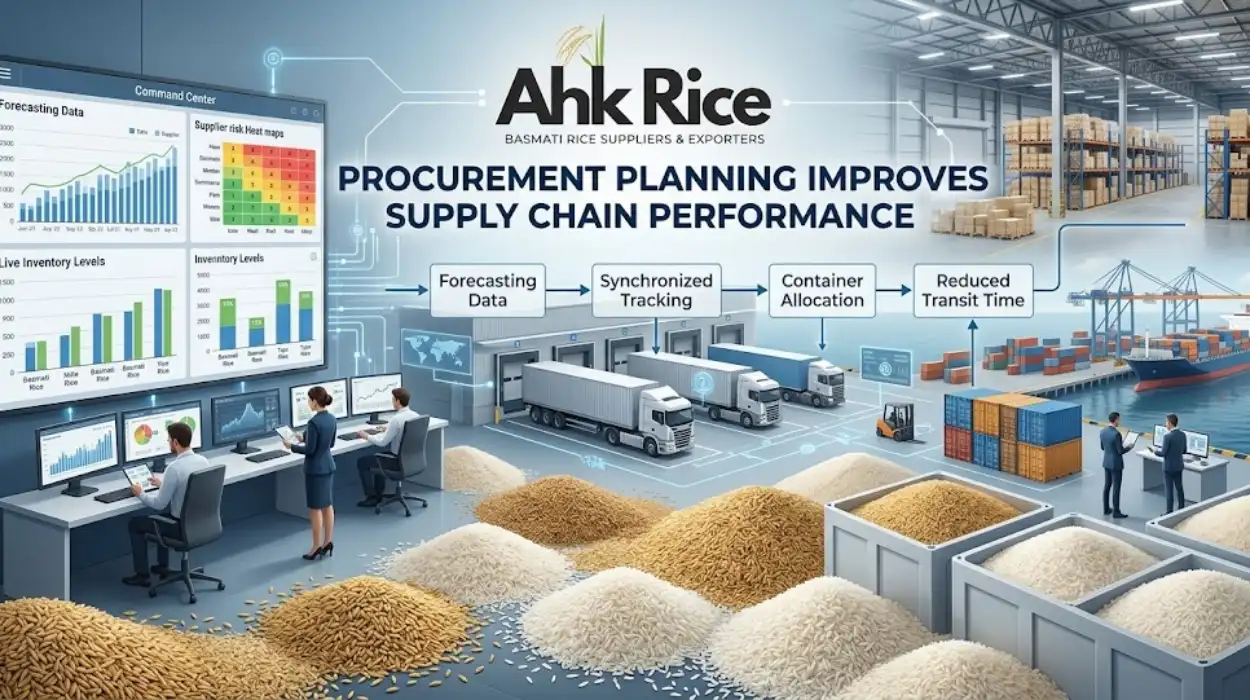
How Does Procurement Planning Improve Supply Chain Performance?
Procurement planning improves supply chain performance by converting expected rice demand into scheduled purchasing, production, quality control, inventory, shipping, and replenishment decisions. Instead of reacting to shortages or freight delays, importers establish specifications, quantities, timing, supplier capacity, and inventory buffers before operational pressure develops.
For importers evaluating Pakistani Basmati rice,
Why buyers should create procurement plans before importing rice explains the planning foundation behind specification control, quantity forecasting, supplier coordination, and shipment scheduling. Procurement planning then extends those principles into a complete supply chain performance system.
When the first product requirement is defined, Pakistani Basmati rice supply for USA buyers can be evaluated against the buyer’s target grade, packaging, quantity, destination, documentation, and delivery cycle. AHK Rice supplies 1121, Super Kernel, and 1509 varieties from Punjab and manages processing and export activities through an integrated supply model.
What are the available procurement planning solutions?
The main procurement solutions are forecast-based purchasing, scheduled replenishment, framework contracts, safety-stock planning, supplier capacity reservations, and spot purchasing. Forecast-based programs provide the strongest control when demand is recurring, while spot buying works better for irregular requirements with flexible specifications.
Procurement planning does not mean using one purchasing method for every rice order. It means matching the purchasing structure to demand frequency, inventory exposure, product specifications, supplier capacity, and delivery requirements.
Forecast-based procurement converts expected monthly or quarterly demand into planned purchase quantities. A U.S. distributor expecting to sell 60 MT per month can schedule several 20–25 MT container orders instead of waiting until warehouse inventory becomes critical.
Scheduled replenishment uses predefined reorder intervals. For example, an importer may review inventory every two weeks and release the next purchase when available stock plus confirmed inbound inventory falls below the reorder threshold.
Framework procurement establishes commercial and quality parameters for repeat purchases while allowing shipment quantities and dates to be confirmed later. This approach suits distributors that want stable specifications without receiving their entire annual requirement at once.
Safety-stock planning adds inventory above expected demand to absorb supply variation. It is particularly useful when the buyer has long ocean and inland lead times.
Spot procurement purchases rice when an immediate requirement appears. It can provide flexibility but exposes the importer to changing prices, production availability, packaging lead times, and vessel schedules.
For international rice supply, procurement planning is strongest when these methods are combined. A buyer can use annual demand forecasting, quarterly supplier planning, monthly inventory reviews, and shipment-specific purchase orders.
How do different procurement approaches compare?
Forecast-based procurement provides the best balance between cost, availability, and operational control for recurring rice demand. Spot purchasing offers flexibility but creates greater exposure to price changes and supply interruptions, while framework agreements improve continuity without requiring immediate full-volume purchasing.
| Procurement attribute | Forecast-based | Scheduled replenishment | Framework agreement | Spot purchasing |
|---|---|---|---|---|
| Demand visibility | High | High | Medium-High | Low |
| Price planning | Strong | Strong | Strong | Weak |
| Supply continuity | High | High | High | Variable |
| Inventory control | Strong | Strong | Medium-High | Reactive |
| Supplier capacity planning | Excellent | Strong | Excellent | Limited |
| Flexibility | Medium | Medium | High | Excellent |
| Best application | Recurring demand | Stable consumption | Long-term programs | Urgent or irregular needs |
The comparison shows why procurement planning improves supply chain performance beyond the purchase price. A lower spot quotation does not automatically create a lower total procurement cost if the buyer later pays for expedited freight, emergency inventory, repacking, specification changes, or lost sales.
Forecast-based purchasing also gives the supplier earlier visibility. The exporter can reserve paddy, processing capacity, packaging materials, inspection windows, and container requirements around the expected shipment program.
This becomes important in 2026 because the U.S. rice market continues to rely heavily on imports. USDA’s August 2026 Rice Outlook maintains projected 2026/27 U.S. all-rice imports at a record 49.8 million hundredweight. Long-grain imports are especially relevant to Basmati buyers because Asian aromatic varieties from Pakistan and India form an important part of the imported long-grain category.
The result is a procurement environment where availability, specification consistency, and timing must be considered alongside the quoted rice price.
Which procurement method works best for different cases?
Recurring wholesale demand benefits most from forecast-based procurement with scheduled replenishment. Private-label programs benefit from framework purchasing, while restaurants and distributors with stable inventory cycles need reorder points. Spot procurement remains suitable for small, irregular, or experimental purchases.
A large U.S. distributor with predictable monthly sales should use forecast-based procurement. Its planning model should include average daily demand, shipment quantity, lead time, safety stock, and reorder point.
For example, if a distributor sells 0.67 MT per day and plans around 45 days of replenishment exposure, baseline lead-time demand is approximately 30 MT. Adding 10 MT of safety stock produces a 40 MT reorder point. When available and committed inventory approaches that level, the next purchase should already be progressing.
An ethnic grocery importer may require several Basmati grades. Its procurement plan should separate 1121, Super Kernel, and 1509 rather than treating all Basmati as one inventory category. Each grade can have different customer demand, packaging requirements, and selling velocity.
A private-label importer benefits from framework procurement because repeat shipments must maintain the same grain appearance, cooking performance, packaging format, and documentation. A specification should be approved before the first commercial production run and retained as the reference standard for future shipments.
A restaurant group with predictable menus can use scheduled replenishment. Its purchasing team can establish a minimum stock level and release orders according to consumption rather than reacting to individual restaurant requests.
A new importer testing market demand may use spot procurement for the first shipment. This limits commitment while the buyer evaluates customer response. Once demand becomes predictable, the buyer should move toward planned replenishment.
What are the procurement advantages and disadvantages?
Planned procurement reduces stockout risk, improves supplier coordination, stabilizes specifications, and supports better working-capital control. Its main disadvantage is reduced short-term flexibility because forecasts can become inaccurate. Spot purchasing has the opposite profile: high flexibility but weaker supply, price, and inventory predictability.
The main advantage of procurement planning is supply continuity. A supplier receives demand information before the shipment becomes urgent. This creates time for production scheduling and quality verification.
The second advantage is specification consistency. A procurement plan can define grain length, broken percentage, moisture, processing type, packaging, labeling, inspection requirements, and documentation before production begins.
The third advantage is inventory optimization. Buyers can calculate cycle stock, safety stock, shipment quantity, and reorder stock separately. This prevents both excessive inventory accumulation and emergency purchasing.
The fourth advantage is logistics coordination. A Pakistani rice shipment normally passes through milling, packing, inspection, documentation, container loading, ocean transportation, port handling, customs clearance, and inland delivery. A procurement plan connects these stages to the warehouse requirement.
The disadvantage is forecast risk. If demand falls sharply, the importer can hold excess stock. If demand rises unexpectedly, the planned shipment quantity may become insufficient.
Another disadvantage is working-capital commitment. Framework programs and advance production reservations can require earlier financial commitments than spot purchases.
The solution is not to eliminate planning. It is to make the plan dynamic. Buyers should update forecasts monthly, compare actual sales with planned demand, monitor supplier performance, and adjust future shipment quantities.
How do market regions affect procurement planning?
Market-region requirements change the ideal procurement strategy because grade preferences, landed pricing, logistics exposure, and inventory cycles differ. GCC buyers commonly prioritize Sella and Golden Sella grades, while U.S. buyers use 1121 Steam, Sella, White, and Super Kernel across retail, restaurant, wholesale, and private-label channels.
GCC market: Saudi Arabia and Gulf distribution
Saudi Arabia and wider GCC markets place strong commercial value on Sella and Golden Sella Basmati because parboiling supports firm, separate grains suited to dishes such as kabsa, mandi, and biryani.
For Saudi Arabia, AHK Rice’s current July 2026 indicative pricing places 1121 Sella at approximately $1,313–$1,353 per MT CNF Jeddah or Dammam, including an indicative $178/MT freight component from Karachi.
The procurement implication is important. GCC buyers can often plan shorter ocean replenishment cycles than inland U.S. buyers. AHK Rice’s Saudi information indicates approximately 10–15 days of port transit for relevant shipments, although the contracted vessel schedule remains the controlling factor.
U.S. market: Nebraska and broader North American distribution
U.S. importers have a wider logistics exposure because the final warehouse may be far from the arrival port. A Nebraska distributor, for example, must account for ocean transit, U.S. port handling, customs clearance, and inland transportation.
Current July 2026 indicative U.S. FOB Karachi pricing places 1121 Sella around $1,135–$1,175/MT, while 1121 Steam is approximately $1,160–$1,200/MT and 1121 White approximately $1,165–$1,205/MT, before destination freight and other landed costs.
AHK Rice’s current U.S. planning information gives approximately 25–35 days door-to-door to major U.S. ports such as New York and Los Angeles, with inland Midwest delivery requiring a longer planning window. For an inland Nebraska buyer, procurement planning therefore needs more inventory protection than a buyer located close to a major gateway.
| Market region | Common grade preference | Indicative 2026 price comparison | Typical shelf-life planning | Main procurement priority |
| GCC / Saudi Arabia | 1121 Sella, Golden Sella, Steam | 1121 Sella: $1,313–$1,353/MT CNF | About 24 months when properly packed and stored | Fast replenishment and cooking consistency |
| USA / Nebraska | 1121 Sella, Steam, White, Super Kernel | 1121 Sella: $1,135–$1,175/MT FOB | About 24 months when properly packed and stored | Longer lead-time and inland inventory control |
Shelf life is commonly planned at approximately 24 months from packaging when rice is stored in suitable cool, dry conditions, but the contractual shelf-life statement must follow the actual product specification and packaging.
The price comparison also demonstrates why FOB and CNF figures should not be treated as equivalent. The U.S. figures above are FOB Karachi, while the Saudi figures are CNF destination-port indications. Freight, insurance, customs, port handling, duties, inland transportation, and other landed costs must be evaluated separately.
What decision factors should buyers use?
Buyers should evaluate procurement methods against five factors: demand predictability, specification stability, lead time, working-capital exposure, and supplier capacity. The strongest procurement decision is the method that protects product availability while keeping inventory and financial commitments aligned with actual sales requirements.
| Decision factor | What the buyer should evaluate | Best planning response |
| Demand predictability | Monthly sales history and forecast accuracy | Forecast-based purchasing |
| Specification stability | Grade, grain length, processing, moisture, broken ratio, packaging | Framework specifications |
| Lead time | Production, inspection, ocean transit, clearance, inland delivery | Safety stock and reorder points |
| Working capital | Cash committed before inventory is sold | Staged replenishment |
| Supplier capacity | Ability to process, pack, inspect, and load required volume | Capacity reservation |
The first factor is demand predictability. Buyers with stable consumption should commit to planned replenishment. Buyers with uncertain demand should use smaller purchase cycles until sales data becomes reliable.
The second is specification stability. A recurring Basmati program should not renegotiate the basic quality definition for every shipment. The specification should become a controlled procurement document.
The third is lead time. Procurement lead time is more than ocean transit. It includes production, packing, inspection, documentation, vessel booking, port handling, customs clearance, and inland delivery.
The fourth is working capital. Importers should compare the cost of carrying extra stock with the cost of a potential stockout. The optimal safety stock is the amount required to protect service levels without unnecessarily tying up cash.
The fifth is supplier capacity. Procurement planning is effective only when the supplier can execute the required volume. A buyer planning 100 MT during a peak period should confirm that the exporter can process, grade, pack, inspect, and load that volume within the required window.
AHK Rice operates an integrated processing and export facility in Punjab, managing activities from paddy procurement through processing and container loading. Its product range includes 1121, Super Kernel, and 1509 Basmati varieties for international buyers.
How should procurement planning be implemented in a rice supply chain?
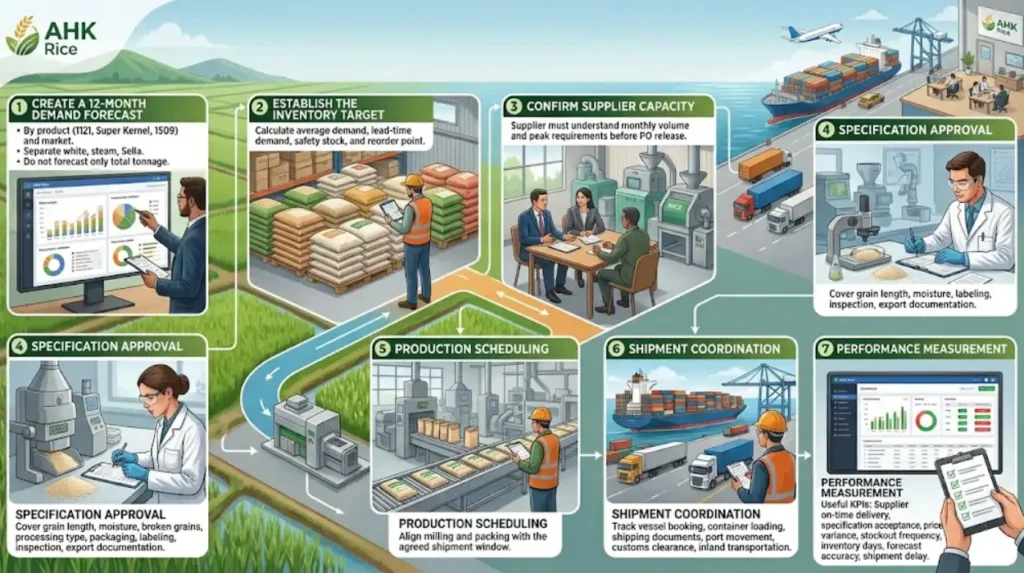
A practical rice procurement plan should begin with demand forecasting, convert forecasts into grade-level quantities, establish reorder points, confirm supplier capacity, approve specifications, schedule production, coordinate logistics, and measure actual delivery performance against the original plan.
The first step is to create a 12-month demand forecast by product and market. Do not forecast only total rice tonnage. Separate 1121, Super Kernel, and 1509, then separate white, steam, Sella, or other contracted processing grades where applicable.
The second step is to establish the inventory target. Calculate average demand, lead-time demand, safety stock, and reorder point.
The third step is to confirm supplier capacity. The supplier should understand the expected monthly volume and peak requirements before the purchase order is released.
The fourth step is specification approval. Product specifications should cover grain length, moisture, broken grains, processing type, packaging, labeling, inspection, and required export documentation.
The fifth step is production scheduling. The exporter aligns milling and packing with the agreed shipment window.
The sixth step is shipment coordination. Buyers should track vessel booking, container loading, shipping documents, port movement, customs clearance, and inland transportation.
The seventh step is performance measurement. Useful procurement KPIs include supplier on-time delivery, specification acceptance rate, purchase-price variance, stockout frequency, inventory days, forecast accuracy, and shipment delay frequency.
This approach turns procurement from a purchasing activity into a supply-chain control system. The buyer can see whether a problem originates in demand forecasting, supplier production, quality release, logistics, documentation, or warehouse planning.
Why does procurement planning improve overall supply chain performance?
Procurement planning improves supply chain performance because every purchasing decision becomes connected to demand, inventory, production, quality, logistics, cash flow, and customer service. The importer gains earlier visibility, fewer emergency purchases, stronger supplier coordination, and more consistent product availability.
The most effective procurement model is not necessarily the one with the lowest quoted price. It is the model that produces the required rice specification at the required time and quantity while controlling inventory and landed cost.
For a Nebraska importer, this distinction is especially important because the supply chain extends beyond the Pakistani export point. A purchase plan must connect Punjab production with Karachi loading, international transportation, U.S. entry, inland movement, and warehouse receiving.
For GCC importers, faster port access can support shorter replenishment cycles, but demand for Sella and Golden Sella still requires grade-level planning. For U.S. buyers, longer inland logistics increase the value of safety stock, shipment visibility, and early reorder triggers.
The strongest 2026 procurement strategy therefore combines forecasting, specification control, supplier capacity planning, inventory thresholds, scheduled replenishment, and shipment tracking. It gives the importer a repeatable process instead of a sequence of emergency purchasing decisions.
AHK Rice’s integrated Pakistan-origin supply model demonstrates how procurement can connect sourcing, processing, quality control, packaging, export documentation, and shipment coordination into one commercial workflow.
Frequently Asked Questions
How does procurement planning improve rice supply chain performance?
Procurement planning connects demand forecasting, purchasing, inventory, production, quality control, logistics, and delivery schedules. This reduces stockouts, emergency purchases, shipment delays, and inconsistent product availability.
What are the main rice procurement planning methods?
The main methods include forecast-based purchasing, scheduled replenishment, framework agreements, safety-stock planning, and spot purchasing. The best method depends on demand predictability, inventory requirements, lead time, and supplier capacity.
Why is demand forecasting important for rice procurement?
Demand forecasting helps importers estimate how much rice they need by variety, grade, packaging format, and delivery period. This allows suppliers to prepare production and shipment capacity before inventory becomes critical.
Which procurement method is best for regular rice demand?
Forecast-based procurement with scheduled replenishment works best for regular demand. It allows importers to establish reorder points, maintain safety stock, and coordinate recurring shipments with supplier production capacity.
How should rice importers calculate safety stock?
Importers should consider average demand, supplier lead time, shipment variability, customs clearance, inland transportation, and desired service levels. Safety stock should protect against normal supply variation without creating excessive inventory.
How do procurement plans improve supplier performance?
A procurement plan gives suppliers earlier visibility of expected volumes, specifications, packaging requirements, inspection windows, and shipment dates. This supports better production scheduling and reduces last-minute changes.
What rice specifications should be included in a procurement plan?
A rice procurement specification can include variety, grain length, processing type, broken percentage, moisture, purity, packaging size, labeling requirements, inspection standards, and required export documentation.