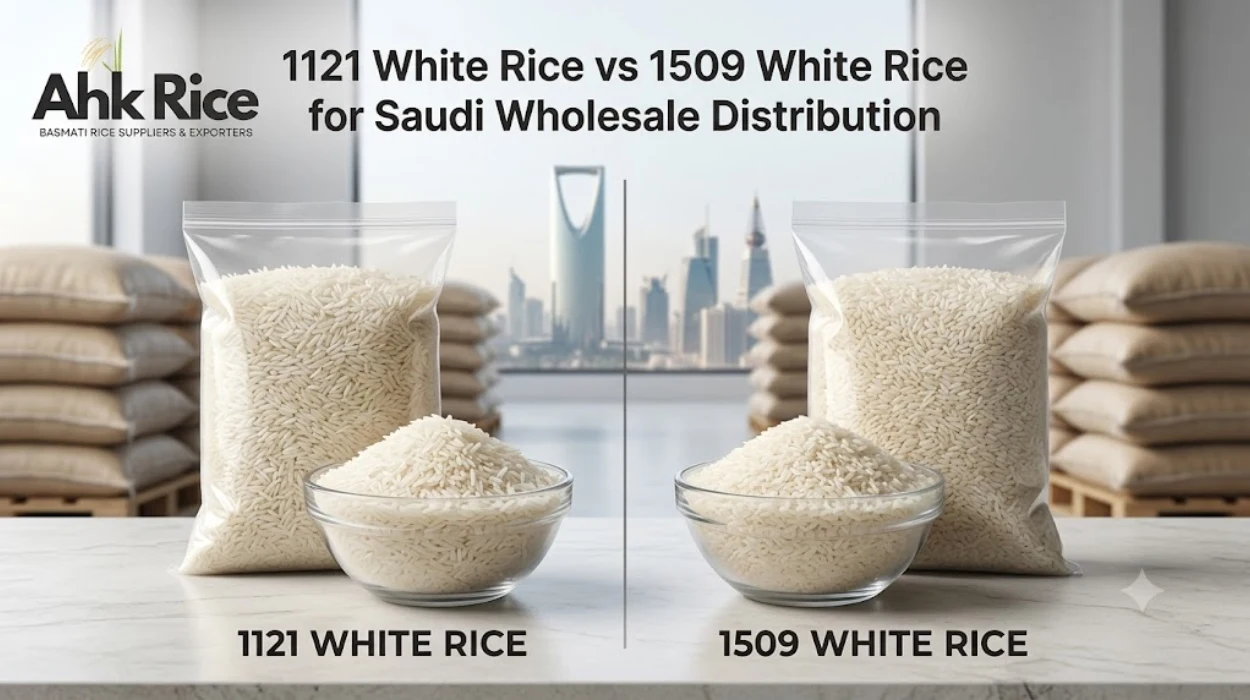
1121 White Rice vs 1509 White Rice for Saudi Wholesale Distribution
Saudi wholesale distributors generally achieve better portfolio coverage with 1121 White Rice for premium retail and foodservice channels, while 1509 White Rice delivers stronger value in price-sensitive distribution networks. The best choice depends on target customers, import budgets, shelf-life requirements, and market positioning across Saudi Arabia’s diverse rice consumption segments.
Saudi Arabia remains one of the largest import destinations for Pakistani Basmati rice in 2026. Importers, wholesalers, and distribution companies increasingly evaluate rice varieties based on grain length, cooking performance, shelf stability, consumer preference, and landed cost rather than variety name alone.
For distributors evaluating Pakistani Basmati options, understanding the specifications that influence buying decisions is essential. A detailed review of Saudi buyer requirements can be explored in our guide on understanding the quality standards Saudi rice importers prioritize when sourcing Pakistani Basmati rice.
Among the most widely traded Pakistani varieties, 1121 White Rice and 1509 White Rice dominate wholesale inquiries. Both belong to the Basmati family but serve different commercial objectives. As a Pakistani Basmati rice exporter, AHK Rice processes and exports both varieties through complete sourcing, milling, packaging, and export management operations for international wholesale markets.
What are the main differences between 1121 White Rice and 1509 White Rice for Saudi wholesale distribution?
1121 White Rice offers superior grain length, stronger premium positioning, and higher retail appeal, while 1509 White Rice provides faster crop availability, lower procurement costs, and efficient volume distribution. Both varieties satisfy Saudi market demand, but they target different buyer segments and pricing strategies.
Before comparing commercial suitability, it is important to define both rice varieties.
1121 White Rice is a premium extra-long grain Pakistani Basmati variety known for exceptional cooked grain elongation. It has become a benchmark product for premium retail shelves, hospitality chains, catering businesses, and luxury foodservice operations throughout the Gulf region.
1509 White Rice is a newer-generation Basmati variety developed to deliver high yields, earlier maturity, and competitive pricing. It offers excellent cooking performance while maintaining many traditional Basmati characteristics valued by importers.
1121 White Rice vs 1509 White Rice Specifications
| Attribute | 1121 White Rice | 1509 White Rice |
|---|---|---|
| Average Grain Length | 8.30–8.50 mm | 8.00–8.30 mm |
| Cooked Grain Length | Up to 20–22 mm | Up to 18–20 mm |
| Aroma Intensity | Strong Basmati aroma | Moderate Basmati aroma |
| Market Position | Premium | Mid-premium |
| Crop Maturity | Longer duration | Earlier maturity |
| Export Price Level | Higher | Lower |
| Wholesale Demand Segment | Premium retail & hospitality | Mass retail & distribution |
The most visible difference is grain elongation after cooking. Saudi consumers traditionally associate longer cooked grains with premium quality. This preference gives 1121 a strong advantage in premium market categories.
However, 1509 remains attractive because it provides a favorable balance between appearance, performance, and procurement cost.
What solutions are available for Saudi wholesale distributors?
Saudi distributors typically choose between premium-focused distribution, value-focused distribution, or mixed portfolio distribution. Each solution aligns with specific consumer demographics, regional purchasing power, retail channel requirements, and foodservice demand patterns throughout the Kingdom’s expanding rice market.
Three common sourcing approaches dominate the Saudi wholesale rice sector.
Solution 1: Premium Distribution with 1121 White Rice
This model targets:
- Premium supermarkets
- Specialty food retailers
- Hospitality groups
- Hotel chains
- Corporate catering companies
The objective is maximum consumer appeal and premium shelf positioning.
Long grain appearance and superior elongation justify higher selling prices while maintaining strong consumer perception.
Solution 2: Value Distribution with 1509 White Rice
This model focuses on:
- Volume wholesalers
- Traditional retail networks
- Price-sensitive consumers
- Regional distributors
The emphasis is affordability while maintaining recognizable Basmati characteristics.
Solution 3: Dual Portfolio Distribution
Many successful Saudi importers utilize both varieties.
1121 serves premium channels.
1509 supports volume-driven channels.
This approach reduces market concentration risk while expanding customer reach.
How do 1121 and 1509 perform across different Saudi market regions?
Regional purchasing behavior significantly influences variety selection. Higher-income urban markets consistently favor premium grain characteristics, while price-sensitive regions prioritize value, stable supply, and competitive retail pricing without sacrificing acceptable cooking performance and appearance standards.
Saudi Arabia does not operate as a single consumer market.
Different regions display different purchasing preferences.
Western Region (Jeddah, Makkah, Madinah)
Grade Preference: Premium
Preferred Variety: 1121 White Rice
Consumers in western Saudi Arabia often purchase premium Basmati products for family consumption, hospitality, and religious tourism-related foodservice businesses.
The visual appeal of extra-long cooked grains strongly influences buying decisions.
Central Region (Riyadh)
Grade Preference: Premium to Mid-Premium
Preferred Variety: Mixed
Riyadh distributors commonly maintain both varieties.
Premium retailers frequently stock 1121.
High-volume distribution networks often combine 1121 and 1509 offerings.
Eastern Region (Dammam, Khobar, Jubail)
Grade Preference: Mid-Premium
Preferred Variety: 1509 White Rice
Industrial workforce populations and large-scale catering operations often prioritize competitive pricing and consistent availability.
1509 performs strongly in these channels.
Southern Region
Grade Preference: Value-Oriented
Preferred Variety: 1509 White Rice
Price competitiveness becomes a more significant factor compared to premium grain elongation.
How does the price per metric ton compare in 2026?
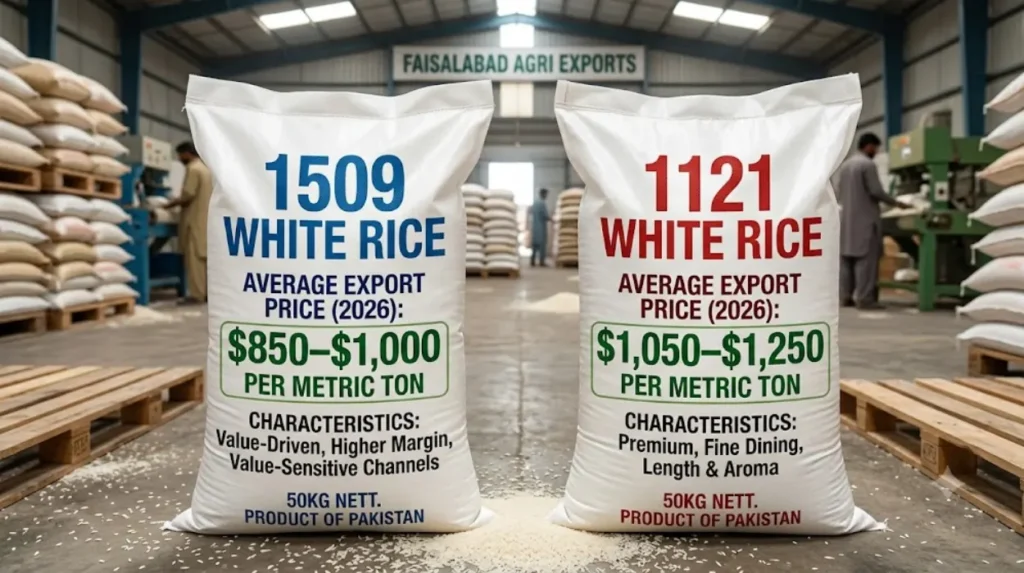
1509 White Rice consistently maintains a lower export price per metric ton than 1121 White Rice. The pricing difference creates opportunities for wholesalers seeking higher margins, broader market penetration, and stronger competitiveness in value-driven distribution channels.
Average export pricing in 2026 varies based on:
- Crop quality
- Milling specifications
- Broken percentage
- Packaging requirements
- Freight conditions
- Contract volume
Typical Export Price Comparison (2026)
| Rice Variety | Average Export Price Range (USD/MT) |
| 1509 White Rice | $850–$1,000 |
| 1121 White Rice | $1,050–$1,250 |
The price gap often ranges between $150 and $300 per metric ton.
For distributors importing thousands of metric tons annually, this difference significantly affects procurement budgets and inventory planning.
How does shelf life compare between 1121 and 1509 White Rice?
Both varieties offer excellent storage stability when processed and packaged correctly. Shelf-life differences are minimal, making packaging quality, moisture control, storage conditions, and logistics management more important than varietal selection alone.
Properly milled and packaged Basmati rice maintains quality for extended periods.
Shelf-Life Comparison
| Factor | 1121 White Rice | 1509 White Rice |
| Standard Shelf Life | 24 months | 24 months |
| Recommended Storage Moisture | Below 14% | Below 14% |
| Aroma Retention | Excellent | Very Good |
| Storage Stability | Excellent | Excellent |
| Export Suitability | Excellent | Excellent |
For Saudi distribution environments, warehouse temperature control and packaging integrity influence product longevity more than variety choice.
What are the pros and cons of each variety?
Both varieties offer clear commercial advantages. 1121 dominates premium positioning and visual appeal, while 1509 delivers cost efficiency and faster market turnover. Understanding these strengths and limitations enables distributors to align inventory with customer expectations.
1121 White Rice
Advantages
- Premium market recognition
- Exceptional grain elongation
- Strong Basmati aroma
- Higher retail positioning
- Strong hospitality demand
Limitations
- Higher procurement cost
- Larger working capital requirement
- Narrower appeal in budget-focused channels
Example
A Riyadh premium supermarket chain may prioritize 1121 because consumers actively compare grain appearance before purchasing.
1509 White Rice
Advantages
- Lower acquisition cost
- Strong volume potential
- Competitive retail pricing
- Faster inventory movement
- Broad distributor accessibility
Limitations
- Slightly shorter grain length
- Lower premium perception
- Less differentiation in luxury retail channels
Example
A regional wholesaler supplying independent grocery stores may achieve better volume growth using 1509 because retail prices remain highly competitive.
Which method works best for different wholesale distribution cases?
The most effective choice depends on target customers, sales channels, procurement strategy, and positioning objectives. Premium brands benefit from 1121, while cost-focused distribution models often generate stronger returns using 1509 or a blended portfolio strategy.
Decision Framework
| Decision Factor | Best Choice |
| Premium Retail Brand | 1121 White Rice |
| Luxury Hospitality Supply | 1121 White Rice |
| Mass Retail Distribution | 1509 White Rice |
| Budget-Conscious Consumer Base | 1509 White Rice |
| Multi-Channel Distribution Network | Combination of Both |
Distributors managing multiple customer categories often achieve optimal results by carrying both products.
Distributors that have finalized their preferred variety often move to supplier evaluation. Reviewing factors involved in selecting a reliable Pakistani rice export partner can help streamline sourcing decisions.
What should Saudi distributors consider before making a final sourcing decision?
Successful procurement decisions balance product specifications, market demand, pricing objectives, inventory strategy, and long-term growth plans. Distributors that align rice variety selection with customer expectations consistently achieve stronger market performance and sustainable profitability.
Five factors should guide final variety selection:
- Customer purchasing behavior.
- Regional market positioning.
- Target retail pricing.
- Inventory turnover goals.
- Procurement budget.
1121 White Rice remains the preferred option when premium presentation and consumer perception drive sales.
1509 White Rice remains the preferred option when affordability and volume growth are primary objectives.
For many Saudi wholesalers, maintaining both varieties creates the most resilient sourcing strategy. It enables distributors to serve premium retailers, traditional trade networks, foodservice operators, and regional resellers through a single procurement framework while adapting to changing market conditions throughout 2026.
Conclusion
1121 White Rice and 1509 White Rice both play important roles in Saudi wholesale distribution. 1121 leads premium retail, hospitality, and high-end consumer segments because of its exceptional grain length and strong market perception. 1509 delivers greater pricing flexibility and volume potential, making it highly effective for broad distribution networks and value-oriented retail channels.
The most successful distributors evaluate customer expectations first and select the variety that aligns with their commercial objectives. In many cases, a dual-variety sourcing strategy provides the strongest combination of profitability, market coverage, and long-term growth potential.
Frequently Asked Questions
Is 1121 White Rice better than 1509 White Rice for Saudi distributors?
1121 White Rice is better for premium retail stores, hospitality businesses, and high-end foodservice channels because of its extra-long grain length and superior cooked grain elongation. However, 1509 White Rice is often a better option for distributors targeting value-conscious customers and large-volume sales.
Why is 1121 White Rice more expensive than 1509 White Rice?
1121 White Rice commands a higher price because it offers longer grains, stronger market recognition, excellent cooking performance, and premium consumer appeal. These characteristics increase demand across Saudi Arabia’s premium rice segments and support higher export prices.
Which rice variety has higher demand in Saudi Arabia in 2026?
Both varieties have strong demand, but they serve different markets. 1121 White Rice is preferred in premium retail and hospitality sectors, while 1509 White Rice is widely used by wholesalers, distributors, and foodservice operators looking for competitive pricing and reliable quality.
Do 1121 and 1509 White Rice have the same shelf life?
Yes. Both varieties typically offer a shelf life of up to 24 months when stored under proper conditions. Maintaining low moisture levels, using quality packaging, and storing rice in a cool, dry environment are the key factors that preserve quality during distribution.
Should Saudi wholesalers import both 1121 and 1509 White Rice?
Many wholesalers benefit from importing both varieties. A dual-product strategy allows distributors to serve premium customers with 1121 White Rice while meeting the needs of price-sensitive buyers through 1509 White Rice. This approach expands market coverage and reduces dependence on a single customer segment.