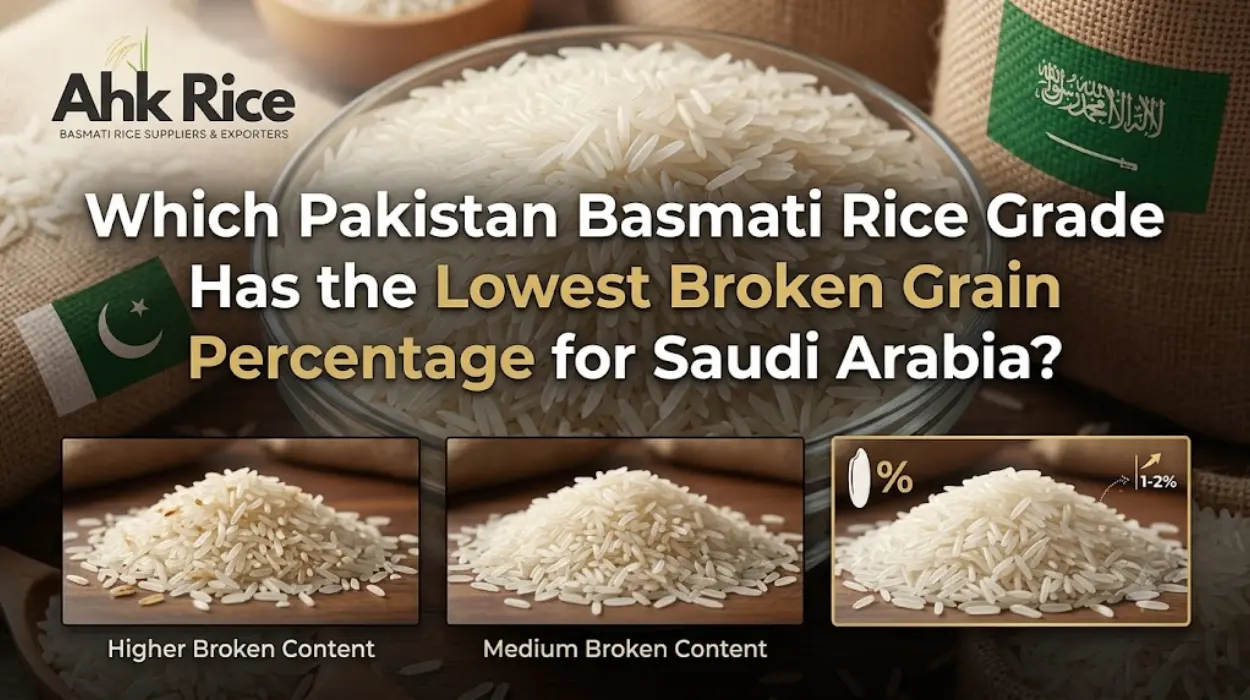
Which Pakistan Basmati Rice Grade Has the Lowest Broken Grain Percentage for Saudi Arabia?
1121 Steam Basmati Rice and 1121 White Basmati Rice consistently deliver the lowest broken grain percentage for Saudi Arabian importers, with premium export specifications reaching below 1% broken grains. Here is why: advanced length grading, optical colour sorting, controlled milling, and strict export inspection preserve grain integrity better than standard commercial grades.
Saudi Arabian buyers evaluate Basmati rice on grain length, cooking performance, broken grain percentage, shelf life, and consistency. Broken grain percentage directly affects visual appearance, cooking uniformity, retail value, and customer satisfaction. Importers sourcing for supermarkets, premium retail brands, hospitality groups, and catering companies therefore prioritize grades with the highest grain integrity.
Understanding how grain integrity is maintained begins with learning the export preservation process. Buyers comparing specifications should first understand how exporters protect grain structure during storage, milling, and shipping.
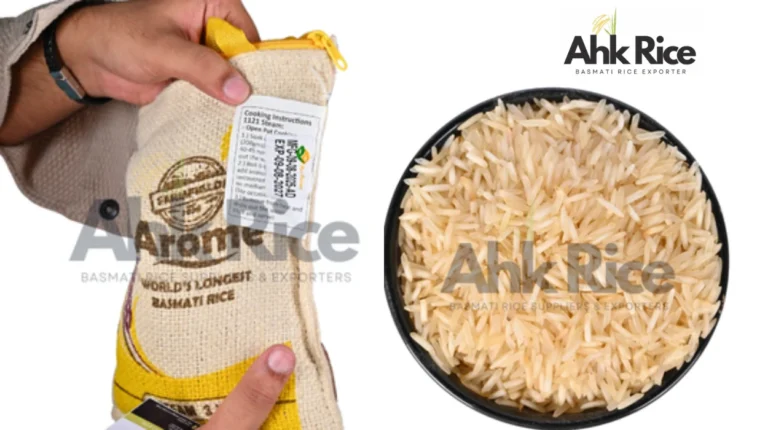
AHK Rice supplies premium Pakistani Basmati varieties to Saudi Arabia and other international markets. The company’s [service page link placement] should be inserted on the first mention of premium export-grade Basmati rice solutions for Saudi buyers. AHK Rice processes 1121, Super Kernel, and 1509 varieties through controlled milling, grading, sorting, testing, packaging, and export documentation systems.
What Does Broken Grain Percentage Mean in Basmati Rice Exports?
Broken grain percentage measures the proportion of rice kernels that are shorter than full-length grains after milling. Premium Saudi specifications require below 2% broken grains, while the highest-value import contracts target below 1% broken grains.
Broken grain percentage represents one of the most important quality indicators in international rice trade. A broken grain is any kernel that loses part of its original length during milling, handling, loading, or transportation.
Saudi importers monitor broken grain levels because appearance strongly influences consumer perception. Long, uniform grains command higher prices than mixed lots containing visible broken kernels.
Export-grade Basmati undergoes multiple processing stages to reduce breakage. Millers clean paddy, dehusk grain, polish kernels, grade by length, sort defects, inspect quality, and package rice under controlled conditions.
The lowest broken percentages generally result from modern milling systems that minimize mechanical stress. Advanced optical sorting systems remove damaged kernels before export packing.
Saudi supermarkets typically require premium visual presentation. Premium hospitality suppliers require even stricter specifications because cooked presentation influences customer satisfaction.
With the importance of broken grain percentage established, the next question is which Pakistani Basmati grades deliver the best results.
Which Pakistan Basmati Rice Grades Have the Lowest Broken Grain Percentage?
1121 Steam Basmati and 1121 White Basmati achieve the lowest broken grain percentages, typically ranging from 0.5% to 1.5%, while premium 1121 Golden Sella follows closely with 1% to 2% broken grains.
1121 White Basmati Rice
1121 White Basmati Rice is produced through conventional milling and polishing without parboiling. The grain remains exceptionally long and slender.
Premium export specifications commonly achieve 0.5%–1% broken grains. Saudi retail brands often select this grade for premium shelf placement.
1121 White Basmati delivers strong visual appeal because the grain maintains a bright appearance and uniform structure.
1121 Steam Basmati Rice
1121 Steam Basmati Rice undergoes controlled steaming before milling. This process strengthens the grain structure while preserving its natural colour.
Premium exporters routinely achieve 0.5%–1.5% broken grains.
Steam processing improves grain durability during transportation. Saudi importers serving supermarkets frequently choose this specification because it combines appearance, cooking quality, and transport stability.
1121 Golden Sella Basmati Rice
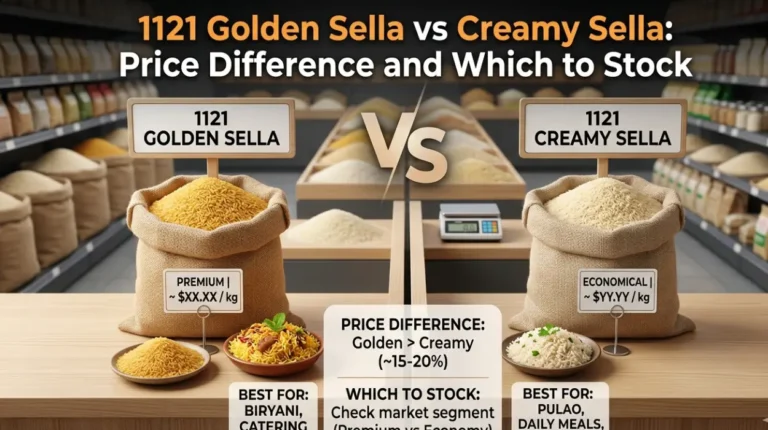
1121 Golden Sella undergoes parboiling before milling. The process increases grain strength and extends shelf life.
Premium export specifications generally maintain 1%–2% broken grains.
Golden Sella dominates foodservice sectors because it performs well under bulk cooking conditions.
Super Kernel Basmati Rice
Super Kernel remains one of Pakistan’s traditional premium varieties.
Export specifications commonly range between 1%–3% broken grains depending on milling quality.
Saudi specialty retailers continue importing Super Kernel because of its aroma and consumer recognition.
1509 Basmati Rice
1509 Basmati offers a shorter cultivation cycle and competitive pricing.
Premium specifications typically achieve 1%–3% broken grains.
Saudi value-oriented importers often select 1509 when balancing quality and budget requirements.
Specification Comparison Table
| Attribute | 1121 White | 1121 Steam | 1121 Golden Sella | Super Kernel | 1509 Basmati |
|---|---|---|---|---|---|
| Broken Grain % | 0.5–1% | 0.5–1.5% | 1–2% | 1–3% | 1–3% |
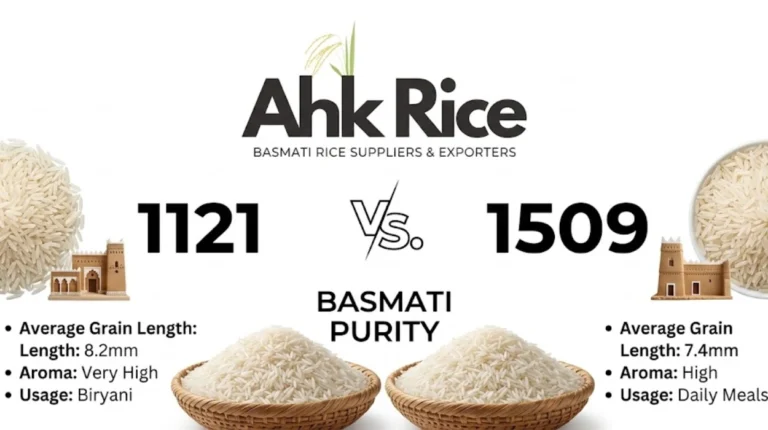
| Grain Length | 8.3–8.5 mm | 8.3–8.5 mm | 8.3–8.5 mm | 7.2–7.8 mm | 8.0–8.3 mm |
| Cooking Elongation | 2x–2.3x | 2x–2.3x | 2.2x–2.5x | 1.8x–2x | 2x–2.2x |
| Colour | White | Creamy White | Golden | White | White |
| Shelf Life | 12–18 months | 18 months | 18–24 months | 12 months | 12–18 months |
| Saudi Market Demand | High | Very High | Very High | Moderate | Growing |
| Premium Retail Suitability | Excellent | Excellent | Good | Good | Good |
These grade comparisons provide the foundation for evaluating regional buying preferences across Saudi Arabia.
How Do Saudi Arabian Buyers Compare Different Basmati Grades?
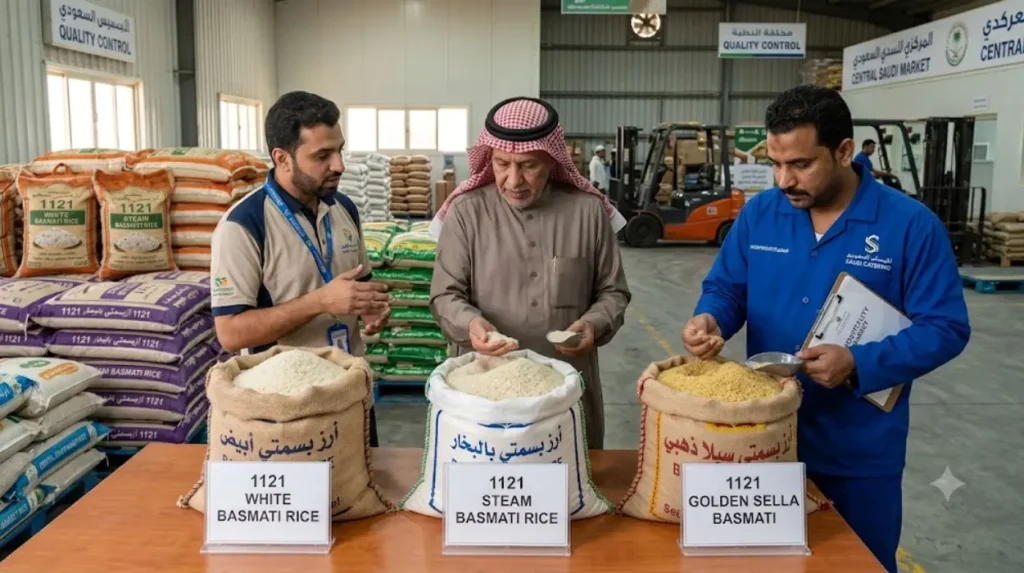
Saudi retail buyers prefer 1121 White and 1121 Steam, while Saudi catering and hospitality buyers primarily select 1121 Golden Sella because of durability, shelf life, and cooking performance.
Central Saudi Arabia Retail Market
Major supermarket distributors prioritize appearance and packaging quality.
1121 White Basmati remains highly popular because consumers associate bright white grains with premium quality.
1121 Steam Basmati continues gaining market share because stronger grains reduce breakage during logistics and shelf handling.
Premium retail importers commonly target broken grain levels below 1.5%.
Western Saudi Arabia Hospitality Market
Hotels, restaurants, and catering suppliers focus on cooking consistency.
1121 Golden Sella dominates institutional purchasing because parboiling improves grain stability during bulk preparation.
Golden Sella lasts longer than Steam. In a high-temperature warehouse environment, Golden Sella maintains quality for up to 24 months, while Steam performs best within 18 months. Hospitality operators benefit from longer storage flexibility.
Saudi catering companies prioritize yield after cooking. Golden Sella typically delivers stronger grain separation than White rice during large-scale food preparation.
Regional demand differences help buyers identify the best grade. The next comparison focuses on price and value.
How Do Price and Value Compare Between Low-Broken Basmati Grades?
1121 White commands the highest premium, 1121 Steam offers the strongest value-to-quality ratio, and 1121 Golden Sella provides the best balance of durability and long-term storage performance.
Export pricing varies according to crop quality, milling standards, freight conditions, and market demand.
Price Comparison Per Metric Ton
| Grade | Typical Export Price Range (USD/MT) |
|---|---|
| 1121 White | $1,250–1,450 |
| 1121 Steam | $1,150–1,350 |
| 1121 Golden Sella | $1,050–1,250 |
| Super Kernel | $950–1,150 |
| 1509 Basmati | $900–1,100 |
Premium 1121 White earns the highest price because visual appearance drives consumer demand.
1121 Steam often provides better overall value. Buyers receive premium grain length and low breakage without paying the highest market premium.
Golden Sella costs less than White grades while delivering superior durability during storage and transportation.
Price alone does not determine the correct choice. Decision factors create the final purchasing framework.
Which Basmati Grade Works Best for Different Saudi Import Scenarios?
The best grade depends on the business model. Retail brands benefit from 1121 White or Steam, while catering operations achieve better performance with 1121 Golden Sella.
Decision Framework for Saudi Importers
| Buyer Type | Primary Goal | Recommended Grade | Broken % Target | Reason |
|---|---|---|---|---|
| Premium Retail Brand | Shelf appearance | 1121 White | <1% | Maximum visual appeal |
| Supermarket Chain | Value and consistency | 1121 Steam | <1.5% | Strong balance of quality and cost |
| Hospitality Supplier | Bulk cooking | 1121 Golden Sella | <2% | Excellent cooking durability |
| Private Label Importer | Brand flexibility | 1121 Steam | <1.5% | Reliable quality control |
| Foodservice Distributor | Storage efficiency | 1121 Golden Sella | <2% | Longer shelf life |
Pros of 1121 White
- Premium appearance
- Lowest broken percentage
- Strong consumer perception
- High retail positioning
Cons of 1121 White
- Highest acquisition cost
- More sensitive during handling
Pros of 1121 Steam
- Excellent grain integrity
- Competitive pricing
- Strong export durability
- Broad Saudi market acceptance
Cons of 1121 Steam
- Slightly shorter shelf life than Golden Sella
Pros of 1121 Golden Sella
- Long shelf life
- Strong cooking stability
- Better storage performance
- Lower cost than White grades
Cons of 1121 Golden Sella
- Golden colour does not match every retail preference
These decision factors identify the optimal specification for different procurement objectives.
What Is the Best Low-Broken Basmati Rice Choice for Saudi Arabia in 2026?
1121 Steam Basmati provides the strongest overall combination of low broken grain percentage, competitive pricing, export durability, and Saudi market acceptance in 2026.
1121 White achieves the absolute lowest broken grain levels and remains the preferred option for premium retail brands.
1121 Steam delivers nearly identical grain integrity while reducing procurement costs and improving logistics performance.
1121 Golden Sella remains the leading choice for hospitality and catering sectors because parboiled grains withstand storage and large-scale cooking more effectively.
Saudi importers evaluating broken grain percentage should prioritize verified milling specifications, grading standards, inspection reports, and export quality certifications. Grain integrity depends on processing quality as much as rice variety selection.
Buyers ready to evaluate suppliers and secure premium grain integrity specifications should continue to the BOFU article importing premium Pakistani long-grain Basmati with verified grain integrity standards.
Frequently Asked Questions
What is considered a low broken grain percentage in Pakistani Basmati rice exports?
A low broken grain percentage is typically below 2% for export-grade Basmati rice. Premium specifications for Saudi Arabia often require 0.5% to 1.5% broken grains, especially for retail and branded packaging programs.
Which Pakistani Basmati rice grade has the lowest broken grain percentage?
1121 White Basmati Rice generally has the lowest broken grain percentage, often ranging from 0.5% to 1%. Premium 1121 Steam Basmati follows closely and is widely preferred because it combines low breakage with strong transport durability.
Why do Saudi importers prefer low broken grain Basmati rice?
Saudi importers prefer low broken grain rice because it improves shelf appearance, cooking consistency, and consumer satisfaction. Uniform grains also increase product value and strengthen premium brand positioning in retail stores.
Does broken grain percentage affect the export price of Basmati rice?
Yes. Lower broken grain percentages usually increase export value because more whole grains remain after milling. Premium grades such as 1121 White and 1121 Steam command higher prices than grades with higher breakage levels.
Which Basmati grade is best for Saudi catering and hospitality businesses?
1121 Golden Sella Basmati Rice is often the preferred choice for catering companies, restaurants, and hotels. The parboiling process strengthens the grain, extends shelf life, and helps maintain grain separation during large-scale cooking operations.