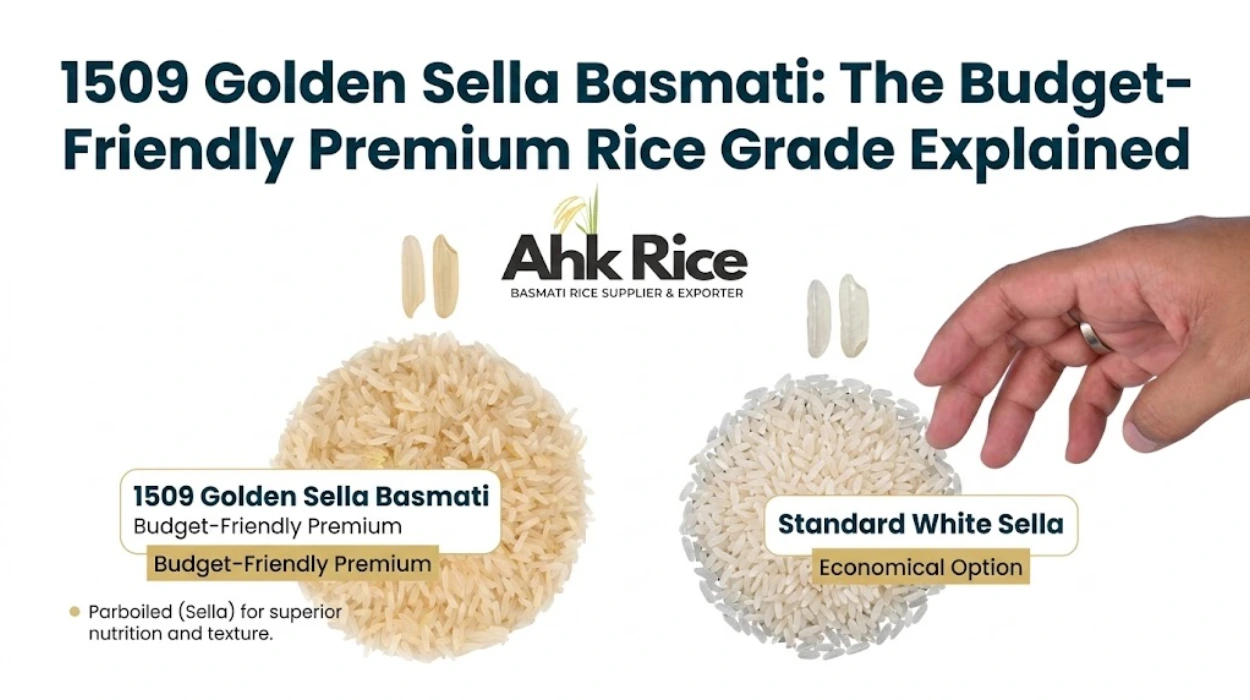
1509 Golden Sella Basmati: The Budget-Friendly Premium Rice Grade Explained
1509 Golden Sella Basmati is a long-grain, parboiled rice variety that delivers premium cooking performance at a lower export price. Here is why: it combines 7.4–7.8 mm grain length, non-sticky texture, and high volume expansion, while costing 15–25% less than 1121 Golden Sella in bulk trade markets.
What is 1509 Golden Sella Basmati?
1509 Golden Sella Basmati is a parboiled long-grain rice variety grown in Punjab, Pakistan and India, defined by medium-long grain length, golden color, and firm cooked texture.
1509 Golden Sella Basmati belongs to the basmati family, which means it retains aroma, elongation, and separate grain structure after cooking. The term “1509” identifies the cultivar, developed for early maturity and higher yield per acre. Farmers harvest this variety in shorter cycles, which increases supply and reduces export price volatility.
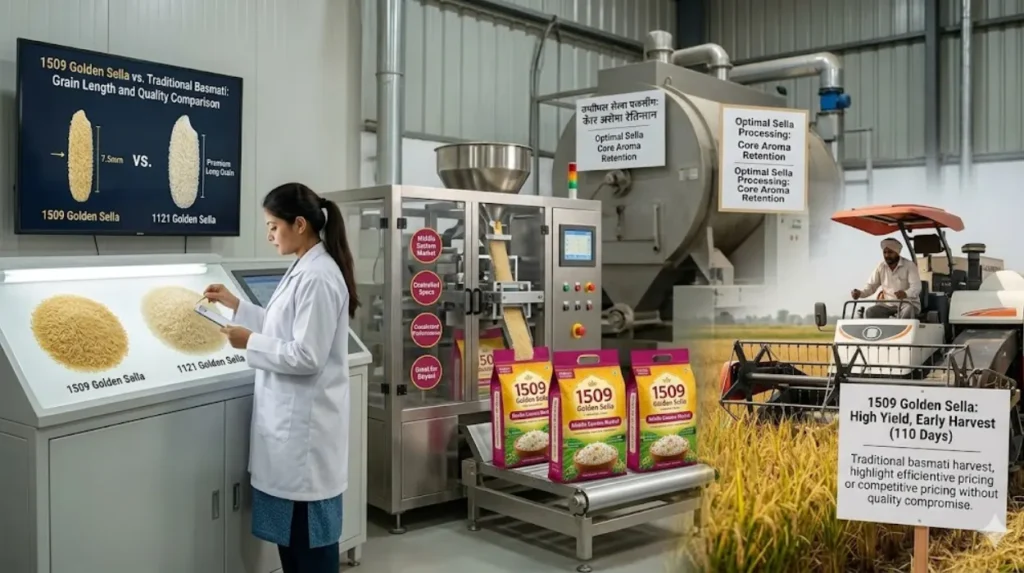
Golden Sella refers to the parboiling method. Millers soak, steam, and dry the paddy before milling. This process moves nutrients from husk to kernel and creates the golden color. The result is a grain that resists breakage during milling and maintains structure during cooking.
1509 Golden Sella serves as a cost-efficient alternative to longer-grain basmati varieties such as 1121. Buyers who need visual appeal and performance without premium pricing select this grade. Examples include bulk catering companies in the Gulf, retail distributors in Africa, and institutional buyers in Central Asia.
With the definition established, the next question is how this parboiling process actually works.
How does 1509 Golden Sella Basmati processing work?
1509 Golden Sella processing uses 9 controlled steps to transform raw paddy into durable, golden-colored rice with improved cooking stability.
Step-by-step processing method
- Clean the paddy to remove dust, stones, and impurities
- Soak the paddy in water at 60–70°C for 6–8 hours
- Steam the soaked paddy under controlled pressure
- Dry the paddy to 12–14% moisture content
- De-husk the grain to remove outer husk
- Polish the kernel to improve surface texture
- Grade the rice by length and thickness
- Sort the grains using optical color sorters
- Pack the rice in export-grade packaging
Each step directly affects the final quality. Soaking hydrates the grain uniformly. Steaming gelatinizes the starch, which strengthens the grain structure. Drying stabilizes the kernel for milling. Milling and polishing improve visual quality, while grading ensures uniformity across shipments.
Parboiling changes the internal structure of the rice. The starch becomes firm and less prone to breakage. This structural change increases head rice yield during milling. Exporters achieve higher whole grain percentages, which improves trade value.
In high-temperature markets such as the UAE or Saudi Arabia, Golden Sella performs better than raw rice. It resists spoilage and maintains quality for 18–24 months in non-climate-controlled storage.
With the process defined, the next question is which components determine quality.
What are the key components of 1509 Golden Sella Basmati quality?
1509 Golden Sella quality depends on grain length, moisture level, purity percentage, color consistency, and broken ratio, each measured with defined export standards.
Grain specifications
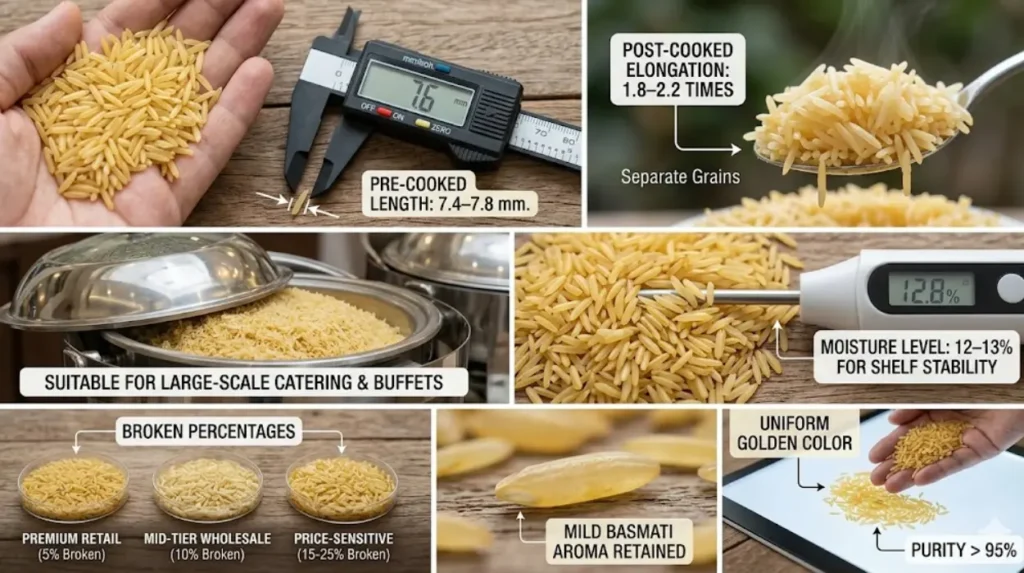
Grain length defines classification. 1509 Golden Sella measures 7.4–7.8 mm before cooking. After cooking, it elongates by 1.8–2.2 times. This elongation creates a premium plate presentation.
Moisture content
Moisture determines shelf stability. Export-grade 1509 Golden Sella maintains 12–13% moisture. Higher moisture increases spoilage risk during shipping.
Broken percentage
Broken grains reduce value. Standard export grades include:
- 5% broken – premium retail packs
- 10% broken – mid-tier wholesale
- 15–25% broken – price-sensitive markets
Color consistency
Golden Sella must show uniform yellow color. Uneven color indicates poor parboiling control. Buyers inspect color under daylight conditions before approving shipments.
Purity and foreign matter
Purity level must exceed 95–98%. Foreign matter such as stones or husk must remain below 0.5%. Optical sorters and graders ensure compliance.
Aroma and cooking behavior
1509 Golden Sella retains mild basmati aroma. It cooks into separate grains without stickiness. This characteristic suits large-scale cooking operations such as buffet catering.
Each component directly influences pricing. Buyers compare these values when sourcing rice across suppliers and origins.
With quality components clear, the next question is what benefits this grade offers.
What benefits does 1509 Golden Sella Basmati provide?
1509 Golden Sella delivers lower cost, strong grain structure, long shelf life, and consistent cooking results, making it suitable for large-volume consumption markets.
Cost efficiency
1509 Golden Sella costs $50–$150 per metric ton less than 1121 Golden Sella (source: REAP export data, December 2025). This price gap allows importers to maintain margins in competitive retail markets.
Cooking stability
Parboiled grains remain separate after cooking. This stability supports large batch cooking. Restaurants and catering services achieve consistent results across multiple servings.
Storage durability
Golden Sella resists moisture absorption. In hot climates, it maintains quality longer than raw or steam rice. In a 40°C warehouse, Golden Sella lasts 18–24 months, while steam rice requires consumption within 12 months.
Higher milling yield
Parboiling strengthens the grain. Mills achieve higher head rice recovery rates. Exporters gain more sellable whole grains from each batch.
Versatility across cuisines
1509 Golden Sella adapts to multiple cooking styles. Examples include:
- Biryani preparation in Pakistan
- Pilaf dishes in the Middle East
- Plain boiled rice in African markets
These benefits explain why this grade is widely traded across price-sensitive regions.
To understand where these benefits apply, the next question focuses on use cases.
Where is 1509 Golden Sella Basmati commonly used?
1509 Golden Sella is used in bulk catering, retail packaging, and institutional food supply chains across Asia, Africa, and the Middle East.
Bulk catering operations
Catering companies use this grade for large-scale meal production. The rice maintains structure during extended cooking times. This reliability reduces food waste.
Retail distribution
Retailers pack 1509 Golden Sella in 5 kg, 10 kg, and 25 kg bags. Consumers prefer it for affordability and consistent cooking results. In African markets, it serves as a staple household rice.
Institutional buyers
Government food programs and NGOs procure this grade due to cost efficiency. The rice meets nutritional needs while staying within budget constraints.
Export markets
Major import regions include:
- Gulf countries such as UAE and Saudi Arabia
- West African countries such as Nigeria and Senegal
- Central Asian countries such as Uzbekistan and Kazakhstan
Pakistan exported over 4.5 million tons of rice in FY2024–25, with parboiled varieties forming a significant share (source: Pakistan Bureau of Statistics, FY2024–25).
For buyers comparing grades, understanding price differences becomes critical. For a detailed comparison, read how 1509 compares with higher-grade varieties in this analysis of price gaps between similar basmati types.
With use cases explained, the next question addresses common misconceptions.
What are the common problems or misconceptions about 1509 Golden Sella?
1509 Golden Sella is often misunderstood as low quality, but it actually offers controlled specifications and consistent performance, with differences based on grain length and price positioning.
Misconception 1: Lower price means poor quality
Lower price reflects higher yield and faster cultivation cycles. Farmers harvest 1509 earlier than traditional basmati. This efficiency reduces cost without reducing essential cooking performance.
Misconception 2: Shorter grain equals inferior product
1509 grains measure slightly shorter than 1121, but still fall within premium basmati range. A 7.5 mm grain remains classified as long grain in international trade standards.
Misconception 3: Golden Sella lacks aroma
Parboiling reduces surface aroma slightly, but retains core basmati fragrance. Cooking methods such as soaking and controlled boiling enhance aroma release.
Misconception 4: All Golden Sella grades are identical
Quality varies by processing control and grading accuracy. Differences appear in broken percentage, color uniformity, and moisture levels. Buyers must inspect specifications before purchase.
Misconception 5: Suitable only for low-end markets
1509 Golden Sella serves both mid-tier and value-premium segments. In Gulf retail chains, it competes directly with higher-priced basmati when packaged and branded correctly.
Understanding these misconceptions helps buyers make accurate sourcing decisions.
With misconceptions clarified, the overall understanding of 1509 Golden Sella becomes complete.
Frequently Asked Questions
What is the average price of 1509 Golden Sella Basmati?
1509 Golden Sella Basmati trades between $850–$1050 per metric ton depending on broken percentage, crop season, and destination port. Prices remain lower than 1121 due to higher yield and wider supply availability.
How does 1509 Golden Sella differ from Steam Basmati?
1509 Golden Sella undergoes parboiling, which gives it a golden color and firmer texture. Steam Basmati skips parboiling, resulting in a whiter grain with softer cooking texture and shorter shelf life.
Which countries import 1509 Golden Sella the most?
Major importers include Saudi Arabia, UAE, Yemen, Nigeria, and Senegal. These markets demand affordable long-grain rice for bulk consumption and retail distribution.
What is the cooking ratio for 1509 Golden Sella rice?
1509 Golden Sella requires a 1:2 rice-to-water ratio. Soak the rice for 20–30 minutes before cooking to achieve longer grain elongation and better texture.
How long can 1509 Golden Sella be stored?
1509 Golden Sella maintains quality for 18–24 months when stored below 25°C with controlled humidity. Parboiling improves resistance to moisture and insect infestation.