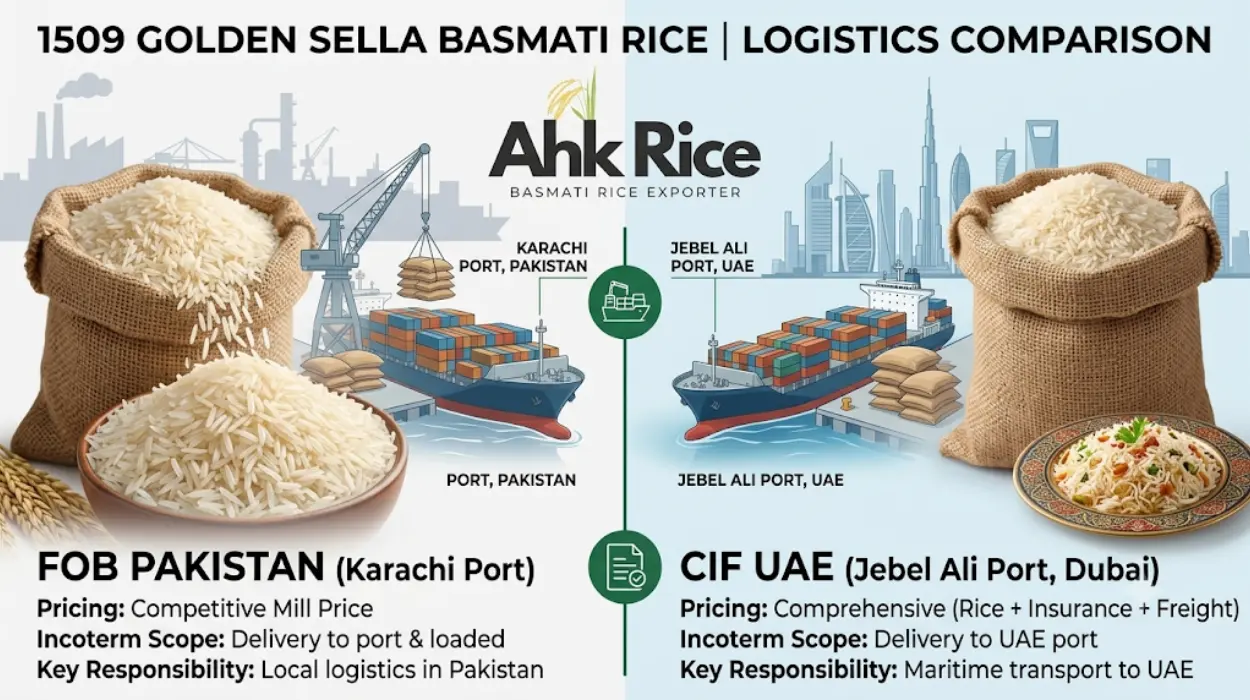
1509 Golden Sella Basmati Rice FOB Pakistan vs CIF UAE: Which Pricing Model Saves More
FOB Pakistan saves more money for experienced importers, while CIF UAE reduces operational risk for buyers seeking predictable landed costs. Here is why: FOB provides freight flexibility and lower procurement costs, while CIF includes shipping and insurance, simplifying import planning and budgeting.
1509 Golden Sella Basmati Rice remains one of Pakistan’s most exported long-grain aromatic rice varieties. The variety offers high grain yield, excellent cooking performance, and strong resistance to breakage during transport. Importers evaluating procurement options often compare FOB Pakistan and CIF UAE pricing models before placing container orders. Buyers seeking a deeper understanding of processing, grading, and export specifications can first explore our guide how Pakistani exporters process and grade premium Golden Sella rice for international markets.
AHK Rice supplies 1509 Golden Sella Basmati Rice from Punjab, Pakistan. The company mills, grades, sorts, inspects, and exports rice to more than fifteen countries. Buyers commonly request FOB and CIF quotations because both pricing structures serve different procurement objectives. Understanding the differences prevents unexpected logistics expenses and improves purchasing decisions.
What Are the Available Pricing Solutions for 1509 Golden Sella Basmati Rice?
The two practical procurement solutions are FOB Pakistan and CIF UAE. FOB offers maximum freight control, while CIF provides complete landed-cost visibility before shipment departure.
International rice trade relies on Incoterms. These rules define responsibility between exporters and importers.
FOB Pakistan Pricing Model
FOB stands for Free on Board. The exporter loads cargo onto the vessel at the designated Pakistani port. Responsibility transfers once cargo is loaded.
Under FOB pricing, the exporter handles:
- Milling and processing
- Export documentation
- Quality inspection
- Inland transportation
- Port handling
- Vessel loading
The importer handles:
- Ocean freight
- Marine insurance
- UAE customs clearance
- Local transportation
- Destination charges
FOB benefits buyers who already negotiate competitive freight contracts. Large distributors often reduce overall costs through freight consolidation.
CIF UAE Pricing Model
CIF stands for Cost, Insurance, and Freight. The exporter includes shipping and insurance costs within the quoted price.
Under CIF pricing, the exporter handles:
- Product supply
- Export documentation
- Ocean freight booking
- Marine insurance
- Vessel loading
The importer handles:
- UAE customs duties
- Port clearance
- Local delivery
CIF simplifies budgeting because buyers know transportation expenses before shipment departure.
FOB and CIF address different procurement objectives. The next section compares both models using measurable specifications.
How Do FOB Pakistan and CIF UAE Compare?
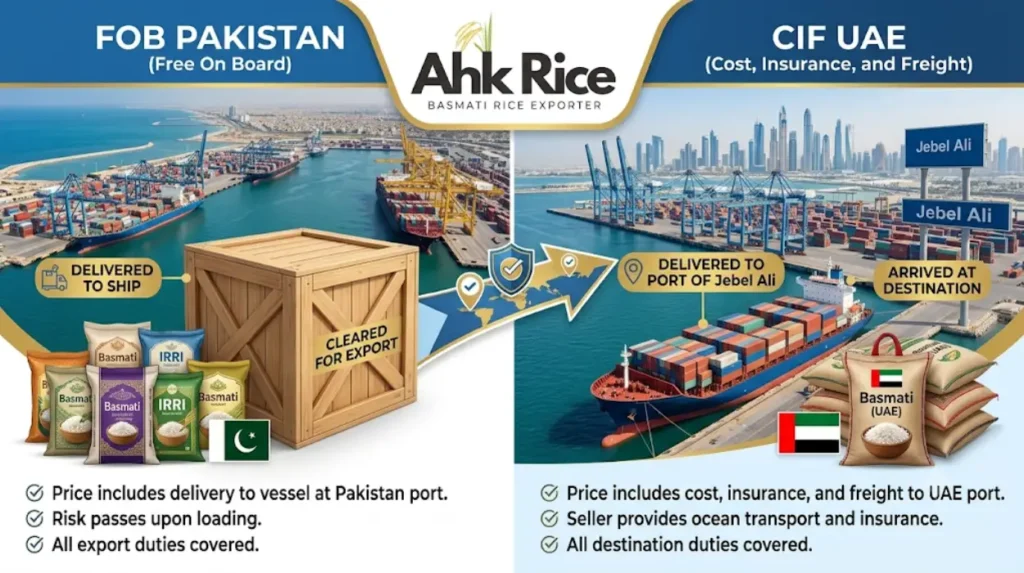
FOB delivers lower procurement costs and greater freight flexibility. CIF delivers simpler logistics management and better cost predictability for first-time importers.
Specification Comparison Table
| Attribute | FOB Pakistan | CIF UAE |
|---|---|---|
| Product Cost per MT | Lower | Higher |
| Freight Included | No | Yes |
| Marine Insurance | No | Yes |
| Freight Negotiation Control | Full | Limited |
| Landed Cost Visibility | Medium | High |
| Logistics Complexity | Higher | Lower |
| Suitable Buyer Type | Experienced Importers | New Importers |
Price Per MT Comparison
Market conditions determine final freight costs. Recent market averages show the following structure:
| Cost Element | FOB Pakistan | CIF UAE |
|---|---|---|
| Rice Value | $1,050–$1,180/MT | Included |
| Freight | Separate | Included |
| Insurance | Separate | Included |
| Typical Landed Cost UAE | $1,120–$1,280/MT | $1,180–$1,320/MT |
Prices vary according to vessel availability, fuel surcharges, and seasonal demand (source: REAP export data, December 2025).
FOB frequently produces lower landed costs for importers managing multiple containers. CIF frequently delivers predictable budgeting for buyers importing one to five containers.
Logistics Control Comparison
FOB allows direct carrier selection. Buyers negotiate shipping schedules and transit routes independently.
CIF allows exporters to arrange transportation. Buyers spend less time coordinating freight operations.
FOB creates flexibility. CIF creates convenience. The choice depends on procurement priorities rather than product quality.
With pricing differences established, the next question concerns market-specific buying preferences.
Which Pricing Model Works Best in Different Markets?
Middle Eastern distributors often prefer FOB for volume purchases, while African and emerging-market importers frequently select CIF for operational simplicity.
UAE and Gulf Cooperation Council Markets
UAE buyers import substantial volumes of Pakistani Basmati rice. Large distributors often maintain relationships with freight forwarders and shipping lines.
Preferred grades include:
- 1509 Golden Sella Premium
- 1509 Golden Sella Extra Long Grain
- 1509 Golden Sella Double Sortex
These buyers usually select FOB because freight contracts reduce transportation expenses.
Saudi Arabian wholesalers follow similar procurement practices. Large tenders frequently request FOB quotations because freight negotiations occur separately.
East African Markets
East African importers commonly purchase:
- 1509 Golden Sella Standard
- 1509 Golden Sella Sortex
- 1509 Golden Sella Economic Grades
Many buyers choose CIF because logistics infrastructure varies by destination. CIF quotations simplify cost calculations before procurement approval.
Market Grade Preferences
| Region | Preferred Grade | Typical Pricing Preference |
|---|---|---|
| UAE | Double Sortex | FOB |
| Saudi Arabia | Premium Long Grain | FOB |
| Oman | Sortex | FOB |
| Kenya | Standard Sortex | CIF |
| Tanzania | Standard Grade | CIF |
| Mozambique | Economic Grade | CIF |
Regional purchasing behavior highlights practical differences between both pricing models. The next comparison focuses on storage performance and shelf life.
How Do Shelf Life and Storage Costs Compare?
Both pricing models deliver the same rice quality, but faster logistics cycles often reduce storage expenses and inventory risk.
1509 Golden Sella Basmati Rice undergoes parboiling before milling. This process strengthens grain structure and improves shelf stability.
Shelf Life Comparison
| Attribute | 1509 Golden Sella Rice |
|---|---|
| Recommended Shelf Life | 18–24 Months |
| Storage Temperature | Below 25°C |
| Moisture Level | 12–13% |
| Packaging Options | 5kg–50kg |
| Container Type | 20ft and 40ft |
Golden Sella lasts longer than many white rice categories. In UAE warehouses exceeding 40°C, properly packed Golden Sella commonly maintains quality for eighteen months.
Golden Sella resists breakage better than standard white rice. In humid coastal environments, properly sealed packaging preserves aroma and grain integrity.
Golden Sella performs consistently during long-distance transport. For distributors maintaining inventory turnover above ninety days, Golden Sella remains a preferred specification.
Storage characteristics remain identical under FOB and CIF contracts. Logistics efficiency becomes the deciding factor.
With product durability covered, buyers can now evaluate practical advantages and disadvantages.
What Are the Pros and Cons of FOB and CIF Pricing?
FOB maximizes purchasing control and cost optimization. CIF minimizes administrative workload and shipping uncertainty.
FOB Pakistan Advantages
- Lower initial quotation
- Greater carrier flexibility
- Better freight negotiation opportunities
- Easier multi-supplier consolidation
- Higher cost efficiency at scale
FOB Pakistan Disadvantages
- Additional logistics management
- Separate insurance arrangements
- Variable freight pricing
- Increased coordination requirements
CIF UAE Advantages
- Single quotation structure
- Freight included
- Insurance included
- Easier budgeting
- Reduced logistics workload
CIF UAE Disadvantages
- Higher quoted price
- Limited freight control
- Less carrier flexibility
- Reduced negotiation opportunities
Example Scenario
A distributor importing ten containers annually often benefits from FOB procurement because freight contracts lower shipping costs.
A new importer purchasing one container benefits from CIF procurement because budgeting becomes simpler and documentation coordination decreases.
Understanding benefits and limitations creates context for final purchasing decisions.
What Decision Factors Should Buyers Evaluate Before Choosing?
Freight volume, logistics expertise, procurement frequency, cash flow planning, and supply chain control determine the most suitable pricing model.
Decision Framework
| Decision Factor | FOB Recommended | CIF Recommended |
|---|---|---|
| Annual Volume | Above 20 Containers | Below 20 Containers |
| Freight Experience | High | Limited |
| Cost Optimization Priority | High | Medium |
| Budget Predictability | Medium | High |
| Internal Logistics Team | Available | Limited |
Procurement Checklist
Before selecting FOB:
- Evaluate freight contracts
- Compare carrier rates
- Verify insurance providers
- Confirm destination charges
- Calculate landed costs
Before selecting CIF:
- Verify freight inclusions
- Confirm insurance coverage
- Review transit times
- Check destination exclusions
- Compare landed cost estimates
Buyers focusing on operational efficiency generally prefer CIF. Buyers focusing on cost optimization generally prefer FOB.
The evaluation process naturally leads to obtaining comparable supplier quotations and landed-cost calculations.
FOB Pakistan saves more money for experienced importers managing freight independently. CIF UAE provides stronger budgeting certainty and operational simplicity. The correct choice depends on shipment volume, logistics capabilities, and procurement objectives. Buyers comparing supplier quotations should also review our detailed guide on evaluating export offers and landed-cost comparisons before final supplier selection.
Is FOB cheaper than CIF for 1509 Golden Sella Basmati Rice?
Yes. FOB quotations are usually lower because freight and insurance remain separate. Experienced importers often achieve lower total landed costs through independent freight negotiations.
Why do UAE importers frequently choose FOB pricing?
Large UAE distributors manage regular container shipments. Existing freight agreements often reduce transportation expenses and improve scheduling flexibility.
Does CIF include customs clearance in the UAE?
No. CIF includes product cost, freight, and marine insurance. UAE customs clearance, duties, and inland transportation remain the importer’s responsibility.
Which pricing model is better for first-time rice importers?
CIF usually suits first-time importers because shipping arrangements and insurance remain included within the supplier quotation.
Does FOB affect rice quality?
No. FOB and CIF only define logistics responsibilities. Rice specifications, grading standards, moisture levels, and quality parameters remain identical.
What is the typical shelf life of 1509 Golden Sella Basmati Rice?
Properly stored 1509 Golden Sella Basmati Rice maintains quality for approximately 18–24 months.