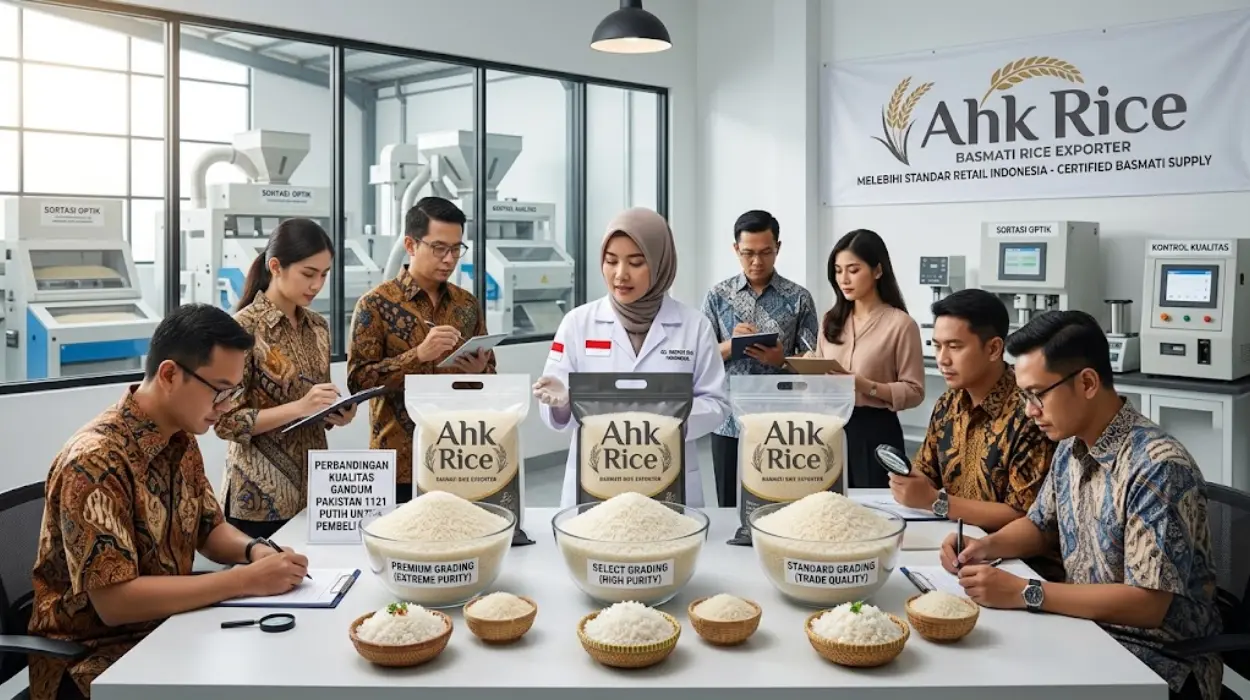
How Do Indonesian Grocery Buyers Compare Pakistan 1121 White Rice Grades?
Indonesian grocery buyers should compare Pakistan 1121 White Rice by grain length, broken percentage, moisture, polishing, aroma, cooking performance, shelf life, and landed cost rather than choosing a grade by variety name alone. 1121 White sits in the premium imported-rice segment because its extra-long grain creates strong shelf presentation and cooked elongation. Commercial specifications commonly place 1121 raw grain around 8.0–8.4 mm, with broken rice commonly specified at 2% or below and moisture around 13% maximum.
Indonesian retailers also need to distinguish between variety and processing grade. 1121 is the rice variety, while White, Steam, and Sella describe how the grain is processed. White 1121 is milled and polished without parboiling, producing a clean white appearance and conventional Basmati cooking profile. Steam 1121 receives controlled steaming before milling, while Sella is parboiled for stronger grain structure and storage performance. Buyers comparing these grades should first understand the wider Indonesian market context covered in this guide to Pakistan 1121, 1509 and Super Kernel for Indonesian retailers.
For grocery distributors, the most practical comparison is therefore between 1121 White specifications, alternative 1121 processing methods, and competing Pakistani varieties. The right selection depends on retail positioning, inventory turnover, consumer expectations, and the price per metric ton.
What are the available solutions for Indonesian grocery buyers?
Indonesian grocery buyers have four practical options: 1121 White for clean premium retail presentation, 1121 Steam for stronger grain integrity, 1121 Sella for extended storage, and lower-cost 1509 or Super Kernel when price or aroma matters more than maximum grain length.
1121 White Basmati
1121 White is the most direct option when the retailer wants a premium white Basmati product. The grain is milled, polished, graded, and sorted to produce a uniform appearance.
The main commercial advantage is presentation. An average grain length around 8.0–8.3 mm gives 1121 White a visible premium characteristic before cooking. After cooking, the grain can elongate substantially while remaining separate.
This grade suits premium grocery shelves, private-label products, specialty food stores, and distributors serving consumers who recognize extra-long Basmati rice.
1121 Steam
1121 Steam is lightly steamed before final milling. This processing method strengthens the grain and improves resistance to breakage during cooking.
The grain remains close to white or light cream in appearance. Published specifications place moisture around 13% maximum, broken grains around 2% maximum, and raw grain length around 8.3 mm.
For Indonesian grocery buyers, Steam can be useful when consumers want premium Basmati appearance but the retailer also needs reliable cooking performance.
1121 Sella
1121 Sella is a parboiled version. Parboiling changes the kernel structure and produces a firmer cooked grain.
Golden Sella develops a deeper golden color, while Creamy Sella has a lighter appearance. These grades are especially relevant where storage duration and grain strength are more important than a conventional white-rice appearance.
1509 and Super Kernel
1509 provides another long-grain Basmati option at a more cost-oriented position. Super Kernel provides strong traditional Basmati aroma with a shorter grain than 1121.
Indonesian retail guidance places 1121 in premium positioning, 1509 in value-premium distribution, and Super Kernel in an aroma-led premium segment.
How do different Pakistan 1121 grades compare?
1121 White provides the strongest conventional premium appearance, 1121 Steam improves grain integrity and cooking consistency, while 1121 Sella prioritizes firmness and storage performance; the best grade depends on retail positioning and inventory turnover.
| Specification | 1121 White | 1121 Steam | 1121 Sella |
|---|---|---|---|
| Processing | Milled and polished | Lightly steamed, then milled | Parboiled, then milled |
| Raw grain length | About 8.0–8.3 mm | About 8.2–8.4 mm | About 8.2–8.4 mm |
| Broken target | Up to 2% | Up to 2% | Up to 2% |
| Moisture target | About 13% max | About 13% max | About 13% max |
| Cooked texture | Soft, fluffy, separate | Firmer, separate | Firm, non-sticky |
| Appearance | White | White to light cream | Creamy or golden |
| Main retail use | Premium grocery | Premium retail and foodservice | Long-storage retail and foodservice |
Specifications vary according to the buyer’s contracted specification. Published Pakistani export references show 1121 grades commonly specified around 8.0–8.4 mm average grain length, 13% moisture maximum, and low broken percentages.
The important point is that a retailer should not compare only grain length. A 1121 White shipment with higher breakage can perform worse commercially than a slightly different specification with stronger sorting and quality control.
How should Indonesian grocery buyers compare price per MT?
1121 White generally commands a premium because of its extra-long grain and retail positioning, while 1121 Sella can offer a lower FOB position; buyers should compare identical specifications, quantities, packaging, crop year, and Incoterms before judging price.
Current published Pakistan export references place 1121 Basmati White around US$1,165–1,205 per MT FOB Karachi, while 1121 Sella is listed around US$1,135–1,175 per MT. These are indicative export benchmarks rather than fixed Indonesian landed prices.
A buyer comparing two offers should therefore calculate:
Landed cost = FOB rice price + ocean freight + insurance + port charges + customs and clearance costs + inland transportation.
For example, a US$40 per MT difference across a 50 MT purchase creates a US$2,000 product-cost difference before freight and local distribution expenses.
Packaging also changes the comparison. A 5 kg private-label retail pack carries different packaging and handling costs from a 25 kg or 50 kg wholesale bag.
For Indonesian grocery distributors, price per MT should therefore be treated as a procurement variable rather than the final decision.
How do two Indonesian market regions differ in grade preference?
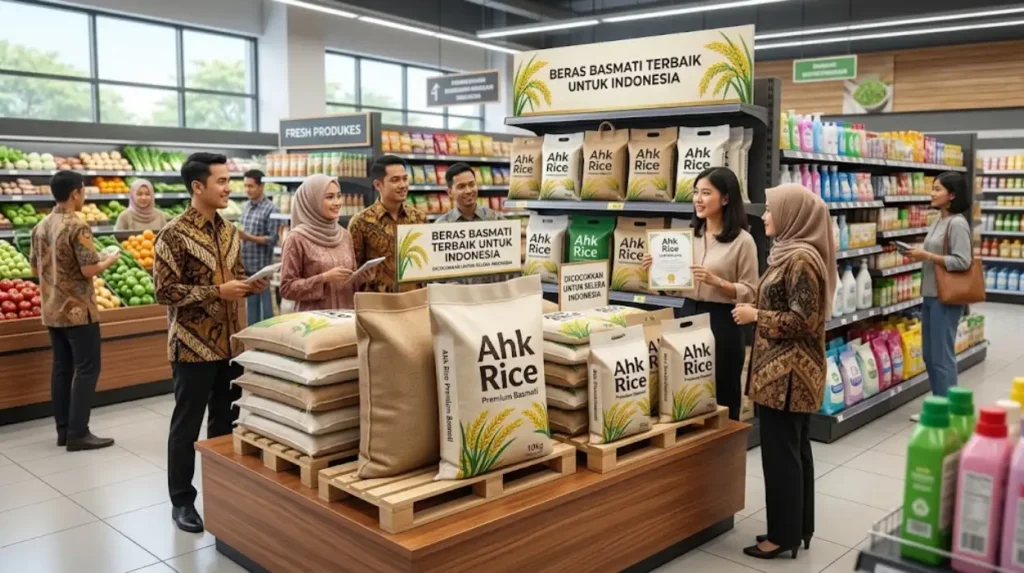
Western Indonesia generally supports higher-value 1121 White and Steam positioning in premium grocery and modern retail, while Eastern Indonesian distribution can place greater emphasis on price efficiency, storage performance, and grades that support longer inventory cycles.
Western Indonesia
Major commercial centers and premium retail channels can support imported Basmati products positioned around grain appearance, aroma, packaging, and premium cooking performance.
1121 White works well when the retailer wants a clean white grain and premium shelf presentation. 1121 Steam provides an alternative where cooking consistency and grain strength are more important.
Premium private-label products can use 1121 when the extra-long grain becomes part of the product’s value proposition.
Eastern Indonesia
Distributors operating longer supply routes must manage inventory and logistics more carefully. Product selection therefore needs to consider storage duration as well as purchase price.
1121 Sella becomes useful where firmer grains and longer storage planning are important. 1509 Steam can also provide a lower procurement position while retaining long-grain characteristics.
The commercial distinction is not absolute. Retailers should use their actual sales velocity, warehouse conditions, and customer profile to determine the correct grade.
How does shelf life affect the comparison?
Shelf life depends on moisture, processing, packaging, warehouse temperature, humidity, pest control, and stock rotation; Sella generally provides stronger long-storage performance, while White and Steam are better suited to faster retail turnover.
Published Indonesian market guidance places premium Basmati storage planning broadly within 12–24 months, depending on grade and storage conditions. Golden Sella generally performs better for extended storage because parboiling strengthens the grain structure.
A grocery distributor with a fast-moving 5 kg retail product can prioritize 1121 White. A distributor holding several months of inventory across regional warehouses may prefer Sella.
Shelf life should never be treated as a fixed number printed against the variety. Moisture control and warehouse management directly affect actual storage performance.
This is especially important in Indonesia because warm and humid storage conditions increase the importance of packaging integrity, moisture control, pest management, and stock rotation.
Which method works best for different retail cases?
1121 White works best for premium grocery shelves, 1121 Steam suits retailers prioritizing cooking consistency, 1121 Sella fits longer inventory cycles, 1509 suits price-sensitive premium channels, and Super Kernel fits aroma-focused specialty retail.
A premium supermarket launching a 5 kg imported Basmati product can select 1121 White because grain appearance is highly visible through packaging and influences consumer perception.
A retailer supplying restaurants can select 1121 Steam because firmer grains provide consistent cooking and separation.
A provincial distributor with slower inventory turnover can select 1121 Sella because parboiling supports stronger kernel structure and storage performance.
A price-sensitive supermarket can evaluate 1509 because it offers long-grain characteristics with a more economical procurement position.
A specialty retailer targeting traditional Basmati consumers can evaluate Super Kernel because aroma becomes a central product attribute.
This approach prevents the buyer from treating every Indonesian grocery channel as the same market.
What are the pros and cons of each approach?
1121 White provides premium appearance but requires stronger quality control; Steam improves cooking consistency but changes the processing profile; Sella supports storage but has a different color and texture; 1509 reduces cost while Super Kernel emphasizes traditional aroma.
1121 White
The main advantage is clean appearance. The white polished kernel fits conventional premium grocery packaging and creates a strong visual distinction from shorter-grain rice.
The limitation is procurement cost. It also requires careful control of broken grains, polishing, moisture, and foreign matter.
1121 Steam
The main advantage is stronger grain integrity. Steam processing supports separate cooked grains and reduces the risk of poor cooking performance.
The limitation is that its processing cost and price can exceed some White alternatives.
1121 Sella
The major advantage is storage and kernel strength. It is suitable for distributors that require longer inventory planning.
The limitation is appearance. Creamy or golden Sella does not provide the same conventional white appearance as 1121 White.
1509
1509 provides strong price-to-quality efficiency. It is suitable for retailers that need long-grain appearance without paying the full 1121 premium.
Its limitation is that it does not provide the same extra-long grain positioning as 1121.
Super Kernel
Super Kernel’s strength is traditional aroma. It can support a differentiated premium product.
Its limitation is grain length. Its typical 7.2–7.6 mm profile is shorter than 1121.
What five decision factors should Indonesian grocery buyers use?
Indonesian grocery buyers should score every supplier against consumer positioning, specification consistency, price per MT, storage requirements, and supply reliability before approving a Pakistan 1121 grade for commercial distribution.
| Decision Factor | Buyer Question | Preferred Direction |
|---|---|---|
| Consumer positioning | Is the product premium or value-premium? | 1121 White for premium |
| Specification | What grain, broken and moisture limits are required? | Contract-specific limits |
| Purchase economics | How much margin is available per MT? | Compare landed cost |
| Inventory cycle | How long will stock remain in warehouses? | Sella for longer storage |
| Supply consistency | Can the supplier repeat the same specification? | Verified mill and inspection |
The specification should appear directly in the purchase contract. Grain length, broken percentage, moisture, foreign matter, damaged kernels, packaging, crop year, and inspection requirements should not remain informal expectations.
The buyer should also request a physical sample before approving production. Sample evaluation should include raw grain appearance, cooked elongation, aroma, texture, breakage, and packaging quality.
AHK Rice operates from Punjab and manages paddy sourcing, cleaning, de-husking, whitening, polishing, grading, sorting, custom packaging, documentation, and container loading as an integrated export process.
For Indonesian buyers evaluating a supplier, this end-to-end structure matters because specification consistency depends on control at multiple stages rather than on the final bag alone.
What should Indonesian grocery buyers choose?
Indonesian grocery buyers should choose 1121 White when premium white-grain presentation and fast retail turnover are the priority; choose Steam for stronger cooking consistency, Sella for longer storage, and 1509 or Super Kernel when price or aroma creates greater commercial value.
The strongest procurement decision is not necessarily the cheapest 1121 quotation. It is the specification that produces the best combination of retail price, consumer acceptance, storage performance, and repeat supply.
For premium grocery shelves, 1121 White remains the clearest choice. Its extra-long grain provides a measurable product attribute that can support premium positioning.
For distributors serving restaurants and foodservice, 1121 Steam can provide stronger cooking consistency. For slower-moving regional inventory, Sella provides a more storage-oriented solution.
Buyers should compare FOB and landed prices using identical specifications. They should then validate the product through samples, inspection, packaging review, and documentation before placing a commercial order.
AHK Rice supplies Pakistani 1121, Super Kernel, and 1509 varieties with processing, grading, sorting, custom packaging, and export documentation for international buyers.
What FAQs should Indonesian grocery buyers know about Pakistan 1121 White Rice?
Is Pakistan 1121 White rice suitable for Indonesian grocery stores?
Yes. Pakistan 1121 White is suitable for Indonesian grocery stores targeting premium imported rice because its extra-long grain, aroma, clean appearance, and cooked elongation create a strong premium product proposition.
What is the typical grain length of 1121 White rice?
Commercial 1121 White specifications commonly place average raw grain length around 8.0–8.4 mm, depending on the contracted grade and milling specification.
What is the typical broken percentage?
Premium 1121 export specifications commonly target broken rice around 2% maximum, although the exact tolerance should be established in the purchase contract.
Is 1121 White better than 1121 Steam?
Neither grade is universally better; 1121 White suits conventional premium retail presentation, while 1121 Steam suits buyers who prioritize stronger grain integrity and cooking consistency.
Is 1121 Sella better for long storage?
1121 Sella is generally better suited to extended storage because parboiling strengthens the kernel, although actual shelf performance depends on moisture, packaging, warehouse conditions, and stock rotation.
What is the indicative price of Pakistan 1121 White rice per MT?
Published Pakistan export references currently show 1121 White around US$1,165–1,205 per MT FOB Karachi, but Indonesian buyers must obtain current quotations based on exact specifications and destination costs.
What should Indonesian buyers check before ordering?
Buyers should verify grain length, broken percentage, moisture, foreign matter, damaged grains, crop year, packaging, inspection requirements, documentation, landed cost, and supplier consistency before approving a shipment.