AHK Rice Supports Kansas Buyers with Reliable Order Fulfillment
Kansas rice importers should choose an origin supplier that can control specifications, sampling, processing, documentation, container loading, and shipment coordination rather than relying on the lowest FOB price. For background,
Understanding why order fulfillment performance matters in rice imports helps buyers evaluate reliability before placing a commercial order. For Kansas, AHK Rice connects Pakistani Basmati supply with a defined export workflow designed for wholesalers, distributors, retailers, restaurants, and foodservice buyers.
The commercial objective is straightforward: receive the agreed rice grade, quantity, packaging, documentation, and shipment within the planned procurement cycle. AHK Rice operates an integrated processing and export facility in Punjab, managing activities from paddy procurement through processing, grading, packaging, inspection coordination, documentation, and container loading.
What is the best solution for reliable rice order fulfillment in Kansas?
The best solution is a specification-led supply program that fixes product requirements, sample approval, quality controls, production scheduling, export documentation, vessel planning, and destination delivery assumptions before the commercial order is released. This reduces avoidable changes and makes repeat procurement easier to manage.
Kansas buyers should begin with a written specification rather than a general request for premium Basmati. The specification should identify variety, processing grade, grain characteristics, broken percentage, moisture target, packaging, quantity, destination port, Incoterm, inspection requirements, and delivery expectations.
For Pakistani Basmati rice, AHK Rice provides a USA export service covering product selection, customized packing, sampling, documentation, container-scale ordering, and shipping coordination. Its USA service identifies products including 1121 Basmati, Super Kernel, and white Basmati for American buyers.
This structure matters because Kansas is an inland market. The buyer is not only managing ocean transportation from Pakistan. The order also requires U.S. port handling, customs clearance, and inland movement to the Kansas receiving location.
A practical procurement specification can include:
| Commercial attribute | Buyer decision |
|---|---|
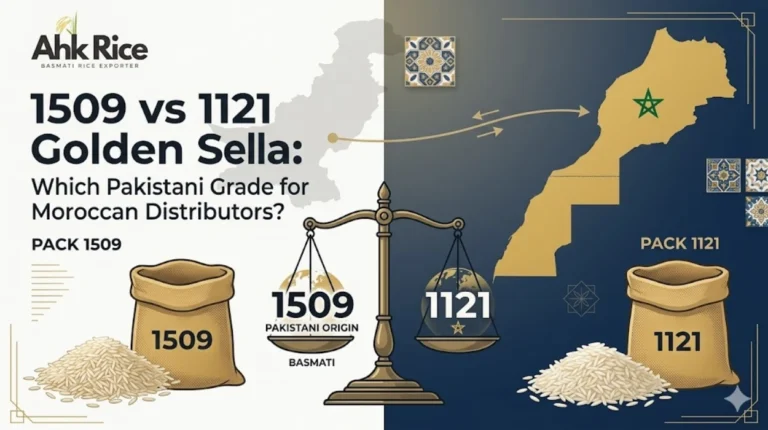
| Variety | 1121, Super Kernel, 1509, or agreed grade |
| Processing | White, Steam, Sella, or specified format |
| Grain specification | Defined average length and tolerance |
| Broken grains | Contractual maximum |
| Moisture | Contractual target |
| Packaging | Retail, wholesale, or private label |
| Quantity | Trial, single container, or recurring program |
| Inspection | Supplier or independent pre-shipment inspection |
| Destination | U.S. gateway plus Kansas delivery point |
| Incoterm | Agreed commercial responsibility |
The objective is consistency. Once a buyer approves a sample, subsequent production should be measured against the same commercial baseline.
Why should Kansas buyers choose the USA service from AHK Rice?
Kansas buyers should choose a USA-focused export service when they need origin-side processing, specification control, sampling, packaging, documentation, and shipment coordination managed through one supply relationship rather than several disconnected suppliers and intermediaries.
AHK Rice is based in Bucheki, Nankana Sahib, Punjab, a major Pakistani rice-producing area. Its integrated facility manages the export workflow from paddy sourcing to container loading. This gives the buyer a single commercial point for product and shipment coordination.
The benefit becomes more important when an importer moves from one trial container to scheduled replenishment. A spot purchase can tolerate more uncertainty. A recurring program cannot. The buyer needs the same variety, processing grade, packaging, documentation standard, and quality tolerance across successive shipments.
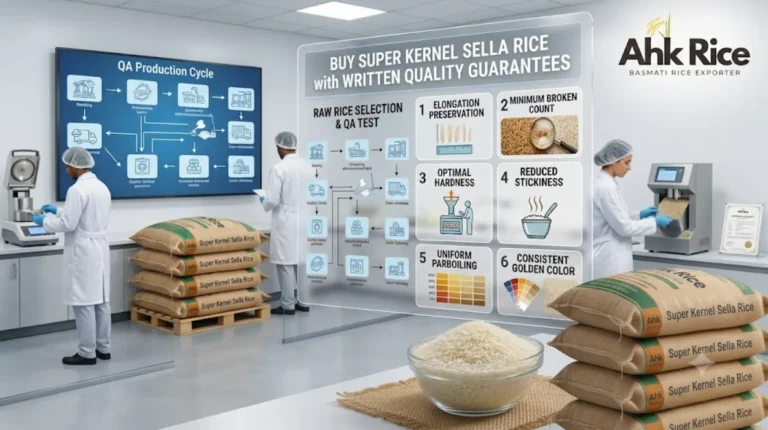
AHK Rice supports commercial buyers by coordinating cleaning, dehusking, milling, grading, sorting, packing, quality verification, export documentation, and container preparation. The company also states that third-party inspections can be incorporated into its USA export process.
Kansas importers should also compare supplier controls before committing to volume. A useful comparison is whether an exporter can demonstrate how the approved sample becomes the final production batch. This is where:
Consistent exporter fulfillment standards become commercially important.
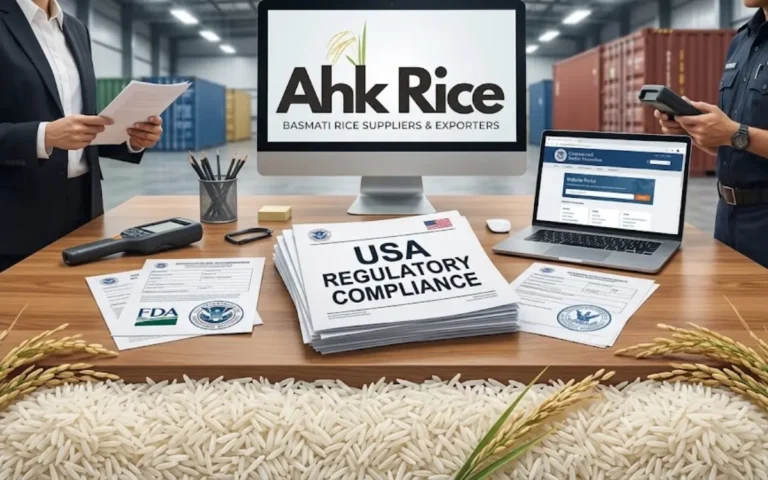
U.S. compliance also remains part of the importer’s responsibility. FDA states that imported food must be safe, sanitary, and properly labeled, and that applicable facilities must be registered with FDA and shipments must meet Prior Notice requirements.
For 2026, importers should also review facility-registration status carefully. FDA’s 2026 biennial renewal period runs from October 1 through December 31, 2026, for facilities subject to the requirement.
AHK Rice can coordinate origin-side documentation and supplier information, but the Kansas importer remains responsible for its U.S. entry process, broker arrangements, and applicable FSVP responsibilities.
How long does shipping from Pakistan to Kansas take?
Kansas buyers should plan international ocean transit separately from inland delivery because Kansas is inland; a practical commercial schedule is roughly 30–45 days or more depending on the U.S. gateway, vessel schedule, customs processing, port congestion, and final rail or truck movement.
Current 2026 lane data illustrates why buyers should avoid promising one fixed delivery number. Published Karachi-to-New York FCL schedules show approximately 27 days for a 40-foot high-cube container, while Karachi-to-Houston services can be approximately 36 days or longer depending on routing.
Kansas delivery adds inland transportation after U.S. port arrival. A buyer routing through an East Coast gateway may use rail or truck service into the Midwest. A Gulf Coast route may provide a different combination of ocean cost and inland cost. A West Coast route can also be considered when vessel availability or inland freight makes it commercially attractive.
For planning purposes:
| Kansas supply route | Ocean planning benchmark | Kansas fulfillment consideration |
| Karachi → New York/New Jersey → Kansas | ~27+ days ocean | Add port, customs, rail/truck |
| Karachi → Houston → Kansas | ~36+ days ocean | Add Gulf port and inland movement |
| Karachi → Los Angeles/Long Beach → Kansas | ~35–45+ days planning | Add West Coast handling and inland freight |
| Port-to-Kansas total | Commonly 30–45+ days | Depends on final delivery point |
| Urgent sample by air | Around 5–7 days may apply | Courier-dependent, not bulk freight |
These are planning ranges, not guaranteed delivery dates. Public freight data explicitly notes that quoted transit times and rates vary with routing, cargo-ready dates, and carrier conditions.
AHK Rice’s USA service gives an approximately 25–35-day door-to-door planning range for major U.S. destinations, but Kansas buyers should request a route-specific schedule because final inland delivery changes the calculation.
What results can Kansas buyers expect from this fulfillment model?
Kansas buyers can expect stronger specification control, clearer production milestones, coordinated export documentation, structured sampling, better shipment visibility, and a repeatable procurement process when the order is managed against agreed commercial requirements from sample approval through final delivery.
The primary result is reduced uncertainty. A buyer knows what product is being ordered before production begins. The exporter knows the required grade and packaging before processing starts. The logistics plan is established around the destination rather than added after production.
A second result is better repeat-order control. If the first shipment uses 1121 Steam Basmati with a defined grain-length, moisture, broken-grain, and packaging specification, those parameters can form the reference point for the next shipment.
AHK Rice’s USA service identifies container-scale ordering beginning at one 20-foot container of approximately 20 metric tons, with larger programs available for recurring requirements.
Pakistan also remains a significant global rice supplier in 2026. USDA’s April 2026 Pakistan Grain and Feed Annual forecasts 2026/27 rice production at 9.8 million metric tons and rice exports at about 5.0 million metric tons, compared with projected 2025/26 exports of 4.7 million metric tons.
For Kansas buyers, the practical advantage is access to a major origin market while maintaining a controlled purchasing specification.
What does the full Basmati rice sample process and cost look like?
The sample process should move from specification confirmation to sample selection, dispatch, testing, approval, commercial quotation, production, inspection, and shipment; the rice sample itself may be supplied without a product charge up to 20 kg, while courier and applicable phytosanitary costs remain buyer responsibilities.
The first step is specification collection. The Kansas buyer provides the variety, processing grade, desired grain characteristics, broken percentage, moisture requirement, packaging preference, quantity, and intended application.
The second step is sample preparation. AHK Rice states that up to 20 kg of Basmati rice can be provided as a sample without a rice charge. The buyer pays applicable sample shipping and phytosanitary costs.
The third step is courier dispatch. A buyer can use its own courier account, or shipping can be arranged according to the agreed process. The final courier price depends on sample weight, dimensions, destination, carrier, and service level. AHK Rice indicates that smaller 1–5 kg samples can be sent by air courier, with an indicative 5–7-day delivery period to the USA.
The fourth step is technical evaluation. Kansas buyers should cook the sample using their actual commercial method. Evaluation should cover aroma, grain appearance, elongation, texture, separation after cooking, broken grains, moisture, and overall suitability.
The fifth step is commercial approval. Once the sample is accepted, the buyer and exporter confirm quantity, packing, Incoterm, payment terms, inspection requirements, destination port, and shipment window.
The sixth step is production and release. AHK Rice coordinates processing, grading, packing, documentation, inspection, and container loading against the approved commercial specification.
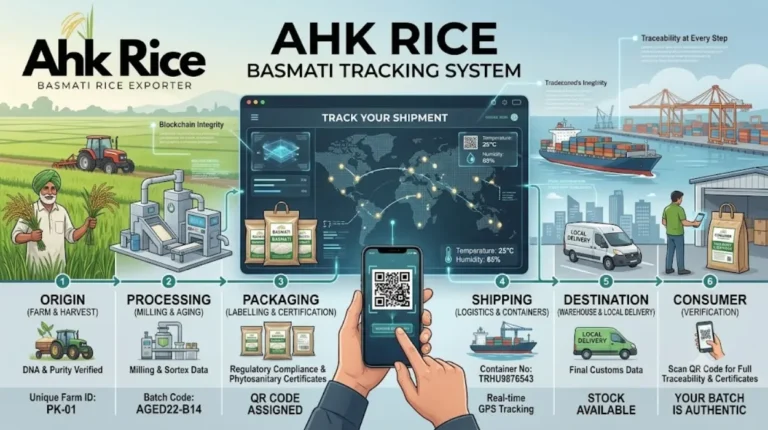
The seventh step is shipment monitoring. The buyer should receive the relevant export and shipping documents and track the container through the U.S. gateway and inland movement toward Kansas.
The sample cost should therefore not be evaluated only as a courier expense. Its purpose is to prevent a much larger commercial mistake: committing to a container of rice before confirming that the actual product meets the buyer’s cooking and quality requirements.
What factors determine the final Kansas rice import cost?
The final Kansas landed cost depends on rice variety and grade, quantity, packaging, origin processing, inspection, export documentation, ocean freight, U.S. port charges, customs and brokerage costs, inland transportation, insurance where applicable, and the selected Incoterm.
Rice price is only one component. Freight can change materially with vessel availability and route. For example, a current published 40-foot FCL benchmark from Karachi to New York shows approximately $7,519–$8,155, while Karachi-to-Houston published options can be approximately $7,890–$9,337 depending on routing and quotation validity.
These figures are freight-market benchmarks, not a Kansas landed quotation. A final AHK Rice quotation should be calculated against the actual product, quantity, packing, destination, shipment date, and commercial terms.
Packaging can also affect the result. Retail-ready private-label bags, printed materials, special weights, or buyer-supplied packaging can create different preparation requirements than standard bulk packaging.
Inspection and testing should be treated as risk-control costs. For a recurring program, independent pre-shipment inspection can be commercially justified when the value of the cargo or consequences of quality failure are significant.
Kansas buyers should therefore compare suppliers using landed cost rather than FOB price alone. A lower origin price can become less competitive when it is paired with higher freight, weaker packaging, additional handling, documentation problems, or inconsistent fulfillment.
How should a Kansas buyer get started with AHK Rice?
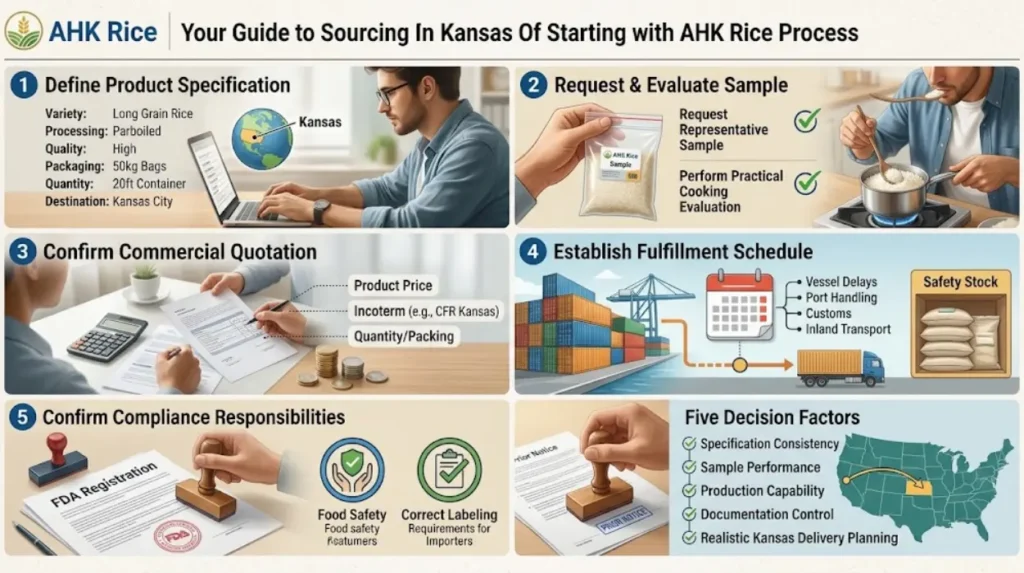
A Kansas buyer should begin with a precise product specification, request a representative sample, test it against the intended commercial application, confirm the final quotation and Incoterm, approve production requirements, and establish a shipment schedule with adequate inventory coverage.
Start by defining the exact rice. State the variety, processing type, quality tolerances, packaging, quantity, and destination.
Next, request the sample and perform a practical cooking evaluation. Do not approve a product only from a photograph or generic quality description.
After sample approval, confirm the commercial quotation. The quotation should identify product price, quantity, packing, Incoterm, shipment assumptions, inspection requirements, and destination logistics.
Then establish the fulfillment schedule. Recurring Kansas buyers should avoid planning inventory around the shortest possible transit time. A better approach is to maintain safety stock that covers vessel delays, port handling, customs processing, and inland transportation variability.
Finally, confirm compliance responsibilities. FDA requires applicable imported food facilities to meet registration requirements and imported food shipments to satisfy Prior Notice rules, while U.S. importers must ensure food is safe, sanitary, and properly labeled.
The decision should ultimately rest on five factors: specification consistency, sample performance, production capability, documentation control, and realistic Kansas delivery planning. AHK Rice is positioned for buyers that want these activities coordinated through one Pakistani origin supplier rather than managed through disconnected purchasing relationships.
For Kansas importers ready to define the product, quantity, destination, and shipment requirements, request a customized quotation through AHK Rice’s request-a-quote process.
Frequently Asked Questions
How does AHK Rice support Kansas rice buyers?
AHK Rice supports Kansas buyers through product specification, sampling, processing, grading, packaging, documentation, container loading, and shipment coordination for Pakistani Basmati rice.
Which Basmati rice varieties can Kansas buyers import from AHK Rice?
Kansas buyers can source varieties such as 1121 Basmati, Super Kernel, and 1509 Basmati, with white, Steam, or Sella processing available according to the agreed specification.
How long does Basmati rice shipping from Pakistan to Kansas take?
A practical planning range is approximately 30–45 days or more for ocean and inland delivery. Actual timing depends on the U.S. port, vessel schedule, customs clearance, and Kansas destination.
Can Kansas buyers request a rice sample before placing an order?
Yes. AHK Rice can provide product samples so buyers can evaluate grain appearance, aroma, cooking performance, texture, and other quality characteristics before approving a commercial shipment.
What does the AHK Rice sample process include?
The process includes specification confirmation, sample selection, dispatch, buyer testing, approval, commercial quotation, production, inspection, documentation, and shipment. Sample courier and applicable phytosanitary costs may apply.
What factors affect the cost of importing Basmati rice to Kansas?
The main factors include rice variety, grade, order volume, packaging, processing, inspection, ocean freight, U.S. port charges, customs and brokerage costs, inland transportation, insurance, and Incoterms.
Does AHK Rice provide customized packaging for Kansas buyers?
Yes. Packaging can be planned around the buyer’s required bag size, labeling, private-label requirements, retail presentation, or wholesale distribution specifications.
What quality specifications should Kansas importers confirm before ordering?
Importers should confirm variety, grain length, broken-grain percentage, moisture, processing type, foreign-material tolerance, packaging, inspection requirements, and applicable documentation before production begins.