How Do Indonesian Food Businesses Compare Pakistan Super Kernel Parboiled Rice Grades?
Indonesian food businesses should compare Pakistan Super Kernel Parboiled Rice by grain length, broken percentage, moisture, processing level, cooking performance, price per metric ton, and shelf stability rather than choosing a grade from appearance or price alone.
What are the available Pakistan Super Kernel Parboiled Rice solutions?
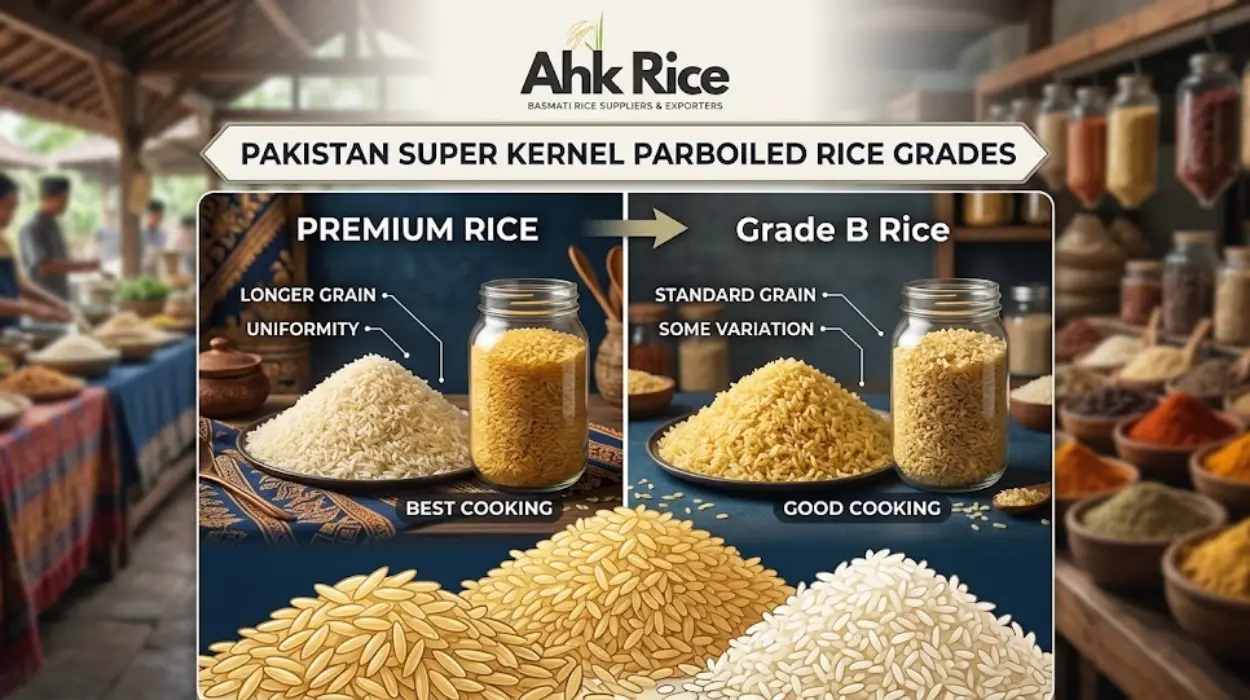
Pakistan Super Kernel Parboiled Rice is available through specification-based grades that differ mainly in grain selection, breakage, moisture, polishing, processing consistency, and intended foodservice use, giving Indonesian businesses distinct options for restaurants, catering, wholesalers, distributors, and institutional kitchens.
Super Kernel is a long-grain Basmati rice variety associated with Pakistan’s Punjab rice-growing region. Parboiling is a controlled process in which paddy is soaked, heated or steamed, dried, and then milled. The process changes the grain structure and improves resistance to breakage during cooking.
For Indonesian buyers, the relevant comparison is not simply “parboiled versus non-parboiled.” Buyers should compare the specification within the parboiled category.
The main procurement solutions are standard commercial Super Kernel Parboiled Rice, tighter low-broken grades, premium polished grades, and customized specifications. AHK Rice’s current Indonesia product specification lists an average grain length of about 7.0–7.2 mm, moisture at or below 12.5%, broken grains at or below 2%, and chalky grains at or below 3%.
The commercial grade should match the food operation. A restaurant serving individual rice plates may prioritize appearance and elongation. A catering business may prioritize low breakage and cooking yield. A wholesaler may prioritize price, packaging flexibility, and repeatable specifications.
Indonesian buyers can therefore evaluate the product as a specification package rather than a single grade name.
For background on why the product fits Indonesian food businesses, the educational article:
What makes Pakistan Super Kernel Parboiled Rice suitable for Indonesian food businesses provides the foundational product context before moving into grade comparison.
How do different Super Kernel Parboiled Rice grades compare?
The most useful grade comparison focuses on seven commercial attributes: grain length, broken percentage, moisture, chalky grains, polishing, cooking behavior, and price, because these attributes directly affect appearance, yield, handling, customer acceptance, and procurement cost.
| Attribute | Commercial Grade | Premium Foodservice Grade | Customized Tight Specification |
|---|---|---|---|
| Average grain length | 7.0–7.2 mm | Around 7.0–7.2 mm, highly uniform | Buyer-defined target |
| Broken grains | Up to 2–3% | Up to 2% | Contract-defined |
| Moisture | Up to 12.5% | Around 12% or lower | Contract-defined |
| Chalky grains | Up to 3% | Lower controlled level | Contract-defined |
| Polishing | Semi-polished/parboiled | Higher polishing consistency | Buyer-defined |
| Cooking behavior | Firm, separate grains | Firmer, more uniform grains | Tested against buyer recipe |
| Typical FOB price* | About $1,050–$1,150/MT | About $1,100–$1,250/MT | About $1,150–$1,300+/MT |
*Indicative 2026 procurement ranges for comparison, not fixed market quotations. Final prices change with crop, quantity, packing, inspection, payment terms, and destination logistics.
The first distinction is breakage. A 2% broken specification gives a food business a different commercial result from a 5% broken specification. Lower breakage generally improves visual uniformity and the proportion of whole cooked grains.
Moisture is equally important. A specification around 12% to 12.5% supports controlled storage when packaging and warehouse conditions are appropriate. Buyers should still verify the actual lot rather than relying only on the nominal grade.
Polishing changes appearance. Semi-polished rice retains a different visual character from highly polished rice. Premium foodservice buyers may accept the higher cost when bright and uniform grains are important to presentation.
Cooking behavior provides the practical test. Parboiling strengthens the grain and supports firm cooking. This can be useful for dishes that require rice to remain separate after cooking, including fried rice, biryani-style preparations, catering trays, and bulk foodservice production.
The correct grade is therefore the one that produces the required cooked yield at an acceptable landed cost.
Which grades suit different Indonesian food business regions?
Java and Bali food businesses generally benefit from uniform, presentation-focused grades for restaurants and hospitality, while Sumatra, Kalimantan, and other bulk-foodservice markets can prioritize economical grades with strong cooking performance, lower breakage, and predictable cost per serving.
Indonesia is geographically diverse, so procurement requirements should reflect the operating environment and customer segment rather than treating the country as one homogeneous rice market.
For Java and Bali, premium foodservice specifications can be more suitable for restaurants, hotels, catering operators, and businesses where plate presentation influences customer perception. A tighter broken-grain specification and consistent polishing can justify a higher purchase price when the cooked product is visible to consumers.
A practical 2026 procurement range for a premium Super Kernel Parboiled specification can be around $1,100–$1,250 per MT FOB Karachi, before freight, insurance, Indonesian import costs, port charges, taxes, and inland distribution.
For Sumatra, Kalimantan, Sulawesi, and other bulk-oriented markets, commercial-grade Super Kernel Parboiled Rice can provide stronger cost control. Buyers serving large numbers of customers may prioritize cooking yield and price per serving over maximum visual uniformity.
A practical comparison range is around $1,050–$1,150 per MT FOB Karachi for a standard commercial specification, with the final quotation determined by contracted quality, quantity, packaging, and shipment terms.
| Indonesian market region | Typical business use | Preferred grade approach | Indicative FOB comparison | Main priority |
| Java & Bali | Restaurants, hotels, catering | Premium, uniform parboiled | $1,100–$1,250/MT | Appearance and consistency |
| Sumatra & Kalimantan | Wholesale, catering, foodservice | Commercial parboiled | $1,050–$1,150/MT | Cost and cooking yield |
| Sulawesi & other markets | Mixed foodservice | Commercial or customized | $1,050–$1,200/MT | Balance of price and performance |
These regional ranges are procurement planning figures rather than official Indonesian market quotations. A buyer should compare the same Incoterm and specification before deciding that one supplier is cheaper.
A $50/MT difference can disappear if the cheaper rice has higher breakage, inconsistent moisture, poorer packaging, or lower usable cooked yield.
How does shelf life differ between Super Kernel Parboiled Rice grades?
Shelf life is determined more by moisture, packaging, processing hygiene, storage temperature, humidity, pests, and oxygen exposure than by the commercial grade name, so lower-moisture, properly packed parboiled rice normally offers stronger storage stability.
A properly processed and packaged dry rice product can remain commercially usable for an extended period when stored in dry, cool, clean conditions. However, buyers should distinguish between a manufacturer’s stated shelf life and the actual storage life achieved in Indonesian warehouses.
For procurement planning, a 12-month shelf-life specification is commonly practical for packaged commercial rice when the supplier’s label and documentation establish that period. Some packaged products can carry longer periods, but the buyer should use the declared shelf life rather than assume an automatic duration.
Premium and commercial grades do not automatically have different shelf lives. A premium grade with poor packaging can deteriorate faster than a commercial grade with better moisture control and packaging.
| Factor | Commercial Grade | Premium Grade |
| Moisture target | ≤12.5% | Around ≤12% |
| Storage stability | Strong with dry storage | Strong with dry storage |
| Typical planning shelf life | Around 12 months | Around 12 months or contract-defined |
| Main risk | Humidity and packaging damage | Same, despite higher grade |
| Buyer control | Moisture + packaging inspection | Moisture + packaging + lot inspection |
Indonesian importers should therefore verify moisture at loading and inspect packaging integrity before shipment. Rice should be protected from direct sunlight, condensation, standing water, insects, and high warehouse humidity.
Shelf-life comparison should also include the remaining shelf life when the shipment reaches the buyer. A product with 12 months declared shelf life is commercially different if it arrives after a long logistics period with inadequate remaining shelf-life documentation.
Which approach works best for restaurants, caterers, and wholesalers?
Restaurants should prioritize cooked appearance and consistency, catering businesses should prioritize whole-grain yield and batch uniformity, and wholesalers should prioritize specification stability, landed cost, packaging flexibility, and repeat supply when selecting Super Kernel Parboiled Rice.
Restaurants typically need a predictable cooked grain. Rice that remains firm and separate can support consistent plating and reduce complaints about sticky or broken grains.
For example, a restaurant serving 300 portions per day can benefit from a low-broken specification even when its FOB price is higher. If the improved grade reduces unusable breakage and produces more consistent cooked portions, the effective cost per serving can become lower.
Catering operations require a different balance. Large batches magnify quality differences. A grade that performs well in one small pot but becomes inconsistent in large-volume cooking creates operational waste.
For caterers, the sample should therefore be cooked using the actual commercial recipe. The test should record water ratio, soaking time if used, cooking time, cooked yield, grain separation, texture, and holding performance.
Wholesalers operate under a different model. Their main concern is repeatability across shipments. A slightly lower-priced grade is useful only if future lots maintain the same specification.
For wholesale procurement, a written specification should define grain length, broken percentage, moisture, foreign matter, chalky grains, packaging, net weight, tolerance, and inspection procedure.
What are the advantages and disadvantages of each grade?
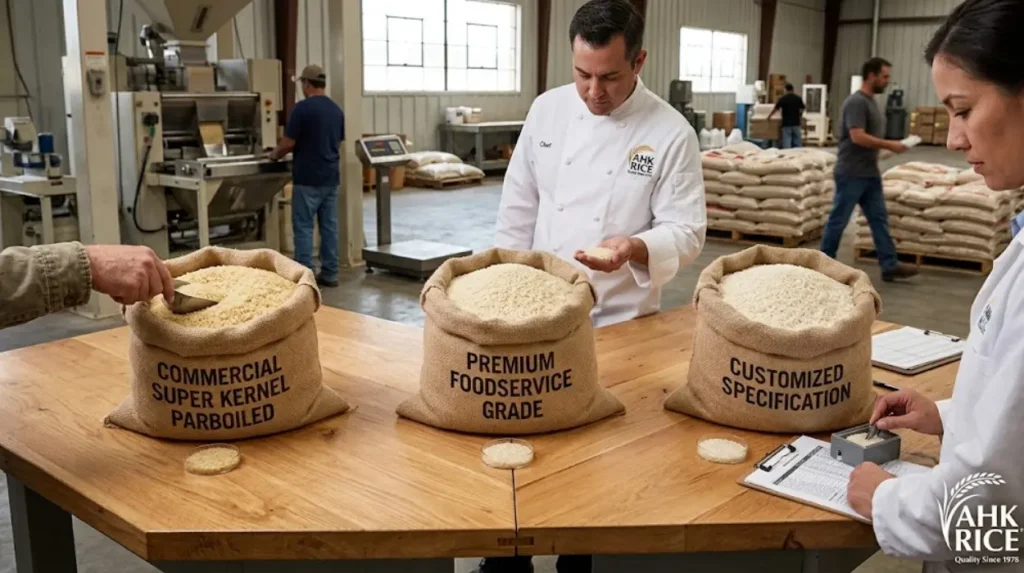
Premium specifications provide stronger visual consistency and lower breakage but cost more, while commercial grades provide better price efficiency but require tighter incoming inspection to prevent variation from affecting cooking performance, customer satisfaction, or resale value.
A commercial Super Kernel Parboiled grade has the advantage of lower procurement cost. It is suitable for bulk kitchens and wholesalers that need predictable performance without paying for maximum visual uniformity.
Its disadvantage is that a broader specification can produce more variation between lots. Buyers should therefore use pre-shipment inspection and retain an approved reference sample.
A premium foodservice grade provides stronger grain uniformity, lower breakage, and more consistent appearance. This is useful for hotels, restaurants, and caterers where rice is directly visible to customers.
Its disadvantage is the higher price. Paying $100–$150 more per MT is not justified if the business cannot recover that cost through selling price, reduced waste, or improved cooked yield.
A customized specification gives the buyer the strongest control. The contract can define exact moisture, broken percentage, grain length, polishing, packaging, and inspection requirements.
Its disadvantage is procurement complexity. Custom production may require longer planning and a higher minimum order because the supplier must organize production around the buyer’s specifications.
How should Indonesian buyers evaluate the total cost per metric ton?
Indonesian buyers should compare FOB price, freight, insurance, port charges, import costs, inland transport, packaging, inspection, financing, and usable cooking yield because the lowest supplier quotation is not necessarily the lowest landed or operational cost.
A simple comparison begins with the FOB price.
Suppose Grade A costs $1,100/MT and Grade B costs $1,175/MT. The apparent difference is $75/MT. If both grades have identical freight and import costs, Grade A looks cheaper.
The comparison changes when Grade B produces less breakage and better cooked yield. A foodservice operator should calculate the cost of usable cooked rice rather than only the cost of uncooked rice.
The calculation should include:
Landed cost per MT = FOB price + ocean freight + insurance + port costs + import charges + inland delivery + inspection + other agreed logistics costs.
Then calculate:
Usable cost per MT = landed cost ÷ usable product percentage.
This approach connects rice specifications to actual operating economics.
For example, a buyer purchasing 100 MT should not approve a grade solely because it saves $7,500 on the supplier invoice. If higher breakage increases kitchen waste or lowers resale value, the apparent saving can disappear.
What five decision factors should Indonesian buyers use?
Indonesian food businesses can make a stronger purchasing decision by scoring specification fit, cooking performance, landed cost, shelf stability, and supply consistency, then approving the grade only after sample testing and documentation review.
| Decision factor | What to verify | Why it matters |
| 1. Specification fit | Grain length, broken %, moisture, chalky grains | Confirms the product matches the business requirement |
| 2. Cooking performance | Expansion, separation, texture, holding | Measures real foodservice performance |
| 3. Landed cost | FOB, freight, duties, port and inland costs | Shows the actual procurement cost |
| 4. Shelf stability | Moisture, packaging, declared shelf life | Protects inventory during storage |
| 5. Supply consistency | Capacity, repeat specifications, inspection | Reduces variation between shipments |
The first factor should always be specification fit. A low price cannot compensate for a grade that does not meet the buyer’s cooking requirements.
The second is cooking performance. Buyers should test a production sample before approving a commercial shipment.
The third is landed cost. Comparing FOB prices from different suppliers without matching freight, Incoterms, packaging, and shipment quantity produces an incomplete comparison.
The fourth is storage stability. Indonesian buyers should evaluate packaging and warehouse conditions together with the rice specification.
The fifth is supply consistency. A restaurant chain or distributor needs the same specification repeatedly. A supplier that can provide one good shipment but cannot reproduce it creates procurement risk.
What is the best overall comparison strategy for Indonesian food businesses?
The best strategy is to select a specification-controlled Super Kernel Parboiled Rice grade based on the food operation, validate it through cooking samples, compare landed cost, confirm documentation, and then use the approved specification as the reference for repeat shipments.
For restaurants and hospitality businesses in Java and Bali, the premium specification provides the strongest balance when presentation and consistent cooked grains are important.
For bulk catering and wholesale operations, commercial-grade Super Kernel Parboiled Rice provides stronger cost efficiency when the buyer’s primary requirements are firm cooking performance, controlled breakage, and predictable supply.
For businesses with strict internal quality standards, customized specifications provide the highest control. The buyer can define measurable parameters instead of relying on broad grade terminology.
The procurement process should therefore move from product name → specification → sample → cooking test → landed-cost comparison → inspection → contract specification.
AHK Rice supplies Super Kernel varieties from Punjab with end-to-end processing, customized packaging, and export handling for international buyers. Its current Indonesia product information specifies Super Kernel Parboiled Rice at approximately 7.0–7.2 mm average grain length, ≤12.5% moisture, ≤2% broken grains, and ≤3% chalky grains.
The next decision stage should focus on the actual supply program, including production, packaging, inspection, shipment documentation, and delivery requirements. For that stage:
Pakistan Super Kernel Parboiled Rice supply option for Indonesian food businesses can be used as the decision-focused internal destination.
For 2026 procurement, Indonesian food businesses should avoid treating “Super Kernel Parboiled Rice” as a single uniform product. The commercial result depends on measurable specifications, cooking behaviour, packaging, landed cost, storage conditions, and supplier consistency. A specification-controlled comparison creates a clearer basis for selecting the right grade for each business model.
Frequently Asked Questions
What is Pakistan Super Kernel Parboiled Rice?
Pakistan Super Kernel Parboiled Rice is a long-grain rice made from Super Kernel paddy in Pakistan. Parboiling improves grain strength, cooking consistency, and resistance to breakage.
Which Super Kernel Parboiled Rice grade is best for Indonesian restaurants?
Premium, low-broken Super Kernel Parboiled Rice is suitable for Indonesian restaurants that prioritize attractive presentation, separate grains, consistent texture, and reliable cooking performance.
What is the typical grain length of Super Kernel Parboiled Rice?
Super Kernel Parboiled Rice commonly has an average grain length of around 7.0–7.2 mm, depending on the contracted specification and processing grade.
What moisture level should Indonesian rice importers look for?
A commercial specification of up to 12.5% moisture is a practical benchmark. Buyers should verify moisture through quality inspection and laboratory testing before shipment.
How much does Pakistan Super Kernel Parboiled Rice cost per metric ton in 2026?
Indicative 2026 FOB prices can range from about $1,050 to $1,250 per metric ton depending on grade, broken percentage, processing, quantity, packaging, and commercial terms.
Does parboiled rice have a longer shelf life?
Parboiled rice can provide strong storage stability when properly dried, packaged, and stored. Shelf life depends on moisture, packaging, warehouse conditions, pests, humidity, and the supplier’s declared specification.
Which grade is better for Indonesian catering businesses?
A low-broken commercial or premium Super Kernel Parboiled specification works well for catering because it supports consistent batch cooking, firm texture, grain separation, and controlled food waste.
How should Indonesian wholesalers compare Super Kernel Parboiled Rice suppliers?
Wholesalers should compare grain length, broken percentage, moisture, chalky grains, cooking performance, packaging, inspection procedures, landed cost, documentation, production capacity, and shipment consistency.