How Does Pakistan 1121 Creamy Sella Compare Across Indonesian Buyer Requirements?
Pakistan 1121 Creamy Sella is the strongest all-round option for Indonesian buyers who need extra-long grain, a lighter creamy appearance, firm cooking performance, and premium positioning without the deeper colour of Golden Sella. The grade uses 1121 Basmati as its base variety and undergoes controlled parboiling, drying, milling, polishing, grading, and sorting. The result is a long, firm kernel designed for commercial cooking and international distribution.
Indonesian buyers should compare 1121 Creamy Sella against Golden Sella, 1509 Sella, and Super Kernel Sella rather than evaluating the product name alone. A useful technical background is available in this guide to how Indonesian wholesalers compare Pakistan Sella rice grades and specifications, which establishes the broader relationship between grain length, processing, broken percentage, moisture, cooking performance, price, and shelf life.
For importers, the main issue is not whether 1121 Creamy Sella is technically superior in every category. The issue is whether its specification matches the buyer’s distribution channel. Premium retailers may value appearance and grain length. Restaurant wholesalers may prioritize cooking yield and consistency. High-volume distributors may place greater weight on landed cost. The procurement decision therefore requires a structured comparison.
What are the available solutions for Indonesian rice buyers?
Indonesian buyers have four practical Sella solutions: 1121 Creamy Sella for balanced premium positioning, 1121 Golden Sella for stronger colour, 1509 Sella for value-focused long grain, and Super Kernel Sella for traditional aroma and balanced cost.
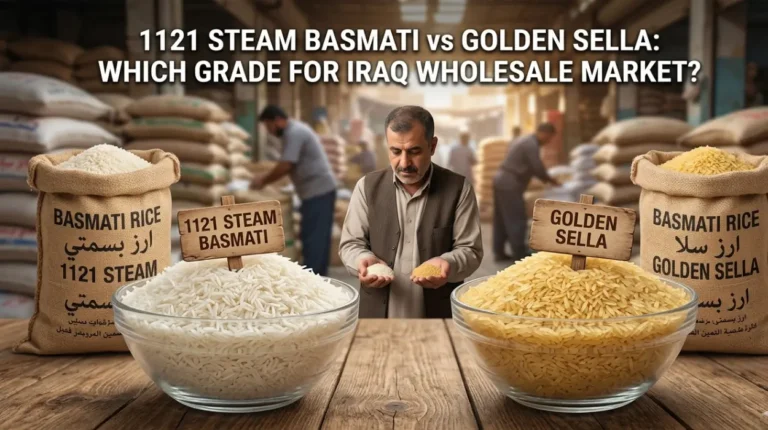
1121 Creamy Sella is a parboiled form of 1121 Basmati. Its raw grain commonly measures around 8.3 to 8.5 mm, depending on crop, milling specification, and supplier tolerance. Its creamy or pale-gold appearance differentiates it from the deeper colour associated with Golden Sella.
1121 Golden Sella uses the same 1121 Basmati base but has a stronger golden appearance. This makes it useful for biryani restaurants, catering businesses, and buyers whose customers associate visible golden colour with premium Sella rice.
1509 Sella is another long-grain parboiled option. Its typical raw grain length is around 8.0 to 8.3 mm. It provides a long-grain presentation while occupying a more value-oriented position than 1121.
Super Kernel Sella generally provides shorter raw grain length than 1121 but maintains a strong traditional Basmati aroma. It suits distributors whose customers prioritize fragrance and Basmati identity instead of maximum grain length.
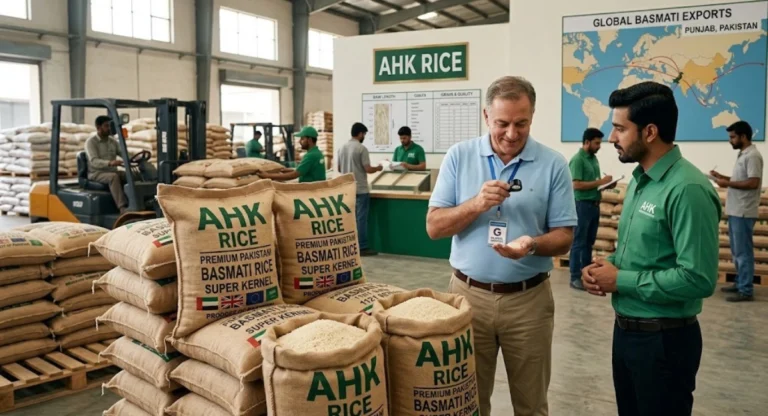
AHK Rice processes Pakistani Basmati rice in Punjab and supplies 1121, Super Kernel, and 1509 varieties through export channels. Its processing model includes milling, grading, sorting, packing, and export documentation, allowing Indonesian buyers to specify commercial requirements before shipment.
How do the main Pakistan Sella grades compare technically?
1121 Creamy Sella leads when Indonesian buyers need extra-long grain and a light appearance, while Golden Sella emphasizes colour, 1509 emphasizes value, and Super Kernel emphasizes aroma; specification, not grade naming, should control procurement.
| Attribute | 1121 Creamy Sella | 1121 Golden Sella | 1509 Sella | Super Kernel Sella |
|---|---|---|---|---|
| Base variety | 1121 Basmati | 1121 Basmati | 1509 Basmati | Super Kernel Basmati |
| Raw grain length | 8.3–8.5 mm | 8.3–8.5 mm | 8.0–8.3 mm | 7.2–7.6 mm |
| Processing | Parboiled Sella | Parboiled Sella | Parboiled Sella | Parboiled Sella |
| Appearance | Creamy / pale gold | Golden / amber | Creamy / golden | Natural golden |
| Cooking structure | Firm, separate grains | Firm, separate grains | Firm, separate grains | Firm, aromatic |
| Broken target | Around 1–2% | Around 1–2% | Around 1–2% | Around 1–2% |
| Commercial position | Premium balanced | Premium visual | Value long-grain | Aroma/value |
These figures are commercial reference ranges rather than contractual guarantees. The final specification should state grain length, moisture, broken percentage, foreign matter, purity, milling yield, crop year, packaging, and inspection requirements.
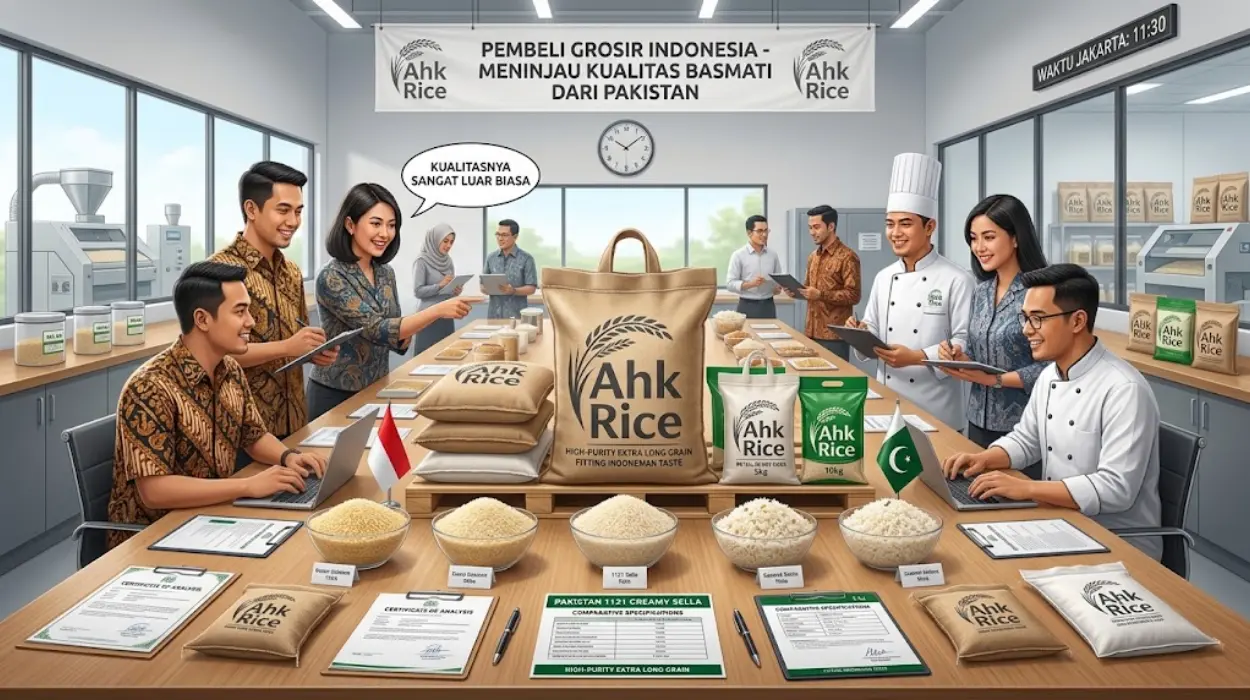
AHK Rice’s published comparison for Indonesian wholesalers identifies 1121 Creamy Sella at approximately 8.3–8.5 mm raw grain length and places it in a premium commercial position. The same comparison identifies 1509 as a value-oriented long-grain option and Super Kernel as an aroma-focused alternative.
How should Indonesian buyers compare price per MT?
Price per metric ton should be compared as a landed-cost calculation rather than as an FOB number because freight, insurance, port handling, customs, packaging, inspection, and inland delivery can materially change Indonesian distributor margins.
For procurement planning, published market benchmarks show 1121 Creamy Sella around US$1,100 per MT FOB in a current commercial price listing, while 1121 Golden Sella is listed around US$1,155 per MT and 1509 Creamy Sella around US$940 per MT. These figures are market benchmarks, not Pakistan-to-Indonesia quotations.
AHK Rice’s current Indonesia-facing 1121 Golden Sella page also publishes a reference price of approximately US$1,100 per MT, demonstrating why buyers should request a shipment-specific quotation rather than treating a generic internet price as a contract value.
| Grade | Indicative FOB benchmark | Price position | Main reason to select |
|---|---|---|---|
| 1121 Creamy Sella | Around US$1,100/MT | High | Long grain + lighter appearance |
| 1121 Golden Sella | Around US$1,100–1,155/MT | High | Golden presentation |
| 1509 Sella | Around US$940/MT benchmark | Medium | Long grain with lower entry cost |
| Super Kernel Sella | Buyer quotation required | Medium | Aroma and Basmati identity |
The correct Indonesian comparison is therefore FOB Pakistan → CIF destination port → warehouse landed cost → distributor margin. Jakarta and Surabaya should not automatically receive the same landed-cost assumption because port charges, inland distribution, order volume, and local logistics can differ.
A 25 MT shipment priced at US$1,100 per MT has a product value of US$27,500 before freight and destination costs. Even a US$50 per MT difference changes the cargo value by US$1,250. This is why small specification differences become commercially significant at container scale.
Which Indonesian market regions prefer which grades?
Java’s major urban distribution channels generally justify premium 1121 grades when retail presentation and foodservice consistency matter, while price-sensitive wholesale channels in outer regional markets can favor 1509 or Super Kernel where procurement cost and aroma outweigh maximum grain length.
Java and major urban markets
Java, including major commercial centres such as Jakarta and Surabaya, represents a useful premium-market segment for evaluating 1121 Creamy Sella. Buyers supplying supermarkets, modern retail, hotels, restaurants, and specialty foodservice can use its extra-long grain and light appearance as differentiation.
Creamy Sella is particularly relevant where customers want long Basmati grains without the stronger golden colour of Golden Sella. The specification supports premium presentation while retaining the firm cooking characteristics associated with parboiled rice.
Golden Sella can become more attractive when the buyer serves biryani restaurants, catering companies, or banquet kitchens where golden colour contributes to the finished dish’s visual identity.
Sumatra, Kalimantan and value-oriented regional distribution
Regional wholesale channels can place greater pressure on procurement cost. In these cases, 1509 Sella offers a practical alternative because it retains long-grain characteristics while occupying a lower commercial price position.
Super Kernel Sella becomes relevant where aroma has greater importance than maximum raw grain length. A distributor serving traditional Basmati consumers can use aroma as the primary product differentiator.
The decision is therefore channel-specific. The same Indonesian distributor can rationally stock 1121 Creamy Sella for premium customers and 1509 Sella for volume-oriented customers.
How does shelf life compare between the solutions?
Sella grades can support approximately 18–24 months of shelf-life planning under controlled commercial storage, but actual performance depends on moisture, packaging, temperature, humidity, sanitation, pest control, and crop age rather than the Sella label alone.
Parboiling contributes to kernel strength and improves handling stability. It does not eliminate the need for appropriate warehouse management.
| Grade | Planning shelf life | Storage requirement | Buyer priority |
|---|---|---|---|
| 1121 Creamy Sella | 18–24 months* | Dry, cool, pest-controlled | Moisture + packaging |
| 1121 Golden Sella | 18–24 months* | Dry, cool, pest-controlled | Colour retention |
| 1509 Sella | 18–24 months* | Dry, cool, pest-controlled | Cost + turnover |
| Super Kernel Sella | 18–24 months* | Dry, cool, pest-controlled | Aroma + stability |
*Planning range under controlled storage, not a universal guaranteed expiry period.
Indonesia’s humid tropical conditions make warehouse management particularly important. Buyers should specify maximum moisture at loading and verify it through representative sampling. AHK Rice’s Indonesian Sella guidance identifies controlled moisture as a key quality consideration and notes a 12% maximum moisture specification for its published Sella comparison.
Packaging also influences storage performance. Bulk PP bags can support wholesale distribution, while smaller custom packs are better suited to retail channels. The packaging specification should identify net weight, material, inner liner where required, stitching, labelling, batch information, and storage instructions.
Which method works best for different Indonesian buyer cases?

The best grade depends on the commercial use: choose 1121 Creamy Sella for balanced premium retail and foodservice, Golden Sella for visual impact, 1509 for cost-sensitive volume, and Super Kernel when aroma drives customer preference.
| Buyer case | Best-fit grade | Why |
|---|---|---|
| Premium supermarket | 1121 Creamy Sella | Long grain and lighter appearance |
| Biryani restaurant | 1121 Golden Sella | Strong colour and separate grains |
| High-volume wholesaler | 1509 Sella | Lower commercial price position |
| Aroma-focused distributor | Super Kernel Sella | Traditional Basmati fragrance |
| Mixed premium portfolio | 1121 Creamy Sella + Golden Sella | Covers different presentation preferences |
This framework prevents buyers from choosing purely on price. A cheaper grade can produce a weaker retail proposition if customers specifically demand extra-long 1121 grain.
Conversely, a premium grade can reduce distributor profitability when the target customer has no willingness to pay for the additional specification. Procurement should therefore begin with the end-use requirement and then work backward to the rice grade.
What are the main advantages and disadvantages?
1121 Creamy Sella combines long grain, premium positioning, firm cooking, and lighter colour, but its higher procurement cost means it performs best when Indonesian buyers can monetize premium appearance and consistent cooking rather than compete only on price.
1121 Creamy Sella
The main advantage is specification balance. It provides 1121’s extra-long grain with a creamy presentation. It is suitable for premium retail, restaurants, catering, and distributors that want a broad premium product.
The main disadvantage is cost. A buyer targeting highly price-sensitive wholesale customers may achieve stronger volume economics with 1509.
1121 Golden Sella
Golden Sella offers stronger visual differentiation. Its colour works well in biryani, pulao, catering, and banquet applications.
Its limitation is presentation preference. Customers seeking pale or white-looking rice may prefer Creamy Sella.
1509 Sella
1509 provides long-grain positioning at a lower commercial level. It can support larger-volume distribution where margin depends heavily on procurement cost.
Its limitation is premium perception. It does not provide the same 1121 positioning when customers specifically ask for extra-long 1121 Basmati.
Super Kernel Sella
Super Kernel’s primary advantage is aroma. It provides a traditional Basmati identity while maintaining parboiled cooking characteristics.
Its limitation is raw grain length. Buyers who use grain size as the principal premium indicator will generally prefer 1121.
What decision factors should Indonesian distributors use before ordering?
Indonesian distributors should evaluate six linked factors: target customer, grain specification, processing quality, landed cost, storage conditions, and documentation; the strongest supplier is the one that meets the complete specification consistently rather than the one offering the lowest initial price.
A practical procurement sequence starts with customer requirements. Define whether the rice is for retail, restaurants, catering, foodservice, or wholesale.
Next, establish measurable specifications. Include average grain length, broken percentage, moisture, purity, foreign matter, colour, processing method, crop year, and packaging.
Then calculate landed cost. Compare the product price with freight, insurance, destination handling, clearance, inland transport, and packaging costs. A US$30–50 per MT price advantage can disappear when freight or destination costs differ.
Finally, validate the product through samples and contract specifications. The approved sample should match the commercial specification. Inspection should verify the agreed parameters before loading.
| Decision factor | What to check | Why it matters |
|---|---|---|
| Customer segment | Retail, foodservice, catering, wholesale | Determines grade positioning |
| Grain specification | 8.3–8.5 mm target for 1121 | Controls premium positioning |
| Quality | Moisture, broken, purity, foreign matter | Protects consistency |
| Landed cost | FOB/CIF + destination expenses | Determines margin |
| Storage | Humidity, temperature, pest control | Protects shelf life |
For Indonesian distributors, this framework makes 1121 Creamy Sella particularly strong when the business needs a premium long-grain product with a lighter visual identity. It is less suitable when the entire purchasing strategy depends on minimizing the initial cost per metric ton.
What is the final comparison for Indonesian buyers?
1121 Creamy Sella is the most balanced choice for Indonesian distributors seeking premium long-grain Basmati with a lighter appearance, while Golden Sella, 1509, and Super Kernel remain stronger choices when colour, price, or aroma is the primary commercial requirement.
The comparison should therefore end with the buyer’s distribution model rather than a universal ranking. A premium supermarket may gain more from Creamy Sella’s appearance and grain length. A catering company may gain more from Golden Sella. A volume wholesaler may protect margin with 1509. An aroma-focused distributor may prefer Super Kernel.
For Pakistani supply, the most important commercial safeguard is a written specification covering grain length, broken percentage, moisture, purity, appearance, packaging, crop year, inspection, and delivery terms. This converts the product name into a measurable procurement standard.
AHK Rice operates from Punjab and supplies Pakistani Basmati varieties including1121, Super Kernel, and 1509 Basmati rice, with processing, custom packaging, and export support. Buyers evaluating the complete Pakistan Basmati rice export service can use the same specification-led approach when comparing grades and shipment requirements.
Frequently Asked Questions
Is 1121 Creamy Sella suitable for Indonesia?
Yes. 1121 Creamy Sella is suitable for Indonesian retail, restaurant, catering, and wholesale channels that value extra-long grain, firm cooking, and a lighter creamy appearance.
What is the grain length of 1121 Creamy Sella?
Commercial specifications commonly place the raw grain around 8.3–8.5 mm. The exact contractual value depends on crop, milling process, grading, and supplier tolerance.
Is Creamy Sella better than Golden Sella?
Neither grade is universally better. Creamy Sella suits buyers wanting a lighter appearance, while Golden Sella is stronger for applications where deeper golden colour supports product presentation.
Is 1121 Creamy Sella more expensive than 1509 Sella?
Generally, yes. Published market benchmarks place 1121 Creamy Sella around US$1,100/MT and 1509 Creamy Sella around US$940/MT, although these are benchmark prices and not fixed Pakistan-to-Indonesia quotations.
How long can 1121 Creamy Sella be stored?
A planning range of 18–24 months can be used under controlled storage. Actual shelf life depends on moisture, temperature, humidity, packaging, pest control, sanitation, and crop age.
What specifications should Indonesian importers request?
Importers should request grain length, broken percentage, moisture, purity, foreign matter, colour, processing method, crop year, packaging, net weight, inspection requirements, and agreed delivery terms.
Which Indonesian buyers should choose 1121 Creamy Sella?
Premium retailers, foodservice distributors, restaurants, caterers, and wholesalers should consider it when customers value extra-long Basmati grains with a light creamy appearance and firm, separate cooking.
Should buyers compare FOB or CIF prices?
Buyers should compare landed cost. FOB shows the supplier-side product price, while CIF incorporates freight and insurance to the agreed destination port. Destination charges still need to be added to calculate warehouse cost.