Basmati Rice Grade Specifications: Average Grain Length, Broken %, Moisture and Purity
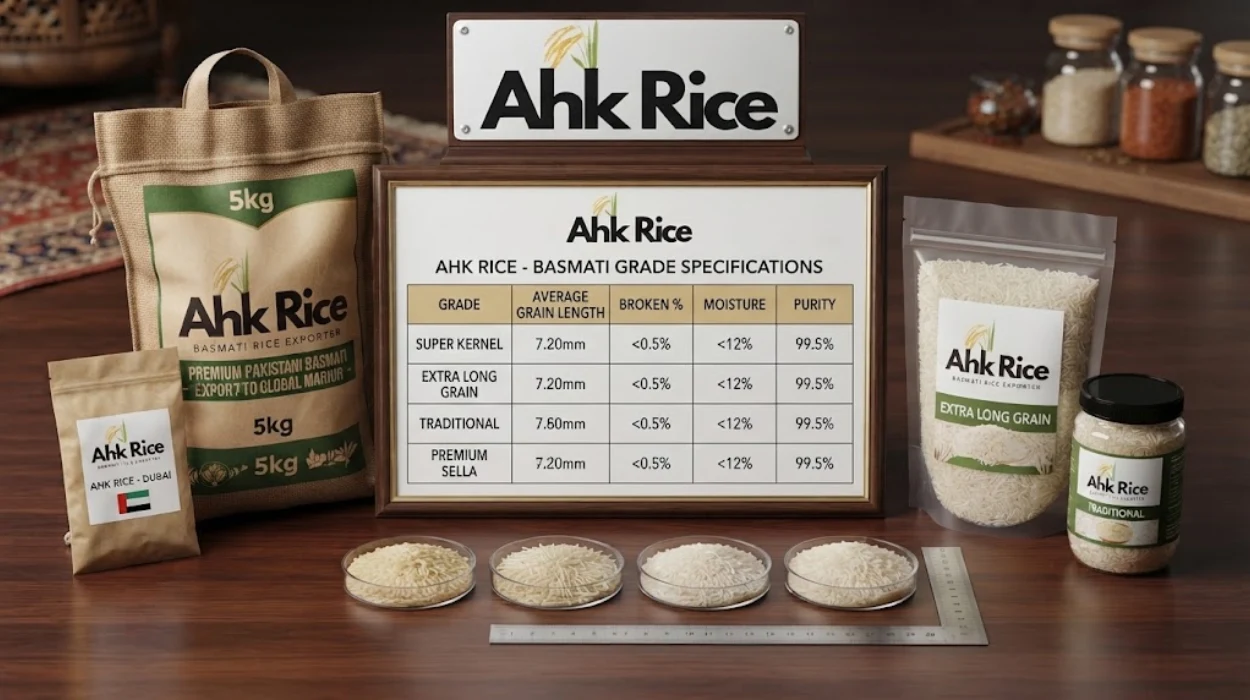
For most commercial buyers, the best Pakistani Basmati rice grade depends on four measurable specifications: average grain length, broken percentage, moisture content, and purity. Buyers should compare these values alongside variety, processing method, cooking performance, destination requirements, and price per metric tonne before approving a supplier.
Understanding these specifications helps importers distinguish premium 1121 Basmati from Super Kernel and 1509 Basmati rice. The guide to Pakistani Basmati rice varieties, cultivation, processing, and export grades explains how variety and processing influence the finished product. For commercial evaluation, buyers also need a consistent specification sheet that defines each measurement, its acceptance limit, and the inspection method used before shipment.
AHK Rice is a Pakistani Basmati rice exporter based in Punjab, supplying 1121, Super Kernel, and 1509 Basmati rice varieties to more than 15 countries. Its end-to-end export operations cover processing, grading, custom packaging, and shipment coordination. Comparing grades through documented specifications gives importers a practical basis for supplier evaluation, quality control, and purchasing decisions.
What do Basmati rice grade specifications mean?
Basmati rice grade specifications are measurable quality parameters used to classify rice for export, establish purchase requirements, and verify shipment consistency. They define acceptable grain dimensions, broken kernels, moisture, purity, foreign matter, processing condition, and other characteristics required by the buyer.
An export specification sheet converts general descriptions such as “premium quality” into measurable requirements. A buyer can request a long-grain product, but the purchase contract must identify the variety, measurement basis, minimum or average grain length, maximum broken percentage, moisture limit, and purity requirements. Both parties must agree on the inspection method and tolerances before production.
Four terms require particular attention:
- Average grain length: The measured length of representative rice kernels, expressed in millimetres. The specification must state whether it covers raw or milled rice.
- Broken percentage: The proportion of kernels classified as broken under the agreed grading method, usually expressed as a percentage by weight.
- Moisture content: The percentage of water in the rice, measured using an agreed method. Moisture affects storage stability and handling.
- Purity: The proportion of rice meeting the specified variety and quality requirements, supported by limits for foreign matter, other varieties, and defective kernels.
These measurements work together. A shipment with long kernels can still fail a buyer’s requirements if its broken percentage exceeds the agreed limit or its moisture content is too high.
Which Basmati rice grades are available for export?
The principal Pakistani Basmati options include 1121, Super Kernel, and 1509, each serving different price points and market requirements. Buyers select among these varieties according to grain appearance, aroma, processing format, cooking performance, customer expectations, and the commercial value of the finished pack.
1121 Basmati rice
1121 is a premium long-grain variety valued for its elongated kernels and cooked-grain presentation. Buyers commonly evaluate White, Steam, Golden Sella, and Creamy Sella formats. It suits premium retail, private-label brands, restaurants, and foodservice distributors that prioritise grain length and appearance.
Super Kernel Basmati rice
Super Kernel is a traditional aromatic Pakistani Basmati variety associated with Punjab. Buyers assess its natural aroma, grain uniformity, milling quality, and cooking behaviour. It serves ethnic grocery retail, South Asian distribution, and foodservice markets seeking a recognisable Basmati profile.
1509 Basmati rice
1509 offers a commercial option for buyers balancing grain length, cooking performance, and purchase cost. White, Steam, and Golden Sella formats address different distribution needs. It suits bulk importers, wholesalers, private labels, catering businesses, and price-sensitive retail segments.
These varieties are not interchangeable solely because their grains appear long. A buyer must specify the variety and processing format separately. Suppliers such as AHK Rice coordinate sourcing, milling, grading, packaging, and export requirements for these product categories.
How do Basmati rice grade specifications compare?
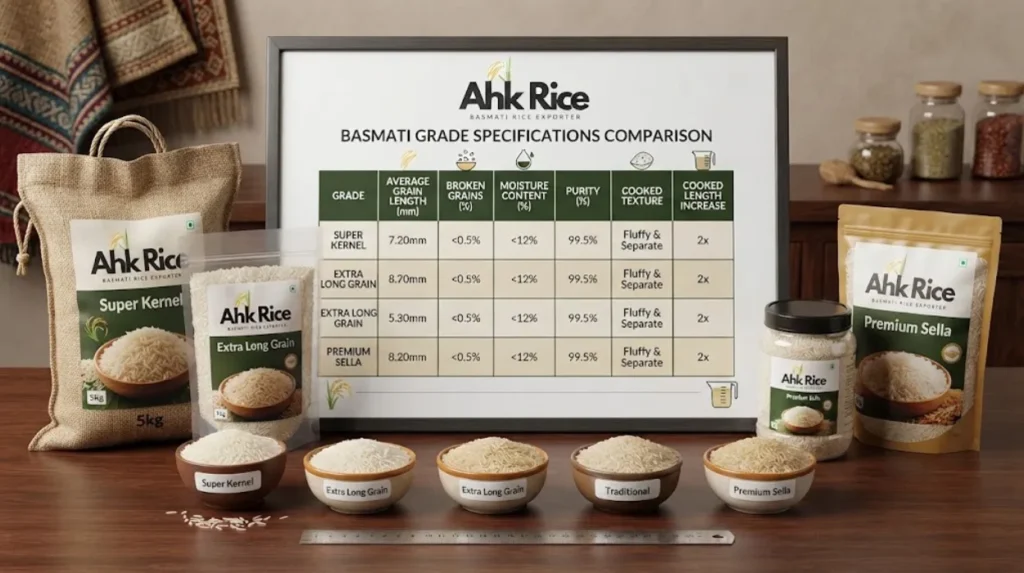
A seven-attribute comparison provides a consistent starting point for evaluating rice grades before requesting samples or negotiating prices. The limits below are practical buying references, not universal legal standards. Buyers must confirm the final values with the supplier and the destination market’s applicable requirements.
| Specification attribute | 1121 Basmati | Super Kernel Basmati | 1509 Basmati |
|---|---|---|---|
| Raw grain length | Commonly around 8.0–8.3 mm, depending on lot | Commonly around 7.0–7.5 mm | Commonly around 8.1–8.4 mm |
| Broken percentage | Set by the contracted grade; premium offers often target 1–2% | Set by the contracted grade; premium offers often target 1–3% | Set by the contracted grade; commercial offers often target 1–3% |
| Moisture content | Common export target: maximum 12–13% | Common export target: maximum 12–13% | Common export target: maximum 12–13% |
| Purity | Variety identity and foreign-matter limits agreed in contract | Variety identity and foreign-matter limits agreed in contract | Variety identity and foreign-matter limits agreed in contract |
| Processing format | White, Steam, Golden Sella, Creamy Sella, Brown | White, Steam, Sella, depending on availability | White, Steam, Golden Sella |
| Aroma and appearance | Premium elongated-grain presentation | Traditional aromatic profile | Long-grain presentation with commercial value |
| Primary buying objective | Premium retail and foodservice | Aroma-led ethnic retail and distribution | Cost-conscious volume purchasing |
Grain lengths vary by crop, milling condition, measurement method, and product format. Broken-percentage targets are negotiated commercial specifications, not fixed definitions of each variety. Buyers should also avoid comparing raw paddy length with milled-rice length or using a cooked-grain measurement as the acceptance limit for raw rice.
The same principle applies to purity. A supplier should identify whether purity refers to varietal purity, freedom from foreign material, or a broader quality assessment. Each has a different measurement basis and acceptance criterion.
What solutions can buyers use to verify rice quality?
Buyers can verify rice quality through supplier specification sheets, representative samples, independent laboratory testing, and pre-shipment inspection. The strongest process combines these methods because documentary claims, sample appearance, laboratory results, and the loaded shipment each provide different evidence.
1. Supplier specification sheet
A specification sheet records the product name, origin, crop or lot details, processing method, grain length, broken percentage, moisture, purity, packing, and inspection requirements. It is the quickest way to screen suppliers and identify differences between quotations.
Its limitation is that it describes the declared product rather than independently proving the condition of every shipment.
2. Physical sample approval
A representative sample lets buyers assess colour, aroma, kernel uniformity, visible defects, and cooking performance. Importers can test samples against their retail or foodservice requirements before confirming a bulk order.
Sample approval does not eliminate the need for shipment inspection. The contract should require the delivered lot to match the approved sample within agreed tolerances.
3. Laboratory testing
Laboratory analysis verifies measurable parameters such as moisture, broken kernels, and relevant food-safety indicators. Buyers should choose tests according to the product, destination regulations, and contract. Residue or contaminant testing requires suitable methods and laboratories.
A laboratory certificate is only useful when the sample is representative, the method is appropriate, and the tested lot is clearly identified.
4. Pre-shipment inspection
An inspection before loading checks whether the prepared goods match the agreed specifications, packaging, quantity, and shipping documents. Depending on the contract, the inspector may sample bags, assess visible quality, verify markings, and arrange testing.
This method gives buyers evidence closer to dispatch, although it cannot guarantee that rice remains unaffected by poor transport or storage after inspection.
5. Combined quality-control process
For container-scale orders, a combined process provides the clearest purchasing control: document review, sample approval, agreed testing, pre-shipment inspection, and final certificate review. Each stage should refer to the same specification and lot identity.
Which approach works best for different buying situations?
A specification sheet works best for initial supplier screening, samples suit product selection, laboratory testing verifies measurable properties, and pre-shipment inspection checks the prepared order. Importers handling recurring or high-volume purchases gain the strongest control by combining these methods under one written acceptance procedure.
| Buying situation | Recommended approach | Reason |
|---|---|---|
| Comparing several suppliers | Specification sheets | Identifies differences quickly |
| Launching a new retail product | Sample approval plus specification | Confirms appearance, aroma, and cooking suitability |
| Supplying a regulated market | Laboratory testing and document review | Checks relevant safety and import requirements |
| Ordering full containers | Pre-shipment inspection plus agreed testing | Verifies the prepared shipment |
| Reordering an established grade | Lot-specific checks against the approved specification | Supports consistency between shipments |
The right approach depends on the cost of a quality failure. A small trial order may need a specification review and sample approval. A recurring container programme needs documented limits, traceable lots, agreed sampling, and a clear procedure for handling non-conforming goods.
How do Gulf and European markets compare on grade requirements?
Gulf markets often prioritise familiar Basmati varieties, consistent cooking results, and value across wholesale and foodservice channels. European buyers place additional emphasis on traceability, documented specifications, and compliance with applicable food-safety requirements. Both regions require buyers to match rice quality to the intended customer and distribution channel.
Gulf markets: UAE and Saudi Arabia
Importers in the UAE and Saudi Arabia source Pakistani Basmati for supermarkets, ethnic grocery stores, wholesalers, restaurants, catering companies, and institutional kitchens. 1121 appeals to premium retail and foodservice buyers seeking long, attractive grains. Super Kernel serves aroma-focused ethnic distribution, while 1509 supports cost-conscious volume purchasing.
Steam and Golden Sella formats also serve different operational needs. Steam rice offers a familiar cooked-grain appearance, while parboiled Golden Sella suits buyers seeking firmer grains for large-batch cooking and catering. Actual performance depends on the processing specification and cooking method.
European markets: UK and other European destinations
European importers assess grain quality alongside supplier traceability, product documentation, packaging information, and applicable food-safety rules. Premium 1121 serves long-grain retail and foodservice segments. Super Kernel suits aroma-led ethnic distribution, while 1509 addresses buyers who need a balance between purchase cost and product performance.
Importers must confirm the applicable maximum residue levels, contaminant limits, labelling rules, and import controls for their destination. A supplier’s general quality certificate does not replace the specific evidence required by the importer or the competent authority.
Indicative price comparison by market
Rice prices change with crop availability, milling yield, processing format, broken percentage, packing, order volume, freight, insurance, and exchange rates. The following figures are illustrative FOB planning ranges in US dollars per metric tonne, not verified live quotations or guaranteed market averages.
| Grade | Indicative FOB planning range | Typical positioning |
|---|---|---|
| 1121 Basmati | $1,050–$1,350/MT | Premium grain length and presentation |
| Super Kernel Basmati | $1,000–$1,250/MT | Traditional aroma and ethnic retail |
| 1509 Basmati | $850–$1,100/MT | Cost-conscious volume distribution |
These ranges are indicative commercial examples. Actual offers can fall outside them depending on crop conditions, quality, date, and contract terms. A buyer comparing UAE and European landed costs must add the relevant freight, insurance, import duties, clearance charges, and other destination costs to the FOB value. European compliance and testing expenses also affect the final purchasing budget.
For a fair comparison, request quotations for the same variety, processing format, bag weight, broken percentage, moisture limit, order quantity, and Incoterm. Comparing a premium 1121 Steam quotation against a lower-grade 1509 White quotation does not establish which supplier offers better value.
How does shelf life compare across Basmati rice grades?
Properly processed and packaged dry Basmati rice generally has a shelf life of around 12–24 months, subject to product type, packaging, storage conditions, and the manufacturer’s validated declaration. Buyers should compare the stated shelf life and storage instructions rather than assuming that one variety always lasts longer than another.
| Product format | Shelf-life consideration | Storage requirement |
|---|---|---|
| White Basmati | Often supports a 12–24-month commercial shelf-life target | Cool, dry, clean storage |
| Steam Basmati | Depends on moisture, processing control, and packaging | Stable temperature and moisture protection |
| Golden Sella Basmati | Requires validated shelf-life and packaging specifications | Dry storage away from pests and odours |
| Brown Basmati | Bran oils increase susceptibility to rancidity | Tighter control of temperature and storage duration |
These are planning considerations, not universal expiry dates. The supplier must validate the shelf life for the specific product and package. Moisture control, sealed packaging, protection from insects, and a clean warehouse help maintain quality. Buyers should request a manufacturing or packing date, best-before declaration, and storage instructions where applicable.
What are the pros and cons of different grade-verification methods?
No single verification method answers every quality question. Specification sheets offer speed, samples demonstrate product suitability, laboratory testing measures selected parameters, and pre-shipment inspection checks the prepared order. Their value depends on the risk being controlled and the evidence required by the purchase contract.
| Method | Advantages | Limitations | Example |
|---|---|---|---|
| Specification sheet | Fast supplier comparison | Declared values require verification | Screening three 1121 offers |
| Physical sample | Shows appearance, aroma, and cooking behaviour | May not represent the final lot | Approving a supermarket private label |
| Laboratory testing | Provides measured results for selected parameters | Costs time and money; depends on sampling | Checking moisture or pesticide residues |
| Pre-shipment inspection | Checks goods close to dispatch | Does not control later storage or transport | Inspecting bagged rice before container loading |
| Combined verification | Connects documents, samples, and shipment checks | Requires coordination and agreed procedures | Establishing recurring monthly imports |
The most common mistake is choosing a supplier from price and grain length alone. An inexpensive shipment can create higher costs through excessive broken kernels, inconsistent cooking, unsuitable packaging, delayed clearance, or failed quality checks. Buyers should calculate the cost of acceptable rice delivered to their warehouse rather than comparing the invoice price alone.
Which decision factors matter before approving a rice grade?
The best grade is the one that meets the buyer’s specification, destination requirements, customer expectations, and target landed cost. Buyers should evaluate the product and supplier through a written decision framework before committing to a commercial quantity.
| Decision factor | Question to ask | What to confirm |
|---|---|---|
| Grain length | Is the measurement based on raw or milled rice? | Method, average, and tolerance |
| Broken percentage | What maximum broken level is acceptable? | Agreed grading method and percentage |
| Moisture | What is the contractual maximum? | Testing method and lot result |
| Purity and safety | Which defects and contaminants are controlled? | Limits, test reports, and applicable regulations |
| Commercial value | Does the grade suit the target customer and budget? | Packaging, shelf life, landed cost, and supply consistency |
Once the buyer has shortlisted a grade, the next step is to request a complete specification sheet for 1121, 1509, and Super Kernel Basmati. Compare the offered values against the target limits, approve a representative sample, and document the sampling and inspection process in the purchase agreement. This creates a measurable basis for supplier approval instead of relying on broad product descriptions.
Frequently asked questions about Basmati rice grade specifications
What is the standard grain length of Pakistani Basmati rice?
Pakistani Basmati grain length varies by variety and processing condition. Raw 1121 commonly measures around 8.0–8.3 mm, Super Kernel around 7.0–7.5 mm, and 1509 around 8.1–8.4 mm. Buyers should confirm the measurement basis and tolerance in the supplier’s specification sheet.
What is an acceptable broken percentage for export Basmati rice?
The acceptable broken percentage depends on the contracted grade and buyer requirements. Premium orders often target approximately 1–2% broken kernels, while some commercial grades allow higher levels. The contract must define the maximum percentage and the grading method.
What moisture content is suitable for export Basmati rice?
A maximum moisture content of 12–13% is a common commercial target for export Basmati rice. The buyer and supplier must agree on the precise limit, test method, and sampling procedure. Destination requirements and product-specific conditions also apply.
How do importers verify Basmati rice purity?
Importers verify purity through representative sampling, visual inspection, grading, and laboratory analysis where necessary. The specification should distinguish varietal purity from foreign-matter limits and defective-kernel tolerances. Buyers should also review the relevant inspection report and lot identification.
Which Pakistani Basmati variety is best for bulk imports?
1509 often suits cost-conscious bulk purchasing, while 1121 fits premium retail and foodservice requirements. Super Kernel serves buyers who prioritise traditional aroma and ethnic-market demand. The best choice depends on the customer’s requirements, agreed specifications, and total landed cost.