Why Do Illinois Distributors Request Factory Audit Documentation?
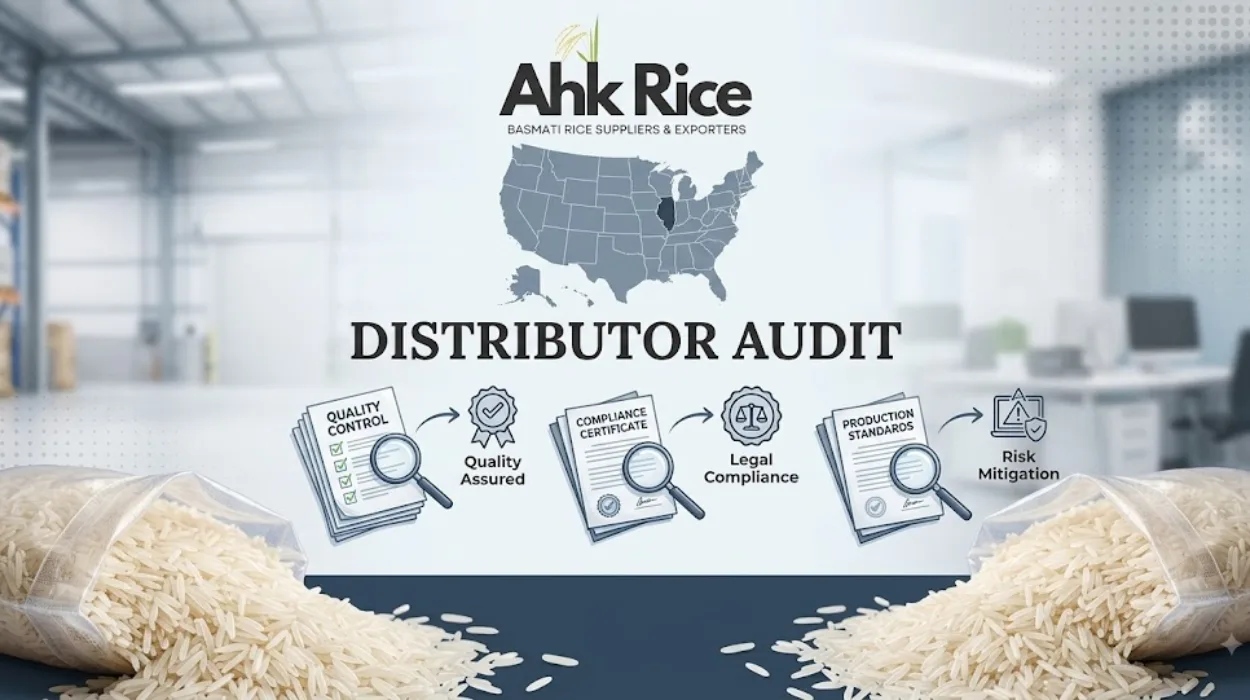
Illinois distributors request factory audit documentation because it shows how a rice facility controls food safety, sanitation, traceability, processing, storage, and corrective actions. The records help distributors evaluate foreign suppliers and support their documented supplier verification responsibilities before each purchase.
Factory audit documentation has become an important part of international rice sourcing because the buyer does not directly observe every stage of production. An Illinois distributor purchasing Pakistani Basmati rice needs evidence about the facility that receives paddy, processes rice, grades kernels, packs finished products, stores inventory, and prepares containers for export.
The audit record provides that evidence. It does not simply describe the factory. It connects written procedures with actual operating conditions and historical records.
For imported food, this distinction matters under the U.S. Food Safety Modernization Act (FSMA). The Foreign Supplier Verification Program (FSVP) places verification responsibilities on covered U.S. food importers. FDA states that supplier evaluation includes food safety procedures, processes, practices, compliance history, and other relevant factors. Verification activities include appropriate combinations of on-site audits, sampling and testing, and review of supplier food-safety records.
What Is Factory Audit Documentation?
Factory audit documentation is a structured record showing how an auditor evaluated a food-processing facility against defined food-safety, quality, operational, and regulatory requirements. It normally includes the audit scope, facility details, findings, evidence, nonconformities, corrective actions, auditor information, and final status.
For rice exporters, the audited facility is the location where raw paddy or rice enters the production system and moves through processing and packing controls.
A typical documentation package contains:
- Factory audit report
- Audit date and scope
- Facility identification
- Production and storage areas covered
- Food-safety management procedures
- Hazard analysis and preventive-control records
- Cleaning and sanitation records
- Pest-control records
- Employee hygiene procedures
- Water-quality records where applicable
- Equipment maintenance records
- Calibration records
- Laboratory or product-testing records
- Traceability records
- Supplier approval records
- Product specifications
- Packaging controls
- Finished-product release records
- Nonconformity reports
- Corrective-action evidence
- Certification documents where applicable
An audit report is therefore different from a product specification sheet. A specification describes the rice. An audit evaluates the system that produces and controls the rice.
This difference is important for Pakistani Basmati varieties such as 1121, Super Kernel, and 1509. A specification can state grain length, broken percentage, moisture, purity, or packaging requirements. An audit examines whether the factory has systems capable of controlling those requirements consistently.
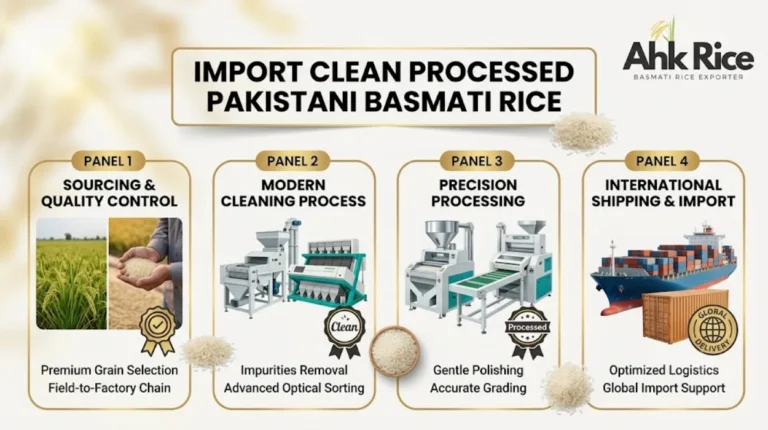
AHK Rice operates in Punjab, Pakistan, where Basmati rice production and processing form an important part of the regional rice industry. Its published product range includes 1121, Super Kernel, and 1509 varieties, with processing stages covering paddy procurement, cleaning, de-husking, separation, whitening, polishing, grading, and sorting.
How Does Factory Audit Documentation Work?
Factory audit documentation works as an evidence chain connecting facility controls with imported rice. An auditor reviews procedures, observes operations, samples records, records findings, assigns corrective actions, and issues a report showing whether controls consistently meet defined requirements for export.
The process starts by defining the audit scope.
For example, an Illinois distributor can request an audit covering Basmati rice processing, packing, storage, sanitation, traceability, and food-safety controls. A different buyer can request a broader audit covering the entire food-safety management system.
The auditor then reviews documented procedures before inspecting the physical facility.
The inspection normally moves through production areas in sequence. Raw-material receiving is checked first. Cleaning, de-husking, milling, grading, sorting, packing, finished-goods storage, and loading areas follow.
The auditor compares written procedures with actual practices.
If a factory procedure states that cleaning equipment is inspected every production shift, the auditor checks inspection records and observes the equipment. If the procedure requires lot traceability, the auditor selects a finished rice lot and traces it backward to processing records and raw-material information.
Findings are then classified according to the audit standard or customer protocol.
A nonconformity identifies a failure to meet a defined requirement. Corrective action explains how the facility addresses the cause. Supporting evidence demonstrates that the action was completed.
The result is a documented record that the distributor can evaluate as part of supplier approval.
For U.S. importers covered by FSVP, FDA specifically allows relevant activities to be performed by another entity when the importer reviews and assesses the corresponding documentation.
For a deeper explanation of the factory evaluation itself, the next-stage article can be integrated naturally here:
How rice processing facilities are evaluated during export audits.
What Are the Key Components of a Rice Factory Audit?
An effective rice factory audit examines personnel hygiene, building conditions, pest control, water, equipment, cleaning, process controls, laboratory testing, traceability, food defense, supplier approval, packaging, storage, records, and corrective actions. Each component provides documented evidence about facility control systems effectively.
Facility and infrastructure
The auditor examines production floors, walls, ceilings, drainage, lighting, ventilation, storage rooms, entrances, and material flow.
The purpose is to identify conditions that create contamination, pest, moisture, or hygiene risks.
Raw paddy and finished rice also require controlled movement. Physical separation helps prevent uncontrolled contact between incoming agricultural material and finished food.
Cleaning and sanitation
Cleaning procedures define what is cleaned, how it is cleaned, who performs the task, which chemicals are used, and how completion is verified.
Records provide evidence that the procedure is actually followed.
Rice facilities also require attention to dust accumulation because milling and grain handling generate fine particulate material throughout production areas.
Pest control
Pest-control programs cover inspection points, monitoring devices, treatment records, findings, corrective actions, and trend analysis.
The audit checks whether pest-control activity is systematic rather than performed only after visible infestation.
Processing controls
Rice processing normally includes cleaning, de-husking, paddy separation, whitening or polishing, grading, length sorting, optical sorting, and packing.
Parboiled or Sella products introduce additional processing controls involving soaking, steaming, drying, and subsequent milling.
Steam rice and parboiled rice therefore require different process records from conventional white rice.
Traceability
Traceability connects a finished product lot with its raw material, processing date, production records, packaging material, storage location, and shipment documentation.
A practical test involves selecting one finished lot and tracing it backward. A second test traces a raw-material lot forward into finished products.
Laboratory and product testing
Testing verifies measurable characteristics such as moisture, broken grains, grain dimensions, foreign matter, purity, and microbiological parameters where applicable.
The audit examines laboratory methods, sampling procedures, equipment calibration, test records, and handling of results.
Which Rice Grades Are Covered by Factory Audits?
Factory audits can cover white, steam, parboiled, Sella, creamy Sella, golden Sella, and brown rice grades because the audit evaluates production controls rather than treating every processing method as the same product. Each processing route requires appropriate operational and quality controls.
For Pakistani Basmati rice, the main commercial varieties include 1121, Super Kernel, and 1509.
1121 Basmati is an extra-long-grain variety widely used in export markets. Common processing grades include 1121 White, 1121 Steam, 1121 Brown, 1121 Parboiled, 1121 Golden Sella, and 1121 Creamy Sella.
Super Kernel Basmati is a slender-grain aromatic variety. Commercial processing grades include Super Kernel White, Brown, Steam, and Parboiled rice.
1509 Basmati is another long-grain export variety. Common grades include 1509 White, 1509 Steam, 1509 Brown, 1509 Parboiled, 1509 Golden Sella, 1509 Creamy Sella, and Sella variants.
The audit requirements change with the process.
A brown-rice operation retains the bran layer. A white-rice operation removes bran through milling. Steam and parboiled products introduce thermal processing controls. Sella production requires controlled soaking, steaming, drying, and milling.
This means an Illinois distributor should compare the audit scope with the actual product being purchased. A certificate covering one production scope does not automatically prove that every other processing line has identical controls.
What Benefits Do Illinois Distributors Get From Audit Records?
Audit documentation benefits distributors by reducing supplier uncertainty, supporting FSVP activities, improving traceability, comparing suppliers, verifying corrective actions, and documenting purchasing decisions. It also gives quality teams evidence for formal customer specifications, retailer requirements, complaints, recalls, and annual supplier reviews.
The first benefit is supplier qualification.
A distributor can use an audit report to determine whether a factory has documented controls before approving the supplier.
The second benefit is risk assessment.
FSVP requires covered importers to evaluate food hazards and supplier performance. FDA identifies factors including manufacturing, processing, packing, sanitation, transportation, storage, and the foreign supplier’s compliance history.
The third benefit is traceability.
A distributor handling multiple containers needs records that connect shipment lots with production records. This becomes important when investigating customer complaints or product-quality deviations.
The fourth benefit is corrective-action verification.
An audit finding without closure evidence leaves a supplier-control gap. A completed corrective-action record demonstrates what was corrected and how the factory verified completion.
The fifth benefit is customer documentation.
Illinois distributors often sell imported rice to restaurants, retailers, wholesalers, food-service companies, and private-label customers. Those customers can impose additional supplier requirements beyond basic import regulations.
Audit documentation gives the distributor a structured evidence package instead of relying only on supplier statements.
Where Are Factory Audit Records Used in Rice Distribution?
Rice factory audit records support multiple use cases, including new supplier approval, annual supplier review, private-label sourcing, high-volume contracts, retailer onboarding, complaint investigation, risk reassessment, and verification of corrective actions. Different buyers use the same evidence for different purchasing decisions.
New supplier approval
A distributor can request the latest audit report before approving a Pakistani rice exporter.
The quality team reviews the audit scope, findings, corrective actions, certification status, and production activities.
Private-label rice
Private-label programs require stronger control because the distributor’s brand appears on the package.
The buyer therefore needs evidence that the facility controls packaging, labeling, traceability, product specifications, and finished-product release.
High-volume contracts
Large contracts increase the commercial impact of quality failures.
An audit helps the buyer evaluate whether the supplier has documented systems for consistent processing, testing, storage, and shipment preparation.
Retailer onboarding
Retail chains often operate their own supplier-approval programs.
A distributor can use factory audit documentation to answer retailer questions about food safety, certifications, traceability, sanitation, and corrective actions.
Complaint investigation
If customers report broken grains, foreign material, packaging damage, unusual odor, or inconsistent cooking performance, audit records provide background on the facility’s controls.
The records help distinguish a production issue from a storage, transportation, or handling issue.
Which Certifications Apply to Rice Factory Audits?
Food-safety certifications provide structured evidence about management systems, but they are not interchangeable with U.S. import requirements. Common schemes include ISO 22000, HACCP-based systems, BRCGS Food Safety, and customer-specific audits, while FSVP remains an importer responsibility rather than a supplier certification.
ISO 22000 is an international food-safety management-system standard. ISO describes it as a framework for organizations throughout the food chain to establish, operate, maintain, and update food-safety management systems. ISO 22000:2018 remains an applicable published standard in 2026, with Amendment 1:2024 addressing climate-action changes.
HACCP means Hazard Analysis and Critical Control Points. It is a preventive food-safety approach that identifies hazards, determines controls, establishes monitoring, and defines corrective actions.
BRCGS Food Safety Issue 9 provides requirements for product safety, integrity, legality, quality, and operational controls in food manufacturing, processing, and packing. BRCGS states that Issue 9 remains the current food-safety standard, with updated position statements effective for audits conducted from August 10, 2026.
FDA Accredited Third-Party Certification is different. FDA describes its program as voluntary and designed around recognized accreditation bodies and accredited certification bodies that conduct food-safety audits of foreign facilities.
FSVP is not a factory certificate. It is the U.S. importer’s documented program for verifying that covered foreign suppliers produce food according to applicable U.S. requirements.
A distributor should therefore ask for the correct document for each requirement rather than treating every certificate as equivalent.
What Are Common Problems and Misconceptions About Factory Audits?
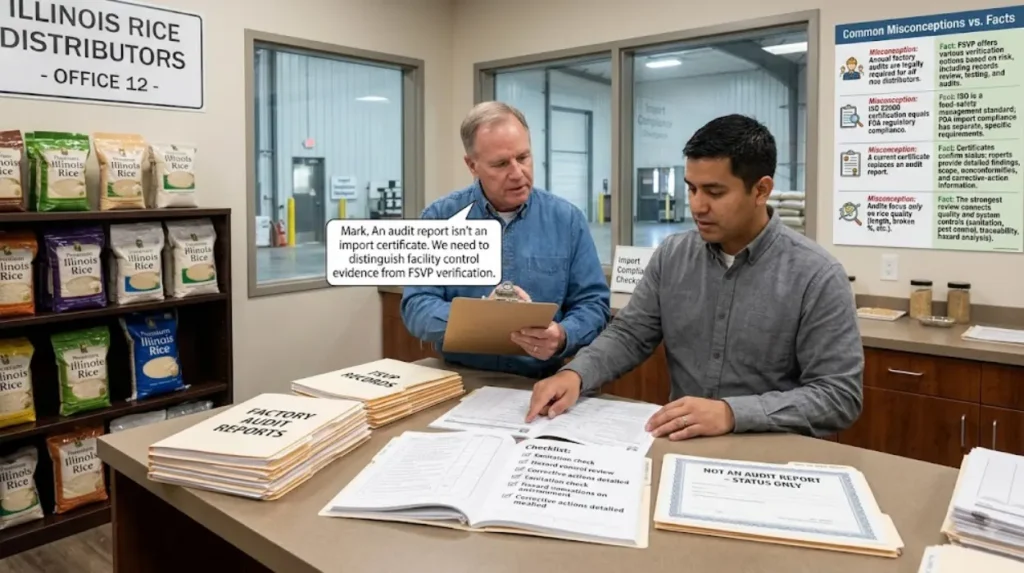
Distributors often confuse an audit report with an import certificate. A factory audit is evidence about facility controls, while FSVP is the importer’s regulatory verification program. Certification schemes are separate systems, and FDA third-party certification is voluntary except specified situations.
One common misconception is that every U.S. rice distributor is legally required to obtain an annual factory audit.
FSVP does not impose one identical verification method on every imported food. FDA gives covered importers several verification options based on risk, including audits, testing, and record review. Annual on-site audits receive specific treatment when a foreign-controlled hazard presents a reasonable probability of serious adverse health consequences or death, subject to the rule’s requirements and alternatives.
Another misconception is that ISO 22000 certification automatically proves U.S. regulatory compliance.
It does not. ISO 22000 evaluates a food-safety management system against its standard. U.S. import compliance involves separate FDA requirements and importer responsibilities.
A third misconception is that a current certificate replaces an audit report.
A certificate confirms certification status against a defined scheme. An audit report provides detailed findings, scope, nonconformities, and corrective-action information.
A fourth misconception is that the audit should focus only on rice quality.
Quality and food safety are connected but different. Grain length, broken percentage, moisture, purity, and appearance are product characteristics. Sanitation, pest control, traceability, hazard controls, and corrective actions are system controls.
The strongest supplier review connects both.
For Illinois distributors, factory audit documentation therefore serves as an evidence layer between the foreign processing facility and the U.S. purchasing decision. It helps establish what was examined, which requirements applied, what findings were recorded, and whether identified problems were corrected.
In 2026, the most useful approach is to match the audit scope to the actual rice product, processing method, supplier risk, customer requirements, and applicable U.S. import obligations rather than requesting certificates without understanding their purpose.
Frequently Asked Questions
Why do Illinois distributors request factory audit documentation?
Illinois distributors request factory audit documentation to verify a rice supplier’s food-safety controls, sanitation procedures, traceability systems, processing practices, corrective actions, and facility conditions before approving or continuing a supplier relationship.
What does a rice factory audit report contain?
A rice factory audit report typically contains the audit scope, facility information, production areas inspected, food-safety procedures, sanitation records, pest-control records, traceability evidence, nonconformities, corrective actions, and final audit status.
Is a factory audit required for every Illinois rice importer?
No. U.S. importers covered by the Foreign Supplier Verification Program (FSVP) must conduct appropriate supplier verification, but FDA does not require one identical verification method for every supplier. The verification approach depends on the food-safety hazards and supplier risk.
What does FSVP have to do with factory audits?
FSVP requires covered U.S. importers to evaluate foreign suppliers and verify that imported food is produced in accordance with applicable U.S. food-safety requirements. An on-site factory audit is one verification method that can provide evidence for this evaluation.
What areas are inspected during a rice factory audit?
Auditors inspect areas such as raw-material receiving, rice processing, milling, grading, sorting, packaging, storage, sanitation, pest control, employee hygiene, equipment maintenance, traceability, testing, and finished-product handling.
Why is traceability important in a rice factory audit?
Traceability shows whether a finished rice lot can be connected to its raw materials, processing records, packaging information, storage location, and shipment records. This supports complaint investigation, corrective action, and product withdrawal when necessary.
Which certifications are relevant to rice processing facilities?
Relevant certifications and systems include ISO 22000, HACCP-based food-safety systems, BRCGS Food Safety, and customer-specific audit programs. Their requirements differ, so distributors should evaluate each certification according to its scope and validity.