Why Do Indiana Buyers Monitor Shipment Consistency from Suppliers?
Indiana buyers monitor shipment consistency because imported rice inventory depends on predictable quantities, specifications, arrival schedules, and documentation. For Pakistani Basmati rice, shipment consistency connects supplier production, export processing, container loading, ocean transit, customs clearance, and warehouse replenishment into one measurable supply process.
A shipment is consistent when repeated orders arrive within the agreed delivery window and maintain the same commercial specification. The specification includes rice variety, grain length, broken percentage, moisture, foreign matter, milling quality, packaging, net weight, and lot identification.
Indiana buyers include food distributors, wholesalers, grocery suppliers, restaurant distributors, institutional food buyers, and importers. Each group uses rice differently. Examples include retail bags for supermarkets, bulk sacks for distributors, and larger commercial quantities for foodservice operations.
What does shipment consistency mean for Indiana rice buyers?
Shipment consistency means receiving the contracted rice quantity, quality, packaging, documentation, and delivery timing repeatedly across purchase cycles. Indiana buyers monitor these variables because each change affects inventory levels, customer orders, warehouse capacity, and replenishment decisions.
Shipment consistency has four measurable dimensions.
The first is quantity consistency. A buyer ordering 20 metric tons per shipment needs the supplier to repeatedly prepare the contracted quantity. A 20-metric-ton order delivered as 16 metric tons creates an inventory gap that affects the next replenishment calculation.
The second is quality consistency. The same product name does not automatically mean identical physical specifications. A buyer purchasing 1121 Basmati rice needs a defined specification for grain length, broken percentage, moisture, color, milling quality, and packaging.
The third is schedule consistency. A purchase order contains a planned production and shipping schedule. The buyer then connects the expected arrival date with warehouse stock and customer demand.
The fourth is document consistency. Commercial invoices, packing lists, bills of lading, certificates, product specifications, and food-import information must identify the shipment accurately. U.S. food imports also operate under FDA requirements for safety, sanitary production, labeling, facility registration, and prior notice.
How does a Pakistani Basmati rice shipment reach Indiana?
A Pakistani Basmati rice shipment moves through paddy procurement, milling, aging, sorting, grading, quality inspection, packaging, container loading, export documentation, ocean transportation, U.S. entry procedures, inland transportation, and Indiana warehouse receiving.
The process begins with paddy procurement in Pakistan. Basmati rice is associated with rice-growing areas of Punjab, where agricultural conditions support aromatic long-grain varieties.
The paddy then enters a rice mill. Milling removes the husk and separates edible rice from other material. Depending on the product, additional processing creates white, steamed, or parboiled rice.
A typical export process contains these stages:
- Paddy procurement and quality inspection.
- Cleaning and removal of impurities.
- Dehusking to remove the outer husk.
- Milling and whitening where required.
- Aging or controlled storage according to the product specification.
- Optical and mechanical sorting.
- Grading by grain characteristics and broken percentage.
- Final quality inspection.
- Packaging into the agreed retail or commercial format.
- Container loading and shipment documentation.
- Ocean transportation to the United States.
- Customs and food-import procedures.
- Inland transportation to the Indiana receiving point.
- Warehouse inspection and inventory entry.
This sequence explains why shipment consistency starts before the container reaches a port. A delay during procurement, processing, packaging, documentation, or transport changes the final arrival date.
For U.S. food imports, FDA requires prior notice before imported food arrives, while most facilities that manufacture, process, pack, receive, or hold food must maintain FDA registration when registration requirements apply.
Which rice specifications should Indiana buyers monitor?
Indiana buyers should monitor variety, grain length, broken percentage, moisture, foreign matter, milling quality, color, packaging weight, lot identification, and shipment quantity because these specifications determine whether repeated deliveries match the product originally purchased.
Pakistani Basmati rice includes several commercial varieties. 1121 Basmati is recognized for extra-long grains and strong elongation after cooking. Super Kernel Basmati is another long-grain Basmati category used in export markets. 1509 Basmati is an early-maturing Basmati variety used in white, steamed, and parboiled commercial formats.
Rice is also sold under processing and grade descriptions. Examples include white rice, steam rice, sella or parboiled rice, and creamy sella.
A buyer should not treat variety and processing method as interchangeable terms. A product such as 1121 Steam Basmati identifies both the variety and processing format. The purchase specification should then define measurable quality parameters.
Important parameters include:
| Shipment variable | What the buyer checks |
|---|---|
| Variety | 1121, Super Kernel, 1509, or contracted variety |
| Grain length | Physical grain measurement and elongation performance |
| Broken rice | Percentage of broken kernels |
| Moisture | Moisture level against the purchase specification |
| Foreign matter | Presence of non-rice material |
| Milling quality | Degree of polishing and milling uniformity |
| Packaging | Bag type, printed information, and net weight |
| Quantity | Metric tons or agreed commercial quantity |
| Lot identity | Traceability between production and shipment |
| Documents | Invoice, packing list, transport and compliance records |
A consistent supplier therefore provides more than containers of rice. The supplier provides repeatable physical and documentary specifications.
What are the key components of shipment consistency?
Shipment consistency depends on production capacity, quality control, inventory coordination, export documentation, logistics scheduling, container management, regulatory compliance, and communication between supplier, freight providers, customs representatives, and the Indiana buyer.
Production capacity determines whether the supplier can prepare the required quantity during the purchasing period. Capacity includes procurement, milling, sorting, grading, packaging, inspection, and loading.
Quality control compares the finished shipment against the approved specification. Examples include grain measurements, moisture checks, broken-kernel analysis, and foreign-matter inspection.
Inventory coordination connects purchase quantities with warehouse stock. A distributor selling 5 metric tons per month needs a different replenishment structure from a distributor selling 20 metric tons per month.
Logistics scheduling covers container availability, vessel booking, port handling, ocean transit, customs processing, and inland transportation.
Documentation control keeps commercial and regulatory information aligned. Incorrect quantities or inconsistent product descriptions create administrative problems even when the physical rice meets the specification.
Regulatory compliance is also part of shipment reliability. FDA states that imported food must satisfy U.S. legal requirements, and imported shipments remain subject to inspection at U.S. ports of entry.
Why does shipment consistency improve inventory control?
Consistent shipments give Indiana buyers a reliable relationship between purchase orders, expected arrivals, warehouse stock, and customer demand. This reduces emergency replenishment, improves safety-stock calculations, supports purchasing schedules, and limits inventory gaps caused by unpredictable deliveries.
Inventory planning starts with demand.
Suppose an Indiana distributor sells 12 metric tons of Basmati rice each month. A shipment of 24 metric tons provides approximately 2 months of supply before accounting for safety stock, damaged goods, promotional demand, and changes in sales volume.
If shipments arrive according to the planned cycle, the buyer can schedule the next purchase before stock reaches the reorder point.
The situation changes when delivery dates vary sharply. A shipment expected in January that arrives in February creates a one-month planning gap. The buyer then has to assess remaining inventory, customer commitments, substitute products, and the next shipment.
This is why shipment consistency is closely related to inventory planning. The buyer is not only measuring whether a container arrived. The buyer is measuring whether the arrival occurred at the point required by the inventory system.
The connection between delivery performance and inventory planning is explored in the next stage of this topic: Understanding:
How consistent shipping improves rice inventory planning.
What benefits do Indiana buyers get from consistent rice shipments?
Consistent rice shipments improve inventory visibility, purchasing accuracy, warehouse planning, customer fulfillment, specification control, financial forecasting, and supplier performance measurement. They also help buyers establish repeatable replenishment cycles instead of reacting to individual shipment problems.
The first benefit is better inventory visibility. Buyers know when the next shipment enters the supply system and how much stock it contains.
The second is better purchasing control. Purchase orders can follow historical demand rather than emergency requirements.
The third is better warehouse planning. A known container quantity allows receiving teams to prepare storage space, labor, inspection procedures, and handling equipment.
The fourth is customer-service stability. Restaurants, retailers, wholesalers, and foodservice distributors depend on available stock. A missed shipment can affect multiple downstream customers.
The fifth is specification control. Repeated shipments create a baseline. Buyers can compare each new lot against the approved specification.
The sixth is financial planning. Predictable purchase cycles help businesses plan procurement expenditure, freight costs, duties, warehouse costs, and working capital.
Where is shipment consistency especially important?
Shipment consistency is especially important for distributors, restaurant suppliers, grocery wholesalers, institutional buyers, private-label programs, and businesses with recurring customer contracts because these operations depend on continuous stock availability and repeatable product specifications.
A food distributor needs consistent quantities because inventory is allocated across multiple customers.
A restaurant supplier needs consistent rice specifications because commercial kitchens rely on predictable cooking performance. Changes in grain quality or processing can affect portion yield and preparation results.
A grocery wholesaler needs packaging consistency because retail customers expect the same product identity, net weight, labeling, and presentation across replenishment cycles.
An institutional buyer needs reliable delivery timing because food purchasing often follows scheduled consumption and procurement cycles.
A private-label program requires stronger consistency because the rice is sold under a defined brand specification. Packaging, product identity, net weight, and quality parameters must remain controlled.
These use cases explain why a buyer should evaluate shipment history rather than only a single successful delivery.
Which certifications and compliance records relate to shipment consistency?
Certifications and compliance records support shipment consistency by documenting food-safety systems, facility controls, product specifications, and traceability. Their relevance depends on the buyer, product, facility, and destination requirements rather than on one universal certification.
Common records include FDA food facility registration, where registration requirements apply, and documentation supporting the U.S. importer’s Foreign Supplier Verification Program (FSVP) responsibilities.
Other commercial buyers request certifications or audit records such as HACCP-based food-safety documentation, ISO 22000, BRCGS, or other recognized food-safety standards. Organic certification applies when the product is sold as organic and the applicable certification requirements are satisfied.
These records should not be confused with FDA approval. FDA states that it does not pre-approve individual imported food products, labels, or shipments. Imported food must comply with applicable U.S. requirements when offered for import.
Shipment consistency therefore includes documentary consistency. The product, facility, lot, quantity, and shipping information need to remain traceable across the transaction.
Pakistan’s rice export environment also affects supply planning. USDA’s July 2026 Pakistan Grain and Feed Update forecasts 2026/27 rice production at 9.1 million metric tons and rice exports at 4.9 million metric tons. The same report identifies logistical challenges affecting Pakistan’s rice exports, showing why buyers need to monitor the complete supply chain rather than production alone.
What common problems cause inconsistent rice shipments?
Common shipment-consistency problems include production shortages, specification changes, delayed packaging, documentation errors, container delays, port congestion, customs issues, inaccurate demand forecasts, and weak communication between suppliers, logistics providers, brokers, and buyers.
A production shortage reduces the quantity available for loading.
A specification change creates differences between purchase orders and delivered rice. Examples include different grain grades, processing methods, broken percentages, or packaging formats.
A documentation error can delay customs or food-import processing. Product identity, quantity, manufacturer information, and shipment records must remain accurate.
A container delay changes the transportation schedule even when production is complete.
A demand forecasting error creates another problem. A buyer that sells 15 metric tons per month but orders based on a 10-metric-ton forecast eventually faces a stock shortage.
Communication gaps also create inconsistencies. Production, quality control, freight booking, documentation, and warehouse receiving need the same shipment reference and commercial specifications.
What is the biggest misconception about shipment consistency?
The biggest misconception is that shipment consistency only means delivering containers on time. True consistency includes quantity, rice specification, packaging, documentation, regulatory readiness, and arrival timing because all six variables determine whether the shipment performs as planned.
A container arriving on schedule does not represent complete consistency if it contains the wrong quantity.
Likewise, correct quantity does not represent consistency if the rice has a different grade or processing method.
A shipment with correct rice can still create problems when documentation contains conflicting product or quantity information.
The correct approach is to measure shipment performance using multiple variables. Indiana buyers can compare planned versus actual quantity, planned versus actual arrival date, specification conformity, documentation accuracy, packaging conformity, and receiving condition.
This creates a shipment-performance record that supports future purchasing decisions.
How should Indiana buyers measure supplier shipment consistency?
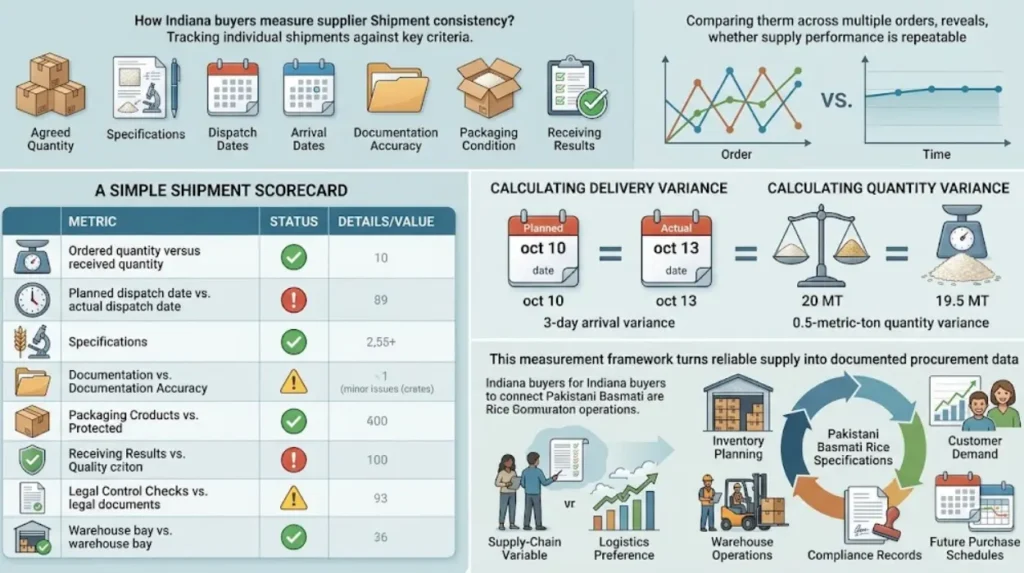
Indiana buyers should track each shipment against agreed quantity, specification, dispatch date, arrival date, documentation accuracy, packaging condition, and receiving results. Comparing these measurements across multiple orders reveals whether supply performance is repeatable.
A simple shipment scorecard can contain:
- Ordered quantity versus received quantity.
- Planned dispatch date versus actual dispatch date.
- Planned arrival date versus actual arrival date.
- Approved rice specification versus received specification.
- Approved packaging versus received packaging.
- Expected documents versus submitted documents.
- Warehouse receiving condition versus purchase requirements.
The buyer can then calculate delivery variance in days and quantity variance in metric tons.
For example, a shipment planned for arrival on October 10 and received on October 13 has a 3-day arrival variance. A shipment ordered at 20 metric tons and received at 19.5 metric tons has a 0.5-metric-ton quantity variance.
This measurement framework turns the broad concept of “reliable supply” into documented procurement data.
Shipment consistency is therefore a supply-chain variable, not simply a logistics preference. Indiana buyers use it to connect Pakistani Basmati rice specifications with inventory planning, customer demand, warehouse operations, compliance records, and future purchase schedules.
Frequently Asked Questions
Why do Indiana buyers monitor rice shipment consistency?
Indiana buyers monitor shipment consistency to maintain reliable inventory levels, meet customer demand, control purchasing schedules, and avoid stock shortages caused by delayed or incomplete rice deliveries.
What does shipment consistency mean in rice imports?
Shipment consistency means receiving the agreed rice quantity, quality, packaging, documentation, and delivery timing across repeated purchase orders.
Which rice specifications should Indiana buyers check?
Buyers should check rice variety, grain length, broken percentage, moisture, foreign matter, milling quality, packaging, net weight, lot identification, and quantity.
How does consistent shipping improve rice inventory planning?
Consistent shipping gives buyers predictable arrival dates and quantities. This helps them calculate reorder points, safety stock, warehouse requirements, and future purchasing schedules more accurately.
Which Pakistani Basmati rice varieties are relevant to Indiana buyers?
Common Pakistani Basmati varieties include 1121 Basmati, Super Kernel Basmati, and 1509 Basmati. Each variety has distinct grain characteristics and commercial processing options.
What causes inconsistent rice shipments?
Common causes include production shortages, packaging delays, specification changes, documentation errors, container delays, port congestion, customs issues, and inaccurate demand forecasts.
Why is documentation important for consistent rice shipments?
Accurate documentation keeps product identity, quantity, origin, shipment details, and regulatory information aligned. Inconsistent documents can delay import processing even when the physical rice meets the purchase specification.
Which certifications can rice importers request?
Depending on the product and buyer requirements, importers can request food-safety certifications and records such as HACCP-based systems, ISO 22000, BRCGS, organic certification where applicable, and FDA-related compliance documentation.
How can Indiana buyers measure supplier shipment consistency?
Buyers can compare ordered versus received quantity, planned versus actual arrival dates, approved versus received specifications, packaging condition, documentation accuracy, and warehouse receiving results across multiple shipments.