Comparing Grain Length, Aroma and Broken Percentages Across Varieties
Buyers comparing Basmati rice varieties achieve the most consistent purchasing decisions by evaluating grain length, aroma intensity, broken percentage, milling quality, cooking performance, and regional market preferences together instead of relying on a single specification. In 2026, importers serving the United States, Europe, and the Middle East increasingly use complete quality specifications to reduce customer complaints, improve cooking consistency, and maintain long-term brand reputation.
Selecting the right Basmati variety requires understanding how every quality characteristic influences consumer satisfaction, retail positioning, restaurant performance, and import costs. If you are still exploring the differences between major varieties before comparing detailed specifications, reading our guide about:
Why different Basmati varieties perform differently in American cooking environments provides useful background knowledge. Likewise, businesses evaluating export-ready products should understand how each specification affects purchasing decisions before selecting a supplier. AHK Rice, a Pakistani exporter based in Punjab, processes and exports premium Basmati rice varieties including 1121, Super Kernel, and 1509 while following internationally recognised quality standards and customised export requirements.
Why do grain length, aroma, and broken percentage matter when comparing Basmati rice?
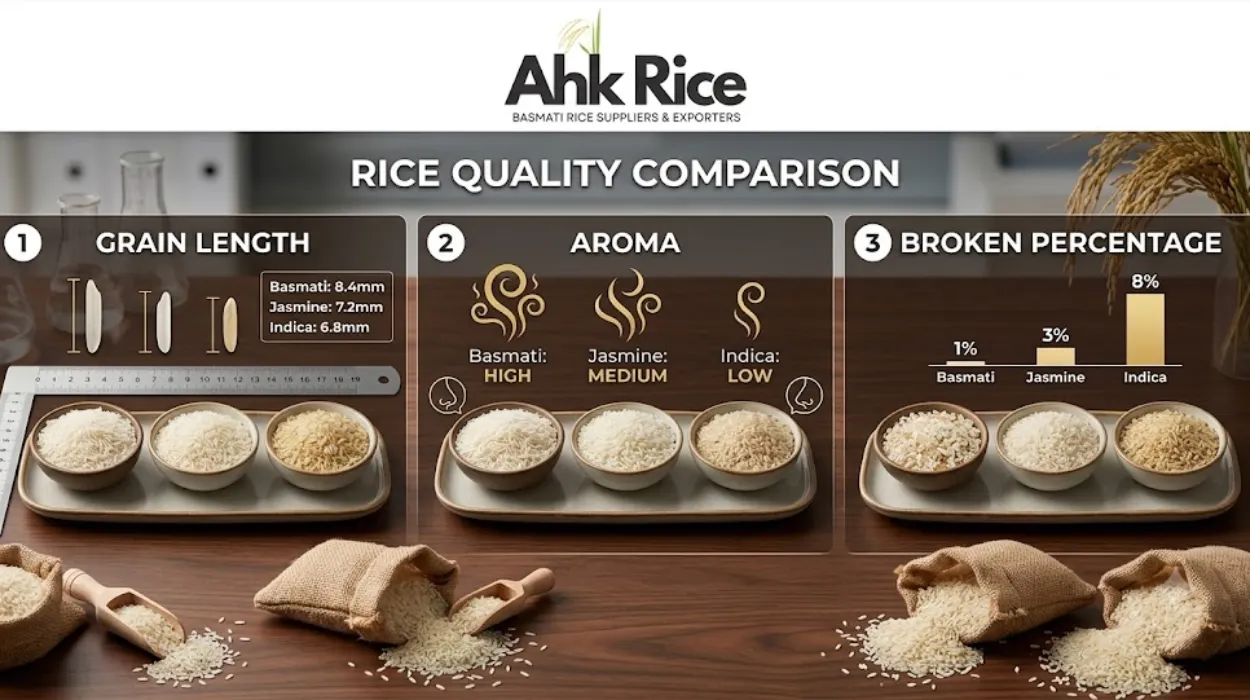
Grain length, aroma intensity, and broken percentage directly influence cooking quality, customer satisfaction, retail value, restaurant performance, shelf presentation, and market acceptance. Importers evaluating these specifications together achieve better purchasing outcomes than buyers focusing only on price or grain appearance alone.
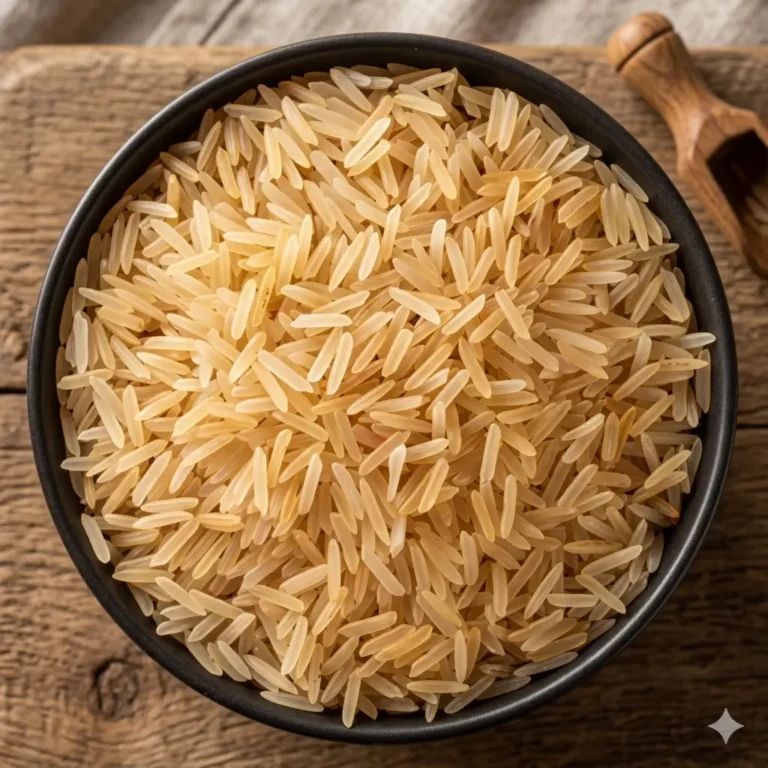
Grain length represents one of the most visible quality indicators in premium Basmati rice. Longer grains create stronger shelf appeal before cooking and produce elegant presentation after cooking. Importers serving premium retail chains usually prioritise extra-long grain varieties because consumers associate longer grains with authentic premium Basmati.
Aroma determines consumer perception before and after cooking. Natural aromatic compounds create the distinctive fragrance expected from authentic Pakistani Basmati. Premium restaurants and specialty retailers generally favour varieties with stronger natural aroma because fragrance significantly influences repeat purchases.
Broken percentage measures the amount of fractured rice kernels present within a shipment. Lower broken percentages improve cooking uniformity, packaging appearance, and product consistency. Premium export contracts commonly specify broken percentages between 1% and 5%, while economy grades allow higher tolerances depending on market requirements.
These three specifications should always be evaluated alongside moisture content, purity, foreign matter limits, milling degree, and ageing because they collectively determine overall export quality.
What are the available solutions when selecting Basmati rice varieties?
Importers can choose among several premium Pakistani Basmati varieties, each offering different strengths in grain length, aroma, cooking performance, and commercial positioning. Matching product specifications with customer expectations produces stronger long-term market performance than selecting varieties solely by price.
Pakistan exports several recognised Basmati varieties suitable for international food markets.
The 1121 Basmati variety is widely recognised for its exceptional grain length and outstanding elongation after cooking. It serves premium retail brands, restaurants, hotels, and food service distributors seeking impressive visual presentation.
The Super Kernel Basmati variety is valued for its traditional aroma, balanced grain characteristics, excellent flavour profile, and consistent cooking behaviour. It remains highly popular across Middle Eastern and European ethnic food markets.
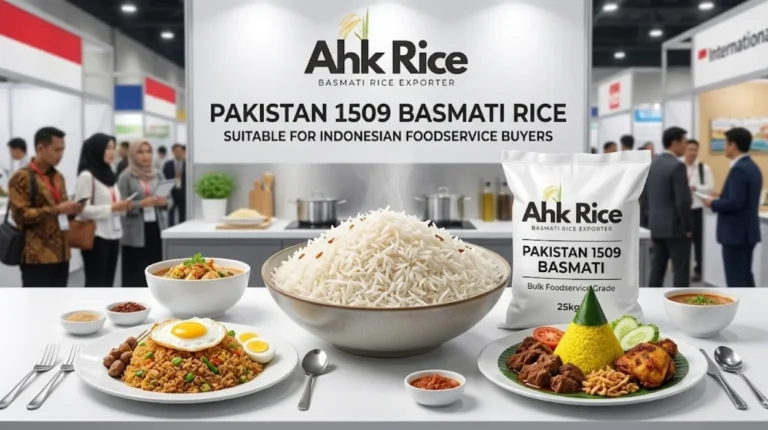
The 1509 Basmati variety offers relatively earlier maturity while maintaining attractive grain appearance, good cooking quality, and competitive commercial pricing. It continues gaining popularity among value-focused importers seeking premium quality with efficient procurement costs.
AHK Rice supplies these varieties with customised processing, grading, packaging, and export documentation according to buyer specifications, allowing distributors to source products matching regional consumer demand.
How do different Basmati varieties compare across key quality specifications?
Comparing technical specifications provides the clearest understanding of variety performance. Grain dimensions, aroma, broken percentage, elongation ratio, cooking behaviour, milling quality, and commercial positioning collectively determine suitability for different retail, food service, and distribution markets.
| Specification | 1121 Basmati | Super Kernel Basmati | 1509 Basmati |
|---|---|---|---|
| Average Grain Length | 8.3–8.5 mm | 7.2–7.6 mm | 8.0–8.3 mm |
| Cooked Grain Elongation | Excellent | Very Good | Excellent |
| Natural Aroma | Strong | Very Strong | Moderate to Strong |
| Premium Export Broken % | 1–2% preferred | 2–5% preferred | 2–5% preferred |
| Milling Appearance | Excellent | Excellent | Very Good |
| Typical Market Position | Premium | Premium Traditional | Premium Value |
| Best Applications | Retail & Restaurants | Traditional Cuisine | Retail & Food Service |
Each specification influences customer experience differently.
Longer grains improve presentation.
Lower broken percentages improve cooking consistency.
Higher aroma strengthens product differentiation.
Superior milling enhances retail appearance.
Balanced specifications create stronger commercial value than excelling in only one characteristic.
How do different international markets compare in their preferred Basmati grades?
Different importing regions prioritise different quality characteristics. Understanding regional buying preferences enables importers to select grades matching consumer expectations, retail positioning, pricing strategy, and competitive market demand without unnecessary specification mismatches.
Consumer preferences differ significantly across international markets.
United States and Canada
North American buyers increasingly prefer:
- Extra-long grains
- Very low broken percentage
- Bright milling appearance
- Uniform grain size
- Premium retail packaging
Restaurants serving South Asian cuisine also prefer maximum cooked grain elongation because presentation strongly influences customer perception.
Middle East and GCC Markets
Buyers across GCC countries often prioritise:
- Strong traditional aroma
- Consistent cooking texture
- Rich flavour profile
- Premium appearance
- Authentic Pakistani origin
Super Kernel continues maintaining strong demand across these markets because traditional consumers recognise its distinctive fragrance and cooking behaviour.
European specialty retailers typically balance both preferences, requesting premium grain appearance alongside authentic aroma while maintaining strict food safety and quality compliance standards.
How do export prices compare between premium Basmati varieties in 2026?
Export pricing varies according to harvest quality, processing standards, packaging, destination, and contract volume. Comparing approximate price ranges alongside quality specifications provides more accurate purchasing decisions than evaluating price independently from technical characteristics.
Indicative Pakistani export prices during 2026 generally follow this pattern for premium processed grades.
| Variety | Approximate Export Price (USD/MT) |
|---|---|
| 1121 Basmati | 1,180–1,420 |
| Super Kernel Basmati | 1,050–1,280 |
| 1509 Basmati | 980–1,180 |
Several variables influence final contract pricing.
Packaging type.
Broken percentage.
Moisture specification.
Container quantity.
Private labelling.
Destination requirements.
Food safety certification.
Seasonal availability.
Importers comparing only price frequently overlook quality differences that influence resale value, customer satisfaction, and long-term profitability.
How does shelf life compare across premium Basmati varieties?
Shelf life depends more on moisture control, storage conditions, packaging quality, and processing standards than on rice variety itself. Properly processed premium Basmati maintains excellent quality throughout extended international storage and distribution periods.
| Variety | Typical Shelf Life |
|---|---|
| 1121 Basmati | 18–24 months |
| Super Kernel Basmati | 18–24 months |
| 1509 Basmati | 18–24 months |
Proper storage requires:
- Moisture below export specifications
- Clean warehouse environments
- Controlled humidity
- Protection from direct sunlight
- Strong export packaging
- Proper container ventilation
When these conditions are maintained, premium Pakistani Basmati preserves aroma, texture, grain integrity, and cooking performance throughout international supply chains.
What are the advantages and disadvantages of each variety?
Every Basmati variety delivers different commercial strengths. Understanding both advantages and limitations helps buyers match products with target customers, retail positioning, operational requirements, and pricing objectives instead of expecting one variety to suit every application.
1121 Basmati
Advantages
- Exceptional grain length
- Excellent elongation
- Premium appearance
- High restaurant acceptance
- Strong retail demand
Limitations
- Higher procurement cost
- Premium positioning limits budget-focused applications
Example: Premium restaurant chains serving authentic South Asian cuisine often select 1121 because cooked presentation supports premium menu pricing.
Super Kernel Basmati
Advantages
- Rich traditional aroma
- Excellent flavour
- Balanced cooking texture
- Strong consumer recognition
Limitations
- Shorter grain compared with 1121
- Less dramatic cooked elongation
Example: Middle Eastern retailers frequently select Super Kernel because returning customers value aroma more than maximum grain length.
1509 Basmati
Advantages
- Competitive pricing
- Long grain appearance
- Strong cooking quality
- Good commercial flexibility
Limitations
- Slightly lighter aroma than Super Kernel
- Premium positioning depends on processing quality
Example: Retail distributors targeting value-conscious consumers often choose 1509 because it combines attractive presentation with competitive pricing.
Which method works best for different purchasing situations?
The best purchasing decision depends on customer expectations, sales channels, budget, product positioning, and regional demand. Matching technical specifications with commercial objectives consistently produces stronger long-term business performance than selecting a universal solution.
| Decision Factor | Best Choice |
|---|---|
| Premium Restaurant Supply | 1121 Basmati |
| Traditional Aroma Focus | Super Kernel |
| Value Premium Retail | 1509 Basmati |
| Luxury Private Label | 1121 Basmati |
| Mixed Retail Distribution | Combination of 1121 and 1509 |
No single variety dominates every commercial application.
Instead, experienced importers often diversify product portfolios to satisfy multiple customer segments while managing procurement costs effectively.
Which decision factors should importers evaluate before choosing a Basmati variety?
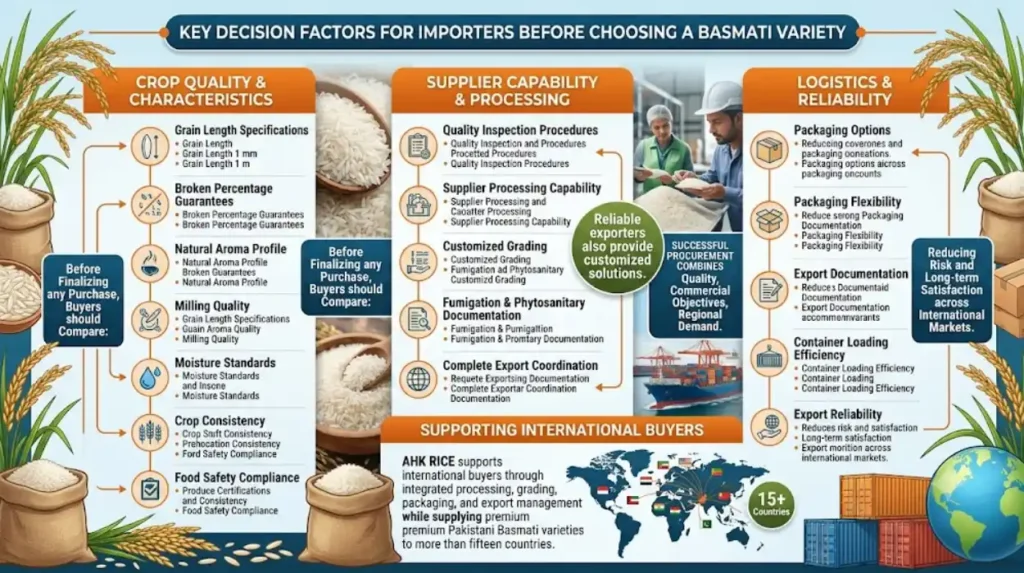
Successful procurement decisions combine quality specifications, commercial objectives, regional demand, supplier capability, packaging flexibility, and export reliability. Evaluating these factors together reduces purchasing risk and improves long-term customer satisfaction across international markets.
Before finalising any purchase, buyers should compare:
- Grain length specifications
- Broken percentage guarantees
- Natural aroma profile
- Milling quality
- Moisture standards
- Crop consistency
- Food safety compliance
- Packaging options
- Export documentation
- Container loading efficiency
- Quality inspection procedures
- Supplier processing capability
Reliable exporters also provide customised grading, packaging, quality inspection, fumigation, phytosanitary documentation, and complete export coordination to simplify international procurement.
AHK Rice supports international buyers through integrated processing, grading, packaging, and export management while supplying premium Pakistani Basmati varieties to more than fifteen countries. Businesses ready to evaluate sourcing options and detailed procurement requirements can also explore our guide on:
Selecting reliable export partners for premium Pakistani Basmati rice distribution before making supplier comparisons.
Frequently Asked Questions
What is the most important factor when comparing Basmati rice varieties?
The most important factors include grain length, aroma, broken percentage, cooking performance, and milling quality. Evaluating these specifications together provides a complete picture of the rice’s quality and suitability for different markets.
Which Basmati rice variety has the longest grain?
1121 Basmati is recognised for its extra-long grain length and exceptional elongation after cooking, making it a preferred choice for premium retail brands and restaurants.
Why does broken percentage matter in Basmati rice?
A lower broken percentage improves the appearance, cooking consistency, and overall quality of the rice. Premium export grades typically contain only 1–5% broken grains.
Which Basmati rice variety has the strongest natural aroma?
Super Kernel Basmati is widely known for its rich natural aroma and traditional flavour, making it popular in Middle Eastern and ethnic food markets.
Which Basmati rice variety is best for the USA market?
The USA market generally prefers 1121 Basmati because of its extra-long grains, excellent cooking performance, and attractive presentation. However, 1509 Basmati is also popular among value-focused buyers.
How long can premium Basmati rice be stored?
When stored in cool, dry conditions with proper packaging, premium Basmati rice typically has a shelf life of 18 to 24 months while maintaining its quality and aroma.
How should importers choose the right Basmati rice variety?
Importers should compare grain length, aroma, broken percentage, price, target market preferences, packaging requirements, and supplier quality standards before making a purchasing decision.