Complete Export Grade Specification Guide for Pakistani Basmati Rice: AGL, Broken %, Moisture and Purity
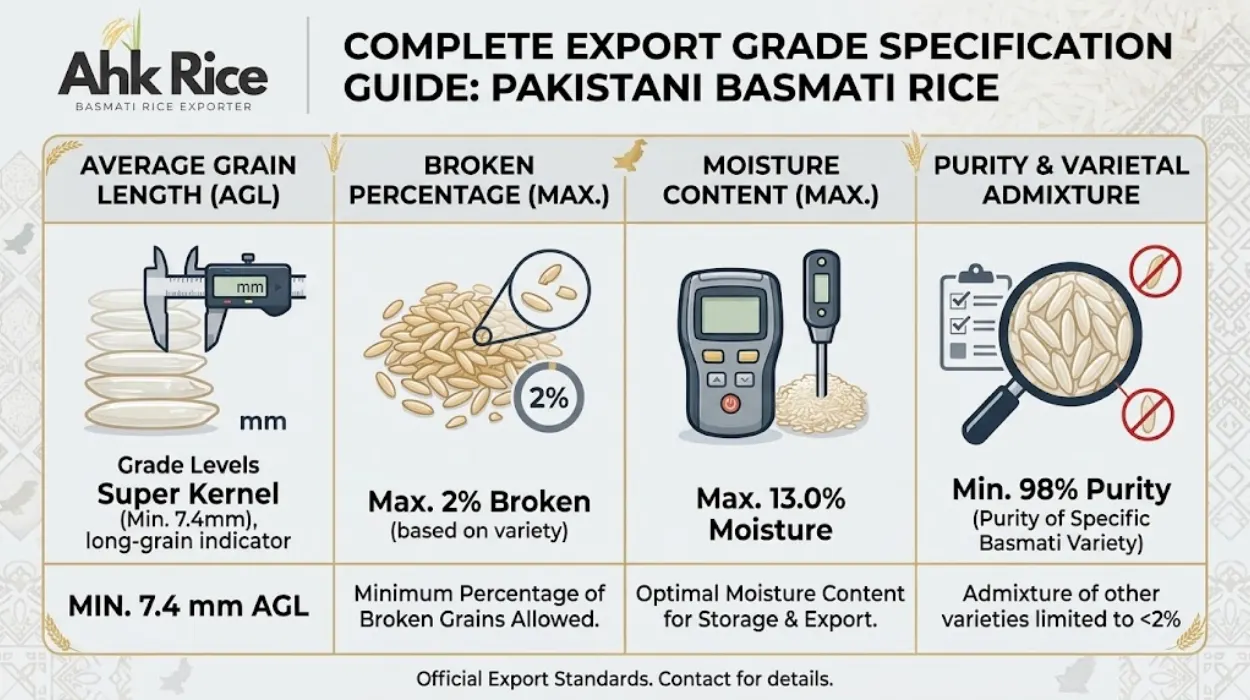
The best export-grade Pakistani Basmati rice specification depends on the buyer’s market, target price, cooking requirements, and quality tolerances: AGL defines average grain length, broken percentage affects presentation and yield, moisture influences storage stability, and purity determines the consistency of the delivered product.
Importers should evaluate these parameters together rather than selecting rice by grain length alone. A shipment with long grains can still fail a buyer’s expectations if it contains excessive broken kernels, foreign matter, inconsistent milling, or moisture outside the agreed limits. Understanding how Pakistani Basmati rice is grown, processed, and graded provides the foundation for comparing export specifications and understanding how milling, sorting, and grading influence the final product.
AHK Rice is a Pakistani Basmati rice exporter based in Punjab, supplying 1121, Super Kernel, and 1509 varieties to more than 15 countries. Its end-to-end processing, custom packaging, and export services support buyers who need specifications aligned with their distribution channels and destination requirements.
What are the main export-grade specifications for Pakistani Basmati rice?
Export-grade specifications define measurable quality limits for grain length, broken kernels, moisture, purity, milling, and defects. Buyers use these parameters to approve samples, compare supplier quotations, establish contractual tolerances, and verify that the delivered shipment matches the agreed specification.
The main specifications are:
- AGL (average grain length): The average length of measured rice kernels, usually expressed in millimetres. Buyers should clarify whether the measurement applies to raw milled grain or another defined sample condition.
- Broken percentage: The proportion of kernels classified as broken under the contract’s measurement method. The definition of a broken kernel must be agreed before shipment.
- Moisture content: The percentage of water in rice by weight. Moisture affects storage stability, handling, and susceptibility to quality deterioration.
- Purity: The proportion of rice meeting the specified varietal or product identity, with permitted limits for other varieties and foreign matter.
- Milling degree: The extent to which bran layers have been removed from milled rice. It influences whiteness, appearance, and processing consistency.
- Damaged and discoloured grains: Kernels that show damage, unusual colour, or other defects beyond the agreed tolerance.
- Foreign matter: Material such as stones, husks, dust, or other non-rice particles. Buyers specify acceptable limits and cleaning requirements.
These parameters form a connected quality system. AGL affects visual presentation, broken percentage affects usable whole-grain yield, and moisture and purity influence storage and consistency. Buyers should therefore assess the complete specification sheet instead of relying on one premium-sounding grade description.
How do AGL, broken percentage, moisture, and purity compare?
AGL measures grain dimensions, broken percentage measures kernel damage or fragmentation, moisture measures water content, and purity measures product consistency. Each parameter serves a different purpose, so buyers need separate acceptance limits and a shared inspection method.
The following comparison illustrates a practical starting point for commercial discussions. These figures are indicative purchasing targets, not universal Pakistani export standards or guarantees for every variety.
| Specification attribute | Indicative commercial target | Why it matters |
|---|---|---|
| Average grain length (AGL) | 7.0–7.5 mm for many Super Kernel specifications; longer-grain varieties require separate targets | Controls raw-grain appearance |
| Broken percentage | 2–3% for selected premium whole-grain orders | Protects whole-kernel presentation |
| Moisture content | Maximum 12–13%, as agreed in the contract | Supports storage stability |
| Varietal purity | Contract-defined percentage, preferably supported by verification | Reduces varietal mixing |
| Foreign matter | Low and within the agreed inspection tolerance | Protects cleanliness and usability |
| Damaged or discoloured grains | Contract-defined maximum | Maintains visual and cooking consistency |
| Milling and polish | Defined whiteness, finish, and bran-removal requirements | Aligns appearance with the buyer’s market |
Important: AGL targets must match the variety. Pakistani 1121 Basmati is selected for its long grain and cooked elongation, while Super Kernel serves buyers seeking traditional Basmati aroma and a balanced grain profile. Pakistani 1509 is another long-grain option, often evaluated for yield efficiency and commercial value. Buyers should request variety-specific raw-grain measurements rather than apply one AGL threshold to all three.
A specification sheet should also identify the test method, sampling procedure, inspection stage, permitted tolerance, and consequences of non-compliance. A target of 2% broken rice means little if the supplier and buyer use different definitions or sampling methods.
What export-grade rice solutions are available?
Importers can select conventional graded rice, enhanced Sortex-processed rice, or a variety-specific specification tailored to retail, wholesale, and foodservice requirements. The appropriate solution depends on the destination’s quality expectations, selling price, packaging, and cooking performance.
Conventional graded Basmati rice
Conventional grading combines milling, screening, sorting, and quality checks to achieve agreed grain dimensions and defect limits. It suits distributors and wholesalers who require dependable commercial specifications without paying for unnecessary processing steps.
The supplier must still document the grade, broken percentage, moisture, and purity. A grade name alone does not establish that a shipment meets the buyer’s requirements.
Sortex-processed Basmati rice
Sortex processing uses optical sorting technology to identify and remove selected discoloured grains and unwanted particles. It improves visual uniformity and is useful for premium retail packs, private-label programmes, and markets with strict appearance expectations.
Sortex does not independently prove varietal authenticity, low moisture, or compliance with every food-safety requirement. Buyers still need laboratory testing and inspection appropriate to the product and destination.
Variety-specific specifications
A variety-specific specification sheet defines the required grain length, broken percentage, moisture, milling finish, purity, and packaging for a named variety. This approach is useful when a buyer needs 1121 for premium presentation, Super Kernel for traditional aroma, or 1509 for value-oriented bulk distribution.
For these requirements, AHK Rice’s Pakistani Basmati rice supply and export service provides the relevant starting point for discussing variety selection, processing, packaging, and export arrangements. The final specification should be approved in writing before commercial production or shipment.
How do different export-grade approaches compare?
Conventional grading prioritises cost control, Sortex processing prioritises visual uniformity, and variety-specific grading aligns the product with a buyer’s commercial needs. A combined approach works when a shipment requires both consistent grain characteristics and enhanced defect removal.
| Approach | Main advantage | Limitation | Best application |
|---|---|---|---|
| Conventional grading | Cost-efficient quality control | Appearance depends on the agreed process and tolerances | Bulk wholesale |
| Sortex processing | Improved removal of selected visual defects | Adds processing cost and does not replace laboratory checks | Premium retail and private label |
| Variety-specific grading | Matches the required grain and cooking profile | Requires clearer specifications and sample approval | Importers with defined customer segments |
| Combined grading and Sortex | Integrates dimensional grading with optical defect removal | Higher processing and inspection requirements | Premium, consistency-focused contracts |
For example, a wholesaler supplying restaurants may prioritise low broken percentage, stable cooking results, and competitive landed cost. A supermarket brand may require stricter visual uniformity, consistent packaging, and batch traceability. Both buyers need a defined specification, but their preferred processing levels differ.
Which Pakistani Basmati varieties suit different export buyers?
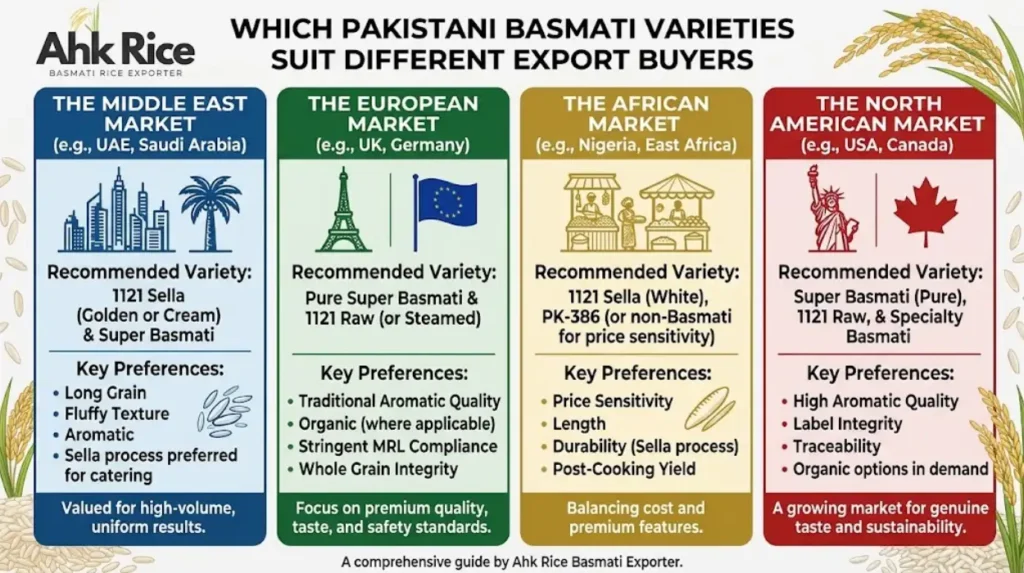
1121, Super Kernel, and 1509 serve different commercial objectives. Buyers should compare raw-grain length, cooked elongation, aroma, broken tolerance, price, and end-use requirements before selecting a variety for an export contract.
- 1121 Basmati: Suits premium retail, biryani-focused foodservice, and buyers who prioritise long cooked grains. The buyer should specify the processing type, such as Steam or Sella, because processing affects colour, texture, and preparation behaviour.
- Super Kernel Basmati: Suits traditional Basmati markets where aroma, familiar cooking characteristics, and commercial value are important. Buyers should agree the exact grain-length target and broken tolerance rather than assume every Super Kernel lot has identical dimensions.
- 1509 Basmati: Suits price-conscious distribution and high-volume foodservice programmes. Its shorter growing cycle and commercial availability can support value-oriented sourcing, while the exact grain quality still depends on the lot and processing specification.
The variety is only one part of the purchasing decision. Steam, Golden Sella, Creamy Sella, and white rice processing options can change appearance and cooking characteristics. Importers should test the actual product configuration they intend to sell.
How do export specifications differ between the Gulf and European markets?
Gulf buyers often balance aroma, whole-grain appearance, foodservice performance, and competitive landed cost. European buyers also evaluate those factors but place strong emphasis on traceability, contaminant controls, and destination-specific regulatory compliance. The exact requirements depend on the importing country and buyer.
Gulf markets: UAE and Saudi Arabia
In the UAE and Saudi Arabia, Pakistani Basmati serves supermarkets, ethnic grocery retailers, wholesalers, restaurants, caterers, and institutional kitchens. Premium retail buyers frequently compare 1121 and Super Kernel for aroma and cooked-grain presentation. Foodservice buyers also consider 1509 and parboiled options where price, holding performance, and batch consistency influence purchasing decisions.
Moisture control is important during storage and transport in hot, humid conditions. Importers should agree the moisture ceiling, inspect packaging integrity, and store rice in clean, dry warehouses away from direct sunlight and condensation. Five-kilogram and ten-kilogram packs can suit retail, while 25 kg and 50 kg bags often serve wholesale and foodservice distribution.
European markets: United Kingdom and the wider EU
European importers typically require documented product identity, traceability, and controls for pesticide residues, contaminants, and other applicable food-safety risks. Premium South Asian retail channels value long-grain appearance and aroma, while distributors serving restaurants may prioritise consistent cooking results and predictable supply.
Buyers should confirm applicable maximum residue levels, contaminant limits, labelling rules, and official import controls for their destination. A supplier’s general quality certificate does not automatically establish compliance with every market-specific requirement.
Indicative price and shelf-life comparison
Export prices vary by crop season, grade, processing, order quantity, packaging, freight, and Incoterm. The following table gives a relative purchasing framework, not a verified live market quotation.
| Comparison factor | Gulf markets | European markets |
|---|---|---|
| Price per metric tonne (MT) | Compare the same variety and grade on a consistent FOB or CIF basis | Compare equivalent specifications and delivery terms; compliance and packaging requirements can affect cost |
| Premium grade selection | 1121 and Super Kernel for aroma and presentation; 1509 for value-led segments | 1121 and Super Kernel for premium retail; 1509 where the buyer’s segment accepts its profile |
| Commercial priorities | Landed cost, cooking performance, packaging, and storage stability | Traceability, food safety, grade consistency, labelling, and landed cost |
| Shelf-life planning | Use the product’s declared shelf life and control heat, humidity, and stock rotation | Use the same product-specific shelf-life evidence and maintain dry, controlled storage |
| Price comparison method | Obtain a grade-specific quotation in US$/MT | Obtain a grade-specific quotation in US$/MT |
How should buyers compare price per MT? Request quotations for the same variety, processing type, broken percentage, moisture ceiling, packaging weight, and inspection terms. Compare FOB Karachi with FOB Karachi, or CIF with CIF for the same destination and shipment assumptions. A cheaper quotation can become more expensive if it requires additional sorting, causes greater breakage, or fails the buyer’s specification.
How should buyers compare shelf life? Use the supplier’s declared shelf life for the exact product and packaging rather than assume all Basmati has the same expiry period. Properly milled white rice often has a shelf life measured in months to years under suitable storage, but the contractual declaration must match the product, packaging, and destination rules. Brown rice generally has a shorter shelf life because its remaining bran contains more oil. Steam and Sella processing alone do not establish a universal shelf-life period.
For a reliable commercial comparison, ask suppliers to state the manufacturing or packing date, best-before period, storage conditions, packaging barrier properties, and any relevant validation supporting the declared shelf life.
What are the pros and cons of tighter export specifications?
Tighter specifications improve consistency and reduce the risk of shipment disputes, but they can increase processing costs and restrict available supply. Buyers should apply stricter tolerances only to attributes that influence their customers, regulatory obligations, or measurable commercial performance.
- Advantages: More consistent appearance, predictable whole-grain yield, clearer inspection criteria, better batch comparison, and fewer disagreements over acceptance.
- Disadvantages: Higher sorting and testing costs, potentially higher purchase prices, stricter rejection exposure, and reduced flexibility when sourcing large volumes.
For example, a premium retail buyer may benefit from stricter limits on broken kernels and discolouration because visible defects affect shelf presentation. A bulk buyer producing rice flour or other processed foods may accept a different broken-grain profile, provided the product meets food-safety requirements and the agreed end-use specification.
Tighter moisture limits can support storage management, but moisture readings must use an agreed method and representative samples. Similarly, optical sorting can reduce selected visible defects, but it does not replace checks for pesticide residues, microbiological hazards, or other contaminants relevant to the destination.
Which method works best for different buying situations?
The best specification is the one that satisfies the destination’s requirements and the buyer’s actual use without paying for unnecessary processing. A decision framework should consider sales channel, grain appearance, acceptable breakage, storage conditions, and compliance requirements together.
| Decision factor | Buyer situation | Recommended approach |
|---|---|---|
| Sales channel | Premium supermarket or private label | Variety-specific specification with enhanced visual sorting |
| Sales channel | Wholesale or bulk distribution | Conventional grading with clearly defined tolerances |
| Whole-grain appearance | Long, intact grains are central to the product promise | Specify AGL, broken percentage, and inspection method |
| Storage and logistics | Long transit or humid warehouse conditions | Agree moisture limits, packaging, storage conditions, and shelf-life evidence |
| Destination compliance | Strict residue, contaminant, or labelling requirements | Obtain relevant test reports, traceability records, and destination-specific documentation |
Before approving a supplier, request a representative sample, verify the specification sheet, and confirm that the sample and bulk shipment will be evaluated against the same contractual criteria. Include acceptable tolerances and a process for resolving inspection disagreements.
What should buyers request before confirming an export order?
Buyers should request a signed specification sheet, representative sample, inspection criteria, packaging details, and applicable export documentation before confirming an order. Written approval establishes the reference standard for production, pre-shipment inspection, and delivery acceptance.
A complete specification sheet should include:
- Variety and processing type, such as 1121 Steam, 1121 Golden Sella, Super Kernel, or 1509 White.
- Average grain length and measurement method.
- Maximum broken percentage and the definition of broken kernels.
- Maximum moisture content and the testing method.
- Purity, foreign matter, damaged-grain, and discolouration limits.
- Milling finish, packaging material, bag weight, and labelling requirements.
- Inspection arrangements, certificate requirements, shipment terms, and acceptance tolerances.
The buyer should also confirm whether laboratory testing, third-party inspection, or a certificate of analysis (COA) is required. The COA records measured quality parameters for the relevant lot; its scope depends on the tests performed. It should not be treated as proof of compliance with every destination requirement unless the necessary tests and documentation support that conclusion.
For buyers comparing product configurations, request a full specification sheet for 1121, 1509, and Super Kernel Basmati from AHK Rice. This decision-focused step helps importers match product characteristics to their target market before approving the order.
Export-grade Pakistani Basmati rice requires a complete quality assessment rather than a decision based on grain length or price alone. AGL, broken percentage, moisture, purity, milling finish, defects, and shelf-life evidence each contribute to product suitability. Their relative importance depends on the destination market, distribution channel, storage conditions, and buyer’s acceptance criteria.
AHK Rice supplies 1121, Super Kernel, and 1509 Basmati rice varieties with processing, custom packaging, and export support. Importers can compare these options by requesting documented specifications and evaluating representative samples before confirming commercial terms.
Frequently asked questions
What does AGL mean in Basmati rice exports?
AGL means average grain length. It expresses the average length of measured rice kernels, usually in millimetres. Buyers should confirm the variety, sample condition, measurement method, and acceptance tolerance before comparing supplier specifications.
What is the ideal broken percentage for export-grade Basmati rice?
A commercial target of 2–3% broken kernels is common in selected premium specifications, but it is not a universal requirement. The acceptable percentage depends on the buyer’s grade, intended use, destination requirements, and contract.
What moisture level should Pakistani Basmati rice meet for export?
Many commercial specifications set a maximum moisture content of 12–13%. The buyer and supplier must agree the precise limit, test method, sampling procedure, and applicable contractual or regulatory requirements.
What is the difference between rice purity and Sortex processing?
Purity concerns the consistency and identity of the rice, including the permitted presence of other varieties or foreign material. Sortex processing uses optical sorting to remove selected unwanted grains and particles. Optical sorting improves visual quality but does not independently certify varietal authenticity or food safety.
Which Pakistani Basmati variety is best for premium export markets?
1121 is suitable for buyers prioritising long cooked grains and premium presentation. Super Kernel suits markets seeking traditional aroma and familiar Basmati characteristics. 1509 serves value-oriented segments that prioritise commercial efficiency. The final choice depends on sample performance, specifications, and customer demand.
How should importers compare Basmati rice prices per MT?
Compare quotations for the same variety, processing type, grain specifications, broken percentage, packaging, inspection requirements, quantity, and Incoterm. Separate FOB prices from freight-inclusive CIF prices to avoid misleading comparisons.
How can buyers verify an export-grade specification?
Request a signed specification sheet, representative sample, relevant COA, and agreed inspection procedure. Use an independent inspection company or laboratory when the contract or destination requirements justify it. Verify that the bulk shipment matches the approved sample and contractual limits.