GSO and UAE Food Label Requirements: Arabic Text, Dates, Origin and Net Weight on Rice Bags
For Pakistani Basmati rice exporters targeting the UAE, bilingual Arabic-English packaging with accurate date marking, country of origin, net weight and product identification provides a stronger compliance foundation than English-only packaging or a last-minute Arabic sticker. The best approach combines label planning, verified product specifications and importer review before printing.
UAE food labelling requirements are based on applicable national rules and Gulf Technical Regulation GSO 9:2022, Labelling of Prepackaged Foodstuffs, including its 2025 amendment. The regulation covers prepackaged food offered to consumers and for catering purposes. Importers must also confirm any product-specific requirements and local food-registration procedures. For the broader educational background, read what labelling rules apply to rice sold in the UAE? to understand how rice specifications and UAE market expectations affect an import plan.
What are the available solutions for UAE-compliant rice bag labelling?
Rice exporters have three practical options: print Arabic and English directly on the bag, apply an approved Arabic supplementary label, or combine preprinted packaging with controlled batch-specific printing. Each method needs accurate mandatory information, legible text and confirmation that the final design meets UAE requirements.
1. Arabic-English preprinted packaging
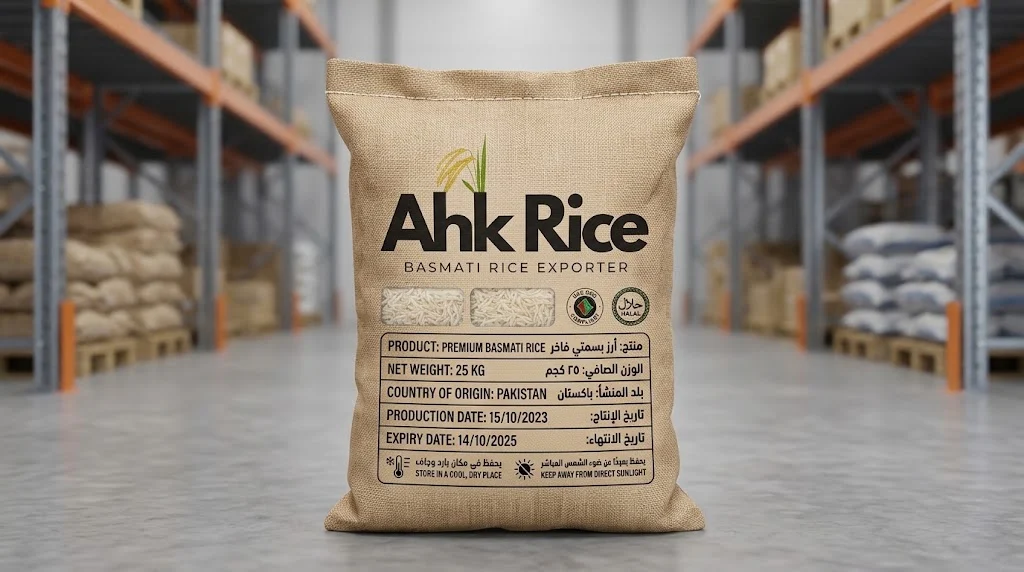
This approach places Arabic and English information directly on the woven polypropylene, laminated bag or retail pouch. The design includes the product name, variety, country of origin, net weight and other applicable declarations. It suits repeat orders with stable specifications, established importer details and predictable packaging quantities.
The main advantage is consistency. Both languages remain visible throughout normal handling, and the packaging presents a unified brand identity. The main disadvantage is the cost of changing printed stock when an importer, product specification or declaration changes.
2. Supplementary Arabic label
A supplementary label adds the required Arabic information to packaging that already carries English text. It can support trial orders, market testing and products with existing packaging inventory.
The label must remain legible, securely attached and consistent with the original information. It must not conceal mandatory declarations or introduce contradictions. Importers should confirm acceptance of the proposed label format with the relevant UAE authority before shipment.
3. Preprinted packaging with variable data
This method combines a stable printed design with batch-specific information added during packing. Depending on the approved design, variable information can include production and expiry dates, lot identification and other details that change between production runs.
It is suitable for exporters supplying several importers or packaging sizes. The process reduces the need to reprint the entire bag when batch data changes. However, print quality, placement and batch-record accuracy require documented checks.
How do GSO 9 and UAE requirements affect rice bag information?
GSO 9 establishes the general framework for prepackaged food labels, while UAE implementation and rice-specific rules determine the applicable declarations. Exporters must verify Arabic wording, date format, origin, net quantity and rice-grade information against the current requirements before approving artwork.
The distinction matters because a label can look professional without meeting every legal requirement. GSO 9:2022 addresses general food labelling, and its 2025 amendment clarifies that electronic codes can provide additional information but do not replace the written label. Rice-specific requirements may also cover grain type, kernel length and broken-kernel percentages.
| Attribute | What to verify | Practical example |
|---|---|---|
| Product identity | Accurate food name and variety | Basmati rice, 1121 Steam |
| Arabic text | Required information in Arabic, with English alongside where used | Arabic product name matching the English declaration |
| Production and expiry dates | Permitted date marking and correct batch data | Dates printed clearly in the approved format |
| Country of origin | Actual country where the rice originates | Product of Pakistan |
| Net weight | Declared net quantity in metric units | Net weight: 5 kg |
| Manufacturer or responsible business | Required name and address details | Exporter, manufacturer, packer or importer details as applicable |
| Rice specifications | Applicable rice type, kernel length and broken-grain declarations | 1121 Basmati, with verified grade specifications |
The table is a planning checklist, not a substitute for a full legal review. The exact mandatory particulars depend on the product, packaging, intended market and applicable UAE rules.
Why are Arabic labels required on rice bags sold in the UAE?
Arabic labelling allows consumers and food-control authorities to read essential product information in the UAE’s official language. English can appear alongside Arabic, but it should not contradict or replace required Arabic declarations. Both versions need consistent product names, dates, origin and quantity information.
For exporters, translation is a compliance task rather than a decorative packaging step. A product name such as “1121 Golden Sella Basmati Rice” must retain its intended meaning in Arabic. The Arabic wording must also match the actual rice type, processing method and commercial specification.
A practical review compares each declaration line by line. The reviewer checks spelling, numbers, units, storage instructions and date details. The review should also check whether any marketing statement creates a misleading impression about the product’s origin, quality or characteristics.
Avoid treating machine translation as final approval. Food terminology can change the meaning of a declaration, and poorly formatted Arabic text can become difficult to read when printed on curved or flexible packaging.
How should production and expiry dates be printed on rice bags?
Production and expiry dates must follow the applicable food-labelling and shelf-life rules. Exporters should establish the approved date format, production records and declared shelf life before printing, then verify every batch mark against the actual product and packaging records.
Date marking needs coordination between the rice processor, packer and importer. The production date should correspond to the relevant production or manufacturing event under the applicable definition. The expiry date must reflect the approved shelf-life basis and required declaration.
Do not copy a date from an earlier shipment simply because the variety and bag design are the same. A new batch needs accurate batch-specific information. Incorrect dates can create registration, clearance, traceability and retail problems.
A reliable process uses a written date-marking specification, calibrated printing equipment and a documented check during packing. The team checks legibility, date sequence, lot identity and consistency between the physical bag and commercial documents.
How should country of origin and net weight appear?
The country-of-origin declaration must identify the product’s genuine origin, while net weight must state the quantity of rice inside the package in an appropriate metric unit. These declarations must remain clear, accurate and consistent with the product specification and shipment documentation.
For Pakistani Basmati rice, the origin statement should accurately identify Pakistan. The exporter should not confuse the rice’s country of origin with the exporter’s office location, the port of loading or the destination country.
Net weight should describe the rice itself rather than the combined weight of rice and packaging. A retail bag may declare 5 kg, while a wholesale sack may declare 25 kg or 50 kg, provided the declared quantity matches the actual packed product and applicable rules.
The packing team should check the bag size, weighing equipment and printed declaration together. Changing from 25 kg to 20 kg requires an artwork and packing-specification review before production begins.
How do packaging approaches compare in cost, shelf life and flexibility?
Direct printing works best for stable, repeat-volume orders, supplementary labels suit controlled market-entry trials, and variable-data printing supports frequent batch changes. Shelf life depends on the rice, processing, moisture, packaging barrier and storage conditions, not on Arabic printing alone.
| Decision factor | Direct printing | Supplementary label | Variable-data printing | |—|—|—|—| | Initial setup | Higher artwork and print setup | Lower redesign cost | Moderate setup and equipment controls | | Repeat-order economics | Strong at consistent volume | Depends on label application labour | Strong when batch data changes | | Design flexibility | Lower after printing | High for approved changes | High for batch-specific information | | Quality control | Artwork and print checks | Adhesion, position and legibility checks | Print accuracy and batch reconciliation | | Main limitation | Printed stock becomes outdated after changes | Labels can peel, wrinkle or obscure information | | Best application | Established retail and wholesale lines | Trial orders and limited runs | Multi-batch export programmes |
How should exporters compare the price per metric tonne?
Packaging decisions affect the total landed cost, but rice grade usually has a more direct influence on the commodity price. Buyers should compare quotations using the same variety, grain specifications, broken percentage, moisture limit, packing weight, order volume and Incoterm.
For planning, AHK Rice has used an indicative 2026 FOB Karachi benchmark of US$1,165–US$1,205 per metric tonne for Super Kernel Basmati. This is a reference for that grade, not a live offer or a guaranteed UAE selling price. A buyer should request a current quotation for each specification and destination.
| Cost component | UAE-bound order | Saudi Arabia-bound order |
|---|---|---|
| Rice price per MT | Quote against selected grade and quality | Quote against selected grade and quality |
| Packaging | Retail pouch, private-label bag or wholesale sack | Retail, wholesale or foodservice sack |
| Label preparation | Arabic-English artwork and review | Arabic-English artwork and market-specific review |
| Freight and handling | Based on port, route and Incoterm | Based on port, route and Incoterm |
| Import compliance | UAE registration and applicable requirements | Saudi registration and applicable requirements |
Do not compare a UAE quotation on FOB terms with a Saudi quotation on CIF terms as if they were equivalent. FOB generally covers the seller’s obligations up to loading at the named port, while CIF includes cost, insurance and freight to the named destination port under the contract terms. The buyer must compare equivalent delivery terms to judge the actual cost difference.
Which rice grades and packaging strategies suit the UAE and Saudi Arabia?
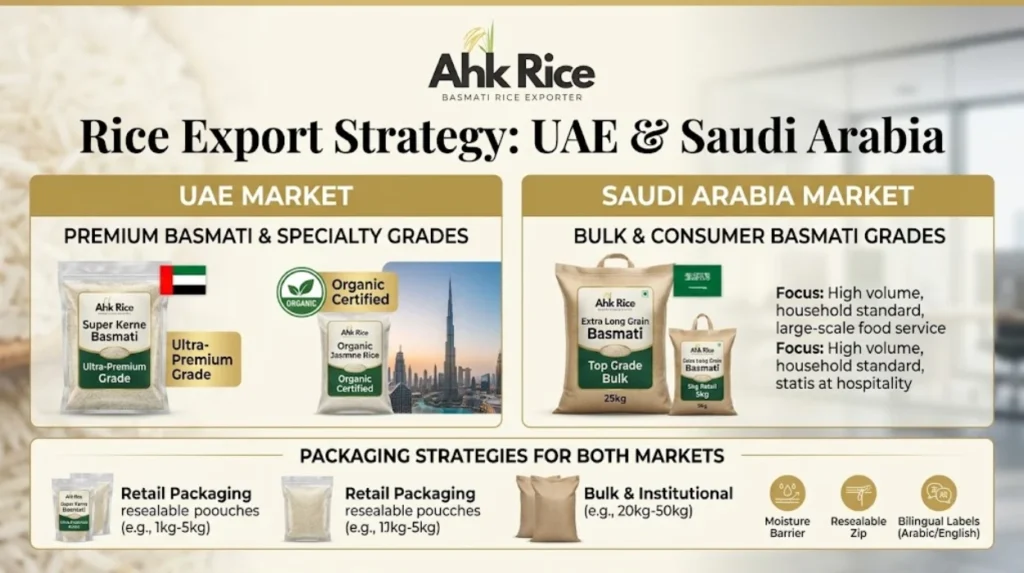
UAE buyers often need a flexible combination of premium Basmati for retail and foodservice and competitively priced rice for wholesale distribution. Saudi buyers also source premium long-grain Basmati and parboiled grades. The right packaging strategy depends on buyer specifications, channel and order volume.
Dubai’s distribution network serves supermarkets, ethnic grocery stores, restaurants and regional traders. Premium 1121 Basmati suits buyers prioritising long grains and presentation. Super Kernel suits traditional Basmati demand, while 1509 can serve price-conscious buyers when its specifications meet their needs.
Retail brands often need bilingual consumer-facing packaging. Wholesale buyers may prioritise clear grade details, accurate sack weight and efficient handling.
Saudi Arabia: retail and foodservice
Saudi importers may select 1121 for premium retail and catering, Super Kernel for established Basmati demand, and Golden Sella for suitable catering, banquet and bulk applications. The actual choice depends on cooking performance, buyer specifications and commercial positioning.
Packaging must meet the applicable Saudi requirements as well as the buyer’s design brief. UAE-compliant artwork should not automatically be reused for Saudi shipments without a market-specific review.
Shelf life comparison across the two markets
The UAE and Saudi Arabia do not have one universal shelf-life period that applies to every rice bag. The declared shelf life must be supported by the product and the applicable requirements. Storage temperature, humidity, moisture control, packaging integrity and pest prevention influence quality during distribution.
| Factor | UAE distribution | Saudi Arabia distribution |
|---|---|---|
| Storage concern | Heat and humidity in warehouses and transport | Heat, warehouse conditions and long distribution routes |
| Packaging priority | Moisture protection and secure seals | Moisture protection and durable transport packaging |
| Shelf-life declaration | Confirm applicable UAE requirements and evidence | Confirm applicable Saudi requirements and evidence |
| Stock management | First-expiry-first-out controls | First-expiry-first-out controls |
| Main risk | Moisture ingress, pests or damaged bags | Moisture ingress, pests or damaged bags |
A longer declared shelf life should never be used simply as a selling point. The exporter and importer need a defensible shelf-life basis, suitable packaging and appropriate storage instructions.
What are the pros and cons of each labelling method?
The best labelling method balances compliance, order size, design stability and production control. Direct printing improves consistency, supplementary labels reduce redesign costs, and variable-data printing improves batch flexibility. Each method fails when information is inaccurate, unreadable or inconsistent with the shipped product.
- Direct printing: Best for established retail lines with repeat orders. It provides a clean, consistent appearance. Its disadvantage is the cost of scrapping or replacing obsolete printed bags after a specification change.
- Supplementary labels: Best for trials or limited packaging runs. They reduce the need to redesign the whole bag. Their disadvantage is the extra inspection required to confirm adhesion, placement and legibility.
- Variable-data printing: Best for exporters managing multiple batches or buyers. It supports controlled changes to dates and lot codes. Its disadvantage is the need for equipment calibration, operator training and batch-level verification.
For example, an importer ordering 10,000 identical 5 kg bags may benefit from direct printing if the artwork remains stable. A buyer testing a new private-label product may prefer an approved supplementary label for an initial shipment. A supplier packing several production lots into one export programme may use preprinted bags with controlled batch coding.
Which labelling method works best for different buyer requirements?
Direct printing suits established brands, supplementary labels suit approved market trials, and variable-data printing suits frequent production changes. Buyers should select the method only after confirming artwork approval, minimum print quantities, batch traceability, importer details and the full cost per packed metric tonne.
Five-row decision framework
| Decision factor | Direct printing | Supplementary label | Variable-data printing |
|---|---|---|---|
| Order volume | Repeat, larger runs | Small or trial runs | Multiple batches or mixed orders |
| Artwork stability | High | Moderate or low | Stable core design with changing batch details |
| Cost priority | Reduce repeat-unit costs | Minimise redesign costs | Reduce full-bag reprinting |
| Compliance control | Approve artwork before printing | Approve label wording and placement | Verify every batch-specific print |
| Recommended use | Established private-label brand | Market-entry shipment | Multi-buyer export operation |
The decision should also account for the importer’s registration process. Artwork approval does not replace product registration, and product registration does not guarantee that every later shipment has correct dates, weights and lot information. Each consignment must match the approved product and its documents.
How can exporters prepare a compliant rice bag before shipment?
Exporters should collect the buyer’s specifications, prepare Arabic-English artwork, verify product and origin declarations, approve date-marking controls and inspect a finished bag before bulk packing. This sequence reduces reprinting, label corrections and avoidable shipment delays.
AHK Rice is a Pakistani Basmati rice exporter based in Punjab, supplying 1121, Super Kernel and 1509 varieties to more than 15 countries. Its rice export and packaging service covers the processing and packaging coordination needed to prepare export orders against agreed buyer specifications.
A practical workflow has five stages:
- Confirm the product specification. Record the variety, processing type, kernel length where applicable, broken percentage, moisture limit, packing weight and destination.
- Prepare the label content. Collect the approved product name, Arabic translation, country of origin, responsible business details, net weight and required date declarations.
- Review market-specific requirements. Ask the UAE importer or compliance specialist to check the complete artwork against current regulations and the relevant product-registration requirements.
- Approve a production sample. Inspect the physical bag or print proof for Arabic text, legibility, colour, dimensions, seals and the location of variable information.
- Verify the packed shipment. Check lot identification, dates, net weight and consistency between the goods, approved artwork and shipping documents.
AHK Rice buyers should agree the final specifications and packaging format before commercial production begins. Changes to the importer, brand, bag size or product declaration require review before the next print run.
What should buyers confirm before approving the final label?
Buyers should approve the actual printed layout rather than relying only on a translation file or digital mock-up. The final review should confirm legal declarations, accurate Arabic-English meaning, correct product specifications, readable dates, net weight and consistency with the importer’s approved product details.
Use this final checklist before releasing packaging for production:
- Arabic declarations have been reviewed by a competent translator or regulatory reviewer.
- English and Arabic descriptions communicate the same product information.
- The country-of-origin declaration accurately identifies Pakistan when applicable.
- Net weight matches the agreed bag specification and packed quantity.
- Production dates, expiry dates and lot codes follow the approved marking procedure.
- Manufacturer, packer, importer or distributor details appear as required.
- Rice-specific declarations match the actual grade and relevant standard.
- Storage instructions and any other mandatory declarations are present.
- The artwork does not contain misleading claims or unsupported quality statements.
- The importer has confirmed the relevant registration and market requirements.
This checklist gives purchasing teams a consistent approval process. It also creates a record of the decisions behind the final packaging design.
Frequently asked questions
Is Arabic mandatory on rice bags sold in the UAE?
Yes. Prepackaged food labels must include the required Arabic information. English may appear alongside Arabic, provided the information is consistent and the applicable UAE requirements are met.
Which GSO regulation covers UAE food labelling?
GSO 9:2022 covers the labelling of prepackaged foodstuffs. Exporters should also check its applicable amendments, including the 2025 amendment, and the current UAE implementation requirements.
Must rice bags show production and expiry dates?
Date marking must follow the applicable food-labelling and shelf-life requirements. Exporters should confirm the permitted format, date declarations and supporting shelf-life basis before printing.
Can an exporter use an Arabic sticker instead of printing Arabic on the bag?
A supplementary Arabic label can be a practical option when it meets the applicable requirements. The importer should confirm its wording, placement, durability and acceptability before the shipment is dispatched.
What country of origin should Pakistani Basmati rice declare?
Rice originating in Pakistan should accurately declare Pakistan as its country of origin. The declaration must not confuse the product’s origin with its export port, exporter location or destination.