How Broken Percentage Influences Super Kernel Rice Market Value
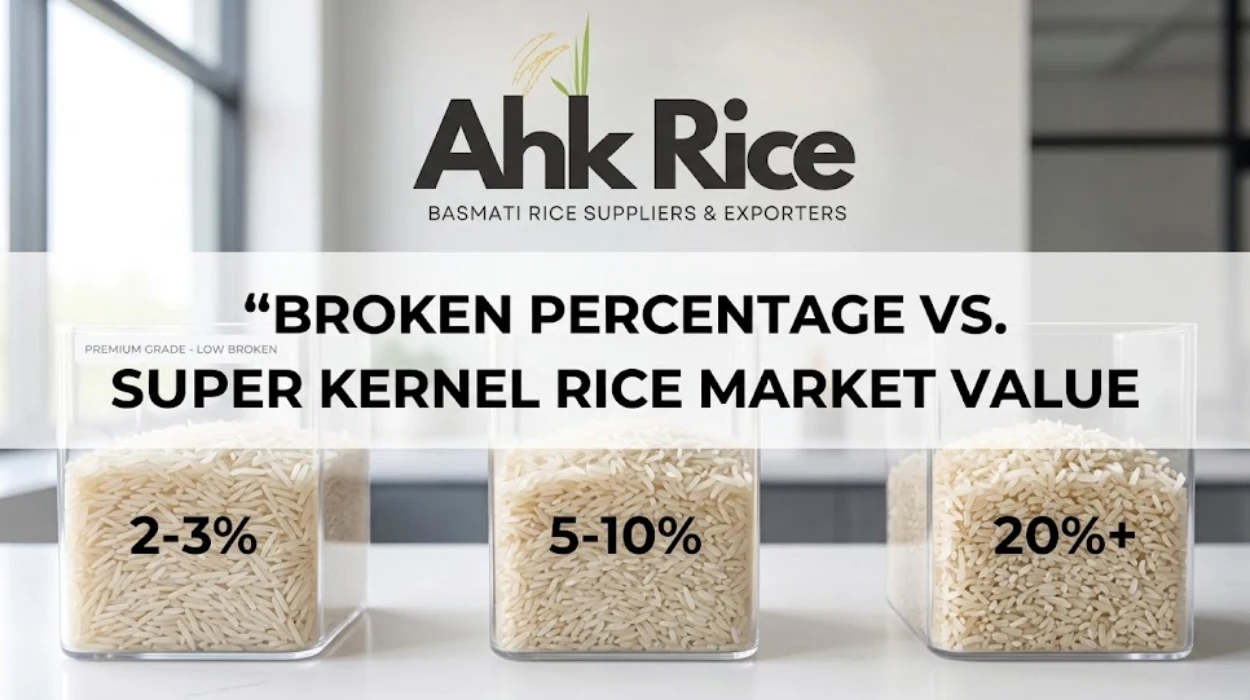
Super Kernel Sella with 0–2% broken kernels generally commands the highest market value, while increasing broken percentage lowers the premium because buyers receive less whole-kernel rice, weaker visual presentation, and reduced resale value. The commercial decision is therefore not simply about paying less per metric ton; it is about matching broken percentage with the target market, cooking application, shelf-life requirement, and expected selling price.
For a foundation on how Sella grades are classified before comparing their commercial value, buyers should first understand:
The different Super Kernel Sella rice grades and their specifications. Super Kernel Basmati is a traditional aromatic long-grain variety associated with Pakistan, particularly Punjab, and Sella refers to rice that has undergone parboiling before milling. Parboiling strengthens the kernel structure and reduces breakage during processing and handling.
The first product specification should be evaluated through the Super Kernel Rice wholesale and export service, because broken percentage cannot be separated from milling, grading, sorting, moisture control, packaging, and export inspection. AHK Rice operates from Punjab and supplies Super Kernel alongside 1121 and 1509 varieties to international markets, with processing covering grading, colour sorting, customized packaging, and export documentation.
What are the available solutions for different broken percentages?
The main commercial solutions are 0–2%, 3–5%, and higher-broken Super Kernel grades, with each tier serving a different balance of appearance, cooking performance, processing cost, and resale value. Low-broken Sella suits premium retail and foodservice, while higher broken ratios suit value-led and industrial applications.
Broken percentage means the proportion of rice kernels that are broken rather than sufficiently intact whole kernels. The United States Department of Agriculture defines a broken kernel as a kernel measuring less than three-fourths of an unbroken kernel. Codex separates broken kernels into large, medium, and small fragments according to their length relative to the whole kernel.
For Super Kernel Sella, the first solution is a 0–2% broken grade. This is the premium specification because most of the shipment consists of intact kernels with stronger visual uniformity. Commercial Pakistani Sella specifications commonly use a maximum of 2% broken, while some suppliers offer 0–2% broken as the defined premium grade.
The second solution is a 3–5% broken grade. This reduces the purchase cost while retaining a high proportion of whole grains. It suits distributors and foodservice operators whose customers still expect attractive grains but whose purchasing model cannot justify the highest premium.
The third solution is a higher-broken specification. This is appropriate when the buyer prioritizes cost per usable kilogram rather than premium grain appearance. Broken rice can serve prepared-food manufacturing, institutional meals, fillings, flour production, and other applications where intact grain length has less commercial importance.
The key point is that broken percentage creates different value propositions rather than simply different quality labels. A 2% broken shipment is valuable when whole-kernel presentation creates additional selling value. A higher-broken shipment becomes commercially rational when the end application does not reward premium appearance.
How do different broken-percentage approaches compare?
Lower broken percentages increase whole-kernel recovery, visual uniformity, and premium positioning, while higher percentages reduce purchase cost but also reduce presentation value; the optimal specification depends on whether the buyer earns margin from retail appearance, restaurant presentation, volume efficiency, or industrial processing.
| Attribute | 0–2% Broken Super Kernel Sella | 3–5% Broken Super Kernel Sella | Higher-Broken Super Kernel |
|---|---|---|---|
| Whole-kernel share | Very high | High | Lower |
| Visual uniformity | Premium | Commercial | Basic |
| Market positioning | Premium | Mid-premium/value | Value/industrial |
| Typical buyer | Retail, premium foodservice | Wholesaler, mainstream foodservice | Food manufacturing, institutional |
| Processing requirement | Tight grading and sorting | Standard grading | Cost-focused grading |
| Price per MT | Highest | Lower | Lowest |
| Resale potential | Highest | Balanced | Volume-driven |
The economic reason is straightforward. Broken kernels sell at a discount to whole-kernel rice. The USDA notes that rice breakage must be controlled during production, drying, storage, milling, and marketing because broken kernels have considerably lower market value than whole-kernel rice.
Current July 2026 indicative FOB Karachi pricing places Super Kernel Basmati around $1,165–$1,205 per metric ton for premium 0–2% broken material. This is a market reference rather than a fixed Super Kernel Sella contract price because processing type, crop year, packaging, quantity, inspection, and destination terms change the final offer.
This distinction matters when comparing quotations. A buyer receiving a $1,150/MT offer should not compare it directly with a $1,200/MT offer until broken percentage, processing type, grain length, moisture, packaging, and inspection terms are aligned.
Which method works best for different market cases?
Premium 0–2% broken Super Kernel Sella works best where appearance and whole-kernel cooking performance drive selling price, while 3–5% works better for mainstream distribution; higher broken grades work best for industrial and institutional applications where lower procurement cost matters more.
Which grade suits the USA market?
The USA market has several buyer segments, including South Asian grocery retailers, halal supermarkets, restaurants, foodservice distributors, and private-label brands. Premium retail and restaurant buyers generally place greater value on intact, uniform grains because the finished dish and retail pack visibly expose kernel quality. USDA also notes that virtually all rice purchased by US consumers or sold to US restaurants is whole-kernel milled rice.
For these buyers, 0–2% broken Super Kernel Sella offers the strongest commercial position. It protects the appearance of biryani, pulao, and other rice dishes while reducing the number of visibly fragmented kernels in retail packaging.
The 3–5% specification fits value-premium distributors that want recognizable Super Kernel characteristics without paying the full premium for the lowest broken ratio. It can also work for foodservice operations where rice is served in high volume and the final plate does not require every grain to remain visually perfect.
Higher broken ratios are more appropriate for manufacturing applications. When rice becomes an ingredient in prepared foods, fillings, mixes, or processed products, the commercial value of long intact kernels declines.
Which grade suits Gulf markets?
The Gulf region, particularly Saudi Arabia and the UAE, places strong demand on aromatic Pakistani rice for households, restaurants, catering operations, hotels, and distributors. Super Kernel is recognized in the region for its aroma and cooking performance, while Sella processing adds structural strength and storage stability.
Gulf buyers commonly prioritize low-broken Sella for premium retail, catering, and foodservice, especially where large cooking batches need consistent appearance. A 0–2% specification therefore provides stronger commercial value for premium distribution.
A 3–5% specification is more suitable for price-sensitive wholesale channels. The buyer sacrifices some visual uniformity but gains purchasing efficiency.
The higher-broken option is strongest when the buyer sells rice through low-price channels or uses it as a food-processing input. The decision should follow the selling application rather than the lowest available quotation.
How do price and shelf life compare between the two market regions?
USA buyers generally justify low-broken Super Kernel Sella when whole-grain appearance supports premium retail or foodservice pricing, while Gulf buyers place additional value on Sella’s storage stability; properly packed Super Kernel Sella commonly carries a commercial shelf-life target of about 24 months.
| Market region | Preferred commercial specification | Broken target | Indicative value position | Typical shelf-life target |
| USA | Premium Super Kernel Sella | 0–2% | Highest | Up to 24 months |
| USA | Value Super Kernel Sella | 3–5% | Mid-range | Up to 24 months |
| Gulf: Saudi Arabia/UAE | Premium Sella | 0–2% | Highest | Up to 24 months |
| Gulf: Saudi Arabia/UAE | Mainstream Sella | 3–5% | Mid-range | Up to 24 months |
Commercial specifications from Pakistani Sella suppliers commonly state approximately 24 months of shelf life under suitable storage conditions, while some specifications extend to 36 months. The meaningful comparison is therefore not a universal expiration number but the combination of moisture control, packaging integrity, warehouse conditions, and stock rotation.
The USA and Gulf markets can therefore use the same low-broken specification for different commercial reasons. A US retailer uses it to strengthen shelf presentation and consumer perception. A Gulf distributor uses it to preserve whole-kernel performance through distribution and high-volume cooking operations.
Shelf life does not automatically increase when broken percentage decreases. Broken percentage primarily affects kernel integrity and market value. Storage life depends more directly on moisture, packaging, temperature, pests, hygiene, and warehouse management.
What are the pros and cons of each broken-percentage solution?
A 0–2% specification delivers maximum presentation and resale potential but carries a higher purchase premium; 3–5% provides better cost efficiency with modest visual compromise; higher broken grades minimize procurement cost but lose the premium value created by intact Super Kernel kernels.
What are the advantages of 0–2% broken?
The primary advantage is presentation. Whole grains remain visually longer and more uniform after cooking. This matters in biryani, pulao, buffet service, premium retail packs, and restaurant dishes where consumers see the rice directly.
The second advantage is resale positioning. A distributor can market a low-broken specification as a premium product when the specification sheet confirms the claim.
The disadvantage is cost. More precise milling, length grading, colour sorting, and quality control are required to maintain a low broken ratio. The buyer therefore pays for greater processing control and higher whole-kernel recovery.
What are the advantages of 3–5% broken?
The 3–5% range provides a strong middle position. The buyer retains most of the visual and cooking benefits of Super Kernel while controlling procurement cost.
This grade suits a distributor supplying restaurants that need reliable cooking performance but do not require luxury retail presentation. It also works for private-label brands positioned between economy and premium segments.
The limitation is reduced visual uniformity. A retailer selling a premium pack may find the additional broken kernels noticeable compared with a 0–2% specification.
What are the advantages of higher-broken grades?
Higher-broken material creates the lowest entry cost and can be highly efficient for manufacturing. If the rice is mixed into another food product, the buyer avoids paying for whole-kernel appearance that customers will never see.
The disadvantage is lower market value per metric ton. The USDA’s market description confirms that broken kernels trade at a considerable discount to whole-kernel rice.
What decision factors should importers use before choosing a broken percentage?
Importers should evaluate broken percentage against selling channel, target consumer, cooking application, purchase price, whole-kernel recovery, packaging, storage period, and quality inspection rather than selecting the lowest quotation without specification matching.
| Decision factor | Question to ask | Best direction |
| Retail presentation | Will customers see individual grains? | 0–2% |
| Restaurant use | Does plated appearance affect selling price? | 0–2% or 3–5% |
| Wholesale value | Is purchase cost the main margin driver? | 3–5% |
| Industrial use | Does grain shape matter after processing? | Higher broken |
| Market positioning | Is the product premium or value-led? | Premium = 0–2% |
| Storage cycle | Will stock remain in warehouses for months? | Sella + controlled storage |
| Quality verification | Can the supplier prove the specification? | Lab/inspection report |
The most important procurement principle is specification matching. Buyers should compare broken percentage alongside grain length, moisture, damaged kernels, chalky kernels, foreign matter, purity, processing type, packaging, and inspection method.
Codex treats broken-kernel limits as a buyer specification rather than a single universal commercial threshold. This is why importers should place the exact broken percentage in the purchase specification and contract instead of relying on terms such as “premium” or “export quality.”
For US buyers, this approach is particularly important because the USDA has been reviewing its rice standards, including criteria related to broken kernels and inspection methods. In November 2025, USDA’s Agricultural Marketing Service opened the US rice standards for potential revisions and specifically identified broken-kernel inspection criteria among the areas under review.
For a procurement team, the correct workflow is simple. First define the market. Second define the application. Third set the acceptable broken range. Fourth compare quotations using the same specification. Fifth verify the shipment through inspection and documented quality testing.
What is the best strategy for protecting Super Kernel rice market value?
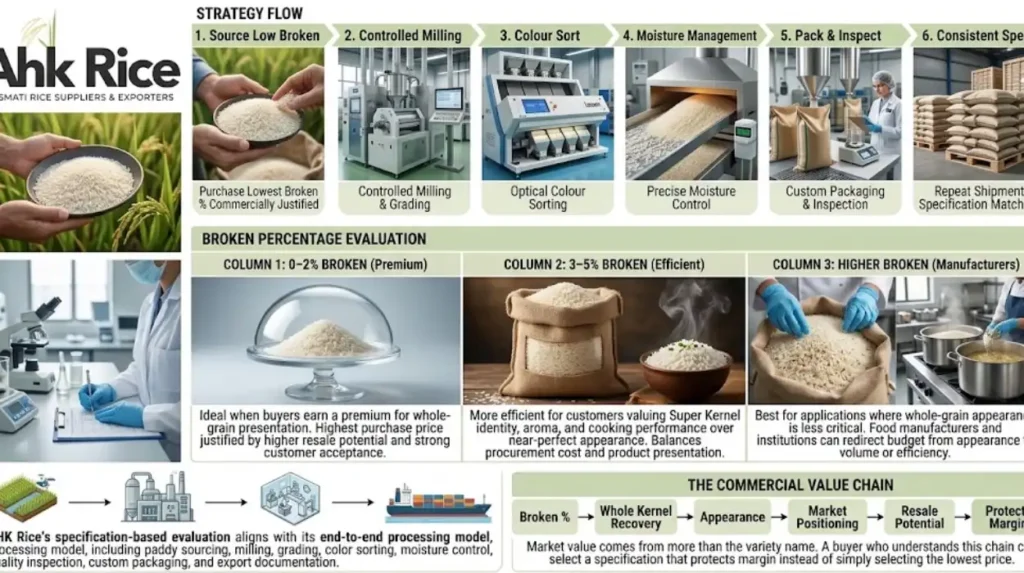
The strongest strategy is to purchase the lowest broken percentage that the target market can commercially justify, then protect that value through controlled milling, colour sorting, moisture management, packaging, inspection, and consistent specification matching across repeat shipments.
A 0–2% broken specification is the logical choice when a buyer earns a premium from whole-grain presentation. The higher purchase price is justified when the finished product can command a higher resale price or stronger customer acceptance.
A 3–5% specification is more efficient when the customer values Super Kernel identity, aroma, and cooking performance but does not pay a premium for near-perfect grain appearance. It creates a better balance between procurement cost and product presentation.
Higher broken percentages make sense when whole-grain appearance does not contribute to the finished product. Food manufacturers and institutional buyers can redirect budget from appearance toward volume, formulation, or production efficiency.
For AHK Rice, this type of specification-based evaluation aligns with its end-to-end processing model, which includes paddy sourcing, milling, grading, colour sorting, moisture control, quality inspection, custom packaging, and export documentation.
The commercial value of Super Kernel Sella therefore comes from more than the variety name. Broken percentage changes whole-kernel recovery. Whole-kernel recovery changes appearance. Appearance changes market positioning. Market positioning changes resale potential. The buyer who understands this chain can select a specification that protects margin instead of simply selecting the lowest price per metric ton.
For US buyers specifically evaluating low-broken procurement, the next decision-stage resource should be:
The guide to sourcing low-broken Super Kernel Sella for USA markets. It can follow this article because readers have already learned why broken percentage changes market value and are now ready to evaluate a supply specification.
Frequently Asked Questions
How does broken percentage affect Super Kernel Rice market value?
Broken percentage directly affects the commercial value of Super Kernel Rice because whole kernels generally command a higher price than broken kernels. A 0–2% broken specification supports premium retail and foodservice positioning, while higher broken percentages reduce the price per metric ton.
What is the best broken percentage for Super Kernel Sella Rice?
A 0–2% broken specification is generally the strongest choice for premium Super Kernel Sella Rice. It provides high whole-kernel recovery, better visual uniformity, and stronger presentation after cooking. A 3–5% specification offers a practical balance between quality and procurement cost.
Why does 0–2% broken Super Kernel Rice cost more?
Low-broken rice requires tighter milling, grading, sorting, and quality control to retain more whole kernels. Because whole kernels have greater market value than broken fragments, maintaining a 0–2% broken ratio increases processing requirements and supports a higher commercial price.
Is 3–5% broken Super Kernel Rice suitable for importers?
Yes. A 3–5% broken specification can suit mainstream wholesalers, distributors, restaurants, and foodservice buyers that need reliable Super Kernel characteristics without paying the highest premium for near-minimum breakage. It provides a balance between product presentation and procurement efficiency.
Which Super Kernel Sella grade is suitable for USA markets?
For premium US retail, restaurants, and foodservice applications, 0–2% broken Super Kernel Sella is the strongest specification because whole-kernel appearance influences consumer perception and plated presentation. Value-focused distributors can consider 3–5% broken material.
Which broken percentage is preferred in Saudi Arabia and the UAE?
Premium distributors and foodservice buyers in Saudi Arabia and the UAE commonly benefit from low-broken Super Kernel Sella because intact grains provide better visual presentation and cooking consistency. A 3–5% specification is suitable for more price-sensitive distribution channels.
Does broken percentage affect Super Kernel Rice shelf life?
Broken percentage itself does not determine shelf life. Storage life depends primarily on moisture content, packaging integrity, temperature, pest control, hygiene, and warehouse conditions. Properly packed Super Kernel Sella commonly has a commercial shelf-life target of around 24 months.
How should importers compare Super Kernel Rice prices?
Importers should compare quotations using the same specifications for broken percentage, grain length, moisture, damaged kernels, foreign matter, purity, processing type, packaging, inspection, and Incoterms. Comparing only the price per metric ton can produce misleading conclusions.
What is the difference between whole-kernel and broken Super Kernel Rice?
Whole-kernel rice retains most of the original grain length, while broken rice consists of kernels that have fractured during processing or handling. Whole kernels generally have greater retail and foodservice value because they provide stronger visual presentation.
Why is broken percentage important when buying rice in bulk?
Broken percentage determines how much of the shipment consists of intact kernels. This affects visual quality, resale positioning, restaurant presentation, and price. Bulk buyers should specify the maximum acceptable broken percentage in the purchase contract.
Is low-broken Super Kernel Sella better for restaurants?
Low-broken Super Kernel Sella is better for restaurants when presentation matters. Intact grains provide a more uniform appearance in biryani, pulao, buffet service, and plated dishes. Restaurants focused primarily on cost can select a higher broken specification when appearance has less commercial importance.
What should be included in a Super Kernel Rice quality specification?
A complete specification should include broken percentage, grain length, moisture, damaged kernels, chalky kernels, foreign matter, purity, processing type, packaging, crop year where relevant, inspection requirements, and permitted tolerances. These details allow buyers to compare supplier quotations accurately.