Source Low Broken Super Kernel Sella Rice for USA Markets
Low-broken Super Kernel Sella Rice is the better choice for USA importers that need stronger whole-grain recovery, consistent cooking performance, and better retail presentation; the buying decision should be based on verified broken percentage, moisture, grain uniformity, packaging, inspection, and delivered logistics rather than price alone.
For importers entering the USA market, the first step is understanding how Super Kernel Sella grades differ before placing a commercial order. A practical guide to:
Super Kernel Sella rice grades helps establish the technical specifications that should appear in the purchase contract.
The second consideration is commercial value. Broken percentage directly affects usable whole-grain output, visual appearance, and the market position of the shipment. Buyers comparing specifications should review:
How broken percentage changes Super Kernel rice value before accepting a supplier quotation.
For a USA importer, the objective is straightforward: source Super Kernel Sella Rice with a defined broken limit, consistent grain quality, suitable moisture, documented inspection, and a shipping schedule that supports inventory planning.
What is the best solution for sourcing low-broken Super Kernel Sella Rice for USA markets?
The best solution is specification-controlled Super Kernel Sella procurement with a contracted broken limit, pre-shipment inspection, representative samples, controlled processing, export documentation, and container-level quality verification before dispatch from Pakistan to the USA market.
Low-broken rice should not be purchased using the phrase “premium quality” alone. The commercial specification should identify the maximum broken percentage, grain length, moisture level, foreign matter tolerance, damaged grains, chalky grains, milling quality, packaging, and inspection method.
Super Kernel is a slender-grain Pakistani Basmati variety cultivated primarily in Punjab. It is valued for aroma, texture, and traditional cooking performance. AHK Rice currently lists Super Kernel in its export portfolio and identifies USA as one of its international markets.
For USA retail and wholesale buyers, low broken content has a practical advantage. More whole grains remain visible in the cooked product and in retail packaging. This can support a cleaner product presentation and reduce the perception of an inconsistent grade.
AHK Rice manages procurement, milling, grading, length sorting, packaging, documentation, and container loading through an integrated export process. The company states that its processing system includes pre-cleaning, de-husking, paddy separation, whitening, grading, length sorting, packaging, documentation, and logistics coordination.
The correct specification should therefore be agreed before production begins. This is more reliable than trying to correct quality problems after a container has been loaded.
Why choose AHK Rice for Super Kernel Sella Rice exports to the USA?
AHK Rice gives USA buyers a single export channel for sourcing, processing, grading, inspection, packaging, documentation, and shipping coordination, reducing specification gaps between suppliers and making repeat shipments easier to manage commercially.
AHK Rice is based in Punjab, Pakistan, and has supplied Pakistani Basmati rice to international buyers since 2019. Its current company information identifies the USA among its export markets and describes an integrated facility covering the process from paddy procurement through container loading.
The main advantage for a USA importer is specification control. A buyer can define the required broken percentage and other quality parameters before production rather than accepting an unspecified stock grade.
AHK Rice also provides third-party pre-shipment inspection options. Its current website states that internationally recognized inspection organizations, including SGS and Bureau Veritas, can be involved in pre-shipment inspection.
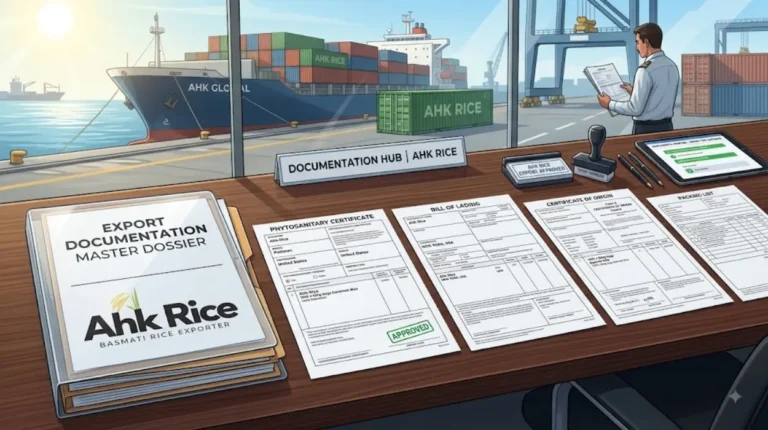
For USA sourcing, documentation is another critical decision factor. AHK Rice identifies commercial invoices, packing lists, certificates of origin, phytosanitary certificates, fumigation certificates, and bills of lading among its export documentation workflow.
The USA export service covers Super Kernel among its listed Pakistani rice varieties and is designed for importers requiring bulk supply from Pakistan.
Basmati Rice Exporter Pakistan to USA — AHK Rice
This structure is particularly useful for distributors, ethnic grocery wholesalers, private-label brands, and foodservice buyers that need repeat shipments rather than one-off purchasing.
What results can USA buyers expect from low-broken Super Kernel Sella Rice?
USA buyers can expect better whole-grain presentation, more predictable cooking performance, clearer procurement specifications, improved shipment verification, and stronger inventory planning when low broken content is controlled consistently from processing through container loading.
The commercial result begins with consistency. If one shipment contains substantially more broken grains than the approved sample, the buyer can face differences in appearance, cooking behavior, packaging presentation, and customer acceptance.
A specification-based process reduces this risk. AHK Rice states that its grading and length-sorting stage uses precision mechanical and optical systems to separate rice according to grain size, length, and quality.
The target outcome should be repeatability across containers. The approved sample becomes the reference point for commercial production. The buyer can then compare inspection results against the agreed specification before accepting the shipment.
For USA retail distribution, this is important because the rice may be sold under a private label or through ethnic grocery channels where consumers expect consistent grain appearance and cooking characteristics.
For foodservice buyers, consistency can be even more important. A restaurant distributor purchasing several containers needs predictable cooking performance across batches. A sudden increase in broken grains can affect the finished dish and the perceived value of the product.
AHK Rice also supports private-label packaging and multiple packaging formats. Its current packaging information lists options including PP, jute, cloth, non-woven, cotton, box, and plastic packaging in several weights.
The strongest result is therefore not simply “low broken rice.” It is a controlled specification that remains consistent from approved sample to commercial container.
How does the Super Kernel Sella sample process work, and what does it cost?
The sample process should begin with the buyer’s written specification, continue through representative sample preparation and courier dispatch, then move to quality evaluation, commercial approval, quotation, and bulk production; sample costs depend on quantity, destination, certification, and courier requirements.
The first step is to define the product requirement. A USA buyer should specify Super Kernel Sella grade, broken percentage, moisture requirement, packing format, quantity, destination port, and any private-label requirements.
AHK Rice can then prepare a representative sample for evaluation. Its USA export information states that sample quantities can reach 20 kg and that clients generally cover sample shipping costs. It also states that buyers can provide their own packing bags or use standard destination-accepted packaging.
A practical sample workflow is:
- Specification confirmation: Buyer provides grade, broken percentage, moisture, packing, quantity, and USA destination.
- Sample preparation: Export-grade rice is selected according to the requested specification.
- Courier dispatch: Sample is packed and shipped to the USA buyer.
- Buyer testing: The buyer checks grain appearance, broken percentage, aroma, cooking behavior, texture, and overall consistency.
- Commercial approval: Buyer confirms that the sample matches the required purchasing specification.
- Quotation: Supplier calculates the commercial offer according to grade, quantity, packaging, Incoterm, and destination.
- Order confirmation: Specifications become part of the commercial agreement.
- Production and loading: Approved specifications are used for commercial processing, inspection, packaging, and container loading.
For planning purposes, AHK Rice’s current published sample guidance indicates that sample shipping costs are normally paid by the client. Its current export quotation guidance gives a sample cost range of approximately $20–$50, depending on destination, while larger commercial samples can involve additional product and shipping costs.
The sample should not be treated as a free marketing exercise. It is a commercial quality-control stage. A USA importer should use it to verify the exact product that will be purchased in bulk.
How many shipping days should USA buyers plan for?
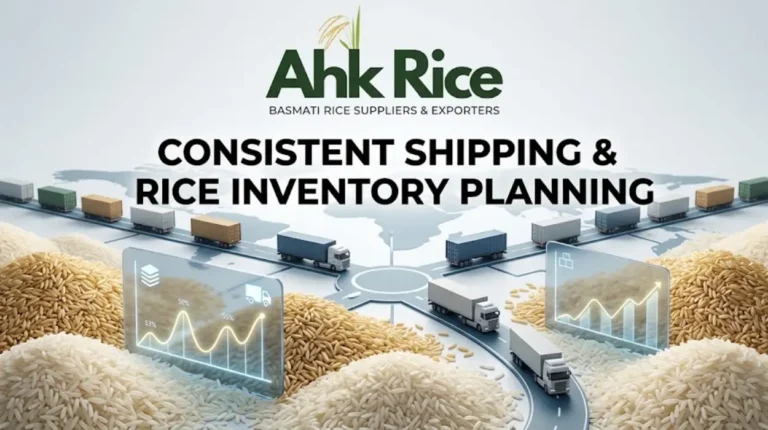
USA buyers should plan approximately 30–48 days for wholesale Basmati shipments from Pakistan to the USA, with the final timeline depending on destination port, vessel schedule, production readiness, documentation, transshipment, and seasonal freight congestion.
AHK Rice’s current USA wholesale guidance states that wholesale Basmati shipments from Karachi normally take approximately 30–48 days to reach the USA, with East Coast ports generally receiving containers faster than West Coast ports.
This means buyers should not use one universal delivery number for every USA shipment.
A practical planning model is:
| Stage | Typical planning window |
|---|---|
| Sample approval | 2–4 days |
| Order confirmation | 3–5 days |
| Production, loading and dispatch | 7–12 days |
| Ocean transit and destination movement | About 30–48 days overall |
| Final delivery | Depends on port and inland transport |
AHK Rice separately publishes a sample approval window of 2–4 days, order confirmation of 3–5 days, and loading and dispatch of 7–12 days as part of its export workflow.
These are planning ranges rather than guaranteed delivery dates. Vessel availability, port congestion, customs procedures, documentation, and inland transportation can change the final arrival date.
For this reason, USA buyers should confirm the destination port before receiving a final shipping commitment. East Coast and West Coast logistics should not be treated as identical.
What factors affect the price of low-broken Super Kernel Sella Rice?
The main price factors are broken percentage, grade, grain selection, processing requirements, paddy availability, order volume, packaging, inspection, export documentation, Incoterm, ocean freight, destination port, and seasonal market conditions.
Low-broken rice can command a higher price than a higher-broken specification because additional sorting and stricter grain selection can reduce the usable output from the original raw material.
Processing cost is only one component. Paddy procurement conditions also influence the commercial offer. AHK Rice’s current export guidance identifies paddy availability, harvest season, demand changes, packaging, destination, and freight as factors affecting export quotations.
Quantity also matters. A full-container order creates a different cost structure from a small trial quantity because production, packaging, documentation, and logistics are distributed differently.
Packaging can materially change the quotation. A basic bulk PP bag and a custom printed private-label package do not carry the same material, printing, handling, or production requirements.
The Incoterm also changes the buyer’s cost calculation. A USA importer comparing quotations should determine whether the supplier is quoting FOB or a delivered basis before comparing numbers.
AHK Rice’s USA wholesale material specifically describes FOB Karachi quotations and explains that buyers should evaluate grade, packaging, quantity, and shipment requirements before final pricing is confirmed.
A buyer should therefore avoid selecting the lowest headline price without checking the specification behind it. A cheaper product with a higher broken percentage may produce a different commercial outcome than a slightly higher-priced low-broken grade.
How should USA importers decide whether to place the order?
USA importers should approve the order only after the sample, broken percentage, moisture, grain specification, packaging, inspection requirements, documentation, price basis, destination port, and shipment schedule are all aligned in writing with the commercial contract.
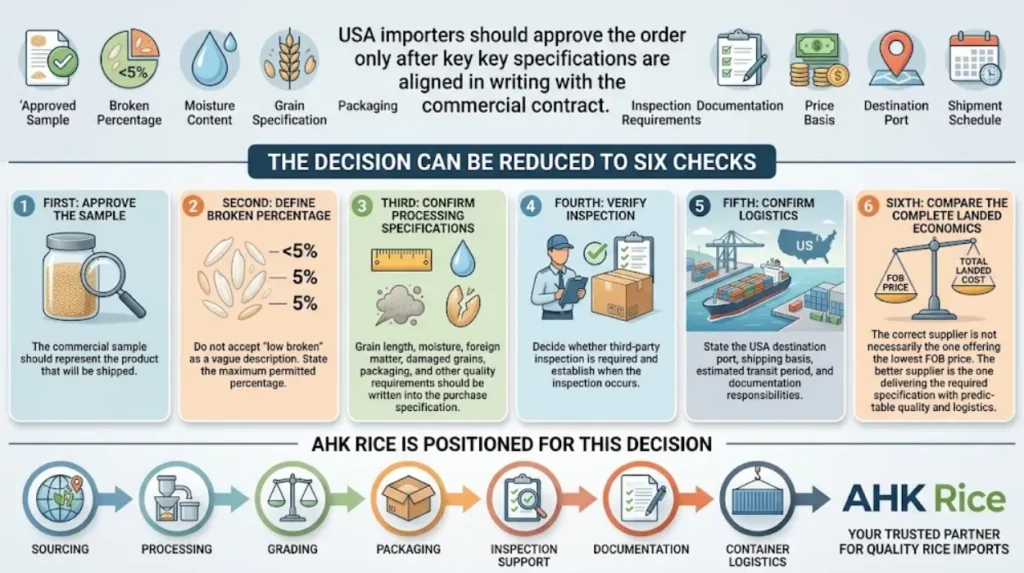
The decision can be reduced to six checks.
First, approve the sample. The commercial sample should represent the product that will be shipped.
Second, define broken percentage. Do not accept “low broken” as a vague description. State the maximum permitted percentage.
Third, confirm processing specifications. Grain length, moisture, foreign matter, damaged grains, packaging, and other quality requirements should be written into the purchase specification.
Fourth, verify inspection. Decide whether third-party inspection is required and establish when the inspection occurs.
Fifth, confirm logistics. State the USA destination port, shipping basis, estimated transit period, and documentation responsibilities.
Sixth, compare the complete landed economics. The correct supplier is not necessarily the one offering the lowest FOB price. The better supplier is the one delivering the required specification with predictable quality and logistics.
AHK Rice is positioned for this decision because its export workflow integrates sourcing, processing, grading, packaging, inspection support, documentation, and container logistics.
How can a USA importer get started with AHK Rice?
A USA importer can start by submitting the required Super Kernel Sella specification, destination port, quantity, packaging requirement, and preferred commercial terms, then reviewing the sample, approving quality, confirming the quotation, and scheduling bulk production.
The most efficient starting specification should include the Super Kernel Sella grade, maximum broken percentage, moisture requirement, packaging size, number of metric tons, destination port, Incoterm, private-label requirements, and inspection preference.
AHK Rice can then coordinate the sample and commercial quotation. Its USA service information specifically supports Super Kernel supply, sample coordination, packaging, and export documentation for American importers.
For a buyer seeking low-broken Super Kernel Sella Rice, the key decision is not simply whether the exporter can supply rice. The question is whether the exporter can reproduce the approved specification at commercial scale and move it through the USA supply chain on a documented schedule.
AHK Rice’s integrated processing and export model is designed around that requirement. The buyer receives one coordinated process covering sourcing, processing, grading, packaging, documentation, inspection support, and shipment execution.
For a USA importer ready to move from sample approval to a commercial Super Kernel Sella order, submit the product specification, quantity, destination port, packaging requirement, and preferred shipping terms through the USA rice export quotation process.
Frequently Asked Questions
What is low-broken Super Kernel Sella Rice?
Low-broken Super Kernel Sella Rice is a premium Pakistani Basmati rice grade with a controlled percentage of broken grains. It is suitable for USA importers seeking better whole-grain appearance, consistent cooking performance, and stronger retail presentation.
Why is broken percentage important for USA rice importers?
Broken percentage affects whole-grain recovery, appearance, cooking consistency, and commercial value. A lower broken percentage generally provides more intact grains, which can be important for retail, foodservice, and private-label applications.
What specifications should USA buyers request for Super Kernel Sella Rice?
Buyers should specify the maximum broken percentage, moisture level, grain length, damaged grains, foreign matter, packaging format, quantity, inspection requirements, and destination port before confirming an order.
How does AHK Rice control Super Kernel Sella Rice quality?
AHK Rice uses processing, grading, and length-sorting stages to separate rice according to grain size, length, and quality. Buyers can also request pre-shipment inspection to verify the agreed specification before dispatch.
Can USA importers request Super Kernel Sella Rice samples?
Yes. USA importers can request samples before placing a bulk order. The sample allows buyers to evaluate grain appearance, broken percentage, aroma, cooking performance, texture, and overall quality against their purchasing requirements.
How much does a Super Kernel Sella Rice sample cost?
Sample costs vary according to quantity, destination, courier charges, and packaging requirements. AHK Rice states that USA buyers generally cover sample shipping costs, with sample-related charges depending on the shipment requirements.
How long does Super Kernel Sella Rice take to ship from Pakistan to the USA?
Wholesale Basmati rice shipments from Karachi to the USA generally require about 30–48 days according to the destination and shipping conditions. East Coast routes can be faster than some West Coast routes.
What affects the price of low-broken Super Kernel Sella Rice?
Price depends on broken percentage, rice grade, paddy costs, processing requirements, order quantity, packaging, inspection, documentation, Incoterms, ocean freight, destination port, and market conditions.
Does lower broken percentage increase Super Kernel Sella Rice cost?
It can. Achieving a lower broken percentage may require stricter grain selection, sorting, and processing. The final price should therefore be evaluated together with the quality specification and expected whole-grain recovery.
What packaging options are available for USA Super Kernel Sella Rice?
Packaging can be customized according to the buyer’s requirements. Options may include bulk PP bags, jute bags, cloth bags, non-woven packaging, cotton packaging, boxes, and plastic formats in different weights.
Can AHK Rice provide private-label Super Kernel Sella Rice for USA buyers?
Yes. AHK Rice supports customized packaging and private-label requirements for export buyers. Importers should provide their packaging specifications, artwork requirements, bag size, quantity, and labeling details before production.