Understanding Super Kernel Sella Rice Grades Before Importing
Super Kernel Sella Rice is a parboiled Pakistani Basmati rice product valued for long slender grains, aromatic character, firm cooked texture, and strong grain integrity. Super Kernel identifies the rice variety, while Sella identifies the parboiling process. Importers therefore need to evaluate both the rice itself and the grade specification before placing a commercial order.
The distinction matters because “Sella” does not represent one universal commercial grade. Export contracts classify Super Kernel Sella through measurable attributes such as broken-kernel percentage, grain length, moisture, foreign matter, chalky grains, color, milling quality, and sortex performance. A buyer comparing two offers must compare these specifications rather than relying on the word “Sella” alone.
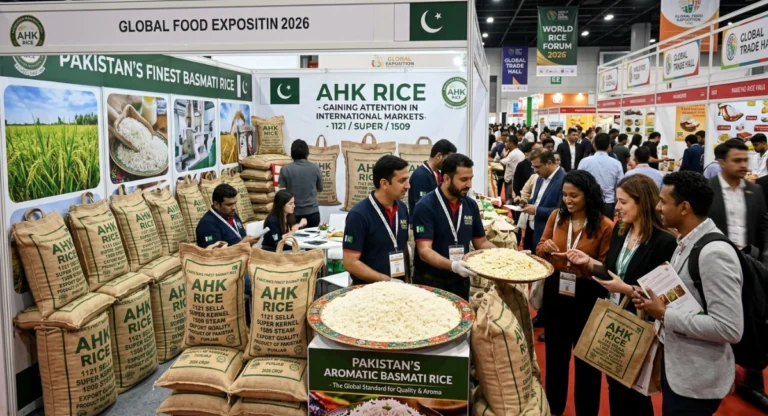
Pakistan remains a major rice-exporting country. TDAP identifies Super Kernel Basmati among Pakistan’s cultivated rice varieties, while current trade information lists markets including the UAE and Saudi Arabia among important destinations in Asia, Africa, and Oceania. Pakistan also exports rice to the United States, United Kingdom, Netherlands, Germany, Belgium, and Italy.
What is Super Kernel Sella Rice?
Super Kernel Sella Rice is a Pakistani Basmati rice variety processed through parboiling before milling, grading, sorting, and packing. The process strengthens kernels, reduces milling losses, supports firm cooked texture, and produces a stable commercial product for retail, food service, distribution, and bulk import applications.
Super Kernel is the variety. Sella is the processing category. Parboiling involves controlled soaking, steaming, and drying of paddy before the husk and bran layers are removed during milling. This sequence changes the physical structure of the grain and helps the kernel withstand subsequent handling.
The product originates primarily from Pakistan’s Basmati-producing areas, particularly Punjab. Punjab provides the agricultural environment associated with Pakistani Basmati production, including fertile soils, irrigation networks, suitable temperatures, and established rice-processing infrastructure.
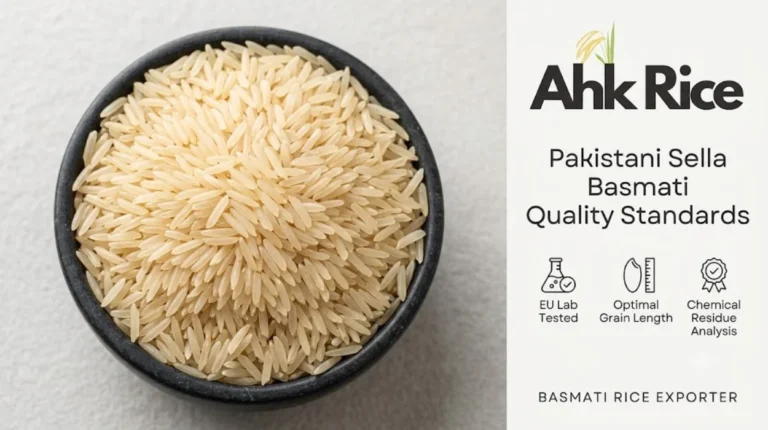
Super Kernel belongs to the Basmati category. Pakistani Basmati rice is recognized for long slender grains, aroma, and elongation during cooking. TDAP material describes Pakistani Basmati varieties as having average grain lengths of 6.5 mm or more and characteristic elongation and fluffy texture after cooking.
The word “Sella” refers to parboiled rice rather than a particular broken percentage. Commercial descriptions also use terms such as Golden Sella and Creamy Sella to describe differences in appearance and processing finish. These names should not replace a written product specification.
How is Super Kernel Sella Rice processed?
Super Kernel Sella processing starts with paddy inspection and cleaning, followed by soaking, steaming, controlled drying, dehusking, whitening, polishing, length grading, color sorting, quality inspection, and packaging. Each stage affects kernel integrity, appearance, moisture stability, cooking behavior, and the final commercial grade.
Paddy reception and inspection
Rice processing begins with harvested paddy. The processor checks the incoming material for variety identity, moisture condition, foreign material, damaged grains, immature kernels, and other physical defects. Proper raw material control establishes the baseline for the finished product.
Cleaning and pre-processing
Cleaning removes materials such as stones, dust, straw, metal particles, and other foreign matter. Mechanical separators and related cleaning equipment prepare the paddy for controlled parboiling.
Soaking
The cleaned paddy is soaked under controlled conditions so water penetrates the grain. The objective is to distribute moisture through the kernel before steaming. Temperature, time, and water management influence the final texture and kernel structure.
Steaming
Steam treatment gelatinizes part of the starch structure inside the grain. This process strengthens the kernel and reduces the likelihood of excessive breakage during later milling. It also contributes to the characteristic cooking behavior of parboiled rice.
Controlled drying
After steaming, the paddy is dried to a suitable moisture level for milling and storage. Drying must be controlled because excessive thermal stress produces cracks, while inadequate drying interferes with milling and storage stability.
Dehusking and milling
The dried paddy passes through husking equipment to remove the outer husk. Whitening then removes the bran layers from the brown rice. Polishing creates the required surface appearance while maintaining the physical integrity of the kernels.
Grading and sorting
The milled rice is separated according to length and physical characteristics. Broken kernels are separated from whole kernels. Color sorting removes discolored or defective grains. Modern export processing therefore uses mechanical grading and optical sorting to achieve a consistent commercial specification.
Inspection and packaging
The finished rice is checked against the agreed specification before packing. Packaging then protects the product from contamination, moisture exposure, handling damage, and physical deterioration during storage and transportation.
Pakistan’s export process is increasingly digital. The Pakistan Single Window system supports electronic processing of export certificates, while phytosanitary certificates for regulated plant commodities are processed through the Department of Plant Protection’s PSW workflow.
Which components determine Super Kernel Sella Rice grades?
Super Kernel Sella grades are determined by measurable physical and quality attributes rather than one name alone. The principal components include broken percentage, grain length, moisture, foreign matter, damaged grains, color uniformity, chalkiness, milling quality, sortex cleanliness, and cooking performance.
Broken-kernel percentage
Broken percentage represents the proportion of kernels that are fractured or smaller than the specified whole-grain requirement. Common commercial specifications use limits such as 2%, 5%, or 10% broken, but the exact tolerance is defined by the buyer-seller contract.
This factor directly changes the visual appearance and commercial positioning of a shipment. A specification with 2% broken contains a higher proportion of whole kernels than one specified at 10% broken.
The commercial impact of this measurement deserves separate attention because broken percentage influences how buyers assess Super Kernel rice market value. The naturally occurring phrase “
How broken percentage influences the Super Kernel rice market value.
Grain length and shape
Grain length is measured in millimeters. Importers also examine slenderness, uniformity, and the proportion of long whole kernels. Length alone does not establish quality because a long grain with excessive breakage or poor uniformity does not deliver the same commercial result as a clean, consistent shipment.
Moisture
Moisture affects storage stability, milling behavior, and product condition. Import contracts specify an acceptable moisture ceiling according to the destination and product specification. Importers should rely on the contractual laboratory specification rather than treating one generic moisture number as universal.
Pakistan’s standards infrastructure includes recognized methods for determining cereal moisture and rice characteristics. PSQCA lists standards for moisture determination, rice milling yield, amylose testing, and rice specification.
Color and sortex cleanliness
Color uniformity affects the appearance of packaged rice. Optical color sorting removes yellow, black, red, damaged, and other visually defective kernels. A higher sorting requirement produces a cleaner and more uniform appearance.
Milling quality
Milling quality measures how effectively paddy is converted into usable whole and broken rice. A higher whole-kernel recovery supports premium commercial grades because the buyer receives more intact kernels from the same quantity of paddy.
What Super Kernel Sella grades are available?
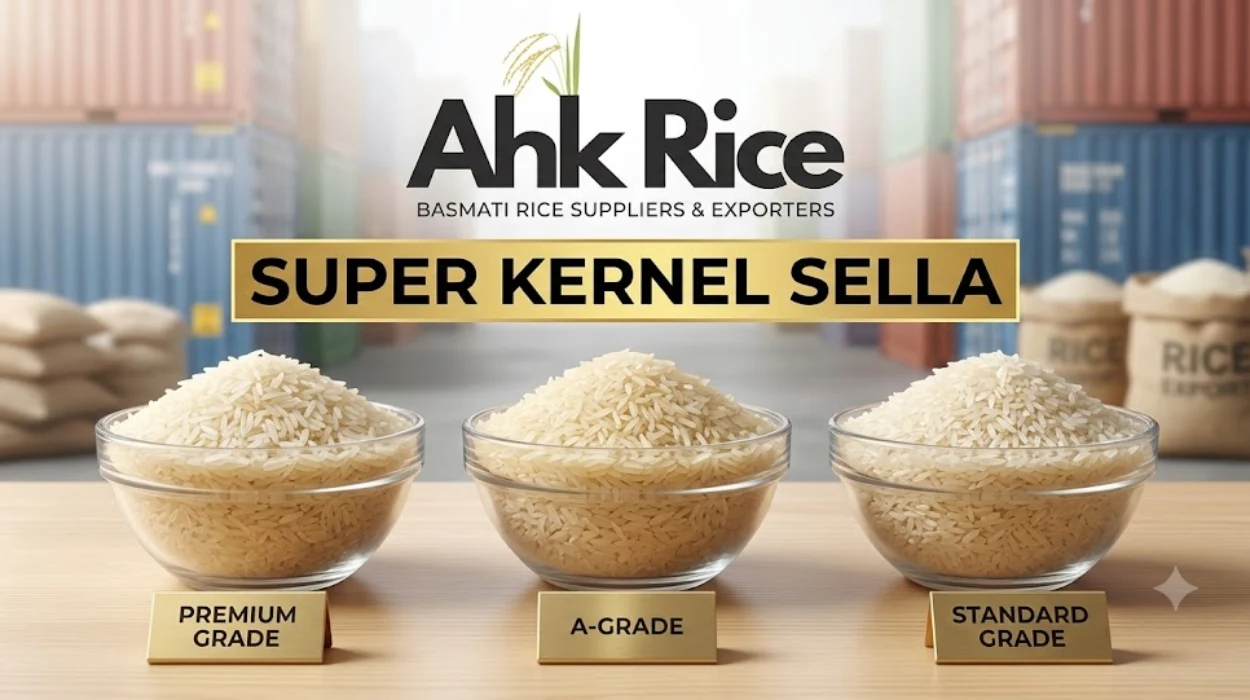
Commercial Super Kernel Sella grades are normally differentiated by broken percentage, sorting level, grain specifications, and appearance rather than by one globally fixed grading system. Typical trade specifications include whole-kernel premium grades, 2% broken, 5% broken, and 10% broken categories.
A “100% whole” specification refers to a commercial requirement focused on whole kernels, but terminology differs among exporters and buyers. Importers should never interpret “100%” without checking the complete specification sheet.
A 2% broken grade allows a very low proportion of broken kernels. A 5% broken grade allows a higher proportion. A 10% broken grade contains a larger broken fraction and generally serves applications where appearance requirements are less strict.
Sorting creates another grading dimension. Standard sortex, double-sortex, and higher optical-sorting specifications describe increasing levels of visual defect removal. These terms should also be defined in the purchase contract because equipment names do not independently establish an international grade.
Sella itself can appear in different visual forms. Creamy Sella retains a lighter creamy appearance, while Golden Sella has a more pronounced golden-yellow appearance after processing. These are processing and appearance descriptions rather than substitutes for broken percentage, grain length, moisture, or defect limits.
What are the benefits of Super Kernel Sella Rice?
Super Kernel Sella provides several functional advantages for commercial rice supply, including stronger kernels, lower milling breakage, consistent cooking texture, long-grain presentation, and stable handling characteristics. These attributes support retail packs, restaurant kitchens, wholesalers, distributors, and institutional food operations.
Parboiling strengthens the rice structure before milling. This improves resistance to breakage during processing and handling compared with untreated kernels. The resulting whole-grain recovery is an important factor in commercial grading.
The cooked grain also retains a firm structure. Properly processed Sella rice produces separate grains with a firm bite when prepared according to the required cooking method.
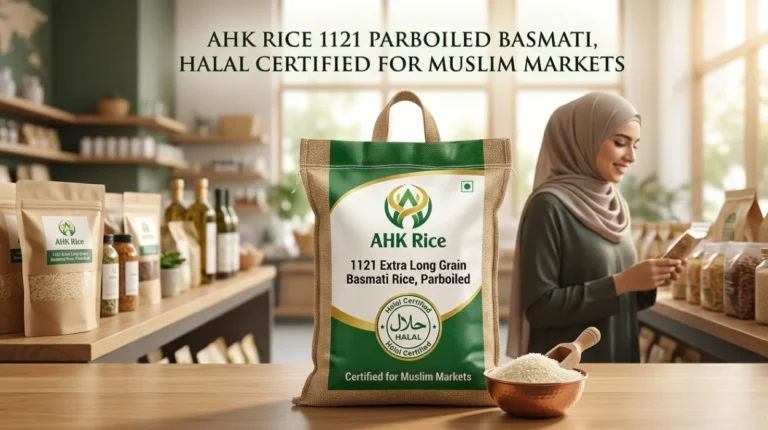
The product also supports standardized packing. Importers can specify quantities such as 1 kg, 5 kg, 10 kg, 20 kg, or 25 kg according to their distribution model. Private-label packaging can then align the physical product with the buyer’s retail or wholesale requirements.
Where is Super Kernel Sella Rice imported and used?
Super Kernel Sella Rice serves international markets where long-grain Basmati characteristics, parboiled cooking performance, consistent appearance, and bulk availability are commercially important. Major Pakistani rice destinations include Gulf markets, Europe, the United Kingdom, North America, and selected Asian and African markets.
The Gulf is an established destination for Pakistani rice. TDAP currently lists the UAE and Saudi Arabia among top export destinations within its Asia, Africa, and Oceania market division.
European and North American markets also form part of Pakistan’s rice export network. TDAP identifies the United States, United Kingdom, Netherlands, Germany, Belgium, and Italy among destinations covered by its Americas and Europe market division.
Super Kernel Sella is used across several commercial channels. Examples include supermarket private labels, wholesale distribution, restaurants, catering operations, institutional kitchens, ethnic food retailers, and food-service distributors.
The appropriate grade depends on the application. A supermarket brand typically prioritizes clean appearance, whole kernels, consistent grain size, and packaging presentation. A food-service distributor focuses more heavily on cooking yield, texture, consistency, and cost per usable kilogram.
Which certifications and export documents apply to Super Kernel Sella Rice?
Export documentation depends on the destination, buyer contract, and regulatory requirements. Common documentation includes phytosanitary certification, certificate of origin, commercial documents, laboratory or inspection reports, and food-safety evidence such as HACCP or ISO-based systems when required by the buyer.
A phytosanitary certificate confirms compliance with plant-health requirements for regulated exports. Pakistan’s Department of Plant Protection processes these certificates electronically through Pakistan Single Window.
A Certificate of Origin identifies the product’s country of origin for customs and trade purposes. TDAP states that certificates of origin are issued through PSW for applicable arrangements, with electronic processing and QR-enabled documentation.
Food-safety certifications are separate from export certificates. HACCP is a preventive food-safety control system. ISO 22000 is an international food-safety management-system standard. Buyers can also specify laboratory testing for microbiological, chemical, pesticide-residue, moisture, or physical parameters according to destination requirements.
The exact document set must therefore follow the importing country’s regulations and the buyer’s purchase contract. A certificate should never be treated as a universal substitute for destination-specific compliance.
What are the common misconceptions about Super Kernel Sella grades?
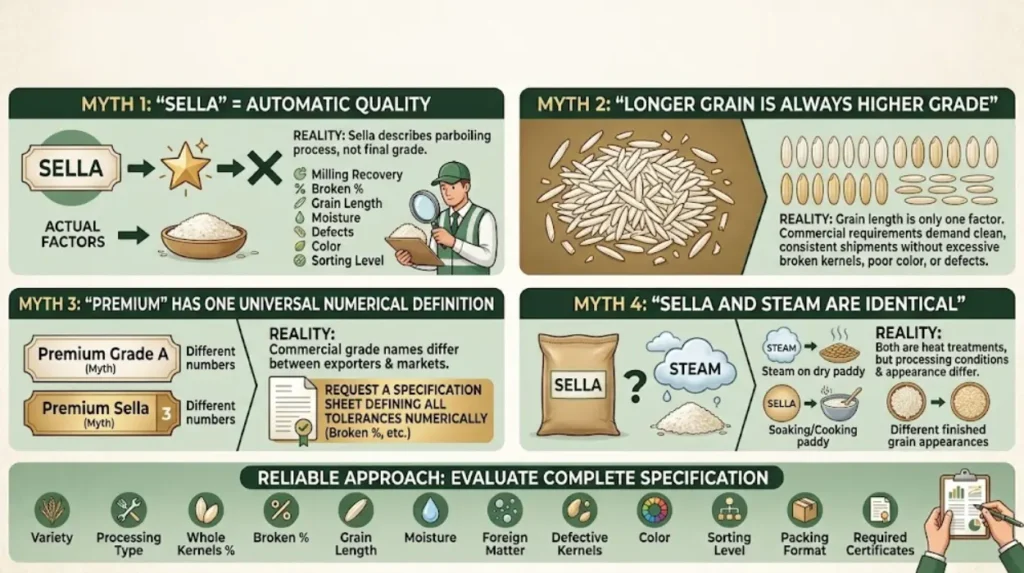
The main misconception is that Sella automatically defines rice quality. It does not. Sella describes parboiling, while grade quality depends on measurable specifications such as broken percentage, grain length, moisture, defects, color, milling recovery, sorting level, and the buyer’s agreed acceptance limits.
Another misconception is that longer grain always means a higher grade. Grain length matters, but a long shipment with excessive broken kernels, poor color uniformity, or high defect levels does not meet the same commercial requirement as a clean, consistent shipment.
A third misconception is that “premium” has one universal numerical definition. Commercial grade names differ between exporters and markets. The importer should therefore request a specification sheet that defines every tolerance numerically.
A fourth misconception is that Sella and Steam are identical. Both involve heat treatment, but their processing conditions and finished appearance differ. Sella is generally associated with parboiling, while Steam describes a steam-processing category used in commercial rice terminology.
The most reliable approach is to evaluate the product through a complete specification. The buyer should compare variety, processing type, whole-kernel percentage, broken percentage, grain length, moisture, foreign matter, defective kernels, color, sorting level, packing format, and required certificates before approving a shipment.
What should importers check before selecting a Super Kernel Sella grade?
Importers should select the grade from the intended market and application first, then match broken percentage, grain dimensions, moisture, appearance, cooking performance, packaging, documentation, and inspection requirements to that application. The complete specification should appear in the commercial purchase contract.
The first check is variety identity. Confirm that the product is Super Kernel Basmati rather than another long-grain rice.
The second check is processing type. Specify Sella and define the required appearance, such as Creamy Sella or Golden Sella, when that distinction matters to the market.
The third check is broken percentage. A 2% broken specification serves a different commercial purpose from a 10% broken specification. The buyer should connect this percentage to the intended retail, wholesale, or food-service application.
The fourth check is physical quality. Confirm grain length, grain shape, moisture, foreign matter, damaged kernels, chalky kernels, color, and milling recovery.
The fifth check is sorting. Define the required optical sorting level and acceptance tolerance rather than relying only on a phrase such as “premium sortex.”
The sixth check is documentation. Confirm phytosanitary requirements, origin documentation, inspection reports, laboratory tests, and food-safety certifications required by the destination.
For 2026 imports, documentation should also be aligned with Pakistan’s digital export environment. PSW currently supports electronic processing for export certificates and related regulatory workflows, while current 2026 trade measures continue to affect rice exporters and export procedures.
Super Kernel Sella Rice is therefore best understood as a combination of variety + parboiling process + measurable grade specification. Importers who separate these three elements can compare offers accurately, match the correct grade to their market, and avoid purchasing decisions based only on broad labels such as “premium,” “Sella,” or “long grain.”
Frequently Asked Questions
What is Super Kernel Sella Rice?
Super Kernel Sella Rice is a Pakistani Basmati rice variety processed through parboiling before milling. It is known for long slender grains, firm cooked texture, aroma, and good whole-kernel integrity.
What does Sella mean in Super Kernel rice?
Sella refers to the parboiling process used before milling. The process involves soaking, steaming, and controlled drying of paddy before dehusking and milling.
Where is Super Kernel Sella Rice grown?
Super Kernel Basmati rice is primarily associated with Pakistan’s Basmati-producing areas, particularly Punjab, where suitable agricultural conditions support Basmati rice cultivation.
What determines the grade of Super Kernel Sella Rice?
Grade specifications are determined by measurable attributes such as broken percentage, grain length, moisture, foreign matter, damaged kernels, chalkiness, color uniformity, milling quality, and sorting level.
What does 2% broken mean in Super Kernel Sella Rice?
A 2% broken specification means the commercial specification permits up to 2% broken kernels, subject to the exact contractual definition and inspection method. It provides a higher whole-kernel proportion than grades allowing 5% or 10% broken.
What is the difference between 2%, 5%, and 10% broken rice?
The difference is the permitted proportion of broken kernels. A 2% broken grade contains fewer broken kernels than a 5% grade, while a 10% broken specification permits a larger broken fraction.
Is Sella the same as Steam rice?
No. Sella and Steam describe different processing categories. Sella is associated with parboiling, while Steam refers to a steam-processing method. Their processing conditions, appearance, and cooking characteristics differ.
What is the difference between Golden Sella and Creamy Sella?
Golden Sella has a more pronounced golden-yellow appearance, while Creamy Sella has a lighter creamy appearance. Both are parboiled rice categories and still require separate specifications for broken percentage, moisture, grain length, and defects.
What moisture level should Super Kernel Sella Rice have?
The required moisture level depends on the commercial specification, destination market, storage conditions, and buyer contract. Importers should use the moisture tolerance stated in the product specification rather than relying on a universal number.
Which countries import Super Kernel Sella Rice?
Pakistani rice is exported to markets including Saudi Arabia, the UAE, the United States, the United Kingdom, the Netherlands, Germany, Belgium, and Italy. Super Kernel Sella is used across retail, wholesale, food-service, and distribution channels.
What certifications are required for Super Kernel Sella Rice exports?
Requirements depend on the destination and buyer. Common documents include phytosanitary certification, Certificate of Origin, commercial export documents, laboratory reports, and food-safety certifications such as HACCP or ISO 22000 when specified.
What should importers check before buying Super Kernel Sella Rice?
Importers should check variety, processing type, broken percentage, grain length, moisture, foreign matter, damaged kernels, color, sorting level, packaging, laboratory reports, inspection requirements, and destination-specific export documentation.
Is longer Super Kernel rice always a higher grade?
No. Grain length is only one quality attribute. A commercial grade also depends on whole-kernel percentage, broken percentage, moisture, defects, color uniformity, milling quality, and sorting performance.
Why does broken percentage matter when importing Super Kernel Sella Rice?
Broken percentage affects whole-kernel recovery, visual presentation, cooking consistency, and commercial positioning. Importers should compare broken percentage alongside grain length, defects, moisture, and other specifications.
What packaging options are available for Super Kernel Sella Rice?
Packaging can be specified according to the destination market and distribution channel. Common formats include 1 kg, 5 kg, 10 kg, 20 kg, and 25 kg bags, including private-label packaging where required.
How is Super Kernel Sella Rice processed?
The process includes paddy inspection, cleaning, soaking, steaming, controlled drying, dehusking, whitening, polishing, grading, broken separation, optical sorting, quality inspection, and final packaging.
What markets use Super Kernel Sella Rice?
Super Kernel Sella Rice is used by supermarkets, wholesalers, food-service distributors, restaurants, caterers, institutional kitchens, and ethnic-food retailers where long-grain Basmati characteristics and parboiled cooking performance are required.