How Can Importers Monitor International Rice Orders More Effectively?
Importers can monitor international rice orders most effectively by combining order milestones, quality documents, shipment tracking, and supplier updates in one control process. Here is why: international rice orders involve production, inspection, documentation, loading, transit, customs, and delivery.
Pakistan exported 6.56 million tonnes of rice worth US$4.19 billion in 2024, making shipment visibility important across multiple destination markets. Saudi Arabia, the UAE, and the UK were among Pakistan’s major rice destinations. (source: World Bank WITS, 2024)
Importers can build better visibility by first understanding how supply chain visibility affects international rice procurement. The strongest process connects the purchase order with product specifications, inspection results, container details, shipping documents, estimated arrival dates, and final delivery confirmation.
What Are the Available Solutions for Monitoring Rice Orders?
The main solutions are supplier milestone reporting, spreadsheet tracking, freight-forwarder portals, carrier tracking, and integrated supply-chain platforms. Each method provides a different level of visibility, cost control, and data integration for importers.
Supplier milestone reporting is the simplest approach. The exporter reports production, quality inspection, loading, dispatch, and document completion. This method works well for smaller importers managing several containers.
Spreadsheet tracking provides stronger internal control. Procurement teams can record purchase order numbers, grades, quantities, shipment dates, container numbers, ports, documents, and expected arrival dates.
Freight-forwarder portals provide logistics visibility. Importers can monitor container movement, vessel schedules, transshipment events, and estimated arrival dates through the forwarding company.
Carrier tracking provides shipment-level information. Container numbers and booking references connect the physical cargo with vessel movements and port events.
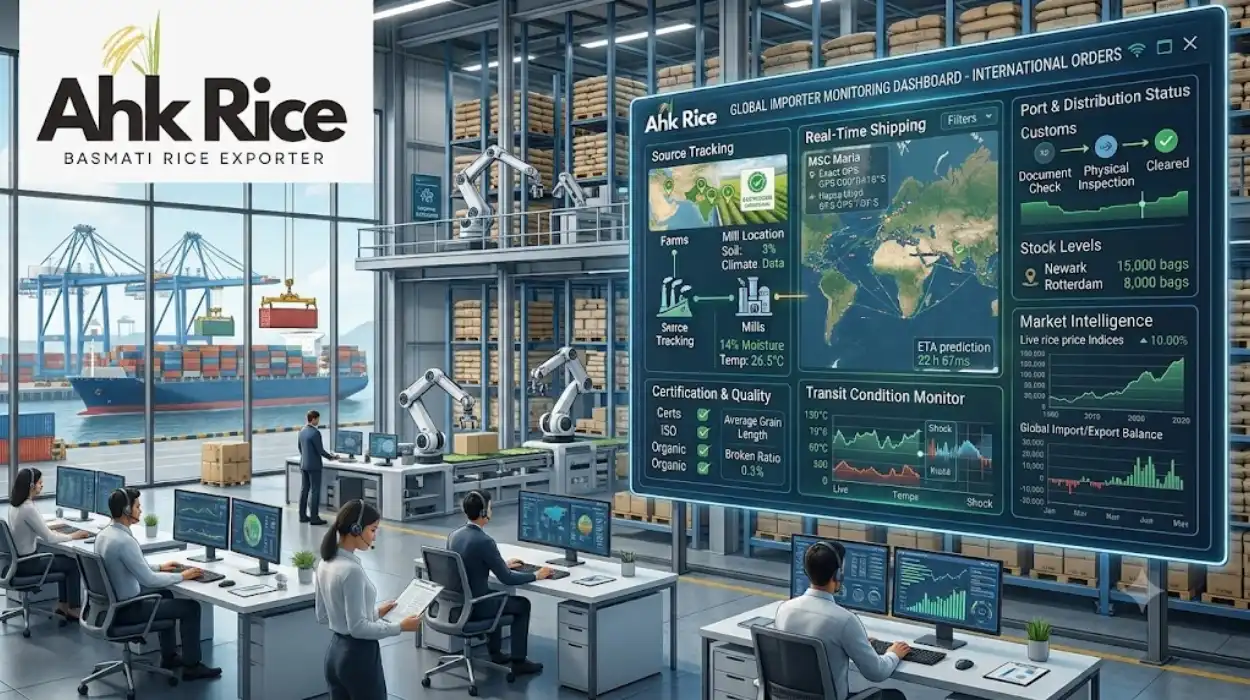
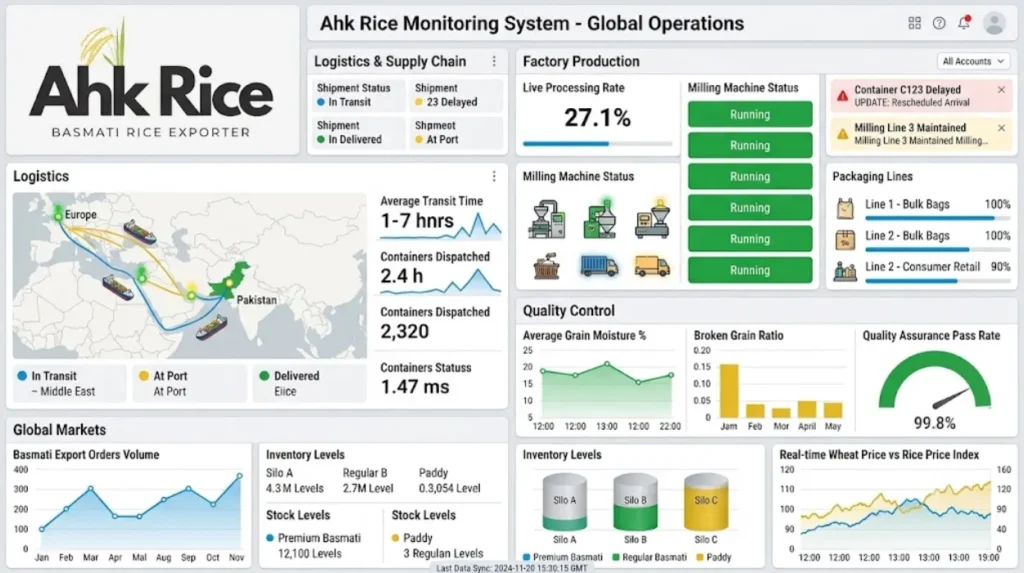
Integrated supply-chain platforms combine these information streams. They can connect purchase orders, inventory, transportation, documents, suppliers, and delivery milestones inside one dashboard.
The strongest solution depends on order volume and operational complexity. The next section compares these approaches against measurable procurement requirements.
How Do Different Rice Order Monitoring Approaches Compare?
Integrated tracking provides the broadest visibility, while supplier reporting offers the lowest operational complexity. Importers should compare each approach using data accuracy, update frequency, document control, cost, scalability, and exception management.
| Attribute | Supplier Updates | Spreadsheet | Freight Portal | Carrier Tracking | Integrated Platform |
|---|---|---|---|---|---|
| Order visibility | Medium | Medium | High | High | Very high |
| Quality visibility | High | High | Low | Low | High |
| Document control | Medium | High | Medium | Low | Very high |
| Shipment tracking | Medium | Low | High | Very high | Very high |
| Update frequency | Scheduled | Manual | Regular | Event-based | Near real-time |
| Cost | Low | Low | Medium | Low | High |
| Scalability | Low | Medium | High | High | Very high |
Supplier updates work well for straightforward transactions. A buyer ordering 1 container monthly can manage production and shipment milestones through scheduled communication.
Spreadsheets suit procurement teams that need detailed internal records. They become difficult when dozens of containers, suppliers, destinations, and purchase orders require simultaneous updates.
Freight portals improve logistics control. They show movement after cargo enters the transportation network. They provide less information about milling, grading, inspection, packaging, and pre-shipment documentation.
Carrier tracking provides accurate vessel and container events. It does not replace supplier communication because physical movement does not confirm product quality or documentation readiness.
Integrated platforms provide the strongest connection between commercial and logistics data. They become valuable for importers managing recurring contracts across several markets.
Pakistan’s 2024 rice exports reached major markets including Saudi Arabia, the UAE, and the UK. This geographic spread illustrates why importers need destination-specific monitoring processes. (source: World Bank WITS, 2024)
The comparison shows that visibility must cover more than container location. The next question is how market requirements change the monitoring process.
Which Monitoring Method Works Best for Different Market Regions?
Gulf buyers benefit from shipment and inventory visibility, while European buyers require stronger documentation and compliance tracking. Market conditions determine which order milestones deserve the closest monitoring attention.
Gulf Markets
Gulf markets include the UAE, Saudi Arabia, Qatar, Kuwait, Oman, and Bahrain. These markets import substantial volumes of rice and support retail, food service, wholesale, and catering channels.
Saudi Arabia received approximately 223,724 tonnes of Pakistani rice in 2024, while the UAE received approximately 205,315 tonnes. (source: World Bank WITS, 2024)
Gulf importers should monitor product specification, production status, inspection, container loading, vessel departure, transshipment, arrival, customs clearance, and warehouse delivery.
1121 Basmati, Super Kernel, and 1509 can serve different buyer requirements. AHK Rice supplies these Pakistani varieties through end-to-end processing and export coordination.
Gulf buyers often require practical inventory planning. Golden Sella provides stronger storage stability than Steam specifications. A 18–24 month shelf-life specification can support longer inventory cycles for suitable storage conditions.
European and UK Markets
European and UK buyers require stronger document visibility. Importers should monitor certificates, laboratory reports, origin documentation, packing details, shipment records, and customs documents.
The UK imported approximately 164,946 tonnes of Pakistani rice in 2024. Pakistan’s exports to the UK were valued at approximately US$149.8 million for rice. (source: World Bank WITS, 2024)
European buyers should connect product specifications with documentation. The order record should identify rice variety, grade, crop year, moisture specification, broken percentage, packaging, quantity, and inspection status.
Regional Comparison
| Factor | Gulf Region | UK & European Region |
|---|---|---|
| Common commercial priority | Delivery reliability | Compliance visibility |
| Strong monitoring need | Vessel and arrival status | Documents and inspection |
| Preferred product focus | 1121, Super Kernel, 1509 | 1121, Super Kernel, premium Basmati |
| Inventory concern | Heat and storage conditions | Warehouse rotation |
| Visibility priority | Shipment + inventory | Documents + shipment |
Gulf buyers should prioritize delivery and inventory signals. UK and European buyers should prioritize compliance records and shipment documentation.
With regional priorities established, importers can now select a monitoring process based on their order structure.
What Are the Pros and Cons of Each Monitoring Approach?
Manual tracking costs less but creates update gaps, while integrated tracking improves control but requires greater implementation effort. Importers should match the monitoring method with order volume, supplier count, and shipment frequency.
Supplier Reporting
Supplier reporting provides direct information from the exporter. The exporter can confirm milling, grading, packing, inspection, loading, and dispatch milestones.
The main advantage is simplicity. The main limitation is update dependency.
A buyer managing five containers monthly can request fixed updates at production completion, inspection completion, loading, vessel departure, and arrival.
Spreadsheet Tracking
Spreadsheets provide structured internal records. Procurement managers can assign every order a unique reference and track each milestone.
The main advantage is flexibility. The main limitation is manual maintenance.
A spreadsheet becomes inefficient when several employees update different versions. Incorrect container numbers can create misleading delivery forecasts.
Freight-Forwarder Tracking
Freight-forwarder tracking provides logistics information. It connects bookings with container movements and vessel schedules.
The main advantage is transportation visibility. The main limitation is limited product information.
A container can show as loaded while inspection documents remain incomplete. Importers therefore need both logistics and quality milestones.
Carrier Tracking
Carrier tracking provides strong physical shipment visibility. Container events can show departure, transshipment, arrival, and discharge information.
The main advantage is accurate transport status. The main limitation is narrow scope.
Carrier data cannot confirm whether the correct rice grade entered the container. It also cannot confirm whether every required certificate is ready.
Integrated Tracking
Integrated tracking connects procurement, quality, documentation, logistics, and delivery.
The main advantage is a single operational view. The main limitation is higher setup and administration requirements.
Integrated tracking becomes more valuable as order volume increases. Importers managing multiple suppliers can identify delays earlier through centralized exception alerts.
The pros and cons show that no single tool fits every buyer. The next step is identifying the decision factors that determine the correct approach.
What Decision Factors Should Importers Use Before Choosing a Monitoring System?
Order volume, supplier count, destination complexity, product specifications, document requirements, shipment frequency, and exception risk should determine the monitoring method. These factors create a practical framework for selecting visibility without unnecessary technology costs.
| Decision Factor | Low-Complexity Requirement | High-Complexity Requirement | Recommended Approach |
|---|---|---|---|
| Monthly orders | 1–5 | 20+ | Spreadsheet → integrated |
| Suppliers | 1–2 | 5+ | Supplier portal → integrated |
| Destinations | 1 | 4+ | Freight tracking → integrated |
| Documents | Basic | Extensive | Spreadsheet → integrated |
| Shipment frequency | Monthly | Weekly | Carrier → integrated |
Order volume determines system pressure. Five monthly shipments require fewer automated controls than 30 recurring containers.
Supplier count determines communication complexity. Multiple suppliers create different production schedules, document processes, and shipment references.
Destination count determines logistics complexity. Each destination can involve different ports, customs procedures, transit routes, and delivery requirements.
Product diversity also matters. Importers purchasing 1121, Super Kernel, and 1509 need product-level identification within every order.
Document requirements create another control layer. A complete order record should connect the commercial invoice, packing list, certificate of origin, phytosanitary certificate, fumigation certificate, bill of lading, and quality certificate.
Exception risk determines the value of automation. Delayed inspection, incomplete documentation, vessel changes, and customs delays require immediate attention.
These factors create a practical decision framework. The final question is how importers can implement stronger visibility without overcomplicating procurement.
How Can Importers Build a Better Rice Order Monitoring Process?
Importers should create one order record, define milestone ownership, verify specifications, monitor logistics events, and close every shipment against delivery documents. This process creates continuity from purchase order to warehouse receipt.
1. Create the Order Record
Create one master record for every purchase order. Include supplier, rice variety, grade, quantity, packaging, price basis, destination port, delivery location, and required shipment date.
Assign one reference number to the complete transaction. Use the same reference across supplier communication, inspection reports, freight records, and customs documentation.
2. Define Production Milestones
Define production milestones before manufacturing begins. Track milling, grading, sorting, packaging, inspection, and loading.
1121 Basmati requires clear product identification. Super Kernel and 1509 orders require the same specification discipline.
3. Verify Quality Milestones
Verify moisture, grain specifications, broken percentage, purity, foreign matter, packaging, and crop-year requirements against the purchase specification.
AHK Rice uses structured processing and quality-control stages. These stages include cleaning, dehusking, drying, milling, polishing, length sorting, colour sorting, inspection, and container loading.
4. Monitor Export Documents
Monitor every required export document against the shipment reference. Mark documents as requested, prepared, verified, and completed.
Document control reduces customs and receiving problems. It also gives procurement teams evidence for supplier performance reviews.
5. Track Container Movement
Track the container from loading through port departure, transshipment, destination arrival, discharge, customs clearance, and final delivery.
Record the estimated arrival date after every major vessel event. Update warehouse planning when the arrival forecast changes.
6. Record Exceptions
Record every exception as a separate event. Include the date, cause, responsible party, impact, and corrective action.
A vessel delay requires different action from a quality-document delay. Separating the events prevents operational confusion.
7. Close the Shipment
Close the order only after warehouse receipt. Match received quantity, packaging, product grade, and delivery documents against the purchase order.
Record supplier performance after every shipment. Repeated delays become measurable procurement data rather than isolated incidents.
This process turns shipment monitoring into supply-chain visibility. It also gives buyers a structured basis for evaluating exporters.
How Does Better Visibility Improve Supplier Evaluation?
Better visibility changes supplier evaluation from price comparison to measurable performance comparison. Importers can assess delivery reliability, specification consistency, documentation accuracy, communication speed, and exception resolution.
Supplier performance should use measurable indicators. Useful indicators include on-time shipment rate, document completion rate, specification compliance rate, response time, and delivery variance.
A supplier that offers a lower price but creates repeated documentation delays can increase total procurement costs.
A supplier that maintains consistent specifications can reduce receiving disputes. Consistency also helps retailers and food-service buyers maintain predictable product performance.
AHK Rice supplies 1121, Super Kernel, and 1509 Pakistani rice varieties to more than 15 countries. Its export process includes processing, custom packaging, quality verification, documentation, and shipment coordination.
Pakistan’s rice export network already spans Asia, Africa, the Middle East, and Europe. In 2024, major destinations included Indonesia, Afghanistan, Kenya, Malaysia, Saudi Arabia, the Philippines, the UAE, and the UK. (source: World Bank WITS, 2024)
The broader the destination network becomes, the more important structured order visibility becomes. Importers can therefore use monitoring data as a supplier-selection tool.
What Is the Best Overall Strategy for International Rice Importers?
The best strategy combines supplier milestone reporting, quality verification, document control, and carrier tracking inside one order-level record. This combination provides practical visibility without treating transportation tracking as the entire supply chain.
Small importers can start with structured supplier updates and spreadsheets. Medium importers can add freight-forwarder and carrier tracking.
Large importers should integrate procurement, supplier, quality, documentation, logistics, and warehouse information.
The core principle remains the same across every scale. One order should have one reference, one specification record, one milestone history, and one delivery outcome.
The strongest monitoring process also connects product and logistics information. A container number alone does not explain whether the correct Basmati grade was produced or inspected.
Importers should therefore monitor the order from commercial confirmation through warehouse receipt. This approach creates a complete chain of evidence for every shipment.
Better visibility does not simply show where rice is. It explains what was ordered, what was produced, what was inspected, what was shipped, where it is, and when it will arrive.
Frequently Asked Questions
How can importers track international rice shipments?
Importers can track shipments through supplier updates, freight-forwarder portals, carrier systems, spreadsheets, or integrated supply-chain platforms. The strongest process connects production, inspection, documents, container movement, customs, and delivery.
What information should a rice order tracker contain?
A rice order tracker should contain supplier, variety, grade, quantity, packaging, purchase order number, inspection status, container number, vessel details, destination port, documents, estimated arrival, and delivery status.
Which Pakistani rice varieties can importers monitor through AHK Rice?
AHK Rice supplies 1121, Super Kernel, and 1509 Pakistani rice varieties. Buyers can monitor specifications, processing, packaging, inspection, documentation, loading, and shipment milestones for export orders.
Why is shipment tracking alone insufficient?
Shipment tracking shows physical cargo movement. It does not confirm product grade, quality inspection, packaging accuracy, or document readiness. Importers need commercial, quality, and logistics visibility together.
Which markets require strong rice order visibility?
Gulf and European markets both require structured visibility. Gulf importers benefit strongly from shipment and inventory tracking. UK and European buyers place greater emphasis on documentation and compliance records.
How does order visibility reduce procurement risk?
Order visibility identifies production delays, incomplete documents, inspection issues, vessel changes, and delivery changes earlier. Importers can then adjust warehouse planning and supplier communication before problems escalate.
What is the best monitoring method for small rice importers?
Supplier milestone reporting combined with a structured spreadsheet provides a practical starting point for smaller importers. The system should still track product specifications, documents, shipment status, and delivery.
What should importers compare when selecting a rice exporter?
Importers should compare specification consistency, quality verification, documentation accuracy, shipment performance, communication, packaging capability, destination experience, and exception management. Price should remain one factor within the complete procurement assessment.