How Do Basmati Rice Shipments Pass UK Border Inspection Checks?
Pakistani Basmati rice shipments pass UK border checks through accurate documents, compliant contaminant results, correct declarations, and consistent cargo identification. Here is why: England uses documentary, identity, physical, food-safety, and customs controls to verify imported consignments.
For importers, the strongest approach combines pre-shipment laboratory testing with inspection-ready documentation and controlled packaging. Our guide to [UK Basmati rice quality and inspection requirements] should be placed here in the second paragraph using the correct ToFu article URL.
What are the main UK border inspection requirements for Basmati rice?
The core requirements are correct import documentation, traceable packaging, contaminant compliance, accurate declarations, and cargo consistency. England applies food-safety controls through competent authorities, while customs checks verify the commercial import declaration.
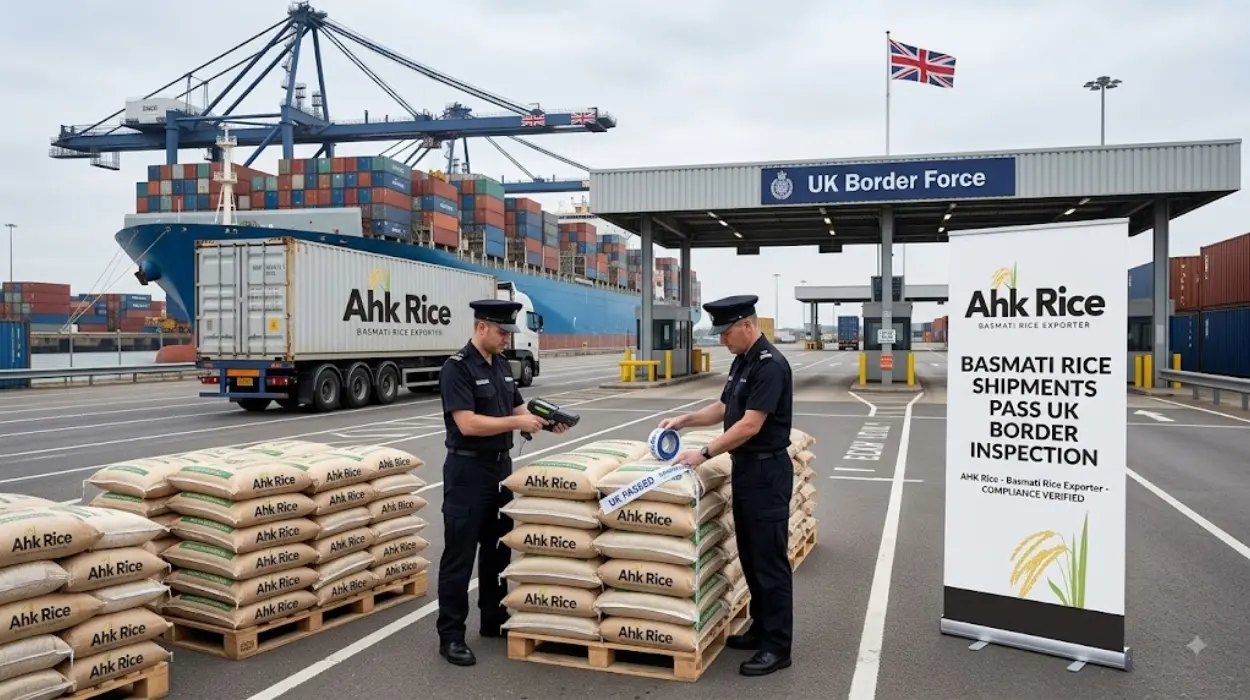
A UK border control post, or BCP, is an official inspection facility for goods subject to sanitary and phytosanitary controls. BCP authorities can perform document, identity, and physical checks. Customs authorities can also conduct separate checks.
Pakistan-origin rice currently receives specific attention under Great Britain food import controls. The UK government lists Pakistani rice under controls for pesticide residues, aflatoxins, and Ochratoxin A.
Pre-notification also forms part of the controlled-import process for relevant high-risk food and feed. Importers use the Import of Products, Animals, Food and Feed System, known as IPAFFS, for applicable consignments.
The practical lesson is straightforward. A shipment should arrive with every document, package mark, product description, and laboratory result aligned.
With the UK inspection framework established, the next question is how different preparation strategies compare.
How do different Basmati shipment preparation approaches compare?
Laboratory-led preparation provides stronger control than document-only preparation, while full pre-shipment verification gives the best inspection readiness. Each approach creates a different balance between cost, speed, evidence, and border risk.
| Attribute | Document-only approach | Laboratory-led approach | Full inspection-ready approach |
|---|---|---|---|
| Product testing | Basic | Pre-shipment testing | Pre-shipment and specification verification |
| Contaminant control | Limited evidence | Strong evidence | Strong documented evidence |
| Package identification | Standard | Verified | Matched against documents |
| Traceability | Moderate | Strong | Strong |
| Border preparation | Basic | Good | Comprehensive |
| Cost control | Highest short-term economy | Moderate | Highest preparation value |
| Buyer confidence | Moderate | High | Very high |
Document-only preparation focuses on commercial paperwork. The exporter supplies invoices, packing details, shipping information, and certificates required for the transaction.
Laboratory-led preparation adds analytical evidence. Testing can address pesticide residues and contaminants relevant to the product and origin. Pakistan-origin rice is currently listed for pesticide residues, aflatoxins, and Ochratoxin A controls.
Full inspection-ready preparation connects laboratory results with the exact shipment. The exporter verifies grade, crop information, packaging, lot identification, quantity, and supporting documents before dispatch.
This comparison matters because border authorities check whether the declared commodity matches the actual consignment. Identity checks compare identification marks and package information with the accompanying documentation.
For a regular wholesale shipment, laboratory-led preparation offers a strong balance. For private-label retail cargo or larger recurring contracts, full inspection-ready preparation provides greater control.
The comparison shows why preparation quality matters more than paperwork volume alone.
What specifications should Pakistani Basmati rice exporters verify before dispatch?
Exporters should verify rice variety, grade, moisture, broken percentage, foreign matter, pesticide residues, aflatoxins, Ochratoxin A, packaging, and lot traceability before dispatch. These specifications connect commercial quality with regulatory inspection requirements.
Product identity
Basmati rice should have a consistent product identity across the purchase contract, invoice, packing list, certificate, laboratory report, and package markings.
AHK Rice supplies Pakistani Basmati varieties including 1121, Super Kernel, and 1509. These varieties serve different buyer specifications and commercial applications.
Physical quality
Physical quality covers grain appearance, length, broken percentage, foreign matter, damaged grains, chalky grains, and other measurable attributes defined in the purchase specification.
Moisture also affects storage performance. Exporters should record the tested value rather than relying on a general statement such as “low moisture.”
Foreign matter control begins during milling. Cleaning, grading, and optical sorting reduce unwanted material before packing.
Food-safety parameters
Food-safety testing becomes particularly important for Pakistani rice entering Great Britain. Current UK controls identify pesticide residues, aflatoxins, and Ochratoxin A for rice from Pakistan.
Pesticide maximum residue levels, or MRLs, define the permitted amount of pesticide residue in food. Food that exceeds applicable MRL requirements cannot be placed on the market.
Aflatoxins are toxic metabolites produced by certain fungi. Ochratoxin A is another mycotoxin relevant to cereal and food safety controls. Testing provides measurable evidence against the applicable requirements.
Packaging and traceability
Packaging should protect the rice from moisture, contamination, physical damage, and handling problems. The package should also carry identification information that corresponds with shipping documents.
Traceability connects the finished bag to its production lot. A consistent lot number supports document matching during inspection and later investigation.
These specifications create the technical foundation for inspection readiness.
What are the inspection stages for a Basmati rice shipment?

A controlled shipment normally moves through documentation review, identity verification, physical inspection when selected, customs processing, and final release. The exact inspection route depends on the commodity controls and the authorities involved.
1. Document check
Document checks verify whether the information is complete, consistent, and compliant with the applicable import requirements. Authorities can conduct document checks remotely before the shipment reaches Great Britain.
Commercial documents should describe the product consistently. The invoice, packing list, product description, quantity, origin, and package information should not conflict.
2. Identity check
Identity checks compare the physical consignment with the declared information. Authorities examine identification marks, stamps, labels, and other package information.
A mismatch creates an avoidable inspection issue. The exporter should therefore verify package markings before loading.
3. Physical inspection
Physical inspection allows authorities to examine the actual cargo. The consignment may need unloading before inspection.
Inspectors can assess the condition and identity of the goods. Laboratory sampling can also support food-safety enforcement where required.
4. Customs checks
Customs authorities can perform additional checks alongside SPS controls. Customs clearance depends on completion of required procedures and resolution of outstanding checks.
Rice also sits within specific UK agricultural import arrangements. Current government notices cover rice import quotas and supporting documentation for applicable trade arrangements.
5. Release
Release follows successful completion of the applicable controls. Non-compliant consignments can face refusal, return, or destruction.
The inspection sequence shows why preparation must begin before loading rather than at the port.
Which Pakistani Basmati grades suit different UK buyer requirements?
1121 suits premium long-grain positioning, Super Kernel suits established Basmati specifications, and 1509 suits buyers seeking a competitive long-grain option. Grade selection should follow buyer specifications, cooking performance, price targets, and packaging requirements.
1121 Basmati
1121 Basmati is widely used for premium long-grain applications. Its long grain profile supports retail, foodservice, and catering specifications requiring visual grain length.
A UK retail buyer may prioritise appearance, grain consistency, packaging presentation, and laboratory evidence. A catering buyer may place greater weight on cooking yield and price.
Super Kernel Basmati
Super Kernel Basmati provides another established Pakistani Basmati specification. Buyers can evaluate grain appearance, broken percentage, moisture, aroma, and cooking performance against their contract requirements.
Super Kernel can suit wholesalers serving established South Asian food markets. The correct specification remains the one matching the buyer’s purchase contract.
1509 Basmati
1509 Basmati provides a commercial alternative for buyers balancing grain characteristics with procurement cost. Its selection depends on the target retail or foodservice segment.
A buyer should compare 1509 against 1121 and Super Kernel using the same laboratory and physical specifications.
Grade selection therefore becomes a commercial decision rather than simply a naming exercise.
How do UK and Gulf market specifications differ?
UK buyers place stronger emphasis on regulatory evidence and contaminant compliance, while Gulf buyers often prioritise cooking performance, ageing, packaging, and price alongside food safety. The same Pakistani grade can therefore require different commercial specifications.
| Attribute | UK market | Gulf market |
|---|---|---|
| Regulatory priority | Food safety and import compliance | Food safety and local import compliance |
| Common buyer focus | Contaminants and traceability | Cooking performance and grain appearance |
| Grade preference | 1121, Super Kernel, 1509 | 1121, Super Kernel, 1509 |
| Price comparison | Contract and compliance driven | Grade, packaging, and destination driven |
| Shelf-life priority | Documented product stability | Strong emphasis on storage performance |
UK buyers require close attention to Great Britain controls. Pakistan-origin rice is specifically listed for pesticide residues, aflatoxins, and Ochratoxin A.
Gulf buyers commonly evaluate rice through practical commercial specifications. These include grain length, cooking yield, broken percentage, packaging, crop age, and storage requirements.
Price per MT cannot be stated accurately as a fixed market figure without a dated quotation. Freight, crop year, grade, packing material, order volume, destination, currency, and contract terms change the landed price.
For the same reason, shelf life should follow the manufacturer’s validated specification. Storage temperature, humidity, packaging, crop condition, and warehouse management influence actual performance.
UK buyers therefore need stronger documentary evidence around regulated hazards. Gulf buyers often place additional commercial weight on cooking and storage performance.
The market comparison helps determine which preparation method offers the strongest commercial value.
Which inspection-ready method works best for different buyers?
Retail importers benefit from full verification, wholesalers benefit from laboratory-led preparation, and price-focused buyers benefit from specification control before dispatch. The best method depends on regulatory exposure, product positioning, order size, and buyer requirements.
| Buyer situation | Recommended method | Main reason | Key evidence | Priority |
|---|---|---|---|---|
| UK retail importer | Full verification | Strong traceability | Lab and shipment documents | Compliance |
| UK wholesaler | Laboratory-led | Balanced cost and evidence | Test reports | Food safety |
| Foodservice buyer | Specification control | Cooking consistency | Product specification | Performance |
| Private-label buyer | Full verification | Brand protection | Lot documentation | Traceability |
| Price-focused importer | Controlled specification | Cost discipline | Contract specification | Value |
Retail importers should verify the complete shipment before dispatch. Private-label packaging creates additional brand exposure when a shipment fails inspection or does not match the approved specification.
Wholesalers can use laboratory-led preparation. This method creates stronger evidence without adding every possible verification step to every shipment.
Foodservice buyers should prioritise cooking consistency. Their specification should define the physical and performance characteristics needed by kitchens and catering operations.
Price-focused buyers should avoid reducing cost through weaker quality controls. A rejected or delayed shipment can create additional storage, handling, disposal, and commercial costs.
The decision framework connects inspection preparation with the buyer’s commercial objective.
What are the pros and cons of each shipment preparation strategy?
Document-only preparation costs less upfront but creates weaker evidence; laboratory preparation improves food-safety control; full verification provides the strongest traceability at a higher preparation cost. The correct choice depends on shipment risk and buyer requirements.
Document-only preparation offers speed and lower immediate testing costs. Its weakness is limited analytical evidence when authorities or buyers require proof of compliance.
Laboratory-led preparation provides measurable evidence for relevant contaminants. Its weakness is additional testing cost and lead time before dispatch.
Full verification connects the product, laboratory evidence, package markings, commercial documents, and shipment details. Its weakness is greater administrative work before loading.
For example, a UK retail shipment with private-label packaging benefits from full verification. A repeat wholesale order with an established specification can use laboratory-led preparation.
The trade-off is therefore between preparation depth and operational cost.
What decision factors should UK Basmati rice importers use?
Five factors should drive the decision: regulatory exposure, buyer specification, laboratory evidence, traceability, and total shipment cost. These factors prevent buyers from choosing rice based only on quoted price per metric tonne.
Regulatory exposure comes first. Pakistani rice currently carries specific UK controls for pesticide residues, aflatoxins, and Ochratoxin A.
Buyer specification comes second. The contract should define variety, grade, broken percentage, moisture, packaging, crop requirements, and testing expectations.
Laboratory evidence comes third. Relevant test reports provide objective evidence instead of relying on verbal quality claims.
Traceability comes fourth. Lot numbers and matching package information make inspection and post-import verification easier.
Total shipment cost comes fifth. Buyers should calculate product cost, packaging, freight, testing, handling, customs, inspection charges, and possible delay costs.
A lower purchase price does not automatically produce a lower landed cost. Inspection delays and non-compliance can increase the total cost of procurement.
The decision framework therefore favours documented compliance over price-only sourcing.
How can exporters make a Pakistani Basmati shipment inspection-ready?
Exporters should confirm the buyer specification, test the rice, verify documentation, match package markings, inspect the finished load, and retain traceability records before dispatch. This workflow connects production quality with border compliance.
- Confirm the specification — Match variety, grade, moisture, broken percentage, packaging, and testing requirements with the purchase contract.
- Test the rice — Analyse relevant food-safety parameters, including pesticide residues, aflatoxins, and Ochratoxin A where applicable.
- Verify the documents — Match invoice, packing list, origin information, certificates, laboratory reports, and shipment details.
- Match the packaging — Confirm product identity, lot information, weights, and required package markings.
- Inspect the load — Check container cleanliness, packaging condition, quantity, seals, and loading records before dispatch.
- Retain traceability — Keep production, laboratory, packaging, and shipment records linked to the relevant lot.
This process reduces discrepancies before the cargo reaches England. It also gives the importer evidence for internal quality assurance.
With the shipment workflow defined, inspection readiness becomes a repeatable procurement process rather than a last-minute border exercise.
What documents should UK importers expect for Basmati rice shipments?
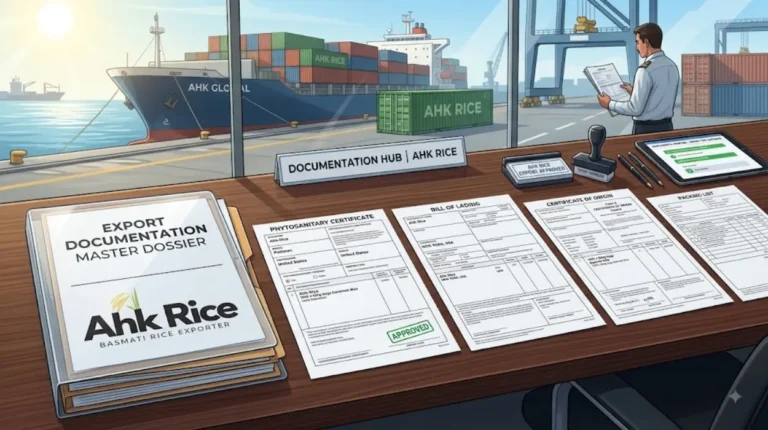
The document set depends on the commodity controls and transaction, but commercial records, import declarations, applicable certificates, laboratory evidence, and traceability documents form the core evidence chain. Importers should confirm requirements for each shipment.
Commercial documents include the invoice and packing list. These establish product description, quantity, packaging, and transaction information.
Laboratory documents provide analytical evidence where testing applies. Pakistan-origin rice currently falls under specific contaminant controls in Great Britain.
Import notifications apply to relevant controlled food imports. IPAFFS supports pre-notification and border information for applicable consignments.
Agricultural import arrangements can also apply to rice. UK government guidance identifies CN codes for husked, semi-milled, wholly milled, and broken rice.
The importer should confirm the current commodity-specific requirements before dispatch because UK import controls can change.
What is the final comparison for UK Basmati rice sourcing?
The strongest UK sourcing strategy combines a compliant Pakistani grade with laboratory evidence, accurate documentation, traceable packaging, and pre-dispatch verification. This approach balances food safety, commercial quality, inspection readiness, and procurement reliability.
A document-only strategy works for basic administrative preparation. Laboratory-led preparation offers stronger evidence. Full verification provides the most complete control for demanding UK buyers.
1121, Super Kernel, and 1509 can all serve different buyer segments. The correct choice depends on the contracted specification rather than the variety name alone.
AHK Rice supports Pakistani Basmati rice supply through end-to-end processing, custom packaging, and export coordination. Its Punjab-based operation supplies 1121, Super Kernel, and 1509 varieties to international markets.
The final decision should therefore combine grade + specification + testing + packaging + documentation + destination requirements.
A shipment becomes inspection-ready before loading, not after arrival at the UK border.
Frequently Asked Questions
Does Pakistani Basmati rice face UK import controls?
Yes. Great Britain currently lists Pakistani rice under controls covering pesticide residues, aflatoxins, and Ochratoxin A. Importers should check the latest official requirements before each shipment.
What happens during a UK border inspection?
A shipment selected for SPS inspection can undergo documentary, identity, and physical checks. Authorities compare documents and package identification with the actual consignment.
Does every Pakistani rice shipment receive a physical inspection?
No. Inspection requirements depend on the applicable commodity controls and risk-based procedures. A document or identity check can occur without a full physical inspection.
What laboratory tests should Pakistani rice exporters consider?
Exporters should consider the applicable testing requirements for pesticide residues, aflatoxins, and Ochratoxin A, alongside commercial quality parameters such as moisture and broken percentage.
Which Basmati grade is best for UK importers?
1121, Super Kernel, and 1509 can all serve UK buyers. The best grade depends on the buyer’s grain, cooking, packaging, price, and retail or foodservice specification.
How can an importer reduce border delays?
Importers should submit required notifications, verify documents before arrival, match package information with declarations, and obtain relevant laboratory evidence before dispatch. Pre-notification supports border risk management for applicable controlled imports.
What happens when a shipment fails UK official controls?
A non-compliant consignment can be returned or destroyed. The importer can also become responsible for associated loss and disposal costs.
What is the difference between SPS and customs checks?
SPS checks focus on sanitary, phytosanitary, food-safety, and biosecurity requirements. Customs checks focus on the customs declaration and related import procedures. Both can affect cargo release.