How Do Food Distributors Select Imported Rice Brands for Growth?
Food distributors select imported rice brands by balancing grade consistency, landed cost, shelf life, market fit, compliance, and supply reliability rather than choosing the lowest FOB price. Here is why: distributors earn repeat revenue when each shipment performs consistently across retail, foodservice, and wholesale channels.
Imported rice brands are commercial products, not simply agricultural commodities. A distributor must evaluate the variety, processing grade, broken percentage, moisture, packaging, documentation, and destination demand together. The broader export process is explained in how 1121 Basmati Rice is grown and processed in Pakistan, which helps buyers connect cultivation and milling decisions with final product performance.
The strongest sourcing model combines direct exporter supply with market-specific grade selection. AHK Rice provides 1121, Super Kernel, and 1509 Basmati through integrated sourcing, milling, grading, sorting, custom packaging, and export coordination. Its service model gives distributors one supply structure for product specifications and shipment preparation.
What are the available solutions for imported rice distribution?
Distributors have four practical sourcing solutions: direct exporters, import wholesalers, brokers, and private-label supply programmes. Direct exporters provide the strongest control over specifications, while brokers provide wider market access but less production control.
Direct exporter sourcing connects the distributor with the company responsible for processing and dispatch. This structure supports specification control because the buyer can define grain length, broken percentage, moisture, processing grade, packing, and shipment terms before production.
Import wholesalers provide convenience after the rice has already entered the destination market. They can reduce lead times and simplify domestic distribution. Their price, however, includes additional handling and inventory costs. The distributor also has less influence over milling specifications.
Brokers connect buyers with multiple exporters and mills. This model can help distributors compare offers quickly. The limitation is accountability. A broker may not control cultivation, milling, grading, or container loading.
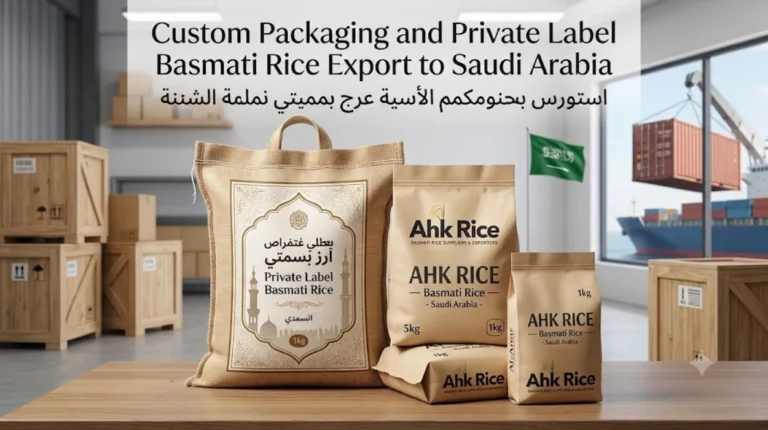
Private-label programmes combine product sourcing with customised packaging. The distributor sells rice under its own brand while the exporter supplies the specified grade. This approach works well for supermarkets and foodservice groups seeking differentiated packaging and repeatable specifications.
The right solution depends on the distributor’s growth model, so the next step is comparing these approaches using measurable procurement attributes.
How do different rice sourcing approaches compare?
Direct export sourcing generally provides the best specification control, while wholesale sourcing provides faster local availability and brokers provide supplier discovery. Private-label programmes provide the strongest brand differentiation.
| Attribute | Direct Exporter | Import Wholesaler | Broker | Private Label |
|---|---|---|---|---|
| Specification control | High | Medium | Low–Medium | High |
| Price visibility | High | Medium | Medium | High |
| Custom packaging | High | Low–Medium | Variable | Very High |
| Supply traceability | High | Medium | Variable | High |
| Minimum order flexibility | Medium | High | Medium | Medium |
| Market differentiation | Medium | Low | Low | Very High |
| Long-term supply planning | High | Medium | Low–Medium | High |
Direct exporter sourcing performs best for distributors ordering repeated container volumes. The buyer can approve a specification sheet before dispatch and use the same specification for future purchase cycles.
Wholesale sourcing performs better for small distributors needing immediate stock. The buyer avoids international freight coordination but accepts a higher supply-chain cost.
Broker sourcing performs best during supplier discovery. It becomes weaker for long-term quality control because the distributor remains dependent on intermediary communication.
Private-label sourcing performs best for retailers building proprietary rice ranges. The distributor controls the consumer-facing brand while the exporter manages the underlying product specification.
This comparison shows why price alone cannot determine supplier selection; market region and product grade must also influence the decision.
Which rice grades work best for different distributor cases?
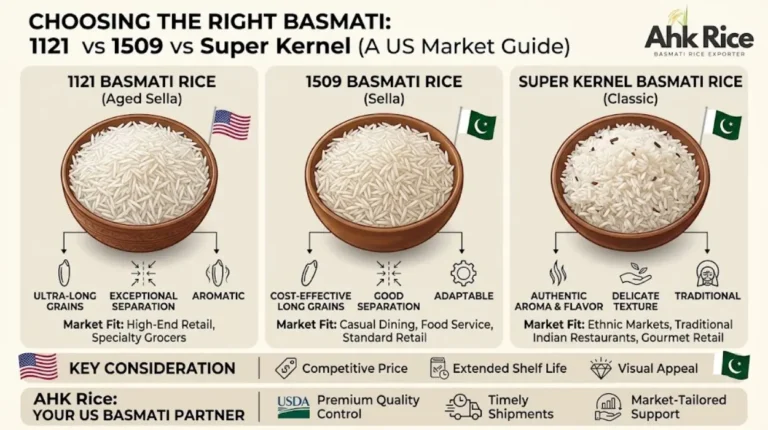
1121 suits premium retail and foodservice, Super Kernel suits premium aromatic positioning, and 1509 provides a stronger price-to-performance balance for volume-focused distribution.
1121 Basmati is recognised for extra-long grain characteristics and strong elongation after cooking. Distributors use it for premium retail packs, restaurants, catering, and branded rice ranges. Steam, White, Golden Sella, Creamy Sella, and Brown forms allow the same variety to serve different applications.
Super Kernel Basmati occupies another premium position. Its long, slender grain, aroma, and traditional Basmati profile support premium grocery, hospitality, and specialty food distribution. It suits buyers who need a premium eating experience without relying exclusively on 1121.
1509 Basmati provides a commercial alternative for distributors focused on volume and price positioning. AHK Rice describes 1509 as a high-yield long-grain variety with competitive pricing and multiple processing options. This makes it useful for mainstream wholesale, catering, and private-label programmes.
Processing also changes the commercial role. White rice emphasises polished appearance and familiar retail presentation. Steam rice emphasises cooking texture and aroma. Golden Sella and other parboiled forms provide stronger grain structure for demanding storage and foodservice applications.
The grade decision therefore connects product performance with customer segment, which makes regional market analysis essential.
Which grades do distributors prefer in the Gulf and European markets?
Gulf distributors generally prioritise 1121 Sella and Steam for catering and premium rice demand, while European distributors place greater emphasis on compliant White Basmati, premium 1121, Super Kernel, and private-label formats.
Gulf market region
The Gulf region includes markets such as Saudi Arabia, the UAE, Qatar, Kuwait, Oman, and Bahrain. Basmati is widely used in biryani, kabsa, mandi, catering, hospitality, and household cooking.
1121 Golden Sella suits high-volume catering because parboiling strengthens grain structure. 1121 Steam suits buyers prioritising aroma and softer cooked texture. Super Kernel supports premium retail and restaurant positioning.
Hot warehouse conditions make storage stability important. AHK Rice’s processing guide states that Golden Sella can maintain quality for 18 months at 40°C, while Steam rice is presented with a 12-month controlled-storage performance.
For a Gulf distributor with long storage cycles, Golden Sella therefore provides a stronger operational specification. For a premium restaurant distributor with faster stock turnover, Steam provides a stronger sensory proposition.
European market
European distributors operate through supermarkets, ethnic retailers, foodservice companies, specialty grocery stores, and private-label programmes. The purchasing decision places greater weight on compliance documentation, traceability, packaging, residue controls, and consistent specifications.
1121 White suits premium retail presentation. Super Kernel supports premium aromatic positioning. Steam grades suit foodservice and specialist retail channels. Private-label packaging provides a route for distributors seeking differentiated shelf positioning.
AHK Rice’s UK export information identifies Super Kernel, 1121 Sella, 370/386, and aged long-grain rice among grades offered for UK buyers.
The regional comparison shows that distributors should select grades according to storage, customer use, and compliance rather than applying one specification globally.
What is the price per MT comparison for distributor sourcing?
Current Pakistani Basmati export indications place premium grades around $1,050–$1,300 per MT FOB, with 1121 Steam and Parboiled near the upper end of the range.
Pakistan Customs’ 2026 export valuation lists Super Basmati White/Sella at $1,050 per MT, 1121 White/Sella at $1,175, 1121 Steam at $1,225, 1509 White/Sella at $1,100, and 1509 Steam at $1,150. These are customs valuation figures rather than final commercial quotations.
Recent market indications provide another benchmark. Rice News Today lists 2025–26 indicative levels around $1,215 per MT for 1121 Parboiled, $1,265 for 1121 Steam, and $1,120 for Super Basmati Parboiled Milled.
| Grade | Indicative FOB/valuation benchmark | Commercial role |
|---|---|---|
| Super Basmati White/Sella | $1,050/MT | Premium value |
| 1509 White/Sella | $1,100/MT | Price-performance |
| 1509 Steam | $1,150/MT | Premium value |
| 1121 White/Sella | $1,175/MT | Premium retail |
| 1121 Steam | $1,225–$1,265/MT | Premium foodservice |
The price difference matters because a distributor does not earn margin from FOB price alone. Freight, insurance, customs, port charges, inland delivery, packaging, financing, warehousing, and stock losses determine landed cost.
Pakistan’s Basmati exports averaged $1,027.11 per MT in FY2024–25, based on export value divided by export quantity reported by the Rice Exporters Association of Pakistan.
A distributor should therefore compare a complete landed-cost model rather than selecting the cheapest quotation.
Which method works best for different distribution cases?
Direct exporter sourcing works best for recurring container volumes, wholesale importing suits smaller stock requirements, and private-label sourcing works best for retailers seeking differentiated products.
A premium supermarket distributor should prioritise 1121 White or Super Kernel with custom packaging. The product needs strong visual presentation, reliable specifications, and repeatable retail packs.
A hotel and catering distributor should prioritise 1121 Golden Sella or Steam. Golden Sella supports longer storage and strong grain structure. Steam supports aroma and premium cooked texture.
A value-focused wholesale distributor should evaluate 1509. Its commercial positioning can provide a stronger balance between premium Basmati characteristics and procurement cost.
A private-label distributor should combine grade selection with packaging development. The supplier must reproduce the same specification across production cycles. Packaging weight, bag material, artwork, labelling, and carton configuration should be approved before shipment.
A regional importer serving mixed customers can maintain two grades. For example, 1121 Golden Sella can serve catering customers, while 1121 White can serve retail customers. This reduces dependence on one consumer segment.
The appropriate method becomes clearer when advantages and limitations are assessed directly.
What are the pros and cons of each rice sourcing approach?
Direct sourcing maximises control but requires stronger planning, wholesale sourcing simplifies availability but raises supply costs, and private label increases differentiation while requiring tighter specification management.
Direct exporter sourcing provides production visibility, specification control, and better long-term procurement planning. The disadvantage is the need to manage international shipping, documentation, minimum quantities, and longer procurement cycles.
Import wholesaling provides local availability and simpler ordering. The trade-off is reduced control over crop origin, milling specifications, and packaging. The distributor also pays for another layer of inventory management.
Broker sourcing provides access to multiple suppliers and can help identify competitive offers. The limitation is fragmented accountability. Quality problems can become harder to trace when the intermediary does not control the mill.
Private-label sourcing creates stronger differentiation. A distributor can develop a recognisable product range and control retail presentation. The disadvantage is greater coordination across packaging approval, artwork, compliance, production, and minimum quantities.
A practical example illustrates the difference. A distributor selling 20 MT monthly needs supply continuity more than spot-market convenience. Direct exporter sourcing therefore provides stronger operational value. A distributor buying occasional 5 MT quantities may benefit from a local wholesaler.
The final selection should follow a structured decision framework.
What factors should distributors use before selecting an imported rice brand?
Distributors should score suppliers on product consistency, landed cost, market suitability, compliance, and supply continuity before approving an imported rice brand for growth.
| Decision factor | What to verify | Why it matters |
|---|---|---|
| Product consistency | Grain length, broken %, moisture, purity | Protects repeat sales |
| Landed cost | FOB, freight, insurance, duties, inland delivery | Protects gross margin |
| Market fit | Grade, cooking profile, packaging | Improves customer acceptance |
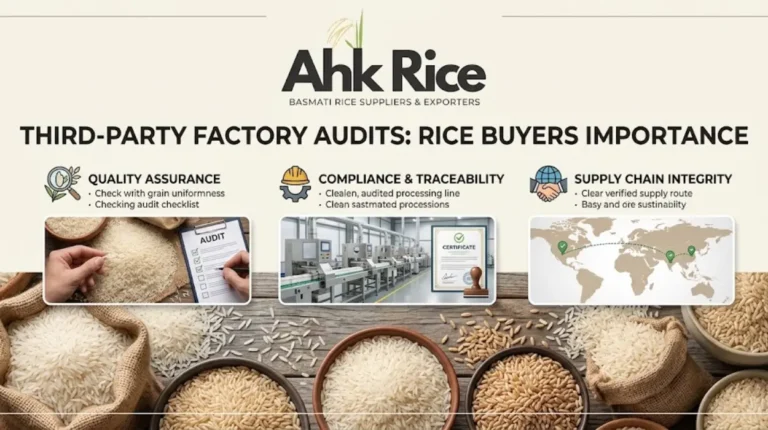
| Compliance | Certificates, lab reports, destination rules | Reduces clearance risk |
| Supply continuity | Capacity, lead time, stock planning | Supports growth |
Product consistency should receive the first review. A distributor cannot build a reliable brand around changing grain length or inconsistent broken percentages.
Landed cost should follow specification approval. A lower FOB price loses value when freight, packaging, inspection, or rejection costs increase the final cost per tonne.
Market fit determines whether the rice can command the expected selling price. A premium 1121 grade may create stronger retail positioning, while 1509 can improve price competitiveness.
Compliance protects market access. Export documentation should match the destination market and buyer contract. AHK Rice states that its export system includes quality control, custom packaging, and full export documentation support.
Supply continuity determines whether growth can continue after the first successful shipment. A distributor needs predictable production allocation and shipment scheduling before increasing customer commitments.
How can distributors build a growth-oriented rice portfolio?
A growth-oriented portfolio combines one premium flagship grade, one commercial-volume grade, and market-specific processing formats instead of relying on one imported rice product.
A distributor can use 1121 as the premium flagship. Its extra-long grain and cooking elongation support higher-value positioning.
Super Kernel can provide a second premium option. It gives retailers and foodservice buyers another aromatic Basmati profile without duplicating the entire product range.
1509 can serve price-sensitive accounts. Its commercial positioning allows distributors to compete across broader wholesale segments while retaining Basmati characteristics.
Processing grades should then match customer requirements. Golden Sella can serve catering and longer storage. Steam can serve aroma-focused restaurants. White can serve retail. Brown can serve whole-grain product segments.
This portfolio structure reduces dependence on one customer type. It also allows the distributor to adjust the product mix according to regional demand without changing its entire supply base.
What is the best overall strategy for food distributors selecting imported rice brands?
The best strategy is specification-led direct sourcing: match each Basmati variety to a customer segment, compare landed cost, verify compliance, and secure repeatable supply before scaling distribution.
The comparison shows that no single grade wins every market. 1121 provides premium positioning. Super Kernel supports premium aromatic demand. 1509 improves price-to-performance balance. Steam, White, and Sella processing then refine the product for specific applications.
Market region changes the decision. Gulf distributors need stronger consideration of storage stability and catering performance. European distributors need stronger attention to documentation, packaging, traceability, and retail consistency.
Price also needs context. Pakistan’s 2024–25 average Basmati export value was $1,027.11 per MT, while current grade-specific benchmarks show premium 1121 products at higher levels.
For distributors, growth comes from repeatability. A rice brand grows when the next shipment matches the previous shipment, reaches the market on schedule, meets the agreed specification, and leaves enough margin for every distribution layer.
Frequently Asked Questions
What rice variety is best for food distributors?
1121 is the strongest premium choice, Super Kernel supports premium aromatic positioning, and 1509 provides a competitive price-to-performance option. The correct variety depends on customer segment and destination market.
Which Basmati grade is best for Gulf distributors?
1121 Golden Sella is strong for bulk catering and longer storage, while 1121 Steam suits aroma-focused foodservice. Storage conditions and turnover determine the better choice.
Which Basmati grade suits European retail?
1121 White and Super Kernel White are strong options for premium European retail. Buyers should also verify destination-specific food safety, residue, packaging, and labelling requirements.
How much does Pakistani Basmati rice cost per MT?
Current benchmarks range roughly from $1,050 to $1,265 per MT for major Basmati categories. Final prices depend on grade, broken percentage, packing, crop, quantity, Incoterm, and destination.
What is the difference between Steam and Golden Sella?
Steam rice emphasises aroma and soft cooked texture, while Golden Sella uses parboiling to strengthen grain structure and storage performance. The choice should match customer use and warehouse conditions.
Why should distributors compare landed cost instead of FOB price?
Landed cost includes the complete route from exporter to warehouse. Freight, insurance, customs, port charges, inland delivery, packaging, inspection, and financing can materially change the final cost per MT.
What certifications should distributors check?
Distributors should verify phytosanitary documentation, food safety certifications, laboratory reports, origin documents, fumigation records, and destination-specific compliance. The exact documentation depends on the importing market and contract.