How 1121 Basmati Rice Is Grown and Processed in Pakistan
1121 Basmati Rice is a long-grain aromatic rice variety cultivated in Pakistan’s Punjab region, defined by its extra-long kernel length of 8.3–8.5 mm after cooking, high elongation ratio, and low amylose texture that produces separate fluffy grains after cooking. Here is why: it is genetically selected for grain elongation, aroma retention, and export-grade milling performance under controlled agricultural conditions in irrigated basmati belts.
1121 Basmati rice belongs to the Oryza sativa basmati subgroup. It grows under controlled irrigation systems in Punjab’s fertile plains. Farmers cultivate it during Kharif season under monsoon-fed water channels.
1121 rice is recognized globally for kernel expansion. The grain expands up to 2.5 times its raw length after cooking. This expansion defines its premium export positioning.
Punjab’s agro-climatic conditions support uniform maturation. Temperature stability and silt-rich soil create consistent grain structure across harvest cycles.
How does 1121 Basmati Rice cultivation and processing work?
1121 Basmati rice is cultivated through transplanted paddy farming and processed through a 9-step industrial milling system involving cleaning, dehusking, polishing, grading, sorting, and packaging under controlled moisture conditions of 12–13%. Here is why: each stage ensures grain integrity, export compliance, and consistent cooking performance across international markets.
Cultivation and field production process
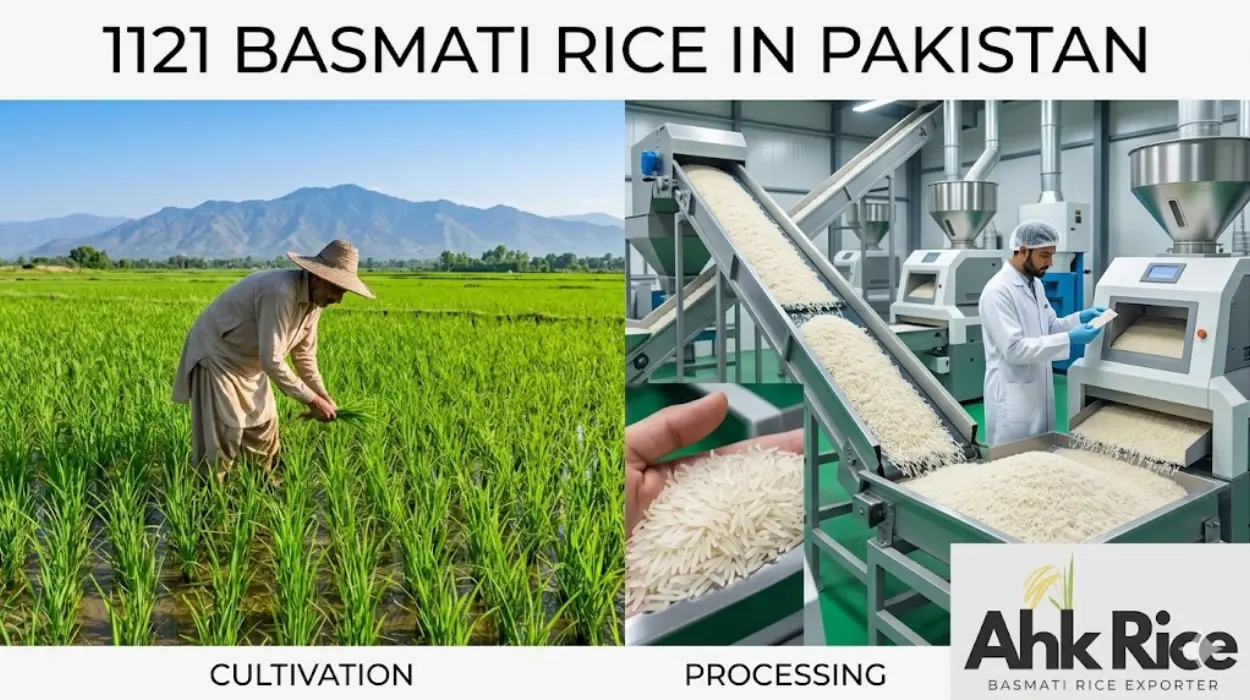
Rice farmers cultivate 1121 basmati in leveled flooded fields.
- Prepare land by plowing deep soil layers for oxygenation
- Transplant seedlings after 25–30 days of nursery growth
- Irrigate fields using canal water distribution systems
- Harvest paddy at 20–22% grain moisture level
Punjab irrigation networks regulate water flow to prevent drought stress. Uniform water depth stabilizes root development.
Milling and processing stages
Processing converts raw paddy into export rice.
- Clean paddy to remove dust, stones, and field impurities
- De-husk grain using rubber roller huskers
- Separate brown rice from husk residues
- Polish grains to improve surface brightness
- Grade rice by kernel length and thickness
- Sort rice using optical color sorters
- Dry rice to 12–13% moisture level
- Pack rice in 5–40 kg export-grade bags
Each milling stage reduces breakage percentage below 5% for premium export batches.
Parboiling variation for export grades
Parboiling transforms starch structure inside the grain.
1121 Golden Sella Basmati Rice
1121 Golden Sella undergoes steaming before milling. This process hardens the grain structure and locks nutrients.
1121 Steam Basmati Rice
Steam rice processes without full soaking, preserving aroma and soft texture. 1121 Golden Sella vs Steam Rice: Which Grade Fits Your Market?
With cultivation and processing defined, the next focus is the industrial components that ensure consistency across export batches.
What are the key components of 1121 Basmati rice production system?
The 1121 production system consists of irrigation infrastructure, milling machinery, grading technology, storage silos, and quality inspection units that operate under humidity control of 60–65% and temperature stability of 20–25°C. Here is why: controlled environments preserve grain integrity from harvest to shipment.
Agricultural components
Agricultural systems control raw grain quality.
- Irrigation canals distribute seasonal water supply
- Soil fertility systems maintain nitrogen and potassium balance
- Seed certification programs ensure genetic purity
Punjab agriculture departments regulate seed purity above 95% for export compliance.
Industrial processing components
Processing systems define export consistency.
- Husker machines remove outer paddy layers
- Whitener machines refine grain surface texture
- Length graders separate broken grains from whole kernels
- Optical sorters detect discoloration and defects
These systems reduce impurity rates below 0.5% in export batches.
Storage and logistics components
Storage maintains post-processing stability.
- Steel silos store milled rice under controlled humidity
- Fumigation chambers eliminate insect contamination
- Export warehouses prepare container loading schedules
Containerized logistics ensure shipment integrity during 20–40 day international transit cycles.
What benefits does 1121 Basmati rice provide to import markets?
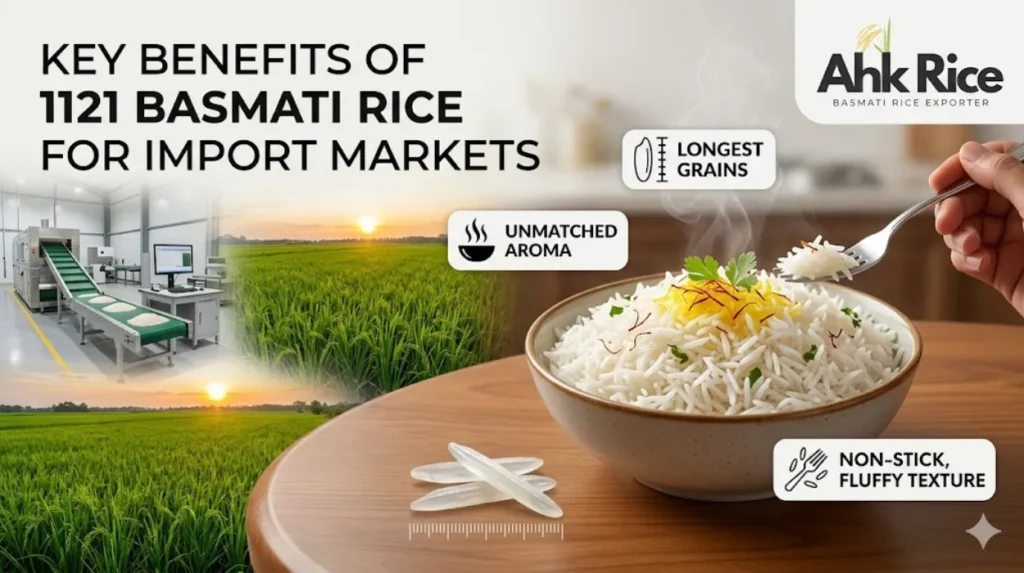
1121 Basmati rice provides high elongation, aromatic consistency, and long shelf stability, offering 18-month storage performance in sealed environments and consistent cooking separation in bulk catering systems. Here is why: its low starch adhesion reduces clumping and improves plating efficiency in commercial kitchens.
Cooking performance benefits
Cooking behavior defines market acceptance.
- Grain elongation improves visual presentation
- Low stickiness ensures separation after boiling
- Aroma retention enhances sensory profile
In UAE catering systems, 1121 maintains structure under buffet heat lamps for 6–8 hours.
Storage and logistics benefits
Shelf stability defines export viability.
- Golden Sella retains quality for 18 months at 40°C
- Steam rice maintains quality for 12 months in controlled storage
- Vacuum packaging reduces moisture reabsorption risk
For Iraqi warehouse storage without climate control, Golden Sella remains the correct specification due to heat resistance.
Commercial trade benefits
Trade consistency improves procurement planning.
- Uniform grading reduces buyer rejection rates
- Stable pricing supports contract-based procurement
- High yield ratio increases milling efficiency
What are the use cases of 1121 Basmati rice grades?
1121 Basmati rice grades serve distinct use cases including catering, retail packaging, and institutional food supply, with Golden Sella used for high-temperature storage markets and Steam rice used for aroma-focused culinary applications. Here is why: grain structure determines performance under heat, humidity, and transport stress.
Golden Sella use cases
Golden Sella supports high durability requirements.
- Bulk catering supplies in GCC countries
- Government food distribution programs
- Long-distance shipping retail packs
Golden Sella maintains firmness under repeated reheating cycles in commercial kitchens.
Steam rice use cases
Steam rice supports premium aroma markets.
- Fine dining restaurants in Southeast Asia
- Retail gourmet packaging in Europe
- Export contracts requiring soft texture profiles
Steam rice absorbs sauces more effectively in plated dishes.
Industrial application comparison
Different industries select grades based on storage conditions.
- Hot climates select Golden Sella for stability
- Cold storage markets select Steam for aroma
- Mixed catering systems use both grades seasonally
With use cases defined, the next section identifies operational problems affecting grain quality during production.
What common problems affect 1121 Basmati rice quality?
Common quality issues in 1121 Basmati rice include broken grain percentage above 5%, moisture imbalance outside 12–13% range, and improper polishing pressure that reduces aroma retention and grain integrity. Here is why: mechanical and environmental factors directly alter starch structure and export classification.
Agricultural problems
Field-level issues affect yield consistency.
- Uneven irrigation causes grain size variation
- Late harvesting increases breakage ratio
- Poor seed selection reduces aroma strength
Delayed harvest increases chalky grain percentage by up to 12%.
Milling problems
Industrial processing introduces structural defects.
- Over-polishing reduces grain length integrity
- Incorrect husker calibration increases broken grains
- Inadequate grading mixes defective kernels
Optical sorter misalignment increases rejection rates in export inspection.
Storage problems
Post-processing handling affects shelf life.
- High humidity increases microbial risk
- Poor fumigation allows insect infestation
- Container condensation damages grain surface
Moisture above 14% triggers spoilage during long-haul shipping cycles.
With quality issues identified, the complete production and processing system of 1121 Basmati rice becomes clear from farm to export container.
Frequently Asked Questions
What makes 1121 Basmati rice different from other varieties?
1121 Basmati rice delivers longer grain elongation, higher expansion ratio, and controlled aroma retention compared to traditional basmati strains.
Where is 1121 Basmati rice mainly grown?
1121 Basmati rice is mainly grown in Punjab, Pakistan, using canal-irrigated farming systems with monsoon-season cultivation cycles.
What is the difference between Golden Sella and Steam 1121 rice?
Golden Sella uses parboiling for heat stability, while Steam rice preserves aroma and softer texture for premium cooking applications.
What is the ideal moisture level for export-quality 1121 rice?
Export-grade 1121 rice maintains 12–13% moisture to ensure storage stability and prevent microbial growth during shipping.
Which markets import 1121 Basmati rice the most?
GCC countries, Iraq, Yemen, Europe, and Southeast Asia import 1121 basmati rice for catering, retail, and hospitality use.