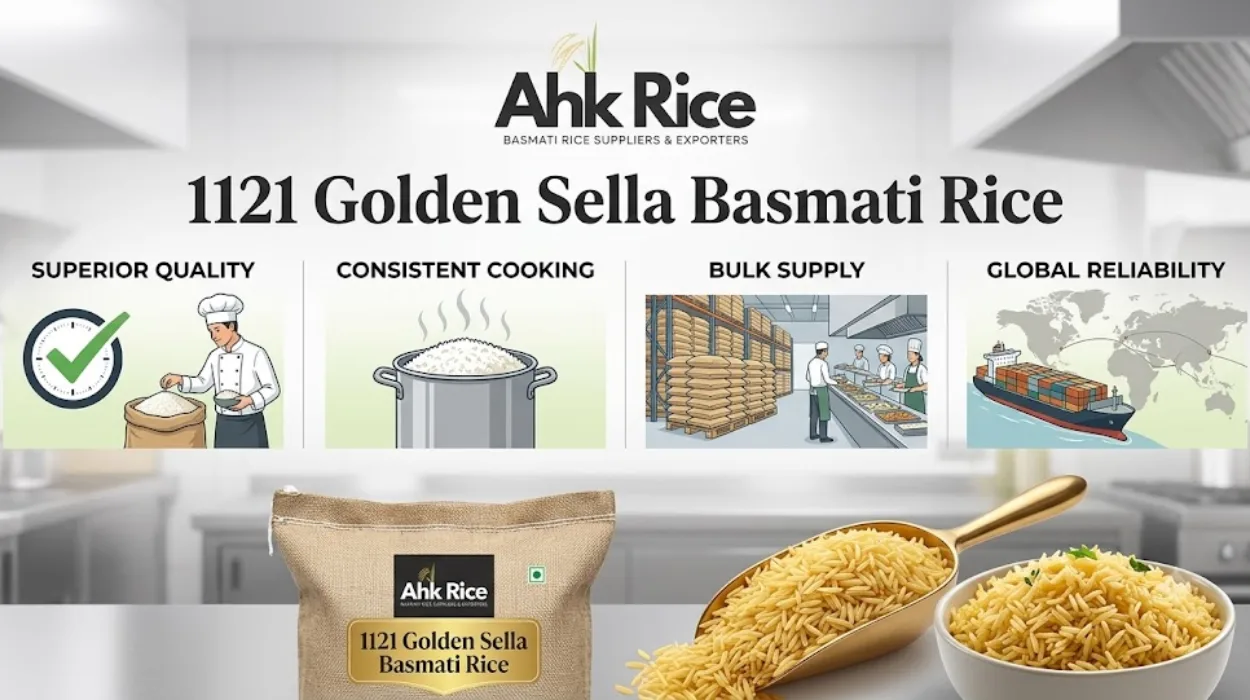
Why Foodservice Buyers Choose 1121 Golden Sella Basmati Rice
Foodservice buyers choose 1121 Golden Sella Basmati Rice because it delivers long grain length, high cooking yield, consistent texture, excellent holding performance, and low grain breakage. These characteristics improve kitchen efficiency for restaurants, hotels, catering companies, airline kitchens, institutional food providers, and large-scale meal production facilities.
The variety belongs to the Basmati rice family, a premium aromatic long-grain rice grown mainly in the Punjab region of Pakistan and parts of northern India. Pakistan remains one of the world’s leading exporters of 1121 Golden Sella Basmati Rice in 2026 due to favorable climate, fertile alluvial soil, irrigation systems supplied by the Indus River, and specialized rice processing infrastructure.
Commercial foodservice operations evaluate rice differently than household consumers. They calculate cost per cooked serving instead of purchase price alone. They also compare grain elongation, cooking consistency, moisture stability, storage life, and serving appearance before selecting a rice variety.
Buyers looking for a deeper understanding of cooking performance can also read:
Comparing Cooking Yield and Grain Elongation of Golden Sella Rice, which explains how processing influences expansion, texture, and plate presentation during commercial food preparation.
What Is 1121 Golden Sella Basmati Rice?
1121 Golden Sella Basmati Rice is a premium parboiled aromatic long-grain rice produced from the 1121 Basmati variety. It undergoes soaking, steaming, drying, milling, polishing, grading, and packaging before export, resulting in stronger grains, excellent elongation, and reliable cooking performance for commercial kitchens worldwide.
1121 refers to the rice cultivar developed for exceptionally long grain characteristics. Before cooking, the average grain length measures approximately 8.2–8.5 mm. After cooking, properly processed grains frequently reach 17–22 mm, depending on cooking method and water ratio.
Golden Sella describes the processing technique rather than the rice variety itself.
During parboiling, paddy rice absorbs nutrients from the bran layer while remaining inside the husk. Controlled steaming hardens the grain structure. Drying stabilizes internal moisture before milling removes the husk and bran.
The natural golden color develops during the parboiling process. After cooking, the rice becomes light golden to creamy white while maintaining separate grains.
Available Grades of 1121 Golden Sella Basmati Rice
Exporters classify rice into commercial grades according to grain quality.
Common grades include:
- Premium Export Grade
- Sortex Clean Grade
- Double Sortex Grade
- Single Polished Grade
- Double Polished Grade
- Head Rice Grade
- Broken Rice Grade
- Customized Customer Specifications
Each grade follows defined specifications for broken percentage, foreign matter, damaged grains, chalky grains, moisture content, and grain length.
How Is 1121 Golden Sella Basmati Rice Produced?
Production follows a controlled agricultural and industrial process beginning with certified seed selection and ending with export packaging. Every processing stage protects grain length, aroma, purity, moisture stability, and international food safety requirements for commercial distribution.
Production begins months before harvest.
Farmers prepare fields during spring. Certified 1121 seed is transplanted into irrigated land after nursery development.
Plants mature over approximately 125–140 days depending on regional climate.
Harvest begins when grain moisture reaches suitable harvesting levels.
Freshly harvested paddy moves to cleaning facilities where stones, straw, dust, immature grains, and field impurities are removed.
The rice then follows the Golden Sella processing sequence.
Step 1: Cleaning
Mechanical cleaners separate foreign materials.
Examples include stones, metal fragments, dust, sticks, immature kernels, and weed seeds.
Step 2: Soaking
Clean paddy is soaked in water under controlled temperature.
The grain absorbs moisture evenly before steaming.
Step 3: Steaming
Steam pressure gelatinizes starch inside each grain.
This strengthens the grain structure.
Step 4: Drying
Industrial dryers reduce moisture gradually.
Most export specifications require moisture around 12–13% before storage and shipment.
Step 5: Milling
The husk is removed.
Additional milling separates bran layers while preserving grain integrity.
Step 6: Polishing
Polishing improves grain appearance.
Commercial buyers request different polishing levels according to destination market preferences.
Step 7: Color Sorting
Optical Sortex machines remove defective kernels.
Examples include black grains, chalky grains, discolored grains, damaged kernels, and immature rice.
Step 8: Length Grading
Length graders separate whole grains from broken rice.
Uniform grain size improves cooking consistency.
Step 9: Packaging
Finished rice is packed into export bags.
Examples include 1 kg, 2 kg, 5 kg, 10 kg, 20 kg, 25 kg, and 50 kg packaging.
Private-label packaging is also common for international food distributors.
What Makes 1121 Golden Sella Basmati Rice Different from Other Rice Types?
1121 Golden Sella differs through its exceptionally long grains, parboiled processing, strong grain structure, aromatic profile, lower breakage, superior cooking expansion, and stable holding performance. These qualities distinguish it from white rice, non-Basmati rice, and ordinary parboiled rice varieties.
Several characteristics explain its popularity.
The first is grain length.
1121 produces one of the longest naturally occurring Basmati grains available in international trade.
The second is aroma.
Natural aromatic compounds create the distinctive fragrance associated with authentic Basmati rice.
The third is grain strength.
Parboiling reduces grain breakage during transportation, storage, handling, and commercial cooking.
The fourth is appearance.
Cooked grains remain long, separate, and visually attractive.
These characteristics suit commercial food presentation.
What Are the Key Components Buyers Evaluate?
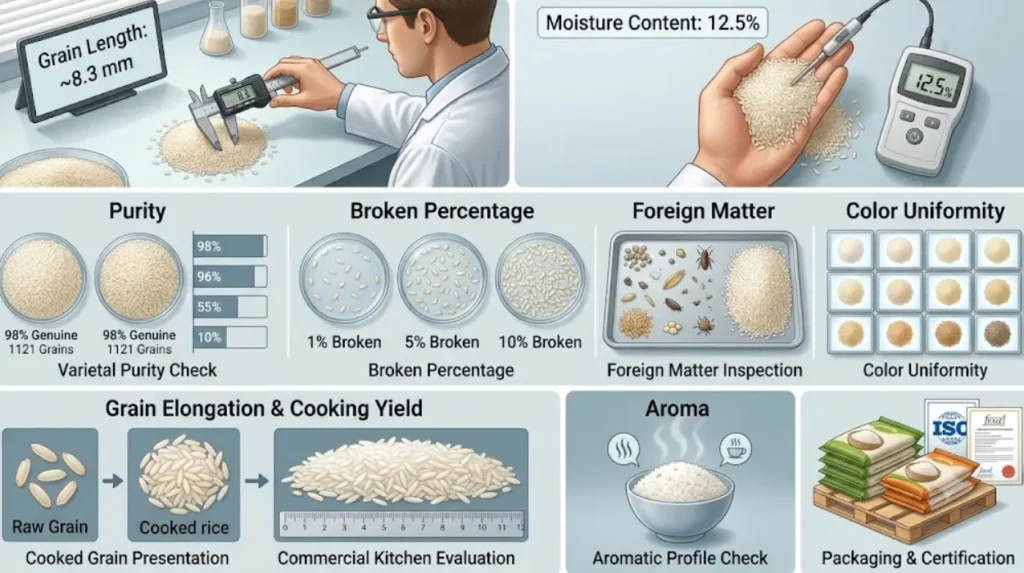
Foodservice buyers evaluate measurable quality parameters instead of relying only on appearance. They compare grain length, moisture, purity, broken percentage, foreign matter, aging, aroma, elongation, cooking yield, color uniformity, packaging, and certification before approving suppliers for commercial procurement.
Commercial specifications commonly include measurable standards.
Grain Length
Premium export quality generally exceeds 8.2 mm before cooking.
Moisture Content
Most export contracts specify approximately 12–13% moisture.
Broken Percentage
Different buyers request varying limits.
Examples include 1%, 2%, 5%, and 10% broken.
Purity
Varietal purity identifies the percentage of genuine 1121 grains.
Premium contracts commonly request high varietal purity.
Foreign Matter
Inspection checks for contaminants.
Examples include stones, husks, dust, insects, metal particles, and field debris.
Aroma
Authentic Basmati possesses a naturally occurring aromatic profile developed during cultivation and storage.
Grain Elongation
Commercial kitchens evaluate cooked grain length because presentation influences customer satisfaction.
What Benefits Does 1121 Golden Sella Offer Foodservice Operations?
Foodservice operations benefit from consistent grain quality, attractive presentation, efficient cooking, reduced breakage, reliable storage stability, high serving yield, and compatibility with large-scale commercial recipes served in restaurants, hotels, institutions, airlines, and catering businesses.
Kitchen consistency ranks among the most important operational requirements.
Chefs expect identical cooking performance across repeated production batches.
Uniform grain dimensions improve recipe standardization.
Reduced breakage improves serving appearance.
Parboiled grains also withstand large cooking vessels better than many softer rice types.
Commercial holding equipment maintains rice after cooking.
Golden Sella maintains grain separation during this holding period more effectively than many ordinary rice varieties.
Another benefit is inventory stability.
Properly stored rice remains suitable for long-term commercial storage under controlled warehouse conditions.
Examples of large foodservice users include:
- Hotels
- Restaurants
- Airline catering
- Hospital kitchens
- University cafeterias
- Military kitchens
- Industrial canteens
- Event catering companies
Which International Markets Import 1121 Golden Sella Basmati Rice?
1121 Golden Sella Basmati Rice serves diverse international markets where consumers value long grains, aroma, and premium presentation. Import demand comes from retail distributors, wholesalers, food manufacturers, hospitality companies, and institutional foodservice organizations across multiple continents.
The Middle East represents one of the largest importing regions.
Countries include:
- Saudi Arabia
- United Arab Emirates
- Qatar
- Kuwait
- Oman
- Bahrain
African markets continue expanding imports.
Examples include:
- South Africa
- Kenya
- Tanzania
- Mozambique
European demand focuses on ethnic retail, restaurants, and specialty food distributors.
Examples include:
- United Kingdom
- Germany
- France
- Italy
- Netherlands
North America imports premium Basmati for retail and hospitality.
Examples include:
- United States
- Canada
Asia also imports selected premium grades.
Examples include:
- Malaysia
- Singapore
- Indonesia
Each destination follows different packaging preferences, labeling regulations, and import documentation requirements.
Which Certifications Apply to Exported 1121 Golden Sella Basmati Rice?
International rice exports require food safety, quality assurance, phytosanitary compliance, and destination-specific certifications. Certification verifies production controls, traceability, hygiene standards, export eligibility, and regulatory compliance throughout the supply chain.
Certification requirements differ by importing country.
Frequently requested certifications include:
ISO 22000
Confirms implementation of food safety management systems.
HACCP
Documents hazard analysis and preventive food safety controls.
Phytosanitary Certificate
Confirms compliance with plant health regulations before export.
Fumigation Certificate
Documents approved pest treatment before shipment where required.
Certificate of Origin
Identifies the exporting country for customs authorities.
Health Certificate
Confirms compliance with applicable food export regulations.
Additional laboratory reports often verify:
- Moisture
- Broken percentage
- Purity
- Foreign matter
- Grain length
Commercial contracts frequently include these analytical specifications.
What Misconceptions Exist About 1121 Golden Sella Basmati Rice?
Several misconceptions confuse buyers when comparing Basmati products. Understanding processing, grading, variety identification, and commercial specifications allows procurement teams to evaluate rice accurately using measurable quality characteristics instead of assumptions.
One misconception is that Golden Sella represents a separate rice variety.
It is actually a processing method applied to the 1121 Basmati variety.
Another misconception is that darker golden color indicates better quality.
Color intensity varies according to processing conditions.
Quality depends on measurable specifications instead of color alone.
Some buyers assume every long-grain rice qualifies as Basmati.
Authentic Basmati belongs to specific recognized varieties grown within approved geographical regions.
Another misconception concerns broken rice.
A higher percentage of broken grains reduces presentation quality but does not automatically indicate unsafe food.
Commercial buyers simply select the specification that matches their intended application.
Storage misconceptions also occur.
Proper warehouse conditions remain essential after export.
Temperature, humidity, ventilation, and pallet management protect grain quality throughout storage.
1121 Golden Sella Basmati Rice combines premium grain length, aromatic characteristics, controlled parboiling, and commercial processing into one of the most widely imported Basmati products in international foodservice. Buyers evaluate measurable specifications including grain length, purity, moisture, breakage, elongation, and certification because these factors directly influence cooking consistency, serving appearance, and operational efficiency. Understanding cultivation, processing, grading, certifications, export standards, and market requirements helps procurement teams compare products using objective quality indicators rather than marketing claims.
Frequently Asked Questions
Why do restaurants prefer 1121 Golden Sella Basmati Rice?
Restaurants prefer this variety because it produces long separate grains, maintains texture during holding, offers a high cooking yield, and creates an attractive presentation for rice dishes.
Where is 1121 Golden Sella Basmati Rice grown?
It is primarily grown in the fertile Punjab region of Pakistan, where climate, soil, and irrigation conditions support the production of premium-quality Basmati rice.
How is 1121 Golden Sella Basmati Rice processed?
The rice is cleaned, soaked, steamed, dried, milled, polished, color sorted, length graded, and packaged to achieve consistent quality and export standards.
What is the average grain length of 1121 Golden Sella Basmati Rice?
The grain measures approximately 8.2–8.5 mm before cooking and can elongate to around 17–22 mm after cooking under proper preparation methods.
Which countries import 1121 Golden Sella Basmati Rice?
Major importing countries include Saudi Arabia, the UAE, Qatar, Kuwait, Oman, the United Kingdom, the United States, Canada, South Africa, Malaysia, and Singapore.
What certifications are commonly required for exporting 1121 Golden Sella Basmati Rice?
Common certifications include ISO 22000, HACCP, Phytosanitary Certificate, Fumigation Certificate, Certificate of Origin, and Health Certificate, depending on the destination market.
What moisture level is recommended for export-quality 1121 Golden Sella Basmati Rice?
Export-quality 1121 Golden Sella Basmati Rice is generally maintained at approximately 12–13% moisture to preserve grain quality during storage and international shipping.
Is Golden Sella a rice variety or a processing method?
Golden Sella is a processing method applied to the 1121 Basmati variety through parboiling. It is not a separate rice variety.
What packaging sizes are available for 1121 Golden Sella Basmati Rice?
Common export packaging sizes include 1 kg, 2 kg, 5 kg, 10 kg, 20 kg, 25 kg, and 50 kg bags, with private-label packaging also available for international buyers.