How Do Inspection Procedures Verify Rice Cleanliness Standards?
Rice inspection procedures are the most reliable way to verify rice cleanliness standards. Here is why: inspection combines physical examination, laboratory testing, grading, foreign matter analysis, moisture verification, and certification checks to confirm that rice meets importer specifications, food safety requirements, and export regulations.
Rice cleanliness directly affects food safety, shelf life, customer satisfaction, and import compliance. Importers, wholesalers, retailers, and foodservice distributors rely on inspection procedures to verify that Basmati rice contains the specified purity level before shipment. Quality inspection reduces claims, prevents rejected containers, and ensures consistent product performance across different markets.
Importers evaluating rice suppliers often first learn about processing and contamination control through resources explaining the importance of foreign matter testing in rice exports. This educational foundation helps buyers understand why inspection standards influence product value and compliance throughout the supply chain.
When buyers evaluate premium Pakistani Basmati rice, services such as <a href=”/basmati-rice-exporter-pakistan/”>custom processing and export-grade quality control</a> become important because inspection results determine whether rice can enter regulated retail and distribution channels.
What Are Rice Cleanliness Standards?
Rice cleanliness standards typically require foreign matter below 0.1%–1%, moisture between 12%–14%, damaged grains within specification limits, and absence of contaminants that affect food safety or market acceptance.
Rice cleanliness standards define acceptable levels of purity. These standards measure foreign matter, dust, stones, paddy grains, damaged kernels, discoloured grains, moisture content, and biological contamination.
Foreign matter refers to any material that is not rice. Examples include stones, straw, husks, soil particles, metal fragments, and weed seeds.
Moisture content affects shelf life. Rice stored above recommended moisture levels faces higher risks of mould growth, insect infestation, and quality deterioration.
Export markets use different standards. UK retailers often demand stricter specifications than wholesale catering markets. GCC buyers frequently focus on grain appearance and low foreign matter percentages.
What Entities Participate in Rice Inspection?
Quality inspection commonly involves:
- Exporters
- Independent inspection agencies
- Laboratory technicians
- Food safety auditors
- Customs authorities
- Importers
- Retail compliance teams
Each participant verifies a different aspect of product quality before shipment reaches the destination market.
With cleanliness standards established, the next question is how inspection procedures verify compliance.
How Do Inspection Procedures Verify Rice Cleanliness?
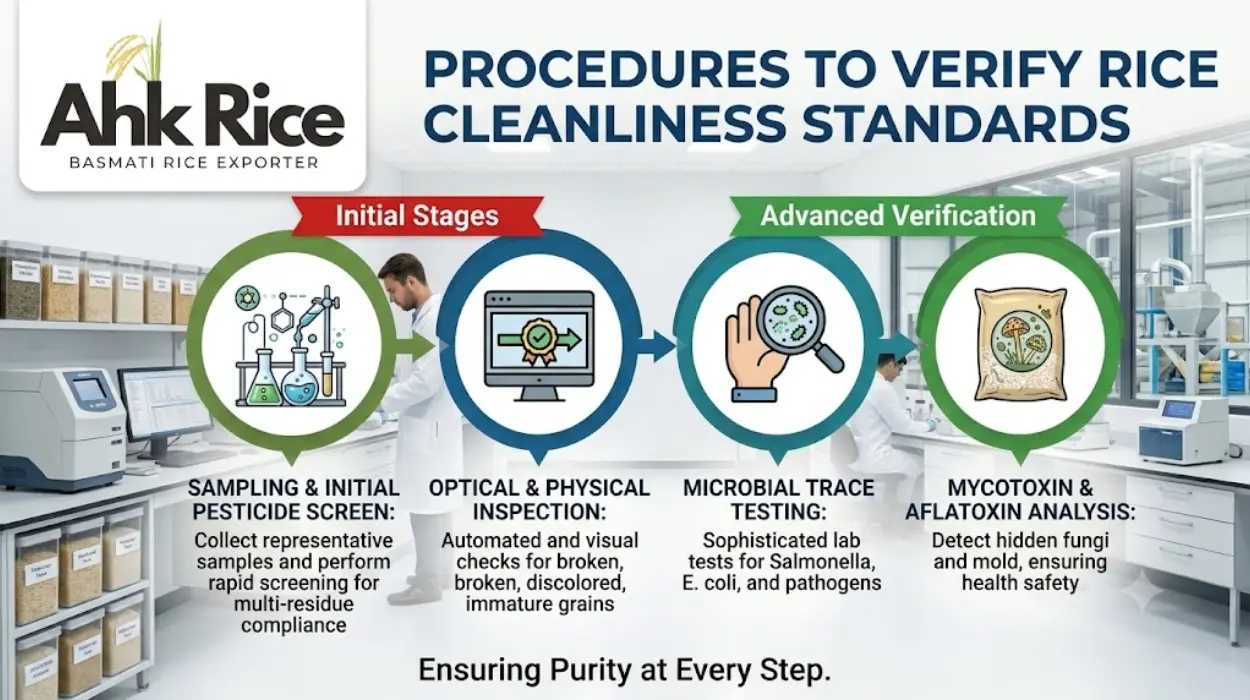
Inspection procedures verify cleanliness through visual examination, laboratory testing, moisture analysis, grading systems, contaminant screening, sampling protocols, and certification reviews before shipment approval.
Inspection begins with representative sampling. Inspectors collect samples from multiple points within production lots to ensure accurate results.
Sampling prevents misleading outcomes. Testing only one bag cannot represent a container carrying 500 to 1,000 bags.
What Inspection Steps Are Used?
Inspection Process
- Collect representative samples
- Separate foreign matter
- Measure moisture content
- Grade grain quality
- Test contaminants
- Verify packaging integrity
- Review documentation
- Certify compliance
- Approve shipment
Foreign matter separation identifies impurities. Inspectors manually and mechanically separate contaminants from rice samples.
Moisture testing uses calibrated equipment. Accurate moisture readings help predict storage stability and shipping performance.
Grain grading evaluates broken rice percentages, grain length, colour consistency, and damaged kernels.
Laboratory testing verifies food safety indicators. Tests may include pesticide residue screening, microbiological analysis, and heavy metal assessments.
Documentation review confirms traceability. Inspectors verify certificates, laboratory reports, fumigation records, and export documentation.
Inspection procedures create measurable quality evidence. The next step is comparing different inspection approaches.
How Do Different Inspection Approaches Compare?
Independent third-party inspections provide the highest credibility, while internal inspections offer faster control and lower costs. Combining both approaches delivers the strongest quality assurance system.
Different inspection models serve different objectives.
Specification Comparison Table
| Attribute | Internal Inspection | Third-Party Inspection |
|---|---|---|
| Credibility | Moderate | High |
| Cost per MT | Lower | Higher |
| Buyer Acceptance | Moderate | Excellent |
| Export Compliance | Good | Excellent |
| Retail Approval Support | Moderate | High |
| Audit Transparency | Moderate | Excellent |
| Claim Resolution Strength | Moderate | High |
Internal inspections occur during processing. Mill operators inspect rice before grading, sorting, and packaging.
Third-party inspections occur before shipment. Independent agencies verify specifications without commercial bias.
Government inspections focus on regulatory compliance. These inspections support export clearances and market entry requirements.
Combined inspection systems offer stronger protection. Exporters verify quality internally while independent inspectors validate final shipment specifications.
Inspection models differ in execution. The next question is which inspection method works best in specific situations.
Which Inspection Method Works Best for Different Cases?
Third-party inspections work best for regulated retail markets, while combined internal and external inspections perform best for long-term international supply agreements.
Different markets prioritize different inspection requirements.
United Kingdom Market
UK distribution networks typically prefer:
- Premium Basmati grades
- Independent inspection certificates
- Retail compliance verification
- Traceability documentation
- Food safety testing
UK retailers frequently source high-purity 1121 Basmati and Super Kernel Basmati grades. Documentation consistency remains a major purchasing factor.
Gulf Cooperation Council Market
GCC buyers commonly prefer:
- 1121 Steam Basmati
- 1121 Golden Sella Basmati
- Competitive pricing
- Visual grain quality
- Moisture compliance
Catering distributors often focus on cooking performance and consistency across large-volume procurement contracts.
Grade Preference Comparison
| Market Region | Preferred Grades | Inspection Priority |
|---|---|---|
| United Kingdom | 1121 Extra Long Grain, Super Kernel | Purity and traceability |
| GCC Countries | 1121 Steam, 1121 Golden Sella | Appearance and consistency |
Price Per MT Comparison
| Grade | UK Market Range | GCC Market Range |
|---|---|---|
| 1121 Steam | £850–£1,050/MT | £800–£980/MT |
| 1121 Golden Sella | £900–£1,100/MT | £850–£1,050/MT |
Prices vary according to crop quality, freight costs, and market conditions.
Inspection priorities differ by destination. Understanding strengths and limitations helps buyers make better sourcing decisions.
What Are the Pros and Cons of Rice Inspection Methods?
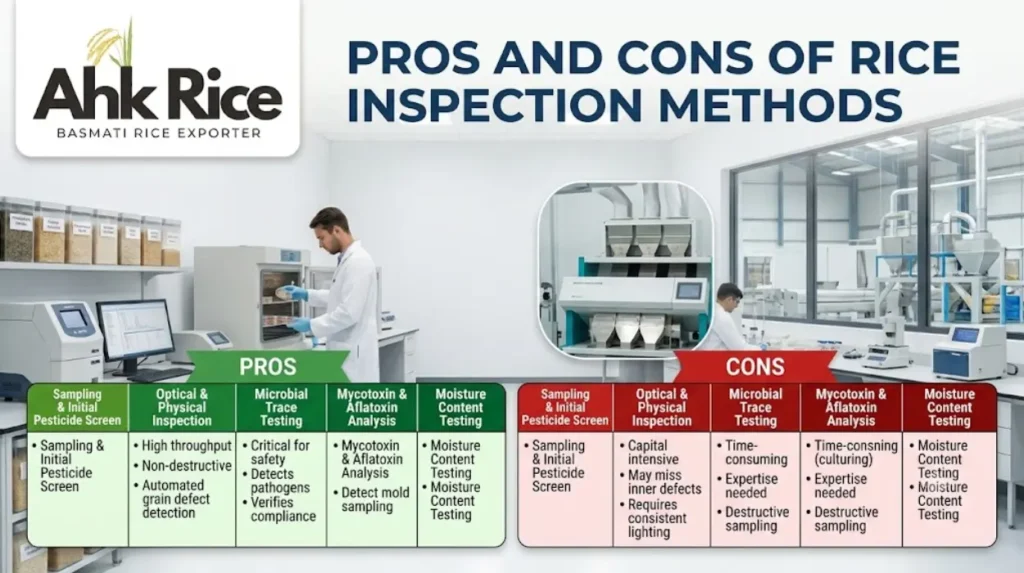
Third-party inspections provide stronger buyer confidence, while internal inspections offer greater operational control and faster decision-making.
Internal Inspection
Advantages
- Faster reporting
- Lower inspection costs
- Continuous monitoring
- Immediate corrective actions
Limitations
- Lower perceived independence
- Reduced buyer confidence
- Limited dispute protection
Example: A mill identifies elevated moisture levels before packaging. Production teams correct drying parameters immediately.
Third-Party Inspection
Advantages
- Independent verification
- Strong importer confidence
- Better dispute resolution support
- Greater retail acceptance
Limitations
- Additional costs
- Longer approval timelines
- Scheduling requirements
Example: A UK importer receives an independent cleanliness report. Retail compliance teams approve shipment documentation faster.
Combined Inspection
Advantages
- Highest verification level
- Reduced rejection risk
- Strong audit support
- Consistent quality monitoring
Limitations
- Higher total cost
- Additional documentation requirements
Combined inspection creates multiple verification layers. These layers reduce quality uncertainty before shipment departure.
Inspection benefits become clearer when buyers understand key decision factors.
What Decision Factors Should Buyers Evaluate?
Foreign matter limits, moisture content, certification requirements, destination regulations, shelf life expectations, and supplier consistency determine the most suitable inspection strategy.
Buyers should evaluate specification requirements before selecting inspection procedures.
Decision Framework Table
| Decision Factor | Low Priority Market | High Priority Market |
|---|---|---|
| Foreign Matter Control | Basic | Strict |
| Moisture Verification | Standard | Intensive |
| Third-Party Certification | Optional | Required |
| Retail Compliance | Limited | Extensive |
| Traceability Documentation | Basic | Detailed |
Shelf life requirements also influence inspection intensity.
Shelf Life Comparison
| Rice Condition | Typical Shelf Life |
|---|---|
| Moisture Below 13% | 18–24 months |
| Moisture 13–14% | 12–18 months |
| Moisture Above 14% | Reduced stability |
Lower moisture improves storage performance. Warehouses in warm climates benefit from stricter moisture verification.
Certification requirements vary by importer. Retail chains often require more documentation than foodservice distributors.
Supplier consistency remains a major decision factor. Reliable inspection systems support repeat purchases and lower operational risks.
With decision criteria established, buyers can confidently compare suppliers and inspection protocols.
Frequently Asked Questions
How often should rice be inspected during processing?
Rice should be inspected at multiple stages. Sampling during milling, grading, sorting, packaging, and pre-shipment verification provides stronger quality control.
What is foreign matter in rice?
Foreign matter includes stones, husks, soil particles, straw, dust, metal fragments, and other materials that are not rice.
Why is moisture testing important?
Moisture testing helps verify storage stability. Excess moisture increases mould growth, quality deterioration, and infestation risks.
Are third-party inspections mandatory?
Many markets do not legally require third-party inspections. However, major retailers and importers frequently request independent verification.
Which Basmati grade receives the strictest inspections?
Premium grades such as 1121 Extra Long Grain Basmati and Super Kernel Basmati usually undergo the strictest quality verification procedures.
Can inspection reports reduce shipment claims?
Yes. Inspection reports provide documented evidence of quality specifications before shipment departure, reducing disputes and claim risks.