How Do Licensed Exporters Improve Supply Chain Reliability?
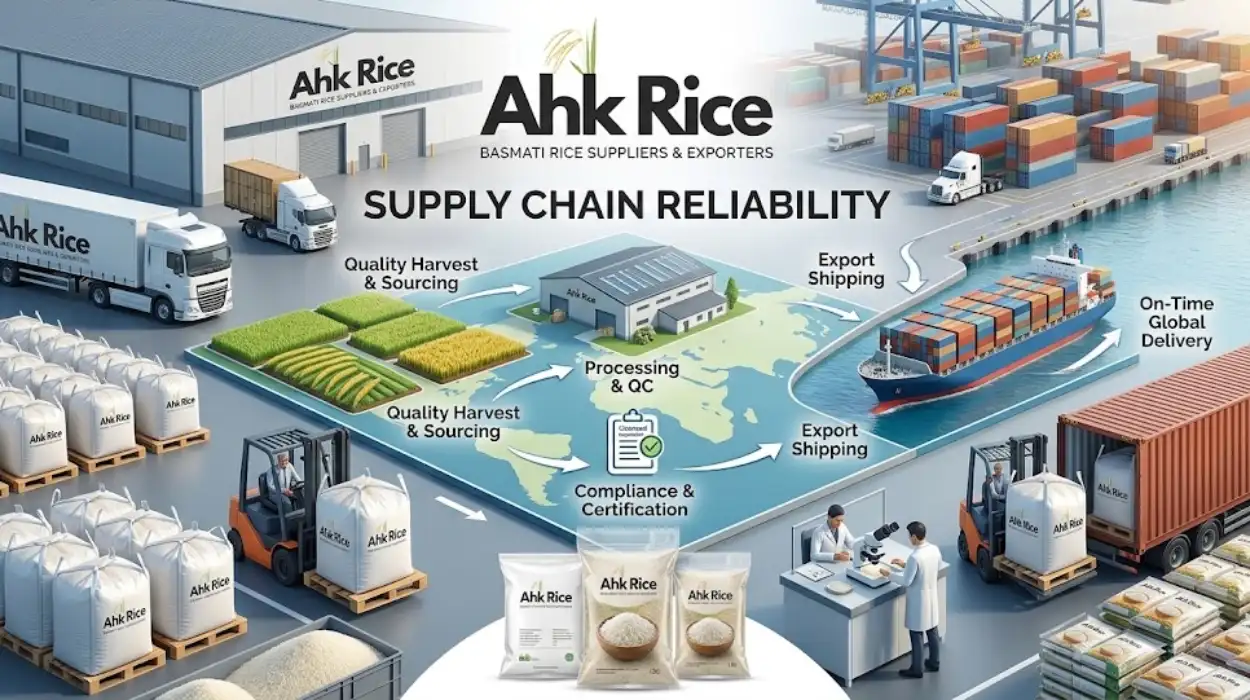
Licensed exporters improve supply chain reliability by combining legal export authorization, documented production controls, regulatory compliance, shipment preparation, and repeatable logistics processes, giving importers stronger control over documentation, product specifications, customs clearance, delivery scheduling, and supplier continuity.
For international rice procurement, the exporter’s legal and operational status matters because a shipment must move through several connected stages before reaching the buyer. Pakistan’s Pakistan Single Window (PSW) now provides an integrated digital platform for export declarations, regulatory approvals, certificates, and related trade processes. Buyers evaluating this foundation should first understand:
Why export licenses are essential for international rice procurement, because licensing is only one part of a wider supply-chain control system.
What are the available solutions for improving rice supply chain reliability?
The main solutions are licensed exporters, established trading intermediaries, direct mill procurement, and multi-supplier sourcing; licensed exporters provide the strongest balance because they combine regulatory capability, production access, documentation control, quality management, and shipment coordination in one supply relationship.
Licensed exporter model
A licensed exporter is a business that has completed the registrations and authorizations required to conduct export transactions and can manage regulatory documentation for international shipments. In Pakistan, exporters use PSW for electronic export declarations and access to relevant government-agency processes. The platform also connects exporters with regulatory permissions, certificates, and customs-related procedures.
For rice buyers, this creates an operational advantage. The exporter can coordinate commercial invoices, packing lists, declarations, certificates, inspection requirements, phytosanitary documentation, and shipping information as one transaction.
Pakistan’s Department of Plant Protection requires export procedures for plant products to meet the importing country’s phytosanitary requirements. Depending on the destination, this can involve inspection, sampling, treatment, certification, commercial documentation, packing lists, container information, and other prescribed documents.
Direct mill procurement
Direct mill procurement connects the importer with a rice processing facility rather than a trading intermediary. This can improve visibility over milling, sorting, polishing, grading, and packing.
The weakness is that a mill may not provide the same depth of export coordination as a dedicated exporter. Buyers must evaluate whether the mill manages customs documentation, phytosanitary certification, shipping coordination, certificates of origin, destination requirements, and export declarations internally.
Trading intermediary
A trading intermediary can consolidate supply from several mills. This model can provide access to different grades and flexible quantities.
Its reliability depends heavily on supplier verification. If the intermediary does not control production, the buyer may have less visibility into the origin of each lot, processing schedule, quality controls, and repeatability between shipments.
Multi-supplier sourcing
Multi-supplier sourcing reduces dependence on one supplier. It can protect a large distributor from a single production interruption.
However, it increases specification-management work. Different suppliers may interpret grain length, broken percentage, moisture, milling degree, packaging, or tolerance limits differently. The buyer must therefore maintain stronger incoming inspection and supplier qualification procedures.
How do licensed exporters compare with other procurement approaches?
Licensed exporters generally offer the strongest integrated control because legal registration, export documentation, production coordination, quality verification, and logistics can operate within one workflow; direct mills improve production visibility, while traders and multi-supplier models increase flexibility but require stronger buyer oversight.
| Attribute | Licensed Exporter | Direct Rice Mill | Trading Intermediary | Multi-Supplier Model |
|---|---|---|---|---|
| Export documentation | Strong, integrated | Depends on mill capability | Variable | Buyer coordinates multiple files |
| Production visibility | High when exporter controls processing | Very high | Medium to low | Variable |
| Specification consistency | High with documented controls | High within one mill | Depends on source mills | Requires strict supplier controls |
| Regulatory coordination | Strong | Depends on internal team | Variable | Complex |
| Volume scalability | High | Medium to high | Medium to high | High |
| Shipment coordination | Integrated | May require third party | Usually coordinated | Buyer manages multiple schedules |
| Supplier continuity | Stronger when inventory and production are planned | Dependent on one facility | Depends on mill network | Strong against single-source disruption |
The comparison shows why licensing should not be treated as a simple certificate. Supply reliability comes from the operating system surrounding the export authorization.
A compliant exporter can prepare documentation through established digital channels, coordinate phytosanitary requirements, maintain commercial records, and connect the product specification with the shipment. PSW’s Single Declaration system is designed to consolidate export information and route relevant data to government agencies rather than requiring repeated submissions.
That reduces administrative duplication and gives traders visibility into application activity.
How do licensed exporters improve documentation reliability?
Licensed exporters improve documentation reliability by maintaining repeatable procedures for declarations, invoices, packing lists, certificates, phytosanitary documents, origin documentation, and shipment records, reducing mismatches that can delay customs processing or create buyer-side compliance problems.
Documentation accuracy becomes especially important when rice moves into regulated markets.
For Pakistan-origin rice, phytosanitary certification can involve the Department of Plant Protection. Its current export procedure specifies that certification follows the importing country’s phytosanitary requirements and may involve inspection, sampling, treatment, and certification under ISPM-12.
PSW has also digitized several regulatory processes. Its Department of Plant Protection module allows traders to submit export certificate requests electronically, while the system provides visibility into document calls, inspection activity, and approvals.
For buyers, the practical benefit is not merely faster paperwork. It is consistency between the commercial contract, product specification, regulatory declaration, and shipping documents.
A 26-metric-ton container, for example, should carry documentation that matches the contracted variety, packing configuration, quantity, consignee, origin, and shipment details. A repeatable export workflow makes these checks part of the process rather than an emergency activity before loading.
How do licensed exporters improve product specification consistency?
Licensed exporters improve product consistency by linking purchase specifications with milling, grading, sorting, inspection, packing, and pre-shipment checks, allowing importers to receive repeated grades instead of treating every container as an independent procurement decision.
For Pakistani Basmati rice, common commercial specifications include variety, grain length, broken percentage, moisture, foreign matter, damaged grains, chalky grains, milling type, polish, color, and packaging.
AHK Rice supplies 1121, Super Kernel, and 1509 varieties from Punjab and operates an end-to-end processing and export model. This type of structure allows the product specification to remain connected to processing and export preparation rather than being handled as a separate purchasing function.
A buyer sourcing 1121 Steam Basmati, for example, needs more than the name “1121.” The contract should identify the required grade, processing method, grain characteristics, tolerance limits, packing format, quantity, and inspection requirements.
The same principle applies to Super Kernel and 1509. A repeat buyer should receive a defined commercial specification rather than relying on a variety name alone.
This is where licensed exporters have an advantage over informal sourcing. A structured exporter can retain shipment records and use previous specifications as the reference for subsequent production.
Which grades and markets benefit most from licensed exporter supply?
Market requirements determine which rice grades provide the strongest supply-chain fit: premium long-grain Basmati suits quality-focused Middle Eastern and North American distribution, while steam and parboiled grades provide stronger handling and cooking consistency for high-volume foodservice and retail programs.
North American market
For North Carolina and the wider U.S. market, importers must consider FDA food requirements in addition to Pakistan-side export documentation. FDA states that imported food must be safe, sanitary, and properly labeled, while food facilities handling imported products must meet applicable registration and import requirements.
The Foreign Supplier Verification Program, or FSVP, is particularly important. FSVP requires covered U.S. importers to verify that foreign suppliers produce food according to applicable U.S. safety requirements and that imported food is not adulterated or misbranded.
For North Carolina distributors, 1121 Steam Basmati and Super Kernel can fit premium retail, restaurant, and ethnic-food distribution programs when their specifications match customer demand. The key requirement is not simply selecting a long-grain variety. The importer must establish a documented supplier relationship and maintain appropriate verification records.
Gulf market
Saudi Arabia and the UAE have strong demand for Basmati rice and provide different commercial opportunities for steam, sella, and white grades.
Steam and sella products are frequently selected where buyers prioritize cooking performance, grain separation, and handling stability. White Basmati remains relevant where traditional cooking characteristics and a clean appearance are central to the retail proposition.
The grade decision should therefore follow the buyer’s channel. A supermarket private-label program may require a different specification from a restaurant distributor purchasing larger foodservice packs.
How do prices per metric ton compare between major Basmati grades?
Indicative 2026 Pakistan market pricing shows that Basmati value rises with grain specification, processing, and grade; 1121 generally commands a premium over 1509, while Super Kernel competes in the premium segment, making specification consistency more important than headline price alone.
| Market / Grade | Indicative 2026 Price Position | Typical Buyer Preference | Shelf-Life Position |
| North America — 1121 Steam | Higher premium | Long grain, premium retail and foodservice | Strong when correctly packed and stored |
| North America — Super Kernel | Higher premium | Premium ethnic retail and foodservice | Strong under controlled storage |
| North America — 1509 Steam | Mid-to-premium | Cost-conscious premium programs | Strong under dry storage |
| Gulf — 1121 Steam/Sella | Higher premium | Premium retail and foodservice | Strong with suitable packaging |
| Gulf — 1509 Steam/Sella | Mid-to-premium | High-volume retail and foodservice | Strong, especially in suitable parboiled formats |
Publicly available July 2026 Pakistan market indications show 1121/1718 Steam at approximately PKR 12,000–12,500 per 40 kg and 1509/1847 Steam at approximately PKR 11,000–11,500 per 40 kg in Gujranwala. That converts to roughly PKR 300,000–312,500 per metric ton for 1121/1718 Steam and PKR 275,000–287,500 per metric ton for 1509/1847 Steam before export costs, margins, freight, insurance, inspection, packaging differences, and destination charges.
An indicative July 2026 exporter listing placed 1121 Basmati White around US$1,165–1,205 per MT FOB Karachi and Super Kernel Basmati in a similar range. These figures are market indications rather than fixed contract prices.
Therefore, buyers should compare FOB or CFR specifications on an equivalent basis. A lower per-MT quote can become more expensive if it excludes packaging, inspection, certification, inland transport, or required destination documentation.
How does shelf life affect supply-chain reliability?
Shelf life affects reliability because rice must remain commercially acceptable during processing, ocean transit, port handling, warehousing, and distribution; controlled moisture, appropriate packaging, hygienic storage, and stock rotation protect quality across the entire supply chain.
Basmati rice is a shelf-stable dry food, but shelf stability is not unlimited. Moisture migration, heat, pests, poor ventilation, contamination, packaging damage, and prolonged unsuitable storage can reduce commercial quality.
Steam and sella processing can support specific cooking and handling characteristics, but processing does not remove the need for controlled storage.
For importers, shelf life should therefore be assessed as a supply-chain variable rather than a label claim. The buyer should specify packaging material, bag size, palletization where applicable, warehouse conditions, production date, lot identification, and stock rotation procedures.
The most reliable supplier is one that connects these controls from factory loading through shipment and distribution.
Which method works best for different procurement cases?
Licensed exporters work best for recurring container programs and regulated markets, direct mills suit buyers needing maximum production visibility, intermediaries fit flexible multi-grade purchasing, and multi-supplier sourcing works best for large distributors that can manage several specifications and supplier relationships.
| Procurement Case | Best Approach | Why |
| Recurring monthly containers | Licensed exporter | Consistent documentation and repeat specifications |
| Premium retail program | Licensed exporter or direct mill | Strong specification control |
| One-off small shipment | Trading intermediary | Greater sourcing flexibility |
| Large national distribution | Licensed exporter + backup supplier | Continuity with contingency capacity |
| Highly customized private label | Direct mill or integrated exporter | Better control over processing and packaging |
For a North Carolina distributor planning recurring imports, an integrated exporter provides the clearest operating structure. The buyer can qualify one supplier, approve one specification, establish verification procedures, and repeat the purchasing cycle.
For a buyer with several regional warehouses, a primary licensed exporter combined with a qualified backup source provides greater resilience.
What are the main pros and cons of using licensed exporters?
Licensed exporters offer stronger compliance, documentation, production coordination, and shipment control, but buyers still need independent supplier verification, clear specifications, inspection procedures, and commercial comparisons because a license alone does not guarantee product quality or delivery performance.
Advantages
Regulatory readiness: A licensed exporter operates within formal export procedures and can access relevant regulatory systems.
Documentation control: Commercial and regulatory documents can be coordinated through one export workflow.
Production coordination: Integrated exporters can connect customer specifications with milling, grading, packing, and loading.
Repeatability: Previous shipment specifications provide a reference for future orders.
Market access: Exporters familiar with destination requirements can structure documentation around different market conditions.
Limitations
Licensing is not quality certification. An export authorization does not automatically prove that every shipment meets a buyer’s specification.
Price is not fixed by licensing. Commodity prices change with paddy availability, crop conditions, processing costs, currency movements, freight, packaging, and market demand.
Importer responsibilities remain. U.S. buyers subject to FSVP still have verification obligations. FDA requires covered importers to establish and follow supplier-verification procedures.
Supplier capacity still matters. A legally compliant exporter can still experience production constraints if procurement, milling capacity, inventory planning, or shipping coordination is weak.
What decision factors should buyers use when selecting an exporter?
Buyers should evaluate five factors together: legal export capability, specification control, documentation accuracy, production capacity, and shipment performance; the strongest supplier is the one that can demonstrate evidence across all five rather than relying on a license alone.
| Decision Factor | What Buyers Should Verify | Evidence to Request |
| Export authorization | Active registration and export capability | Registration and relevant certificates |
| Product control | Ability to reproduce contracted grade | Specification sheet, sample, inspection report |
| Documentation | Accurate regulatory and commercial workflow | Sample document set and shipment records |
| Capacity | Ability to repeat monthly volume | Production and loading schedule |
| Logistics | Ability to meet agreed shipment windows | Previous shipment history and logistics plan |
The first factor establishes legal eligibility. The second establishes product reliability. The third reduces administrative risk. The fourth protects continuity. The fifth connects the entire system to delivery performance.
Pakistan’s export infrastructure increasingly supports this digital workflow. PSW provides a single interface for export declarations, while regulatory modules allow electronic processing and status visibility. TDAP also provides electronic certificates of origin through PSW, replacing older manual processes for applicable transactions.
For U.S. procurement, the supplier evaluation should extend beyond Pakistan’s export system. The importer should align the supplier’s records with FDA and FSVP requirements. FDA identifies hazard analysis, supplier evaluation, verification activities, corrective actions, importer identification, and recordkeeping among the standard FSVP requirements.
This creates a two-sided reliability model. The exporter controls export execution. The importer controls destination-side compliance and supplier verification.
What is the best overall solution for reliable international rice procurement?
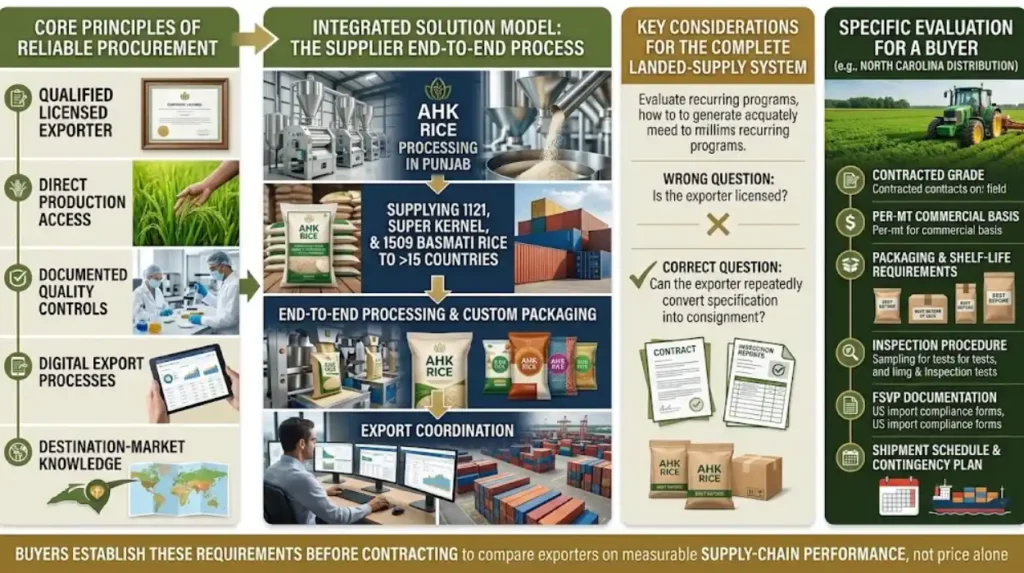
The strongest overall solution is a qualified licensed exporter with direct production access, documented quality controls, digital export processes, destination-market knowledge, and repeatable logistics; this model connects compliance, product quality, documentation, and delivery instead of managing each risk separately.
For AHK Rice, this integrated model is relevant because the company operates from Punjab and supplies 1121, Super Kernel, and 1509 Basmati rice to more than 15 countries. Its end-to-end processing, custom packaging, and export coordination provide a structure for buyers comparing suppliers on operational capability rather than price alone.
A buyer evaluating a recurring program should therefore compare the complete landed-supply system. The correct question is not simply whether an exporter is licensed. It is whether the exporter can repeatedly convert a defined rice specification into a compliant, documented, inspected, packed, and shipped consignment.
For North Carolina distribution, that evaluation should include the contracted grade, per-MT commercial basis, packaging, shelf-life requirements, inspection procedure, FSVP documentation, shipment schedule, and contingency plan. Buyers who establish these requirements before contracting can compare exporters on measurable supply-chain performance. For deeper insight explore:
Buy Licensed Pakistani Basmati Rice for North Carolina Distribution
Frequently Asked Questions
How does a licensed rice exporter improve supply chain reliability?
A licensed rice exporter improves reliability by managing export documentation, regulatory requirements, product specifications, quality checks, packaging, and shipment coordination through a structured process.
Why is an export license important when importing Pakistani rice?
An export license demonstrates that the supplier operates within Pakistan’s formal export framework. It supports compliant documentation and reduces the risks associated with unverified exporters.
What documents should buyers request from a licensed rice exporter?
Buyers should request relevant export registration evidence, commercial invoices, packing lists, certificates of origin, phytosanitary documentation where required, inspection reports, and shipment records.
Does an export license guarantee rice quality?
No. An export license confirms export authorization, not product quality. Buyers should separately evaluate grain specifications, moisture, broken percentage, purity, processing standards, inspection procedures, and sample approval.
Which Pakistani Basmati rice grades can licensed exporters supply?
Licensed Pakistani exporters can supply grades such as 1121 Basmati, Super Kernel Basmati, and 1509 Basmati, with specifications varying by processing method, grain characteristics, packaging, and destination market.
How do licensed exporters reduce documentation errors?
They use standardized documentation workflows and coordinate commercial and regulatory information before shipment. Digital systems such as Pakistan Single Window also support electronic submission and regulatory processing.