Why Is Premium Basmati Rice Growing in Maine Specialty Food Stores?
Premium Basmati rice is gaining attention in Maine speciality food stores because it combines aromatic flavour, long-grain appearance, distinct cooking performance, and a strong connection to South Asian cuisine. Retailers use premium imported rice to serve customers seeking recognizable origin, higher grain quality, and products suited to biryani, pilaf, curries, and restaurant-style meals.
Basmati rice is an aromatic long-grain rice traditionally associated with the Indian subcontinent. Pakistani Basmati is cultivated mainly in the Punjab rice-growing belt, where soil, climate, irrigation, and traditional cultivation practices support aromatic grain production. Pakistan’s commercial export portfolio includes varieties such as 1121, Super Kernel, and 1509.
The growth of premium Basmati in Maine is part of a broader U.S. import environment. USDA’s August 2026 rice outlook projects U.S. all-rice imports at a record 49.8 million hundredweight for 2026/27. That larger import market creates space for differentiated products, including specialty aromatic rice.
What Is Premium Basmati Rice and Why Does It Matter to Maine Retailers?
Premium Basmati rice is a high-value aromatic rice selected for grain length, aroma, purity, cooking expansion, appearance, and consistent specifications. Maine retailers use it to serve specialty shoppers seeking differentiated imported foods.
The word “premium” describes a specification rather than a single universal grade. Retail buyers normally evaluate several measurable attributes before placing an imported rice product on a specialty shelf.
Grain length is one major attribute. Pakistani 1121 Basmati has a typical raw grain length around 8.3 mm and can expand beyond 22 mm after cooking. Super Kernel generally measures around 7.2 mm, while 1509 is also positioned in the extra-long-grain segment.
Aroma is another defining characteristic. Basmati contains naturally occurring aromatic compounds that produce its recognizable fragrance after cooking. Texture also matters because premium rice should cook into separate grains rather than becoming excessively sticky.
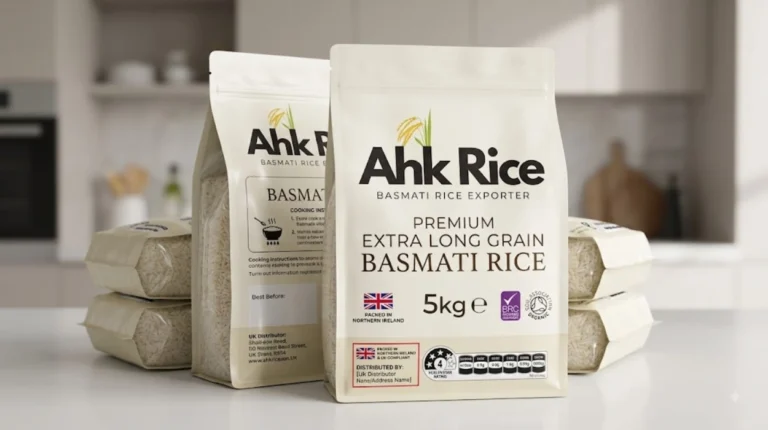
Retail packaging converts these physical characteristics into a consumer product. A 5 lb or 10 lb package can communicate variety, origin, cooking instructions, net weight, nutrition information, and applicable certifications.
This explains why premium Basmati differs from generic long-grain rice. The buyer evaluates the complete product rather than grain length alone.
Where Is Pakistani Basmati Rice Grown?
Pakistani Basmati rice is concentrated in Punjab, where the rice-growing environment supports aromatic varieties including 1121, Super Kernel, and other recognized Basmati types. Production begins with paddy cultivation before milling and export processing.
Punjab provides the main production base for Pakistan’s Basmati industry. Farmers cultivate rice in areas connected with the wider Punjab rice belt, where seasonal temperatures, water availability, and agricultural practices support aromatic rice production.
The harvested crop is called paddy because the rice grain remains enclosed in its husk. Paddy is transported from farms to mills after harvesting.
Variety selection determines the final product characteristics. 1121 is known for very long grains and high cooking elongation. Super Kernel provides a traditional aromatic profile with a shorter grain than 1121. 1509 is another extra-long-grain Basmati variety used in international trade.
Pakistan’s official Basmati specification framework also recognizes multiple Basmati varieties. The Trade Development Authority of Pakistan’s specification document includes varieties such as Basmati 515, PK 1121 aromatic, Punjab Basmati, Kissan Basmati, Super Basmati, and newer registered varieties.
For a Maine retailer, origin therefore means more than printing “Pakistan” on a package. The product’s variety, crop, processing method, and specification determine the actual rice being sold.
How Is Premium Basmati Rice Processed Step by Step?
Premium Basmati processing starts with paddy reception and continues through cleaning, husking, milling, polishing, grading, optical sorting, quality testing, packing, and container loading before the finished product reaches U.S. distribution.
The process begins when harvested paddy arrives at a rice mill. The mill checks the incoming material for moisture, foreign matter, damaged grains, and other physical characteristics.
Cleaning removes materials such as stones, dust, straw, and other field residues. The cleaned paddy then passes through dehusking equipment that removes the outer husk.
The resulting brown rice contains bran layers that are removed during whitening and polishing. Processing intensity affects the appearance and surface finish of the finished grain.
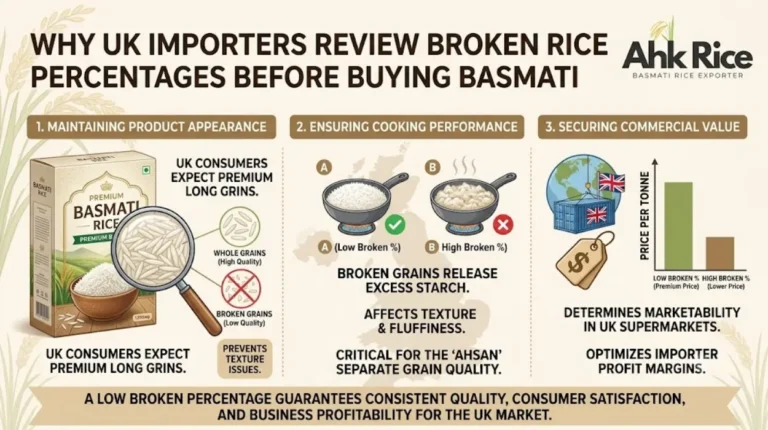
Grading separates rice according to length and physical characteristics. Broken grains are separated from whole kernels because broken percentage affects commercial grade and consumer appearance.
Optical sorting provides another quality-control stage. Cameras and sensors identify discolored, damaged, or defective grains. Air jets then remove selected grains from the product stream.
Processing differs according to the finished type. White Basmati is milled without parboiling. Sella Basmati is parboiled before milling, creating a firmer cooked texture. Steam Basmati receives steam treatment that produces a texture between conventional white rice and strongly parboiled rice.
The finished rice undergoes laboratory and physical checks before packaging. Common specifications include moisture, broken percentage, foreign matter, grain length, damaged grains, and purity.
Packaging follows the approved retail specification. Specialty products can use printed bags, pouches, cartons, or other formats according to the intended market and distribution channel.
Finally, export documentation, container loading, and shipment preparation connect the mill with the U.S. importer.
Which Premium Basmati Grades Are Available?
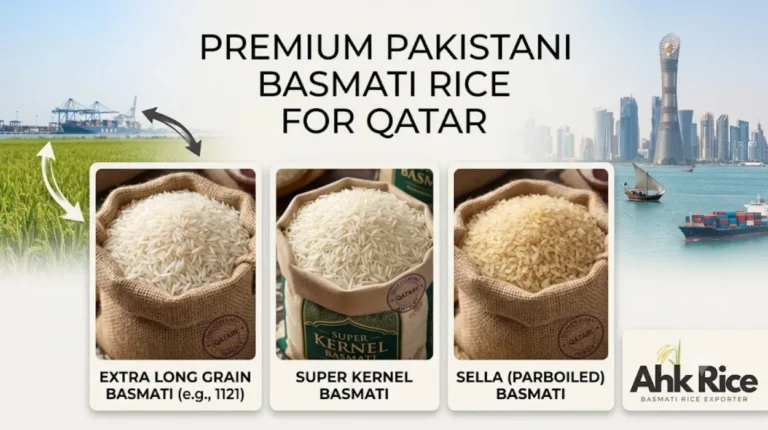
Premium Pakistani Basmati includes varieties such as 1121, Super Kernel, and 1509, with white, steam, and parboiled processing options depending on the variety and supplier specification. Grade selection determines appearance, texture, cooking behavior, and positioning.
1121 Basmati is the extra-long-grain segment. Its raw grain commonly measures about 8.3 mm, with substantial elongation after cooking. It suits consumers who associate premium rice with visibly long, separate grains.
Super Kernel Basmati is a traditional Pakistani aromatic variety. Its grain is shorter than 1121 but retains the fragrance and cooking characteristics associated with Basmati.
1509 Basmati is another extra-long-grain variety. It is commonly available in white and parboiled forms and is used in retail and foodservice applications.
Processing grades create additional product distinctions. White rice retains the natural aromatic profile with a softer cooked texture. Steam rice produces firmer grains and strong separation after cooking. Sella, or parboiled rice, provides firm grains and strong resistance to overcooking.
Other commercial distinctions include broken percentage, grain length, moisture level, purity, crop year, and packaging format. A premium retailer should treat these as separate specifications rather than assuming that every product labeled “Basmati” performs identically.
How Does Premium Basmati Reach Maine Specialty Food Stores?
Premium Basmati reaches Maine specialty stores through an international supply chain connecting farms, rice mills, exporters, U.S. importers, distributors, warehouses, and retailers. Each stage controls product identity, documentation, handling, inventory, and delivery.
The supply chain starts with agricultural production in Pakistan. Paddy moves to a processor, where it is cleaned, milled, graded, tested, packed, and prepared for export.
An exporter coordinates commercial documentation and ocean freight. The shipment normally moves in containers from Pakistan to a U.S. port before customs clearance and inland transportation.
The U.S. importer carries regulatory responsibility for the food entering interstate commerce. FDA states that imported foods must meet U.S. legal requirements and that facilities handling imported food must comply with applicable registration requirements. Prior Notice is also required for covered food imports.
The Foreign Supplier Verification Program, or FSVP, places additional responsibility on U.S. importers to verify that foreign suppliers produce food in a manner consistent with applicable U.S. food-safety requirements.
After clearance, the product moves through a distributor or warehouse. Specialty stores then purchase smaller quantities for retail shelves.
This structure explains why retail availability depends on more than rice production. Import documentation, container scheduling, customs clearance, warehouse inventory, and distributor replenishment all influence whether a product remains consistently available.
Retail buyers also need to understand:
How specialty distributors select imported rice products because distributor requirements often determine which specifications reach specialty shelves.
What Makes Premium Basmati Useful in Specialty Food Stores?
Premium Basmati gives specialty retailers a differentiated staple with strong culinary versatility, visible grain quality, aromatic identity, and compatibility with South Asian, Middle Eastern, Mediterranean, and modern specialty-food cooking applications.
Its first use case is South Asian cuisine. Consumers use Basmati for biryani, pulao, curries, and rice-based festive dishes.
A second use case is Middle Eastern cuisine. Long-grain aromatic rice works with grilled meats, stews, vegetables, and spiced rice preparations.
Restaurants represent another important application. Foodservice operators value consistent grain separation because a predictable cooking result reduces preparation variability.
Meal-preparation consumers also use premium Basmati for weekly rice dishes. The long grain and aromatic profile provide a different eating experience from standard U.S. long-grain rice.
Specialty stores can therefore position Basmati as both an ingredient and a cultural food product. Its value comes from measurable specifications combined with culinary identity.
Which Certifications and Compliance Requirements Apply to Imported Basmati?
Imported Basmati must comply with U.S. food-import requirements, while certifications such as organic, halal, HACCP-based systems, ISO 22000, and BRCGS apply according to the product claim, buyer specification, or supplier certification program.
FDA compliance is fundamental for imported food. FDA explains that imported food must be safe, sanitary, properly labeled, and compliant with U.S. requirements. Food facilities involved in manufacturing, processing, packing, or holding food for U.S. consumption generally fall under FDA registration requirements.
Prior Notice is also part of the import process. FDA uses this information to identify and assess incoming food shipments before arrival.
FSVP is an importer responsibility rather than a retail marketing label. It requires applicable U.S. importers to establish supplier-verification procedures.
HACCP means Hazard Analysis and Critical Control Points. It is a preventive food-safety system that identifies hazards and controls critical stages.
ISO 22000 is an international food-safety management standard. BRCGS is a widely used food-safety certification scheme that many commercial buyers request from food suppliers.
Halal certification verifies that the product and applicable production processes meet the requirements of the certifying organization.
USDA Organic certification applies when a product is marketed as organic under U.S. organic regulations. A supplier should not use an organic claim simply because the rice is perceived as natural.
These distinctions matter because regulatory compliance and voluntary certification are different concepts. A certificate does not replace FDA compliance, and FDA registration does not automatically mean that a product is certified organic, halal, HACCP, or BRCGS.
What Common Problems Do Buyers Have With Premium Basmati Rice?
The most common problems involve inconsistent grain specifications, unclear variety identification, excessive broken grains, inaccurate labeling, poor documentation, weak supplier verification, and differences between approved samples and the rice delivered in commercial shipments.
The first misconception is that all Basmati rice has the same grain length. It does not. 1121, Super Kernel, and 1509 have different physical and cooking characteristics.
The second misconception is that “extra-long grain” automatically means superior rice. Grain length is important, but purity, broken percentage, moisture, aroma, cooking performance, and consistency also determine quality.
A third problem occurs when buyers approve a sample without creating a detailed commercial specification. A sample should establish measurable requirements for grain length, broken percentage, moisture, foreign matter, milling quality, processing type, packaging, and labeling.
A fourth problem is confusing certifications with legal compliance. A HACCP certificate does not replace FDA import requirements. Organic labeling requires the appropriate certification framework. Halal certification depends on the certifying body and the applicable product process.
A fifth problem is inconsistent supply. A retailer can receive an excellent first shipment and then encounter different grain appearance or cooking performance in later lots if the supplier does not maintain a fixed specification.
The solution is specification control. The product should be defined before procurement, tested against the approved specification, and documented throughout production and shipment.
Which Markets Import Pakistani Basmati Rice?
Pakistani Basmati is exported to multiple regions, including the United States, Middle East, Europe, and other international markets. Demand differs by region because consumers and foodservice buyers prioritize different grain, processing, packaging, and price specifications.
The United States is an important destination for premium aromatic rice. USDA’s 2026 outlook shows that total U.S. rice imports remain structurally significant, with 2026/27 imports projected at a record 49.8 million hundredweight.
Middle Eastern markets also consume significant quantities of Pakistani Basmati. Saudi Arabia and the UAE commonly use long-grain aromatic rice in household, restaurant, catering, and institutional cooking.
European markets include specialty retail and ethnic-food distribution channels where product origin, labeling, food safety, and consistent specifications influence purchasing decisions.
African markets import Pakistani rice across several product categories, although the preferred varieties and price points differ from premium specialty retail.
This regional diversity explains why the same rice variety can be processed and packaged differently for different destinations. A retail package intended for Maine requires a U.S.-compliant label and supply chain, while a bulk shipment for another market follows a different commercial specification.
Why Is Maine an Important Specialty-Retail Context for Premium Basmati?

Maine’s specialty-food environment gives imported Basmati a distinct retail role because specialty stores rely on differentiated products, international ingredients, culinary identity, and premium food attributes rather than competing only on commodity price.
A specialty store does not need to sell the largest volume of rice to justify a premium product. It needs a product that fits a defined customer segment.
Basmati meets that requirement through its combination of aroma, long-grain appearance, cultural identity, and cooking versatility.
The retail opportunity also connects with the wider U.S. import market. USDA’s August 2026 outlook projects tighter U.S. rice supplies and record total rice imports for 2026/27.
For Maine retailers, the important lesson is that premium Basmati should be evaluated as a specification-controlled imported food. Variety, origin, processing, grade, packaging, food safety, certification, and supply continuity all determine the finished retail product.
The trend is therefore not simply about consumers buying more rice. It reflects a broader specialty-food preference for differentiated imported products with clear origin, identifiable characteristics, and predictable culinary performance.
Frequently Asked Questions
Why is premium Basmati rice becoming popular in Maine specialty food stores?
Premium Basmati rice is gaining retail attention because of its distinctive aroma, long grains, cooking performance, cultural identity, and versatility in South Asian, Middle Eastern, and specialty cuisine.
What is premium Basmati rice?
Premium Basmati rice is aromatic long-grain rice selected for characteristics such as grain length, aroma, purity, low broken percentage, moisture control, appearance, and consistent cooking performance.
Where is Pakistani Basmati rice grown?
Pakistani Basmati rice is primarily grown in Punjab, where the agricultural environment supports aromatic rice cultivation. Important commercial varieties include 1121, Super Kernel, and 1509.
What are the main Pakistani Basmati rice varieties?
The main commercial varieties discussed in premium export markets include 1121, Super Kernel, and 1509. Each has different grain dimensions, cooking characteristics, and processing applications.
What is 1121 Basmati rice?
1121 Basmati is an extra-long-grain aromatic rice variety. Its long grain and high cooking elongation make it suitable for premium retail, restaurants, biryani, pulao, and other rice-based dishes.
What is Super Kernel Basmati rice?
Super Kernel Basmati is a traditional Pakistani aromatic rice variety with a shorter grain than 1121. It is valued for its aroma, texture, cooking performance, and suitability for household and foodservice use.
What is 1509 Basmati rice?
1509 Basmati is an extra-long-grain aromatic variety commonly processed as white, steam, or parboiled rice. It is used across retail, foodservice, and international export markets.