Source Regulation-Compliant Pakistani Basmati Rice for Scotland Through AHK Rice
AHK Rice provides specification-controlled Pakistani Basmati rice for Scottish buyers, with product testing, export documentation, sampling, packaging, and shipment coordination handled through one procurement process. Here is why: Scottish importers need more than a suitable rice grade. They need a shipment specification that supports UK food controls, documentation, customs clearance, and reliable delivery. For background, buyers can first review Why Must Scottish Buyers Understand Food Import Regulations for Rice? before moving into supplier selection.
What is the best solution for regulation-compliant Pakistani Basmati rice?
The best solution is a documented rice specification matched with verified quality, required certificates, compliant packaging, and controlled export logistics. AHK Rice connects these requirements before the container leaves Pakistan. This reduces specification disputes and documentation gaps.
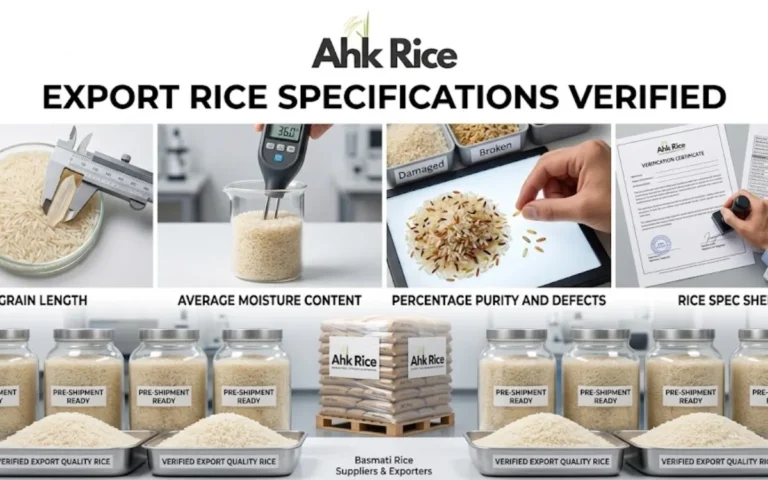
Pakistani Basmati rice for Scotland should be purchased against measurable requirements. These include rice variety, grain length, broken percentage, moisture, purity, foreign matter, crop year, packaging, quantity, destination, and inspection requirements.
UK import controls also require attention to rice-specific rules. Current UK guidance lists rice from Pakistan among foods subject to GB import restrictions. The July 2026 update specifically includes controls for aflatoxins and ochratoxin A.
Rice imports can also involve tariff-rate quota arrangements. UK government notices for 2026 cover imports of semi-milled or wholly milled rice under CN code 1006 30. Importers must check the applicable quota and licence position for their shipment.
The practical solution therefore starts before production. The buyer should define the specification, destination, packaging, quantity, documentation, and delivery requirement before approving the commercial order.
For a detailed comparison of UK requirements, buyers can also review How UK Food Import Rules Affect Basmati Rice Shipments before selecting the final supplier.
With the compliance problem defined, the next decision is which supplier can control the specification from processing through dispatch.
Why choose AHK Rice for Scottish Basmati rice supply?
AHK Rice combines Pakistani Basmati sourcing, milling, grading, sorting, testing, packaging, documentation, and container coordination in one export workflow. This gives Scottish buyers one specification to approve and one supplier process to manage.
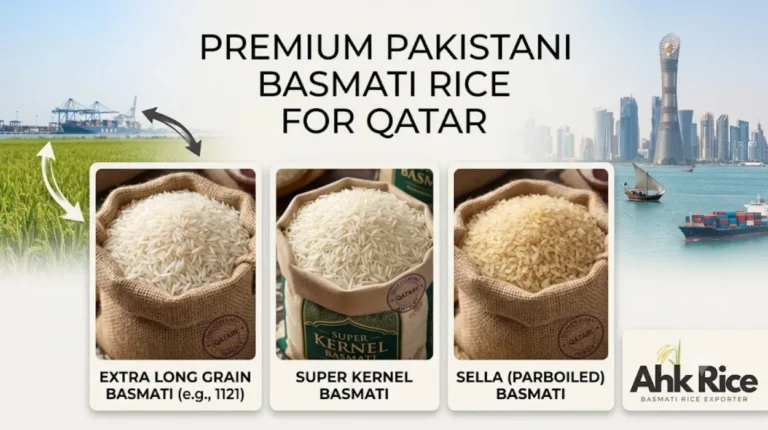
AHK Rice supplies Pakistani Basmati varieties including 1121, Super Kernel, and 1509. Each variety can be specified around the buyer’s intended retail, wholesale, restaurant, catering, or private-label application.
Processing control starts with paddy selection and continues through milling, polishing, grading, and sorting. Colour sorting supports visual uniformity. Moisture testing supports storage stability. Quality inspection verifies the agreed commercial specification before dispatch.
AHK Rice also supports custom packaging and export documentation. The commercial specification can identify bag weight, packaging material, printed artwork, quantity, destination port, and shipment schedule.
The documentation package should be matched to the actual shipment. Typical export documents can include commercial invoices, packing documentation, certificate of origin, and applicable phytosanitary or inspection documentation. The exact requirement depends on the product and UK import conditions.
AHK Rice’s strongest commercial advantage is coordination. A Scottish buyer should not approve a rice sample separately from the packaging, documentation, freight, and final production specification.
A representative sample should match the eventual commercial order. The buyer should approve the same grade, moisture range, broken percentage, purity, processing level, and packaging specification used for bulk production.
With supplier capability established, the next question is how a Scottish buyer can verify the product before committing to a container.
How does the AHK Rice sample process work, and what does it cost?

The sample process starts with a defined specification, followed by sample preparation, courier dispatch, dry-grain inspection, cooking evaluation, and final specification approval. AHK Rice states that samples up to 20 kg can be provided, while the buyer covers sample shipping.
What should a Scottish buyer provide before sampling?
The buyer should provide:
- Specify the Basmati variety and grade.
- Confirm required grain length and broken percentage.
- Confirm moisture and purity requirements.
- Select the preferred bag size and packaging format.
- Provide the Scottish delivery location or UK port.
- State required certificates or laboratory tests.
- Confirm the intended commercial quantity.
AHK Rice can then prepare a representative sample against the requested specification.
What should the buyer test?
Dry-grain inspection should examine grain length, uniformity, broken grains, colour, foreign material, and general appearance.
Cooking evaluation should then assess aroma, elongation, separation, texture, and finished appearance. The same cooking method should be used across supplier samples.
The sample cost should be separated from courier and testing expenses. AHK Rice states that sample shipping is covered by the client.
Courier pricing depends on weight, dimensions, destination, carrier, and service level. Laboratory costs also depend on the requested analysis. A fixed sample price should therefore not be presented without shipment details.
A practical sample budget should include:
| Cost factor | Commercial treatment |
|---|---|
| Rice sample | Confirm quantity and sample charge |
| Courier | Obtain shipment-specific carrier quote |
| Laboratory testing | Confirm requested tests |
| Certification | Confirm whether required |
| Packaging | Confirm standard or custom format |
| Commercial order | Confirm whether sample costs are credited |
The commercial decision should follow the approved sample. The bulk specification should never change after approval without buyer confirmation.
With sample approval established, shipping time becomes the next inventory-planning factor.
How many shipping days should Scottish buyers plan?
Scottish buyers should plan approximately 30–45 days for a standard sea-freight supply chain from Karachi to the UK, plus UK clearance and inland delivery to Scotland. Actual timing depends on vessel routing, transshipment, port congestion, customs clearance, and final delivery.
Current Karachi-to-Felixstowe shipping information shows approximately 28–43 days for FCL ocean transit, with one current benchmark showing 43 days.
A Scottish importer should therefore plan beyond port-to-port sailing time. Production, inspection, documentation, container loading, vessel departure, UK clearance, and inland transport all affect the final delivery window.
| Scottish destination | Practical planning approach |
|---|---|
| Glasgow | Ocean transit plus UK inland delivery |
| Edinburgh | Ocean transit plus UK inland delivery |
| Aberdeen | Ocean transit plus longer inland planning |
| Dundee | Ocean transit plus UK inland delivery |
| Inverness | Ocean transit plus extended inland planning |
A container destined for Glasgow should not be planned around the vessel arrival date alone. The importer should reserve time for clearance and onward transport from the UK port.
The safest procurement method is to reorder before warehouse stock reaches its minimum level. This creates room for vessel delays and customs processing.
With the logistics window established, the remaining commercial question is the total landed cost.
What factors affect the final price of Pakistani Basmati rice?
Final pricing depends on rice grade, quantity, packaging, processing, testing, freight, destination, Incoterm, inspection, and current market conditions. A Scottish importer should compare landed cost rather than FOB rice price alone.
Rice grade directly affects the base product price. Extra-long 1121 Basmati can command a different price from Super Kernel or 1509.
Quantity also affects procurement economics. Full-container purchasing usually provides a clearer freight and packing structure than small-volume shipments.
Packaging changes the commercial calculation. Standard export bags usually differ from printed private-label packaging in material, artwork, printing, and production requirements.
Testing and inspection add another cost layer. Buyers requesting laboratory analysis or third-party inspection should include those charges in the purchase calculation.
Freight varies by route and booking date. Karachi-to-UK freight should therefore be quoted against the actual container size, destination, and shipment window.
Incoterms also change the buyer’s responsibility. FOB, CFR, and CIF allocate freight, insurance, and risk differently.
A Scottish importer should request a quotation showing the exact product specification and commercial basis. This makes supplier comparisons more accurate and prevents a low FOB number from hiding additional costs.
The best purchase is not necessarily the lowest-priced rice. The stronger decision is the specification that delivers consistent cooking performance, documentation control, predictable logistics, and acceptable landed cost.
With pricing defined, the final decision becomes a controlled procurement process.
What results can Scottish buyers expect from AHK Rice?
Scottish buyers can expect stronger specification control, clearer documentation, predictable sampling, coordinated export logistics, and more consistent bulk shipments. These outcomes reduce avoidable procurement problems.
Product consistency starts with the approved sample. The commercial shipment should reproduce the agreed grain, moisture, broken percentage, purity, packaging, and processing requirements.
Documentation control improves shipment readiness. The buyer can establish required documents before container dispatch rather than discovering missing requirements after arrival.
Logistics coordination improves inventory planning. A practical 30–45-day sea-freight planning window gives Scottish wholesalers a starting point for replenishment scheduling.
Packaging control supports retail and foodservice requirements. Private-label buyers can define bag weight, artwork, material, and presentation before production.
Quality control also supports repeat procurement. A measurable specification gives the buyer a reference point for subsequent containers.
For example, a Glasgow wholesaler supplying restaurants can approve 1121 Basmati against a defined grain and moisture specification. The same specification can then guide the next purchase.
A supermarket supplier can use the same process for private-label packaging. The commercial focus shifts from buying generic rice to buying a repeatable finished product.
These results make specification control the central decision factor rather than supplier price alone.
How can a Scottish buyer get started with AHK Rice?
Start with the product specification, approve a representative sample, confirm compliance documents, obtain the shipment quotation, and schedule production against the required Scottish delivery window. This creates a controlled path from enquiry to container arrival.
What should the buyer submit?
- Specify the Basmati variety.
- Confirm the required grade.
- Confirm the quantity.
- Select the packaging format.
- Provide the destination.
- State required testing.
- Confirm the preferred Incoterm.
- Set the target delivery window.
AHK Rice can then structure the commercial quotation around the actual order rather than a generic rice price.
The buyer should approve the sample before final production. The approved sample becomes the reference for the commercial specification.
The buyer should also confirm the applicable UK import requirements before shipment. Current government guidance shows that Pakistan rice is subject to specific GB food controls, including updated contaminant controls.
Rice quota requirements should also be checked for the relevant import arrangement. UK government notices confirm active 2026 rice quota procedures and documentation requirements.
AHK Rice therefore offers a practical route for Scottish buyers seeking Pakistani Basmati rice through a specification-led export process.
The decision is straightforward: approve the product specification, verify the sample, confirm the compliance package, calculate landed cost, and schedule the shipment.
For a quotation based on your Scottish destination, quantity, packaging, grade, and required documentation, request a quote from AHK Rice.
Frequently Asked Questions
Can Scotland import Basmati rice from Pakistan?
Yes, Pakistani Basmati rice can enter Great Britain subject to applicable import controls.
Pakistan rice is currently listed under GB food import restrictions. The July 2026 update includes aflatoxins and ochratoxin A controls. Importers should verify the requirements for each shipment before dispatch.
How long does Pakistani rice take to reach Scotland?
A practical planning range is about 30–45 days by sea. Current Karachi-to-Felixstowe information shows roughly 28–43 days FCL transit. UK clearance and Scottish inland delivery require additional planning.
Does AHK Rice provide rice samples?
Yes, AHK Rice states that samples up to 20 kg can be provided. The buyer covers the sample shipping cost. Courier charges depend on weight, dimensions, destination, and service level.
Testing costs depend on the laboratory requirements selected by the buyer.
What affects Pakistani Basmati rice pricing?
Rice grade directly affects the base product price. Quantity, packaging, processing, testing, freight, and destination also affect cost. Incoterms change which transport and insurance costs each party carries.
Why should Scottish buyers use a specification-controlled supplier?
Specification control creates a measurable reference for every commercial shipment. Buyers can define grain length, moisture, broken percentage, purity, and packaging. The approved sample can become the reference for bulk production.