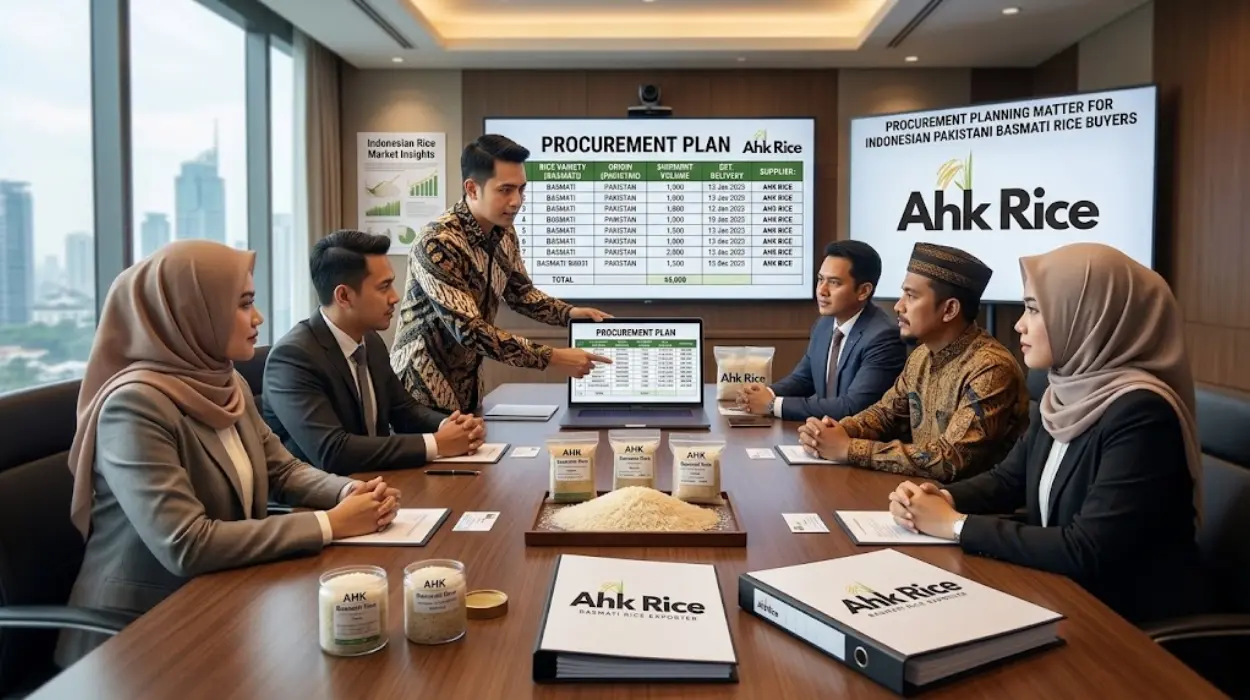
Why Does Procurement Planning Matter for Indonesian Pakistani Basmati Rice Buyers?
Procurement planning helps Indonesian rice buyers select the correct Pakistani Basmati grade, calculate purchasing requirements, control costs, and maintain consistent supply. Here is why: grade selection, processing specifications, shipment schedules, and inventory requirements determine whether imported rice meets retail, wholesale, and foodservice needs.
Indonesian importers source Pakistani Basmati rice for distributors, restaurants, supermarkets, and food manufacturers. Each buyer requires different grain lengths, cooking characteristics, packaging formats, and purchase volumes. Procurement planning connects these requirements with suitable products before an order is placed.
Pakistan cultivates Basmati rice in regions with suitable soil, water, and climate conditions. Punjab remains a major rice-producing region. The country exports Basmati varieties including 1121, Super Kernel, and 1509 to international markets. Indonesian buyers use these varieties for different commercial purposes.
What Is Procurement Planning for Indonesian Pakistani Basmati Rice Buyers?
Procurement planning is the structured process of forecasting rice demand, selecting grades, setting specifications, budgeting purchases, and scheduling imports before placing supplier orders. Here is why: a documented plan connects business requirements with measurable product and delivery conditions.
Procurement planning begins with demand forecasting. An Indonesian importer estimates the quantity required for the next purchasing cycle. A supermarket distributor forecasts retail sales. A restaurant group calculates monthly kitchen consumption. A food manufacturer estimates rice requirements for production.
The next step establishes product specifications. Buyers define rice variety, grain length, processing type, broken percentage, moisture level, packaging, and order quantity. These specifications prevent confusion between products that share similar names.
Budget planning covers the expected purchase price and related expenses. Buyers calculate the cost of rice, packaging, inland transport, ocean freight, insurance, customs clearance, and local distribution.
A procurement plan also identifies the required arrival date. Indonesian buyers coordinate supplier preparation, export documentation, vessel schedules, and warehouse receiving. This process reduces supply interruptions.
Procurement planning connects demand forecasts with grade selection and import scheduling. The next question is how this process works from harvest to warehouse.
How Does Pakistani Basmati Rice Procurement Planning Work?
Pakistani Basmati procurement follows seven connected stages: forecast demand, define specifications, select grades, evaluate suppliers, approve samples, schedule shipments, and monitor inventory. Here is why: each stage establishes information needed for the next purchasing decision.
1. Forecast Indonesian Rice Demand
Demand forecasting estimates the quantity of rice required during a defined period. A distributor selling 50 tonnes monthly needs a different purchasing plan from a restaurant group consuming 8 tonnes monthly.
Forecasting uses sales records, customer orders, seasonal demand, warehouse inventory, and expected business growth. Buyers should calculate monthly consumption and establish a safety stock target.
2. Define Rice Specifications
Specifications describe the physical and commercial requirements of the order. A specification sheet includes variety, processing type, grain length, broken percentage, moisture, foreign matter, packaging, and quantity.
A buyer requiring long-grain rice for premium retail needs a different specification from a catering distributor prioritising cooking consistency and price.
3. Select Suitable Grades
Grade selection matches the product with its intended use. Pakistani Basmati varieties include 1121, Super Kernel, and 1509. Processing types include Steam, Sella, and Golden Sella.
The buyer compares grain appearance, cooking performance, processing characteristics, and commercial requirements. This prevents purchasing a grade that fails the intended application.
4. Evaluate Supplier Capabilities
Supplier evaluation examines processing capacity, quality-control procedures, export documentation, packaging capabilities, and shipment coordination.
A supplier with end-to-end processing can coordinate paddy preparation, milling, sorting, grading, packaging, and dispatch. Buyers should verify these capabilities through documentation and product samples.
5. Approve Rice Samples
Sample approval confirms that the proposed product meets the agreed specification. Buyers inspect grain appearance, aroma, uniformity, cooking performance, and broken percentage.
Sample records should identify the variety, processing type, batch, and approval date. This creates a reference for future shipments.
6. Schedule Import Shipments
Shipment scheduling connects production completion with vessel availability and warehouse receiving capacity. Buyers calculate the time required for processing, loading, ocean transport, customs clearance, and local delivery.
A shipment plan also identifies required documents, payment milestones, and receiving arrangements.
7. Monitor Inventory
Inventory monitoring compares available stock with forecast demand and expected shipment arrivals. Buyers track opening inventory, consumption, incoming quantities, and safety stock.
This information supports the next purchasing decision and prevents emergency procurement.
The seven-stage process turns procurement planning into a repeatable purchasing system. Its effectiveness depends on the product attributes included in the plan.
What Are the Key Components of a Pakistani Basmati Rice Procurement Plan?
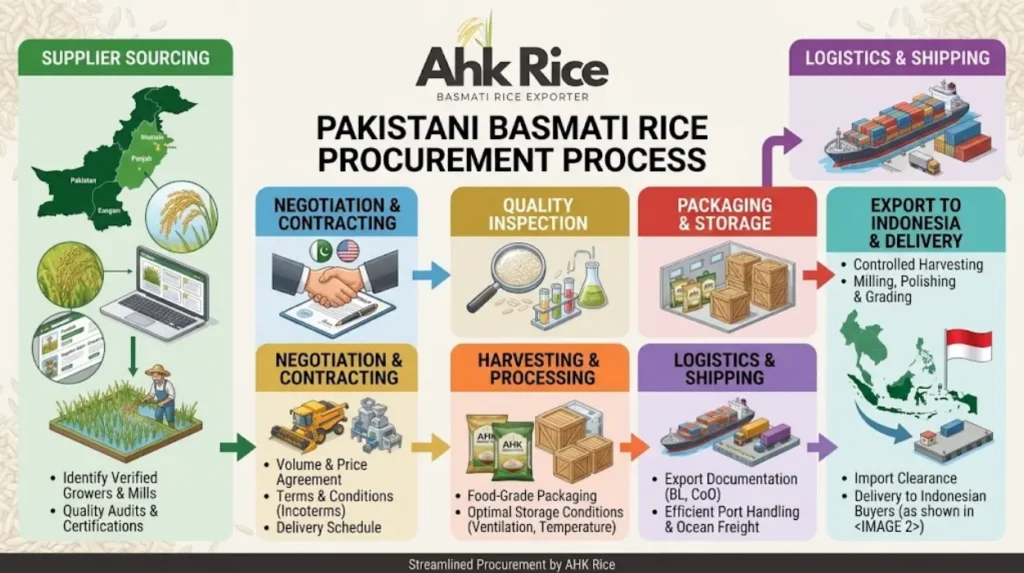
The essential components are demand volume, rice variety, processing grade, quality limits, packaging, price basis, delivery schedule, documentation, and inventory requirements. Here is why: these components define the product, establish purchasing costs, and control the conditions required for successful importation.
Rice Variety and Processing Grade
Rice variety identifies the genetic and commercial type of grain. Processing grade identifies how the grain is prepared for cooking and sale.
| Variety | Processing types | Typical commercial use |
|---|---|---|
| 1121 Basmati | Steam, Sella, Golden Sella | Premium retail, restaurants, foodservice |
| Super Kernel Basmati | Steam, Sella, Golden Sella | Retail, wholesale, catering |
| 1509 Basmati | Steam, Sella, Golden Sella | Mid-premium retail, foodservice |
1121 Basmati is known for its long grain and strong commercial demand. Super Kernel offers a distinct Basmati grain profile. 1509 provides an alternative for buyers balancing grain appearance and purchasing costs.
Quality Specifications
Quality specifications establish measurable acceptance limits. Buyers define grain length, moisture, broken percentage, foreign matter, and grain uniformity.
A procurement sheet should distinguish between product descriptions and actual testing requirements. “Premium quality” does not define a measurable acceptance standard.
Packaging Requirements
Packaging protects rice during handling, storage, and transportation. Common formats include polypropylene bags, woven bags, laminated bags, and retail packs.
A wholesale distributor requiring 25 kg bags has different packaging requirements from a supermarket selling 1 kg consumer packs. Packaging also affects palletisation, warehouse handling, and shipping calculations.
Price and Delivery Terms
Price planning identifies the agreed commercial basis. FOB pricing covers the goods and export loading responsibilities specified in the contract. CIF pricing includes the agreed ocean freight and insurance to the destination port.
Indonesian buyers compare quotations using the same currency, quantity, specification, and delivery basis. This produces a more accurate purchasing comparison.
Documentation
Import documentation supports customs clearance and product verification. Common documents include commercial invoices, packing lists, bills of lading, certificates of origin, and applicable inspection or phytosanitary documents.
The exact requirements depend on Indonesian import regulations and the product classification.
Inventory and Delivery Schedule
Inventory planning establishes how much rice the buyer needs before the next shipment arrives. A distributor with 100 tonnes in stock and 30 tonnes of monthly demand has approximately 3.3 months of inventory before accounting for safety stock.
This calculation helps determine the next order date and quantity.
These components establish the information required for purchasing decisions. The next question is how they improve business performance.
What Benefits Does Procurement Planning Provide for Indonesian Rice Importers?
Procurement planning improves grade accuracy, purchasing cost control, inventory availability, quality consistency, and shipment coordination. Here is why: buyers make purchasing decisions from documented requirements instead of relying on incomplete product descriptions or urgent stock needs.
Better Grade Selection
Grade planning aligns the rice variety and processing type with the intended market. A premium restaurant requires cooking performance and grain appearance. A wholesale distributor prioritises consistent supply and commercial value.
More Accurate Cost Forecasting
Cost planning includes the product price and related import expenses. Buyers calculate the expected landed cost before approving an order.
For example, a 25-tonne shipment with a rice price of $900 per tonne has a product value of $22,500. Freight, insurance, customs, and local transport require separate calculations.
Improved Supply Continuity
Supply planning establishes reorder points and safety stock. Buyers avoid relying on emergency purchases after inventory reaches zero.
Stronger Quality Control
A documented specification creates a reference for sample approval and shipment inspection. Buyers compare the delivered rice with the agreed product requirements.
Better Warehouse Management
Packaging and quantity planning help warehouses prepare receiving space, handling equipment, and storage capacity. Buyers also coordinate stock rotation and consumption records.
The benefits show why procurement planning supports operational control. Its practical value becomes clearer across different Indonesian buyer types.
Which Indonesian Buyers Use Pakistani Basmati Rice Procurement Planning?
Retail distributors, supermarkets, restaurant groups, catering businesses, food manufacturers, and wholesalers use procurement planning to match rice purchases with their operational requirements. Here is why: each buyer has different demand patterns, packaging needs, quality priorities, and inventory cycles.
Retail Distributors
Retail distributors forecast sales across stores and regional warehouses. They plan multiple pack sizes and grades according to customer demand.
A distributor selling premium Basmati rice requires consistent grain appearance and packaging. Another distributor serving price-sensitive customers prioritises commercial value.
Supermarkets
Supermarkets plan purchases around shelf availability, consumer demand, and retail packaging. A premium rice range can include 1121 Basmati, while a mid-premium range can include 1509 Basmati.
Restaurant Groups
Restaurant groups forecast rice consumption across multiple kitchens. They prioritise cooking consistency, grain appearance, and dependable replenishment.
A restaurant group operating 10 locations requires a central procurement plan that coordinates volume, specifications, and delivery schedules.
Catering Businesses
Catering businesses plan purchases around event schedules and recurring foodservice demand. They require predictable cooking performance and sufficient inventory for large meal volumes.
Food Manufacturers
Food manufacturers include rice in production formulas and packaged food products. They define specifications for grain quality, processing characteristics, and supply consistency.
Wholesalers
Wholesalers purchase rice for resale to smaller distributors, retailers, and foodservice businesses. They require flexible purchasing quantities and clear commercial specifications.
These use cases demonstrate how procurement planning adapts to different business models. The next section addresses the problems that occur without a structured plan.
What Common Problems Affect Pakistani Basmati Rice Procurement?
Common procurement problems include incorrect grade selection, unclear specifications, inaccurate landed-cost calculations, delayed shipments, inconsistent quality, and insufficient inventory. Here is why: each problem begins with missing information or weak coordination between purchasing, suppliers, logistics, and warehouse operations.
Incorrect Grade Selection
Incorrect grade selection occurs when buyers choose rice based only on variety names. 1121 Steam and 1121 Golden Sella share the same variety but differ in processing characteristics.
Buyers should specify both variety and processing type before requesting quotations.
Unclear Quality Requirements
Unclear quality requirements create disputes over grain length, broken percentage, moisture, and foreign matter. Buyers should establish measurable limits before sample approval.
Inaccurate Landed-Cost Estimates
Inaccurate landed-cost estimates occur when buyers compare product prices without including freight, insurance, customs, and local transport. A complete cost model produces a more reliable purchasing decision.
Shipment Delays
Shipment delays affect warehouse availability and customer fulfilment. Buyers should coordinate production completion, vessel schedules, documentation, and receiving capacity.
Inconsistent Product Quality
Inconsistent quality occurs when shipments lack a defined reference specification. Sample approval and inspection records provide a measurable comparison point.
Insufficient Inventory
Insufficient inventory occurs when buyers reorder after stock reaches a critical level. Demand forecasting and safety stock calculations establish a more reliable replenishment schedule.
These problems show why procurement planning requires measurable specifications and coordinated purchasing decisions. Indonesian importers can use grade-based planning to create a stronger procurement system.
How Should Indonesian Importers Plan Pakistan Basmati Purchases by Grade?
Indonesian importers should plan purchases by matching 1121, Super Kernel, and 1509 with processing type, customer requirements, quality limits, packaging, price, and expected inventory demand. Here is why: grade-based procurement creates a direct connection between product selection and commercial use.
1121 Basmati suits buyers seeking long-grain rice for premium retail and foodservice. Super Kernel supports buyers requiring a distinct Basmati variety for retail and wholesale distribution. 1509 provides an option for mid-premium purchasing strategies.
The processing type also matters. Steam rice follows a steaming and drying process. Sella rice undergoes parboiling before drying and milling. Golden Sella uses a parboiling process that produces its characteristic golden appearance.
Each grade requires its own specification sheet, sample approval, and purchasing plan. Buyers should compare grain attributes, processing characteristics, packaging, and expected commercial use before selecting the final product.
For a detailed comparison of these purchasing decisions, the next-stage article explains how Indonesian importers should plan Pakistan Basmati purchases by grade.
Frequently Asked Questions
What is procurement planning in rice importing?
Procurement planning is the process of forecasting rice demand, defining product specifications, selecting grades, calculating purchasing costs, and scheduling imports before placing an order.
Why do Indonesian buyers need grade-based procurement?
Grade-based procurement helps Indonesian buyers match rice varieties and processing types with retail, wholesale, restaurant, catering, and manufacturing requirements.
Which Pakistani Basmati varieties should Indonesian buyers consider?
Indonesian buyers can consider 1121, Super Kernel, and 1509 Basmati. Each variety serves different commercial requirements based on grain characteristics, processing type, and customer demand.
What information should a rice procurement plan include?
A rice procurement plan should include variety, processing grade, quality specifications, packaging, quantity, price basis, delivery schedule, documentation, and inventory requirements.
How does procurement planning reduce rice supply problems?
Procurement planning establishes demand forecasts, reorder points, safety stock, and shipment schedules. These measures help buyers maintain inventory and coordinate future purchases.
What is the difference between Steam, Sella, and Golden Sella?
Steam rice undergoes steaming and drying. Sella rice undergoes parboiling before drying and milling. Golden Sella undergoes parboiling and develops a golden appearance during processing.