Pakistani Basmati Rice Export Trends to the UAE: Volumes, Demand Drivers and Seasonal Peaks
Pakistani Basmati rice exporters serve different UAE market segments through premium long-grain varieties, aromatic traditional grades, and cost-conscious alternatives, while importers achieve more consistent supply through demand forecasting, planned purchasing, and forward contracts. The best procurement strategy depends on product positioning, inventory turnover, seasonal demand, landed cost, and the buyer’s storage capacity.
The UAE is an important destination for Pakistani rice because Dubai and other emirates connect retail distribution, wholesale trading, hospitality, catering, and regional re-export channels. Importers evaluating how Pakistani Basmati rice is grown, processed, graded, and exported can use these fundamentals to compare supplier offers and select suitable specifications. Understanding export trends requires more than tracking shipment volumes. Buyers must also evaluate consumer preferences, grade consistency, seasonal purchasing patterns, logistics, and the commercial terms that determine their total procurement cost.
What drives Pakistani Basmati rice exports to the UAE?
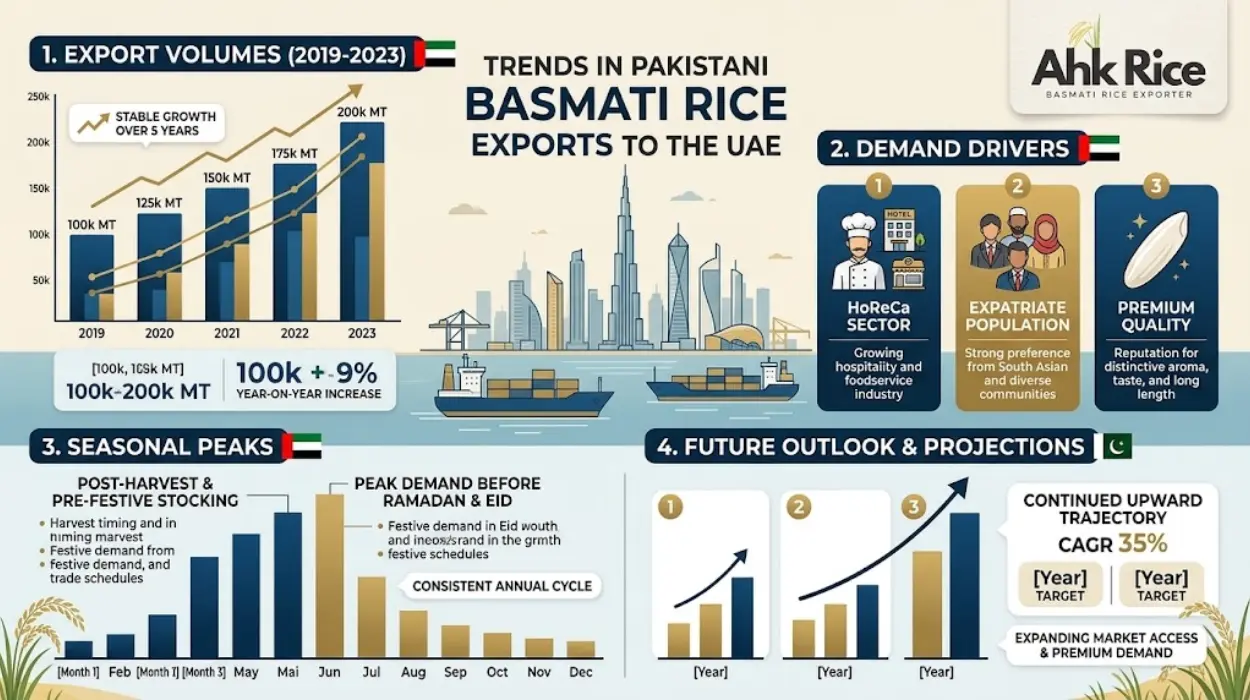
Pakistani Basmati exports to the UAE depend on retail demand, hospitality consumption, wholesale distribution, re-export activity, and price competitiveness. Grain quality, reliable documentation, suitable packaging, and predictable shipment schedules help importers maintain availability across these connected market channels.
Retail and wholesale distribution
UAE supermarkets, ethnic grocery stores, independent retailers, and wholesale distributors serve customers with different expectations. Premium retail buyers prioritize grain length, aroma, appearance, cooking performance, and packaging presentation. Wholesale buyers often evaluate price per metric tonne, broken-grain percentage, moisture, and consistency between shipments.
Pakistani 1121 Basmati appeals to premium segments seeking long, slender grains and pronounced cooked elongation. Super Kernel serves buyers who value traditional Pakistani Basmati aroma and familiar cooking characteristics. The 1509 variety provides another option for importers balancing grain appearance, supply requirements, and purchase cost.
Hotels, restaurants, and catering
Hotels, restaurants, catering companies, and institutional kitchens purchase rice according to menu requirements, cooking volume, and serving consistency. Biryani-focused businesses frequently assess grain separation, elongation, aroma, and the ability to maintain appearance during large-batch preparation.
Parboiled Sella grades can suit operations that prioritize firm cooked grains and consistent results in bulk cooking. Steam and white rice grades serve other menu and presentation requirements. Buyers should conduct cooking tests before approving a specification for recurring procurement.
Re-export and regional trade
Dubai’s trading infrastructure connects international suppliers with buyers across regional markets. Importers and traders evaluate not only local consumption but also the requirements of their onward customers. Destination specifications, packaging language, documentation, and delivery commitments influence whether a shipment fits a particular distribution channel.
Re-export demand must be assessed separately from domestic UAE consumption. A shipment entering the UAE does not necessarily represent rice consumed within the country. Import statistics, export statistics, and domestic sales therefore measure different stages of the trade.
What do UAE import volumes reveal about export trends?
Import volumes indicate the scale and direction of trade, but they do not independently explain consumer demand, current inventory, or future purchasing requirements. Buyers should compare annual tonnage, shipment frequency, variety mix, unit values, and seasonal movements before adjusting procurement plans.
A reliable analysis distinguishes Pakistani rice exports from total UAE rice imports and separates Basmati from non-Basmati categories. Customs classifications, reporting periods, and country-of-origin definitions also affect comparisons. Aggregate rice statistics cannot establish the exact volume of Pakistani 1121, Super Kernel, or 1509 purchased by UAE customers unless the underlying dataset identifies those varieties.
Importers should monitor five indicators:
- Annual import volume: Measures the overall scale of reported trade.
- Monthly arrivals: Identifies shipment concentration and possible seasonal patterns.
- Average import unit value: Provides a broad price indicator, not a confirmed quotation for a specific grade.
- Origin and variety mix: Shows how sourcing is distributed across suppliers and product categories.
- Inventory and sales velocity: Helps determine when the next order should be placed.
Trade data should come from identifiable sources such as Pakistan’s trade statistics, the Rice Exporters Association of Pakistan, and UAE customs or official statistical publications. Reports must specify the period and product category. Historical tonnage should never be presented as a current shipment total without verification.
For commercial planning, the most useful question is not simply whether imports increased. It is whether demand for the buyer’s chosen grade is growing faster than available inventory and whether replenishment can arrive before stock reaches its minimum operating level.
Which Pakistani Basmati varieties suit UAE buyers?
The best variety depends on the buyer’s customer segment, cooking requirements, selling price, and acceptable quality specifications. 1121 targets premium long-grain positioning, Super Kernel supports traditional aromatic Basmati demand, and 1509 provides an alternative for buyers prioritizing procurement efficiency.
1121 Basmati
The 1121 variety is associated with exceptionally long raw grains and substantial cooked elongation. Steam, Golden Sella, Creamy Sella, brown, and broken variants serve different processing and commercial requirements. Premium retailers, specialty rice distributors, and restaurants can evaluate 1121 where grain length and presentation support their product positioning.
Golden Sella and other parboiled variants suit buyers who need specific cooking characteristics. However, the final result depends on processing quality, moisture, milling, storage, and cooking technique. Buyers should approve the exact grade rather than relying on the variety name alone.
Super Kernel Basmati
Super Kernel is a traditional Pakistani Basmati variety valued for its characteristic aroma and cooking performance. It fits distributors and retailers serving customers familiar with Pakistani Basmati. Procurement specifications should define grain length, broken percentage, moisture, crop year, packaging, and quality tolerances.
1509 Basmati
1509 is an alternative for buyers seeking a different balance of grain length, cost, and supply requirements. Steam and Sella processing options allow importers to compare cooking performance against their intended market. The decision should use verified samples and commercial specifications instead of assuming that one variety always delivers the lowest total cost.
How do different procurement approaches compare?
Spot purchasing, scheduled repeat orders, seasonal bulk buying, and forward contracts address different commercial risks. Spot orders offer flexibility, repeat orders simplify replenishment, seasonal buying builds inventory ahead of demand, and forward contracts establish agreed terms for future deliveries.
A spot purchase is a single transaction negotiated against current supplier availability and market conditions. It suits importers with flexible purchasing dates and immediate inventory needs. Its main limitation is uncertainty over the price and availability of subsequent orders.
Scheduled repeat purchasing establishes an ordering rhythm based on sales and inventory. It supports regular replenishment and reduces the need to store excessive quantities. It still exposes buyers to changing prices and supplier availability when future orders remain uncommitted.
Seasonal bulk purchasing brings larger quantities into inventory before anticipated demand peaks. It can consolidate logistics and secure stock ahead of busy periods. However, it increases working-capital requirements, warehouse pressure, and the risk of slow-moving inventory.
Forward contracts establish agreed commercial terms for planned future deliveries. Depending on the contract, these terms can cover quantity, grade, price or pricing formula, delivery windows, packaging, inspection, and payment. They improve planning when both parties define their obligations clearly. They do not eliminate every market, logistics, or counterparty risk.
Seven-attribute procurement comparison
| Attribute | Spot purchase | Repeat orders | Seasonal bulk buying | Forward contract |
|---|---|---|---|---|
| Price certainty | Low beyond current order | Low to moderate | Depends on purchase timing | Defined by agreed pricing terms |
| Supply commitment | Single shipment | Order-by-order | Large initial quantity | Agreed future quantity and schedule |
| Inventory requirement | Usually lower | Moderate | High | Depends on delivery schedule |
| Cash-flow pressure | Concentrated per order | Distributed across orders | Often high upfront | Depends on deposits and payment terms |
| Seasonal preparation | Limited without early booking | Requires active planning | Strong when forecasts are accurate | Strong when delivery windows are agreed |
| Flexibility | High for future decisions | Moderate | Lower after bulk purchase | Governed by amendment and cancellation clauses |
| Best fit | Occasional purchases | Stable ongoing demand | Predictable seasonal peaks | Recurring demand requiring supply planning |
These approaches are not mutually exclusive. An importer can contract a core annual quantity, schedule regular deliveries, and reserve a smaller spot-buying allowance for unexpected demand. This hybrid structure balances continuity with purchasing flexibility.
Which UAE market regions and channels require different grades?
UAE procurement decisions differ by customer segment, distribution channel, and destination within the wider trading network. Premium retail buyers emphasize presentation and aroma, while foodservice operators prioritize cooking consistency, bulk availability, and cost per usable serving. Re-export traders must also meet onward-market specifications.
Dubai and Northern Emirates
Dubai combines retail, wholesale, hospitality, and trading demand. Importers supplying premium supermarkets and specialty distributors can assess 1121 and Super Kernel against customer expectations for aroma, grain length, and cooking quality. Wholesale and foodservice suppliers should compare those varieties with suitable 1509 and Sella grades based on cooking tests and contract specifications.
Northern Emirates buyers may use different distribution and storage arrangements depending on warehouse capacity, customer coverage, and delivery frequency. Rather than applying one grade to every customer, distributors should segment demand by pack size, turnover, and price band.
Abu Dhabi and institutional foodservice
Abu Dhabi procurement can include retail distribution, hotels, catering, and institutional kitchens. Buyers serving large kitchens should evaluate cooking yield, batch consistency, handling requirements, and cost per serving. The lowest purchase price per tonne does not necessarily deliver the lowest operating cost if a grade performs poorly under the kitchen’s cooking process.
Institutional contracts benefit from clearly defined specifications, delivery schedules, and quality acceptance procedures. Buyers should test samples under realistic kitchen conditions and record the results before approving recurring shipments.
Price and shelf-life comparisons
No single price per metric tonne applies to every grade or UAE destination. A valid comparison uses quotations collected for the same period, quantity, Incoterm, packaging, and quality specification.
| Comparison factor | Premium 1121 | Super Kernel | 1509 |
|---|---|---|---|
| Typical positioning | Premium long-grain | Traditional aromatic Basmati | Alternative balancing cost and grain characteristics |
| Price per MT | Obtain a current grade-specific quotation | Obtain a current grade-specific quotation | Obtain a current grade-specific quotation |
| Shelf-life planning | Verify packaging and product declaration | Verify packaging and product declaration | Verify packaging and product declaration |
| Main evaluation | Length, elongation, presentation | Aroma, cooking quality, consistency | Yield, cooking quality, purchase cost |
| Buyer priority | Premium retail and selected foodservice | Traditional retail and distribution | Price-conscious retail and bulk trade |
Shelf life depends on product condition, processing, packaging, storage temperature, humidity, pest control, and the supplier’s declared best-before period. Buyers should use the actual product specification and packaging declaration rather than assuming every Basmati variety has an identical shelf life. Dry, hygienic storage and stock rotation help preserve quality.
When do seasonal peaks affect UAE Basmati procurement?
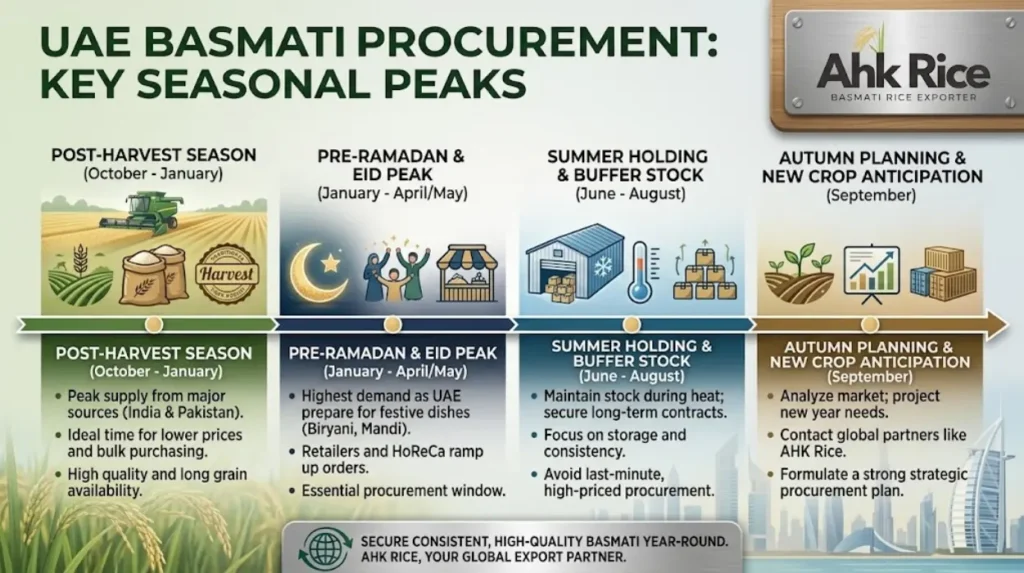
Seasonal purchasing commonly reflects Ramadan, Eid, hospitality activity, promotional calendars, and distributor stock cycles. Importers should forecast these periods using previous sales, confirmed customer orders, inventory levels, and supplier lead times rather than assuming the same demand increase every year.
Ramadan can change household purchasing, restaurant operations, catering volumes, and promotional activity. Eid-related trading may influence restocking before or after the holiday, depending on the channel. Hotels and foodservice businesses also plan around occupancy, events, and menu demand.
The procurement calendar must account for production, milling, quality inspection, export documentation, port handling, ocean transit, customs clearance, and inland delivery. Buyers should work backward from their required warehouse arrival date and add a buffer for operational disruption.
A practical forecast divides annual requirements into baseline demand, expected seasonal uplift, and contingency stock. The importer then allocates supply across delivery windows. This avoids placing the entire seasonal requirement into storage too early while reducing the risk of running out during a busy period.
What are the advantages and disadvantages of each sourcing strategy?
Spot purchasing favors flexibility, repeat orders favor operational continuity, bulk buying favors planned high-volume demand, and forward contracts favor predictable future supply. Each approach has trade-offs involving price exposure, working capital, inventory risk, and the flexibility to change specifications or delivery dates.
| Strategy | Main advantage | Main disadvantage | Example |
|---|---|---|---|
| Spot purchase | Quick response to immediate needs | Future price and availability remain uncertain | A wholesaler replenishes an unexpected stock shortage |
| Repeat orders | Easier routine inventory management | Each uncommitted order remains exposed to market changes | A retailer orders monthly against sales |
| Seasonal bulk buying | Stock is available ahead of a predictable peak | Excess stock ties up cash and warehouse space | A distributor prepares for Ramadan demand |
| Forward contract | Future quantity and delivery terms can be agreed | Contract changes may require approval or incur costs | A hotel group schedules several deliveries |
| Hybrid sourcing | Balances committed supply with flexibility | Requires stronger forecasting and supplier coordination | An importer contracts core demand and retains spot capacity |
Forward contracts work best when demand is reasonably predictable and the supplier can document its production and shipment capacity. Spot buying remains useful for unusual demand spikes, while repeat orders support stable distribution networks. Seasonal bulk purchases suit buyers with sufficient cash flow and storage capacity.
How should UAE importers choose a procurement method?
Importers should select a sourcing strategy by evaluating demand stability, required grade, price exposure, cash flow, storage capacity, and delivery risk. A documented decision framework turns those factors into an actionable purchasing plan and clarifies which commercial commitments are necessary.
Five-row procurement decision framework
| Decision factor | Recommended approach | Reason |
|---|---|---|
| Unpredictable demand | Spot buying with a small safety stock | Limits long-term commitments |
| Stable monthly sales | Scheduled repeat orders | Supports replenishment discipline |
| Reliable seasonal peak | Bulk purchasing or staggered forward deliveries | Prepares stock without requiring all inventory at once |
| Fixed customer specifications | Contracted grade and documented quality tolerances | Reduces ambiguity between orders |
| Limited warehouse or working capital | Smaller, scheduled deliveries | Reduces inventory and cash-flow pressure |
Before placing an order, buyers should compare landed cost rather than relying solely on FOB or supplier price. Landed cost includes the applicable freight, insurance, handling, clearance, inland transport, inspection, and other relevant charges. The exact components depend on the Incoterm and contract allocation of responsibilities.
The buyer should also verify supplier identity, sample quality, export documentation, payment terms, shipment schedule, packaging requirements, and the procedure for handling nonconforming goods. Inspection arrangements should identify the inspection stage, sampling method, acceptance criteria, and responsibility for charges.
How can forward contracts support year-round Basmati supply?
Forward contracts support year-round supply by agreeing on quantities, product specifications, delivery windows, and pricing terms before future shipments are required. They work best when the importer has a demand forecast, the exporter has confirmed capacity, and both parties document quality and delivery obligations.
A workable contract starts with a demand schedule covering baseline monthly consumption and expected seasonal increases. The buyer identifies the required variety, processing type, grain specifications, packaging, destination, and delivery frequency. The exporter then confirms the quantities and production or shipment windows that can be supported.
Pricing terms should state whether the price is fixed, periodically reviewed, or calculated through an agreed formula. Payment conditions, inspection requirements, shipping documents, delivery responsibilities, and procedures for delays or specification changes should be explicit. Both parties should also define remedies for nonperformance and the process for resolving disputes.
AHK Rice is a Pakistani Basmati rice exporter based in Punjab, supplying 1121, Super Kernel, and 1509 varieties to international buyers. Its end-to-end processing, custom packaging, and export coordination provide a basis for discussing grade requirements and planned shipment schedules. UAE importers should assess each proposed arrangement against their volume forecast, approved sample, destination requirements, and total landed cost.
For buyers seeking a structured purchasing plan, the next step is to evaluate forward contracts for securing year-round Basmati supply to the UAE. Contract suitability depends on confirmed specifications, available quantities, mutually agreed commercial terms, and the buyer’s actual replenishment requirements.
Pakistani Basmati rice export trends to the UAE are best understood through a combination of trade statistics, variety-level demand, seasonal sales patterns, and procurement economics. Importers should distinguish aggregate import volumes from actual demand for their chosen grade and compare supplier offers using consistent specifications and landed costs.
Spot purchases, repeat orders, seasonal buying, and forward contracts each solve different supply problems. A hybrid approach often provides a practical balance between committed supply and flexibility. Demand forecasts, verified samples, clear specifications, and realistic delivery schedules help buyers protect inventory availability without tying up unnecessary working capital.
For UAE distributors, retailers, hotels, and catering businesses, year-round supply planning begins with an accurate forecast and a clear procurement specification. Those foundations make it easier to select suitable Pakistani Basmati grades, compare commercial offers, and negotiate contracts aligned with real purchasing requirements.
Frequently asked questions
Which Pakistani Basmati variety is best for the UAE market?
1121 suits buyers seeking premium grain length and cooked elongation. Super Kernel fits traditional aromatic Basmati demand. 1509 provides another option for balancing purchase cost and cooking requirements. The right selection depends on customer preferences and sample-test results.
When should UAE importers order Basmati rice for Ramadan?
Importers should plan backward from their required warehouse arrival date, accounting for production, inspection, export documentation, ocean freight, customs clearance, and inland delivery. Previous sales and confirmed customer orders should determine the required volume.
How can buyers compare Pakistani Basmati prices per metric tonne?
Compare quotations for the same variety, processing type, grade, broken percentage, moisture limit, packaging, order quantity, Incoterm, and delivery period. Calculate landed cost before comparing suppliers.
Does a forward contract guarantee a fixed rice price?
A forward contract guarantees a fixed price only when the signed agreement explicitly establishes that pricing method. Other contracts use review periods or agreed formulas. Buyers must also examine adjustment clauses, delivery conditions, and cancellation provisions.
How long does Pakistani Basmati rice remain suitable for storage?
The declared shelf life depends on the product specification, processing, packaging, and storage conditions. Importers should follow the supplier’s best-before declaration, maintain dry and hygienic storage, control pests, and rotate inventory using the first-expired, first-out method.