How Is Basmati Rice Purity Tested with DNA Analysis?
Basmati rice purity is tested through DNA analysis by examining genetic markers in rice grains and comparing their DNA profiles with authenticated reference varieties. This scientific process identifies genuine Basmati characteristics, detects non-Basmati admixtures and helps laboratories estimate the percentage of unwanted rice varieties in a commercial sample.
Basmati rice is a premium aromatic long-grain rice associated with the Punjab region of the Indian subcontinent. Its commercial identity depends on varietal characteristics, including grain structure, aroma, cooking behaviour and genetic identity. DNA fingerprinting provides scientific evidence of varietal authenticity that visual inspection and conventional quality testing cannot establish independently.
What Is Basmati Rice Purity Testing Through DNA Analysis?
Basmati rice DNA purity testing is a laboratory procedure that examines genetic markers to verify rice varietal identity. It identifies genetic differences between authentic Basmati varieties and non-Basmati grains, helping laboratories detect admixtures and evaluate the genetic composition of commercial rice samples.
DNA, or deoxyribonucleic acid, is the genetic material present in rice cells. It contains inherited information that distinguishes one rice variety from another. DNA fingerprinting examines specific genetic regions called markers to establish a variety’s genetic profile.
Rice purity refers to the proportion of grains belonging to the declared variety or permitted varietal group. A sample containing 98% of its declared variety and 2% of another variety has a different genetic composition from a completely uniform sample.
DNA analysis is particularly important in international rice trading because different long-grain varieties sometimes have similar physical appearances. A non-Basmati variety can resemble premium Basmati after milling, making visual identification unreliable.
DNA testing also supports commercial authenticity claims. Importers use laboratory evidence to evaluate whether the genetic composition of a purchased rice consignment matches its declared identity.
How Does DNA Analysis Test Basmati Rice Purity?
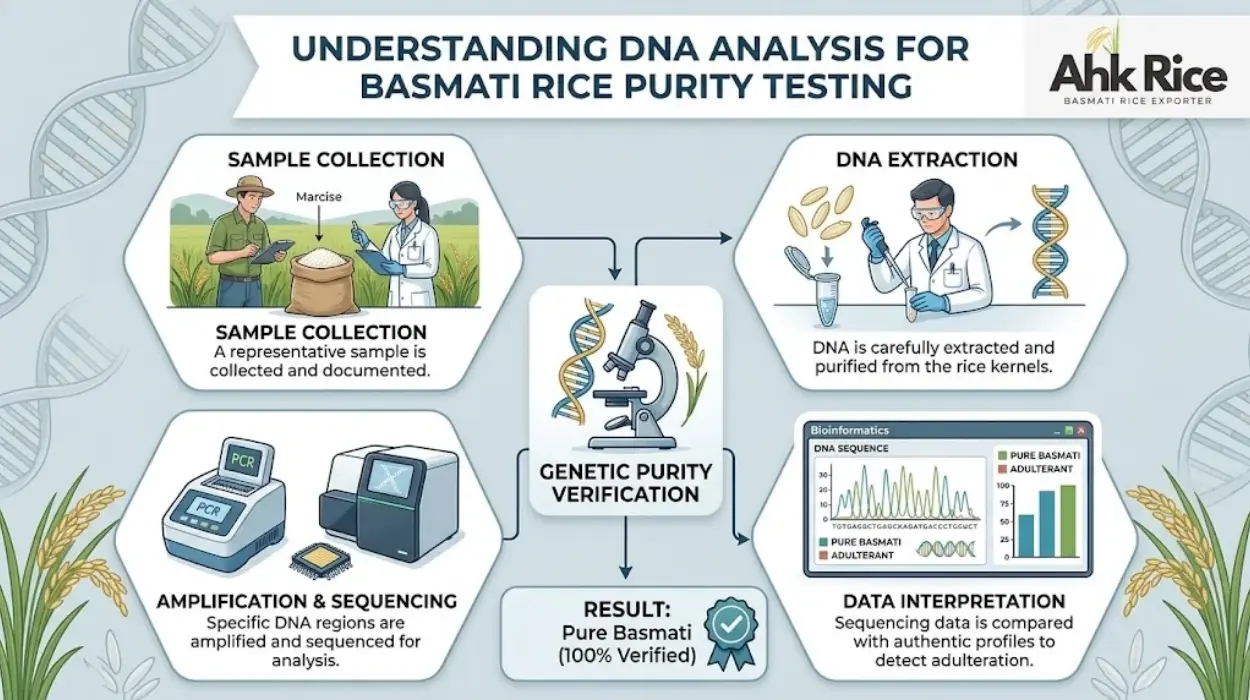
DNA analysis tests Basmati rice through representative sampling, DNA extraction, genetic marker amplification, laboratory separation and comparison with authenticated reference profiles. These stages identify genetic differences between rice varieties and establish evidence of unwanted admixtures within the tested commercial sample.
1. Rice Sample Collection
The process begins with representative sampling from a rice batch. A laboratory receives rice grains collected from different locations within the consignment or production lot.
Proper sampling reduces the risk of overlooking mixed grains. The sample must represent the actual shipment rather than a small selection of visually attractive kernels.
Laboratories can examine bulked samples, individual grains or a combination of both. Bulk testing provides an overview of genetic variation, while single-grain testing helps identify different varieties within complex mixtures.
2. DNA Extraction
The laboratory separates genetic material from the rice grain. Technicians prepare the sample, break down its cellular material and extract DNA using laboratory reagents and purification procedures.
The extracted DNA contains genetic information required for varietal identification. Its quality and quantity affect the reliability of subsequent analysis.
Processing conditions also influence DNA recovery. White-milled, brown and parboiled rice samples require suitable preparation and reference materials because processing can affect DNA integrity.
3. Selection of Genetic Markers
Laboratories select specific genetic markers to distinguish rice varieties. Simple Sequence Repeat (SSR) markers, also called microsatellite markers, are commonly used for rice DNA fingerprinting.
SSR markers identify variations in repeated DNA sequences. Different rice varieties produce distinguishable genetic profiles across selected marker locations.
A marker panel examines several genetic regions rather than relying on one characteristic. This improves the ability to distinguish genuine Basmati varieties from genetically different rice.
4. Polymerase Chain Reaction (PCR)
PCR is a laboratory technique that produces millions of copies of selected DNA regions. Scientists use specific primers to amplify the genetic markers required for analysis.
Multiplex PCR amplifies several selected markers in one reaction. This approach allows laboratories to examine multiple genetic characteristics efficiently.
The amplified DNA fragments are then prepared for separation and detection. Their sizes and resulting genetic patterns contribute to the rice variety’s DNA fingerprint.
5. Genetic Profile Analysis
Laboratories examine amplified DNA fragments using techniques such as capillary electrophoresis. This instrument separates DNA fragments according to their size and produces measurable genetic profiles.
The resulting profiles are compared with authenticated reference samples. Matching genetic characteristics support varietal identification, while additional or unexpected genetic profiles indicate possible admixtures.
6. Purity Assessment and Reporting
The laboratory interprets the genetic results and prepares a report. Depending on the method, the report identifies detected genetic profiles and estimates the proportion of specified adulterant varieties.
Quantification requires suitable reference samples, validated testing procedures and calibration standards. A DNA report should clearly identify the method, tested varieties, detection capability and limitations.
What Are the Key Components of Basmati DNA Purity Testing?
Basmati DNA purity testing depends on authenticated reference varieties, extracted genetic material, selected DNA markers, PCR equipment, fragment detection systems and validated interpretation methods. Each component contributes to identifying varietal differences and evaluating the genetic composition of commercial rice samples.
The main components include:
- Reference DNA profiles: Authenticated genetic profiles provide comparison standards for recognised rice varieties.
- SSR markers: These genetic markers identify differences between rice varieties through repeated DNA sequences.
- DNA extraction kits: Laboratory reagents isolate genetic material from rice grains.
- PCR equipment: Thermal cyclers amplify selected DNA regions for analysis.
- Capillary electrophoresis: This technique separates amplified DNA fragments and identifies their sizes.
- Reference databases: Genetic profile records support varietal identification and comparison.
- Quantification standards: Known mixtures establish calibration curves for estimating adulteration levels.
The reference panel is particularly important. Testing a Pakistani 1121, Super Kernel or 1509 sample requires suitable authenticated reference profiles for the varieties being evaluated. A laboratory cannot establish a complete varietal identity from an unrelated or incomplete reference database.
What Are the Benefits of DNA-Based Basmati Rice Authentication?
DNA-based authentication provides genetic evidence of rice varietal identity, detects certain non-Basmati admixtures and supports quantitative purity assessments. It strengthens quality assurance, reduces dependence on visual inspection and provides importers with scientific information for evaluating commercial rice authenticity.
DNA analysis offers several practical benefits to the rice industry.
1. Accurate varietal identification: Genetic markers distinguish rice varieties that share similar grain dimensions and physical appearances.
2. Adulteration detection: DNA profiles reveal the presence of specified non-Basmati varieties in mixed samples.
3. Quantitative assessment: Validated methods estimate the proportion of identified adulterants within a tested sample.
4. Import quality assurance: Buyers receive laboratory evidence that supports their supplier verification and purchasing procedures.
5. Commercial transparency: DNA reports provide an additional reference for evaluating varietal identity during international trade.
6. Supply chain verification: Testing at suitable production and shipment stages helps compare declared product identity with laboratory findings.
Research published in 2022 demonstrated that multiplex PCR testing of 20 randomly selected individual grains helped identify different admixtures in complex Basmati samples. This illustrates the importance of single-grain analysis when bulk testing does not provide sufficient detail.
Where Is DNA Analysis Used in the Basmati Rice Industry?
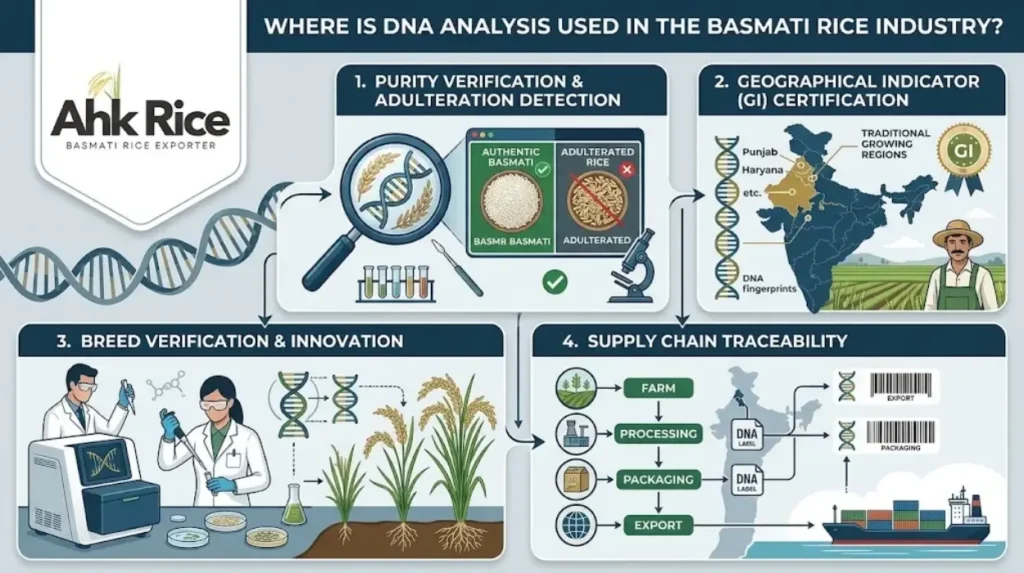
DNA analysis is used in rice export quality control, commercial authenticity verification, varietal research, regulatory investigations and supply chain monitoring. Importers, exporters, laboratories and food manufacturers use genetic testing to evaluate whether declared rice varieties match the tested samples.
Rice Exporters and Processing Mills
Exporters use DNA analysis to evaluate varietal identity before commercial dispatch. Processing mills also benefit from testing when handling multiple rice varieties because separate production batches reduce the risk of unintended mixing.
International Importers
Importers use DNA reports to assess the authenticity of purchased rice. Indonesian, Middle Eastern, European and North American buyers can include genetic testing in their supplier verification procedures.
Food Manufacturers
Food manufacturers use varietal authentication when purchasing rice for packaged products, ready meals and branded rice products. Genetic identity supports product specification and purchasing consistency.
Research and Agricultural Institutions
Research institutions use DNA fingerprinting to identify rice varieties, study genetic relationships and maintain reference profiles. These applications support rice breeding, seed identification and agricultural research.
Which Basmati Rice Varieties Require Genetic Identification?
Basmati rice includes traditional and evolved varieties with distinct genetic profiles. Commercial varieties such as 1121, Super Kernel and 1509 require appropriate authenticated reference samples and validated genetic markers to establish their identity accurately during laboratory purity assessment.
Important commercial varieties include:
- 1121 Basmati: Recognised for exceptionally long slender grains, aromatic characteristics and pronounced cooked-grain elongation.
- Super Kernel Basmati: A Pakistani aromatic variety valued for its grain appearance, fragrance and cooking performance.
- 1509 Basmati: A high-yielding, early-maturing variety used in domestic and international rice markets.
- Traditional Basmati: Includes established aromatic varieties with recognised genetic and physical characteristics.
These varieties differ in genetic composition, grain characteristics and agricultural development. Their identification requires suitable reference profiles rather than assumptions based solely on grain length or aroma.
What Are the Common Problems and Misconceptions About DNA Purity Testing?
DNA purity testing has technical and interpretive limitations. It does not independently establish geographical origin, pesticide safety, moisture content or cooking quality. Accurate conclusions depend on representative sampling, appropriate reference varieties, validated laboratory methods and clearly defined detection limits.
Several misconceptions affect the interpretation of rice DNA reports.
Misconception 1: Long grains automatically indicate genuine Basmati.
Grain length is a physical characteristic, not definitive genetic evidence. Other long-grain rice varieties share similar dimensions.
Misconception 2: DNA testing identifies the country of cultivation.
DNA fingerprinting identifies genetic characteristics. It does not independently prove that rice was cultivated in Pakistan, India or a particular agricultural district. Geographic origin requires additional traceability and origin-verification evidence.
Misconception 3: One DNA marker identifies every variety.
Reliable varietal identification generally requires multiple informative markers. Different varieties can share individual genetic characteristics.
Misconception 4: Every DNA test detects every adulterant.
A method detects only the varieties and genetic differences covered by its validated marker panel. An incomplete reference database limits the conclusions.
Misconception 5: DNA purity means complete food safety.
DNA analysis does not replace pesticide residue, heavy metal, moisture, microbiological or other food safety tests. These require separate laboratory procedures.
Misconception 6: Every mixed sample can be assessed accurately through bulk testing.
Complex mixtures containing several varieties sometimes require individual-grain analysis. Research has demonstrated that testing selected single grains can reveal admixtures that bulk analysis does not fully resolve.
Which Other Laboratory Tests Complement DNA Analysis?
DNA analysis verifies genetic identity, while conventional laboratory tests evaluate physical, chemical and food safety characteristics. Combining these methods provides a broader assessment of Basmati rice quality, commercial specifications and suitability for international food markets.
Complementary tests include:
- Grain length analysis: Measures average raw grain length and dimensional consistency.
- Broken percentage: Determines the proportion of broken kernels in a sample.
- Moisture testing: Measures water content and supports storage stability assessment.
- Aroma evaluation: Assesses the characteristic fragrance of Basmati rice.
- Cooking tests: Examine elongation, texture, separation and cooked-grain appearance.
- Pesticide residue analysis: Checks residues against applicable regulatory limits.
- Heavy metal testing: Evaluates contaminants such as arsenic, lead and cadmium.
- Microbiological analysis: Checks relevant microbial contamination indicators.
A combined testing programme provides stronger evidence than relying on a single quality parameter.
How Do DNA Reports Support International Basmati Rice Trade?
DNA reports support international rice trade by documenting tested varietal identity, detected admixtures, laboratory methods and analytical findings. Importers use this information alongside commercial specifications, certificates of analysis, origin documents and applicable food safety requirements.
A useful DNA report identifies the laboratory, sample reference, testing date, analytical method and reference varieties. It also explains the detection limit and quantification method where applicable.
For importers, the report should match the commercial sample or shipment under review. Sample identification, batch numbers and documented collection procedures help maintain consistency between testing and delivery.
Indonesian importers evaluating Pakistani Basmati supplies should distinguish genetic authentication from food safety compliance. DNA results address varietal identity, while other documents establish the relevant quality, origin and regulatory information.
Understanding what Indonesian importers should ask Pakistani exporters about DNA purity reports helps buyers assess laboratory evidence before approving a commercial rice order.
DNA analysis therefore forms one part of a broader rice authentication and quality assurance system. Its value comes from combining genetic evidence with representative sampling, traceability, physical testing and documented export specifications.