Why Is Demand for Imported Basmati Rice Growing Across Idaho?
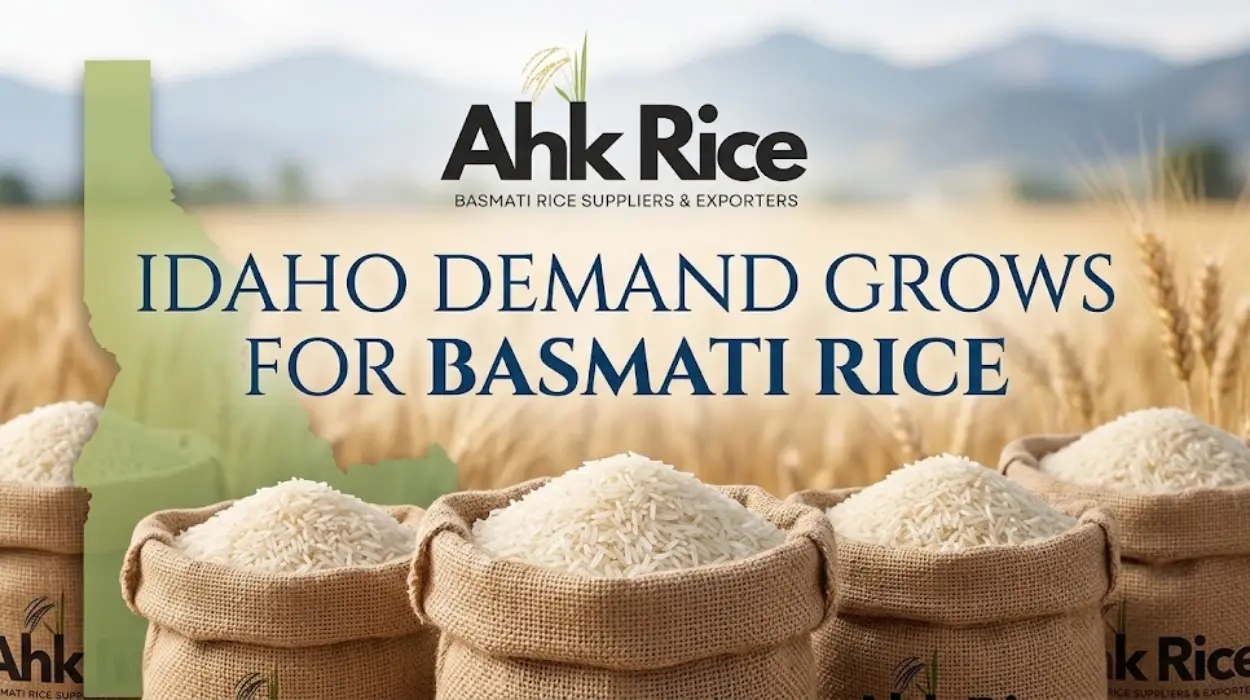
Imported Basmati rice demand across Idaho is expanding because population growth, broader food preferences, restaurant diversification, retail availability, and demand for long-grain aromatic rice are increasing the addressable market. Idaho’s population reached 2,029,733 in July 2025, up 10.4% from the 2020 Census base.
Basmati rice is a premium long-grain rice traditionally associated with the Himalayan foothills of the Indian subcontinent. Pakistani Basmati is cultivated mainly in Punjab, where soil, irrigation, climate, and traditional growing conditions support its characteristic grain shape, aroma, and cooking performance. Export programs commonly include 1121, Super Kernel, 1509, and traditional Basmati rice.
For Idaho buyers, imported Basmati is not simply another rice category. It serves restaurants, grocery stores, ethnic food retailers, foodservice distributors, catering operations, and households seeking aromatic rice with long grains and distinct cooking characteristics. Understanding the product, its production chain, grades, documentation, and market applications explains why imported Basmati has a defined place in Idaho’s food supply.
What is imported Basmati rice and why does it matter in Idaho?
Imported Basmati rice is long-grain aromatic rice produced outside the United States and brought into Idaho through U.S. import channels. Its demand connects consumer preferences, restaurant menus, retail assortment, international cuisine, and a dependable packaged-rice supply.
Basmati differs from standard long-grain rice through its aroma, grain appearance, elongation during cooking, and texture. The raw grain is slender. Properly processed Basmati produces separate cooked grains rather than a compact mass.
Pakistan is an important origin for Basmati supplied to international markets. Punjab provides the principal production base for Pakistani Basmati. Rice is cultivated, harvested, dried, milled, graded, tested, packed, and exported before reaching U.S. distributors and Idaho buyers.
Idaho does not need to produce Basmati locally to support consumption. Imported rice enters the U.S. food distribution system through international ports and then moves through domestic transportation networks to wholesalers, distributors, retailers, restaurants, and foodservice operators.
The state’s population growth also expands the total food market. Idaho’s population increased from 1,839,106 in the 2020 Census to an estimated 2,029,733 in July 2025. That represents an increase of more than 190,000 people.
How does Pakistani Basmati rice move from Punjab to Idaho?
Pakistani Basmati moves through a controlled chain covering paddy cultivation, harvesting, drying, milling, aging where specified, sorting, grading, laboratory testing, packaging, export documentation, ocean freight, U.S. entry procedures, inland transportation, and final Idaho distribution.
The process begins with paddy cultivation in rice-growing areas of Punjab. Farmers manage planting, irrigation, crop protection, harvesting, and drying. The harvested paddy contains the rice grain inside its husk.
Milling removes the husk and separates usable rice from foreign material and damaged kernels. Processing equipment then controls grain appearance and consistency. Optical sorting removes discolored or defective grains.
Some Basmati products undergo aging. Aging reduces grain moisture and changes cooking behavior. The exact aging period depends on the specification and commercial grade.
The rice is then graded according to measurable characteristics. These include grain length, broken percentage, moisture, foreign matter, damaged kernels, chalky grains, and other quality parameters.
Laboratory testing verifies the agreed specification. Tests can cover moisture, pesticide residues, microbiological parameters where applicable, heavy metals where required by the buyer or regulation, and physical quality.
Packaging follows the commercial requirement. Common formats include retail bags, foodservice sacks, and larger commercial packs. Examples include 5-pound retail bags, 10-pound bags, 20-pound bags, 40-pound bags, and bulk-oriented formats.
The exporter prepares shipping and compliance documents. These commonly include commercial invoices, packing lists, bills of lading, certificates of origin, phytosanitary documentation where required, and inspection or laboratory reports.
The U.S. importer remains responsible for compliance with U.S. food laws. FDA states that imported food must meet the same legal requirements applicable to food produced domestically. Food facilities involved in manufacturing, processing, packing, or holding covered foods must meet applicable FDA registration requirements, and imported food shipments generally require Prior Notice.
After U.S. entry and customs processing, containers move through domestic distribution channels toward Idaho. The final route depends on the arrival port, inland carrier, warehouse location, and purchasing arrangement.
Which Basmati grades are available for Idaho buyers?
Export Basmati grades differ by variety, grain length, processing method, broken percentage, moisture, purity, and packaging specification. Common Pakistani commercial categories include 1121, Super Kernel, 1509, and traditional Basmati in white, steam, and parboiled forms.
1121 Basmati
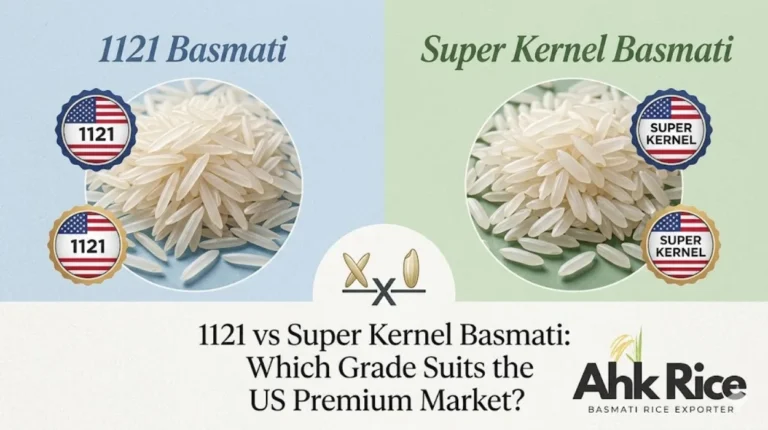
1121 Basmati is recognized for its exceptionally long slender grain. It is available as White, Steam, and Sella or parboiled rice. Its long cooked grain makes it suitable for biryani, pulao, catering, restaurants, and premium retail products.
Super Kernel Basmati
Super Kernel Basmati is a premium Pakistani Basmati category with a long slender grain and strong aromatic profile. White, Steam, and Sella processing formats are available according to supplier specification and market demand.
1509 Basmati
1509 Basmati is an early-maturing Basmati variety used for export markets. It is commonly processed as White, Steam, and Sella rice. Buyers select it when they require a long-grain aromatic product with a different price and supply position from established Basmati categories.
Traditional Basmati
Traditional Basmati represents established aromatic Basmati types rather than newer high-yielding export varieties. Its grain profile, aroma, aging requirements, and price position differ from 1121 and 1509 specifications.
White rice
White Basmati is milled rice with the husk, bran, and germ substantially removed. It provides a clean appearance and direct cooking format.
Steam rice
Steam Basmati is processed with steam treatment before final milling. The process improves grain firmness and supports separate cooked grains. It is widely used in foodservice and restaurant applications.
Sella or parboiled rice
Sella Basmati is parboiled before milling. Parboiling changes the grain structure and produces a firmer cooked texture. It is commonly selected for dishes that require grains to remain separate during cooking.
Commercial buyers should treat these names as specification categories rather than assuming that every shipment has identical physical characteristics. A purchase specification should state variety, processing type, grain length, broken percentage, moisture, purity, packaging, tolerance, and testing requirements.
Where is imported Basmati rice used across Idaho?
Imported Basmati serves Idaho restaurants, grocery retailers, foodservice distributors, catering businesses, specialty food stores, meal producers, and households. Each channel selects rice according to cooking performance, pack size, price position, customer preference, and menu requirements.
Restaurants use Basmati in biryani, pulao, curry meals, rice bowls, grilled-meat dishes, and South Asian menus. Foodservice operators often prioritize grain consistency because the same specification must perform across repeated cooking cycles.
Retailers use packaged Basmati to expand their rice assortment. Examples include mainstream supermarkets, specialty stores, international-food retailers, and independent grocery businesses.
Distributors connect imported rice with multiple downstream customers. A distributor can purchase container quantities and supply restaurants and retailers in smaller commercial quantities.
Catering businesses have another requirement. They need rice that retains grain separation when prepared in larger batches. Steam and Sella grades often fit applications where cooked-grain integrity is important.
Households purchase Basmati for everyday meals and international recipes. The product’s aroma and long cooked grain distinguish it from ordinary white rice.
What benefits explain the growth of imported Basmati demand?
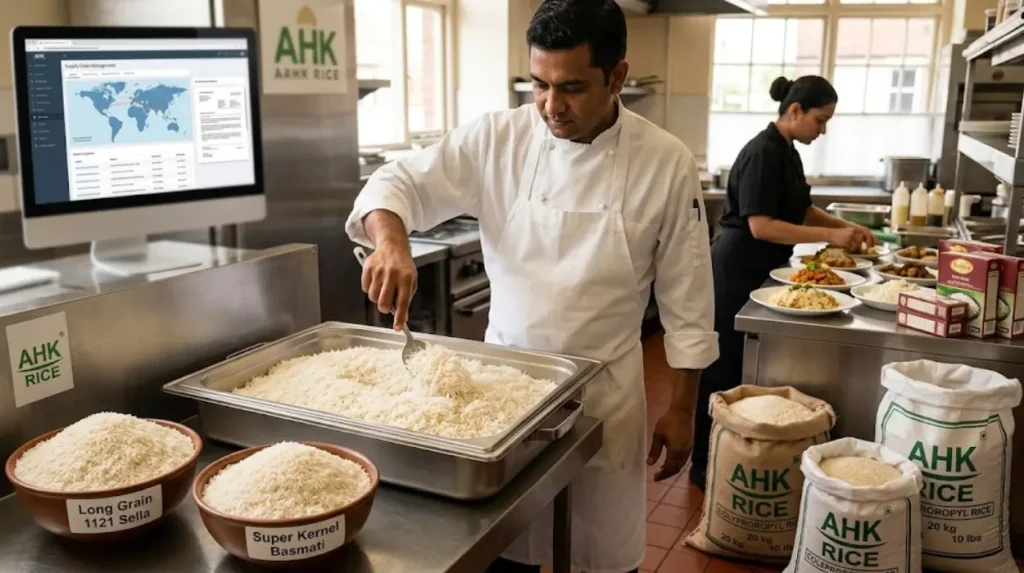
Imported Basmati provides Idaho buyers with aromatic flavor, long cooked grains, multiple processing formats, established international supply channels, varied package sizes, and product specifications suited to retail, restaurant, catering, and foodservice applications.
The first benefit is product differentiation. Basmati gives retailers and restaurants a distinct rice category rather than another generic white-rice option.
The second is cooking performance. Long-grain varieties produce an elongated cooked appearance. This characteristic supports dishes where individual grains are visually important.
The third is specification flexibility. Buyers can select among 1121, Super Kernel, 1509, and traditional Basmati. They can also select White, Steam, or Sella processing.
The fourth is packaging flexibility. Retail and foodservice buyers require different pack sizes. A defined packaging specification helps control handling, storage, labeling, and inventory planning.
The fifth is international availability. Pakistan has an established rice export industry serving markets across the Middle East, Europe, North America, Africa, and other regions.
These benefits become commercially important when buyers compare suppliers. Product selection, quality control, documentation, shipment scheduling, and inventory planning all affect the reliability of an imported rice program.
Which certifications and documents apply to imported Basmati rice?
Imported Basmati shipments require U.S. food-import compliance plus commercial and origin documentation. Applicable requirements include FDA facility registration, Prior Notice, FSVP responsibilities, compliant labeling, customs documentation, and phytosanitary or other certificates when required.
FDA registration applies to covered facilities that manufacture, process, pack, or hold food for U.S. consumption. FDA also requires Prior Notice for covered imported food shipments.
The Foreign Supplier Verification Program, or FSVP, places verification responsibilities on the U.S. importer. The importer evaluates whether the foreign supplier and food meet applicable U.S. safety requirements.
Food labels must provide required information in English and comply with applicable U.S. labeling rules. FDA states that imported foods must be safe, wholesome, produced under sanitary conditions, and truthfully labeled.
A phytosanitary certificate is a plant-health document issued by the exporting country’s competent authority when required for the commodity and destination. It verifies compliance with applicable plant-health requirements.
A certificate of origin identifies the country where the product originates. Commercial invoices identify transaction value, buyer, seller, product description, and other trade information. Packing lists identify package quantities and shipment details.
Third-party certifications such as HACCP systems, ISO 22000, BRCGS, or other food-safety certifications can also appear in commercial procurement. These certifications are not automatically equivalent to FDA approval. FDA explicitly states that it does not pre-approve individual imported food products, labels, or shipments.
What problems and misconceptions affect Idaho Basmati sourcing?
The main misconceptions concern product naming, certification, price, grain length, cooking performance, and import responsibility. A Basmati name alone does not establish one uniform specification, and a private certification does not replace mandatory U.S. import compliance.
One misconception is that all 1121 rice has identical grain length and quality. Commercial specifications differ by crop, processing, sorting, tolerance, and contract requirements.
Another misconception is that Steam and Sella are interchangeable. Both use heat treatment, but their processing methods and resulting characteristics differ. Buyers should specify the exact process.
A third misconception is that the exporter alone carries all regulatory responsibility. FDA assigns important responsibilities to U.S. importers, including applicable FSVP activities and ensuring imported food meets U.S. requirements.
A fourth misconception is that the lowest price produces the lowest landed cost. Freight, duties where applicable, inland transportation, inspection, storage, packaging, demurrage, and inventory losses affect the final cost.
A fifth misconception is that certification automatically guarantees product quality. Certification addresses defined systems or standards. A shipment still requires a product specification, testing protocol, lot identification, and acceptance criteria.
How should Idaho buyers understand future Basmati import demand?
Idaho’s expanding population and increasingly varied food market create a larger addressable customer base for imported Basmati. Buyers should evaluate demand through product specifications, customer segments, inventory requirements, import compliance, and reliable international supply planning.
The 2025 Idaho population estimate of 2.03 million provides a larger market base than the state’s 2020 population of 1.84 million.
Demand is also segmented. A restaurant purchasing 40-pound bags has different requirements from a retailer selling 5-pound consumer packs. A catering company prioritizes cooking consistency, while a supermarket prioritizes packaging, labeling, shelf presentation, and replenishment.
The next stage is supply planning. Importers need to connect forecast demand with approved rice specifications, supplier production capacity, packaging schedules, export documentation, container availability, transit planning, customs procedures, and Idaho delivery requirements.
That connection becomes especially important as purchase volumes increase. Buyers moving from occasional purchases to recurring container programs need a defined supply process rather than treating every shipment as an isolated transaction.
For a deeper consideration-stage explanation of how importers connect demand forecasts, production capacity, inventory, shipment timing, and supplier planning, the related article:
How Do Buyers Scale Rice Imports Without Supply Disruptions? provides the next step in the topic cluster.
Frequently Asked Questions
Why is demand for imported Basmati rice growing across Idaho?
Demand is growing because Idaho has a larger and more diverse food market, including restaurants, grocery retailers, foodservice distributors, catering businesses, specialty stores, and households seeking aromatic long-grain rice.
What is Pakistani Basmati rice?
Pakistani Basmati rice is a premium aromatic long-grain rice cultivated primarily in Punjab, Pakistan. It is known for its slender grains, aroma, elongation after cooking, and separate cooked-grain texture.
Which Pakistani Basmati varieties are available for Idaho buyers?
Common export varieties include 1121 Basmati, Super Kernel Basmati, 1509 Basmati, and traditional Basmati. Each variety has different grain characteristics, cooking performance, pricing, and commercial applications.
What is the difference between White, Steam, and Sella Basmati rice?
White Basmati is conventionally milled rice. Steam Basmati receives steam treatment before milling, producing firmer grains. Sella Basmati is parboiled before milling and generally provides strong grain separation after cooking.
Where is Pakistani Basmati rice grown?
Pakistani Basmati is primarily grown in Punjab, where the agricultural environment supports the grain’s characteristic aroma, shape, and cooking qualities.
How is Pakistani Basmati rice processed for export?
Processing includes paddy harvesting, drying, milling, cleaning, sorting, grading, optional aging, laboratory testing, packaging, documentation, container loading, and international shipment.
Which Idaho businesses use imported Basmati rice?
Restaurants, grocery stores, specialty food retailers, foodservice distributors, caterers, meal producers, and other commercial food businesses use imported Basmati rice for products and prepared meals.
What dishes commonly use Basmati rice?
Basmati is commonly used for biryani, pulao, curry meals, rice bowls, grilled-meat dishes, and other South Asian and international recipes where long, separate grains are preferred.
What specifications should Idaho rice buyers evaluate?
Buyers should evaluate variety, processing type, grain length, broken percentage, moisture, purity, foreign matter, damaged kernels, packaging, labeling, laboratory testing, and shipment requirements.
What FDA requirements apply to imported Basmati rice?
Imported Basmati must comply with applicable U.S. food requirements. Depending on the shipment and parties involved, requirements include FDA facility registration, Prior Notice, applicable FSVP responsibilities, compliant labeling, and customs documentation.