How Long Does Rice Take to Ship from Pakistan to China in 2026
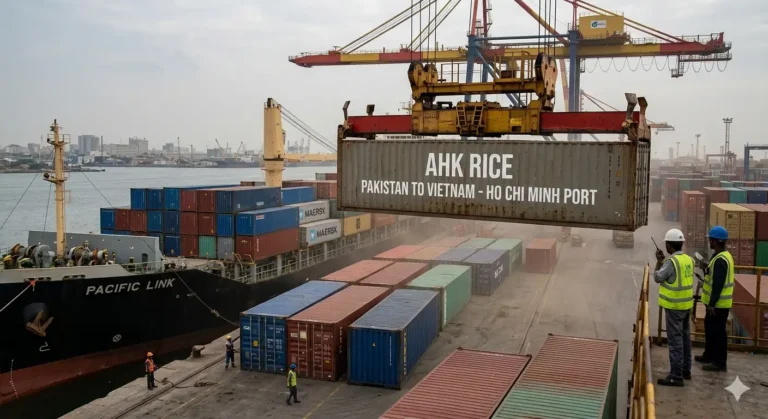
Rice shipping time from Pakistan to China is the total duration required to move rice cargo from origin warehouses in Pakistan to the final port or inland destination in China, typically ranging between 18 to 35 days depending on route, port congestion, and shipping method.
Rice shipping time defines the full logistics cycle, not just vessel sailing days. It includes inland transport from rice mills in Punjab, container stuffing, customs clearance at Karachi Port, sea freight transit, discharge at Chinese ports, and final delivery. Each stage contributes specific time intervals.
The central route starts from processing regions like Punjab, where varieties such as 1121 Basmati, Super Kernel, and 1509 are milled and packed. Cargo is then transported to Karachi Port, Pakistan’s primary export gateway. From there, containers move through sea freight lanes toward major Chinese ports such as Shanghai, Shenzhen, and Qingdao.
Transit time differs based on shipping line schedules and port pair combinations. For example, Karachi to Shanghai averages 20 to 28 days, while Karachi to Shenzhen averages 18 to 25 days. Inland delivery inside China adds 2 to 5 days depending on distance and customs efficiency.
How does rice shipping from Pakistan to China work?
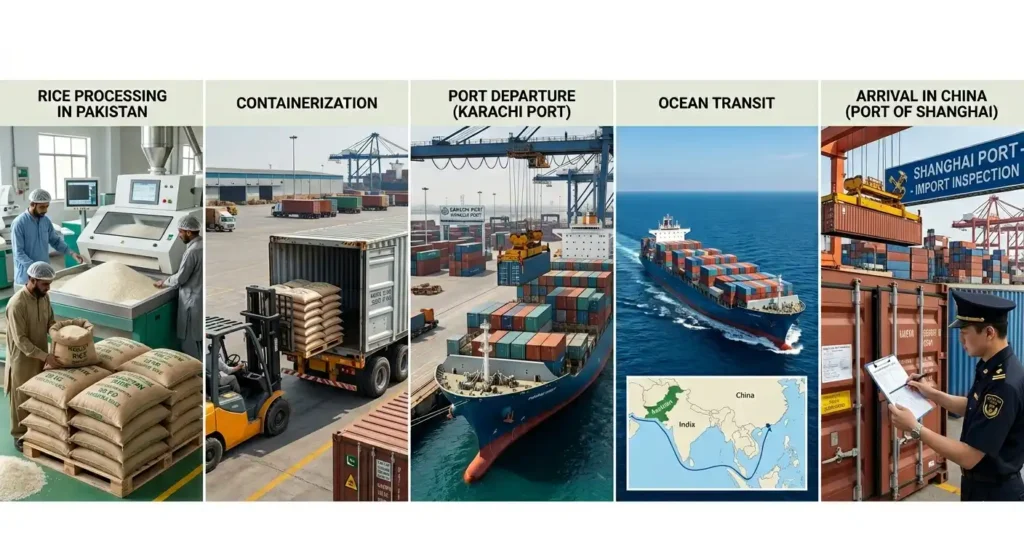
Rice shipping from Pakistan to China works through a structured export process that includes milling, grading, containerization, customs clearance, ocean freight transport, and import clearance in China, with each step contributing fixed time durations within the total transit period.
The process begins at rice processing units where paddy undergoes drying, husking, polishing, grading, and sorting. Each step ensures uniform grain length, moisture control between 12% to 14%, and removal of broken grains.
After processing, rice is packed into export-grade bags such as 5 kg, 10 kg, 25 kg, or 50 kg polypropylene or jute packaging. These bags are then palletized or directly loaded into containers depending on buyer requirements.
Transport from mill to port takes 1 to 3 days. At Karachi Port, containers undergo documentation verification, including commercial invoice, packing list, phytosanitary certificate, and certificate of origin. Customs clearance takes 2 to 4 days under standard conditions.
Once cleared, containers are loaded onto vessels operating under sea freight Pakistan China routes. Transit time on water ranges from 14 to 22 days depending on route and transshipment stops. Direct routes reduce time, while transshipment via ports like Singapore increases duration.
Upon arrival in China, cargo undergoes import inspection, quarantine checks, and customs clearance, taking 2 to 5 days. Final delivery to warehouses completes the process.
What are the key components affecting rice transit time to China ports?
Key components affecting rice transit time to China ports include inland logistics, port handling efficiency, vessel schedule frequency, sea route distance, customs procedures, and seasonal congestion, each adding measurable time to the total shipping duration.
Inland Transportation
Movement from rice mills in Punjab to Karachi Port takes 1 to 3 days. Delays occur during peak harvest seasons due to truck shortages and road congestion.
Port Handling and Documentation
Port handling includes container booking, stuffing, and customs clearance. Standard processing takes 3 to 5 days. Delays arise from incomplete documentation or inspection holds.
Vessel Scheduling
Shipping lines operate fixed weekly or bi-weekly schedules. Missing a vessel cut-off adds 5 to 7 days to total transit time.
Sea Freight Route
Direct routes from Karachi to Shanghai take 14 to 18 days. Indirect routes with transshipment take 18 to 25 days.
Chinese Port Clearance
Chinese customs and quarantine processes take 2 to 5 days. Strict inspection protocols for agricultural goods influence this stage.
Seasonal Factors
Peak export seasons, such as post-harvest months from October to January, increase congestion at both Karachi and Chinese ports, adding 3 to 7 extra days.
What is the average sea freight Pakistan China transit time in 2026?
The average sea freight Pakistan China transit time in 2026 ranges between 14 to 22 days on water, with total door-to-port delivery timelines reaching 18 to 35 days depending on port pairing and operational efficiency.
Sea freight forms the core segment of international rice logistics. The maritime distance between Karachi and major Chinese ports determines baseline transit time.
For example:
- Karachi to Shanghai: 20 to 28 days total
- Karachi to Shenzhen: 18 to 25 days total
- Karachi to Qingdao: 22 to 30 days total
Transit time includes both sailing duration and waiting time at ports. Shipping lines with direct routes reduce variability. Indirect routes with transshipment introduce additional waiting time at intermediate ports.
Container type also impacts transit consistency. Standard 20-foot containers (TEU) and 40-foot containers (FEU) follow similar schedules, but consolidation cargo may experience delays due to grouping requirements.
What are the benefits of efficient rice shipping timelines?
Efficient rice shipping timelines ensure product freshness, stable supply chain planning, reduced storage costs, and predictable delivery schedules, which directly improve trade reliability between Pakistan exporters and Chinese importers.
Rice quality depends on controlled storage and timely delivery. Extended transit increases risk of moisture fluctuation, leading to quality degradation. Efficient shipping minimizes this risk.
Predictable timelines allow importers to manage inventory cycles accurately. For example, wholesalers and retailers in China depend on consistent delivery schedules to maintain stock levels.
Lower transit time reduces warehousing costs at origin and destination. Faster turnover improves cash flow for exporters and distributors.
Stable shipping schedules strengthen trade relationships. Buyers prioritize suppliers who maintain consistent delivery performance over long periods.
What are the main use cases for rice shipping from Pakistan to China?
Rice shipping from Pakistan to China is used for bulk import supply chains, retail packaging distribution, food processing industries, and government procurement programs, each requiring specific transit timelines and logistics configurations.
Bulk Import Supply Chains
Large importers purchase rice in bulk quantities such as 500 to 5,000 metric tons. These shipments prioritize cost efficiency and consistent delivery schedules.
Retail Distribution
Retail chains import packaged rice in smaller units like 5 kg and 10 kg bags. These shipments require precise labeling, branding, and timely delivery to meet shelf demand.
Food Processing Industry
Food manufacturers use rice as raw material for products like rice flour, snacks, and ready meals. These industries require continuous supply with minimal delays.
Government Procurement
Government agencies import rice to maintain food reserves. These shipments demand strict compliance with quality and certification standards.
What are common problems and misconceptions about rice delivery to China?
Common problems and misconceptions about rice delivery to China include underestimating total transit time, assuming direct shipping always occurs, ignoring customs delays, and misunderstanding port congestion impact, all of which lead to inaccurate delivery expectations.
One major misconception is that shipping time equals sailing time. Actual transit includes inland transport, port handling, and customs clearance, which together add 6 to 13 days beyond sea transit.
Another issue is assuming all shipments follow direct routes. Many shipments pass through transshipment hubs, increasing delivery time by up to 7 days.
Documentation errors create delays at both export and import stages. Missing certificates or incorrect declarations result in inspection holds.
Port congestion significantly affects delivery schedules. High traffic at Karachi or Chinese ports leads to vessel delays and extended waiting periods.
Weather conditions also impact timelines. Monsoon seasons and storms disrupt shipping schedules, causing unpredictable delays.
How long does Karachi to Shanghai shipping specifically take?
Karachi to Shanghai shipping takes approximately 20 to 28 days total, including 2 to 4 days for export clearance, 14 to 18 days sea transit, and 2 to 5 days for import clearance and delivery within China.
This route represents the most commonly used corridor for rice exports to China. Shanghai serves as a major import hub with advanced port infrastructure and high processing capacity.
Export clearance at Karachi Port involves documentation verification and container loading. Efficient handling ensures minimal delays at this stage.
Sea transit duration depends on shipping line routes. Direct services reduce travel time, while indirect routes increase duration due to transshipment stops.
Upon arrival, Shanghai Port processes cargo through customs and quarantine checks. Clearance time depends on compliance with Chinese import regulations.
Final delivery from port to inland warehouses completes the logistics cycle. This step typically takes 1 to 3 days depending on distance.
How do certifications and compliance affect shipping time?
Certifications and compliance affect shipping time by determining clearance speed at both export and import stages, with complete and accurate documentation reducing delays and ensuring smooth cargo movement across borders.
Rice exports require multiple certifications. These include phytosanitary certificates, fumigation certificates, and quality inspection reports. Each document verifies product safety and compliance with international standards.
Chinese import regulations require strict inspection of agricultural goods. Non-compliance leads to delays, re-inspection, or cargo rejection.
Accurate labeling and packaging also impact clearance time. Incorrect labeling results in additional inspection procedures.
Pre-shipment inspection reduces risks at destination. Verified quality and documentation ensure faster processing at Chinese ports.