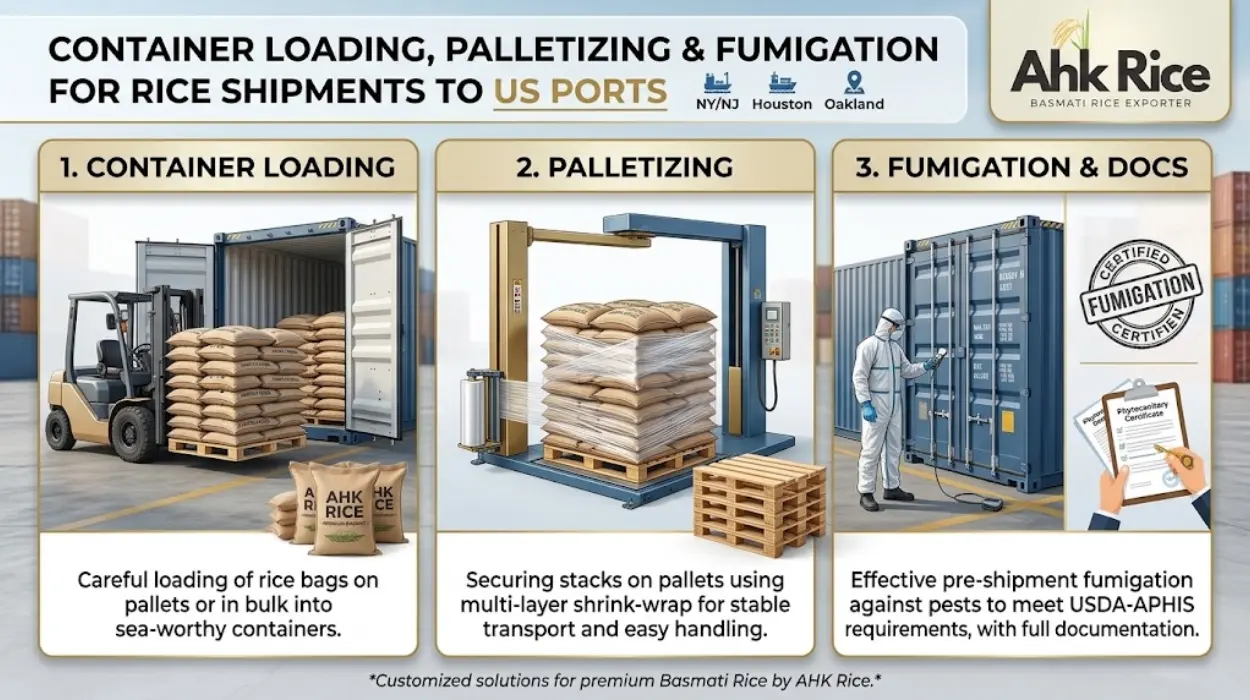
Container Loading, Palletizing and Fumigation for Rice Shipments to US Ports
Full-container-load (FCL) shipping with properly inspected containers, moisture-controlled rice packaging, and risk-based pest treatment provides the strongest foundation for transporting Pakistani Basmati rice to US ports. The best configuration depends on cargo volume, packaging format, transit conditions, importer requirements, and the applicable US entry conditions.
For importers comparing container preparation methods, understanding how Pakistani Basmati rice varieties and processing affect export quality helps connect grain specifications with packaging, storage, and transportation decisions. Container loading, palletizing, and fumigation serve different purposes, so buyers should evaluate them separately before combining them into an export plan.
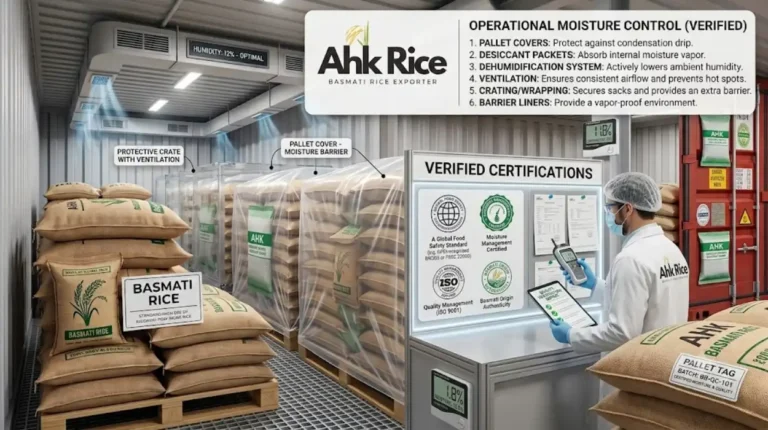
Rice shipments face three major logistical risks: moisture damage, cargo movement, and pest-related noncompliance. Moisture can encourage mould and compromise packaging. Poorly secured bags can shift during ocean transit. Inadequate pest management can result in inspection delays, treatment requirements, or other regulatory consequences.
AHK Rice is a Pakistani Basmati rice exporter based in Punjab, supplying 1121, Super Kernel, and 1509 varieties to international buyers. Its end-to-end processing, custom packaging, and export coordination support buyers evaluating shipment preparation from mill to port. Importers should establish cargo specifications and destination requirements before confirming the loading plan.
What are the available solutions for loading rice containers?
Exporters use floor-loaded containers, palletized cargo, and hybrid loading arrangements to transport bagged rice. Container selection, packaging strength, cargo restraint, and moisture protection determine suitability. Fumigation is a separate phytosanitary measure used when required by destination rules or an identified pest risk.
1. Floor-loaded containers
Floor loading means placing individual rice bags or securely formed bundles directly on the container floor without pallets. Exporters arrange the bags in stable layers to use the available cargo space efficiently.
This method suits bulk shipments in 5 kg, 10 kg, 20 kg, 25 kg, or 50 kg bags, depending on the buyer’s packaging specification. It reduces pallet procurement costs and can increase the quantity loaded within a container’s payload and volume limits.
However, workers must maintain stable stacking patterns and prevent bags from pressing against vulnerable doors or being damaged by sharp surfaces. Suitable dunnage, protective liners where appropriate, and cargo-restraint measures reduce movement during transport.
2. Palletized container loading
Palletizing means placing bags on pallets to create stable, manageable cargo units. Exporters can use stretch wrapping, straps, corner protection, and suitable slip sheets to reduce movement and handling damage.
Palletized cargo works well for importers operating warehouses, distribution centres, and retail supply chains. Forklifts can handle consolidated loads efficiently, and pallet configurations can support faster receiving and inventory movement.
The disadvantages are additional pallet costs, reduced usable container space, and the need to comply with applicable wood-packaging rules when wooden pallets are used.
3. Hybrid loading
Hybrid loading combines palletized units with carefully arranged floor-loaded bags when the packaging specification and cargo plan allow both methods.
It can balance warehouse handling requirements with container utilization. However, the loading plan must account for weight distribution, load stability, unloading sequence, and the possibility of bag compression.
Hybrid loading is unsuitable when the receiving warehouse requires every unit to arrive palletized or when mixed configurations create unacceptable handling risks.
4. Fumigation and alternative pest controls
Fumigation uses an approved pest-control treatment to address specified organisms under defined conditions. It does not replace container inspection, clean storage, sound packaging, or preventive pest management.
Exporters and importers must confirm whether treatment is required or permitted for the commodity, origin, packaging, and intended US entry. They must also verify the treatment provider’s qualifications, documentation, and any applicable safety requirements.
Fumigation is not automatically mandatory for every rice container entering the United States. The applicable requirements depend on the product, shipment circumstances, and relevant regulatory instructions. Importers should confirm the entry conditions with their customs broker and the appropriate US authorities before loading.
How do floor loading, palletizing, and fumigation compare?
Floor loading generally prioritizes container utilization, while palletizing prioritizes handling efficiency and warehouse compatibility. Fumigation addresses specific pest risks rather than cargo arrangement. The correct comparison separates physical loading methods from phytosanitary treatments and combines them only when the shipment requires them.
The following table compares seven attributes that influence export decisions.
| Comparison attribute | Floor-loaded cargo | Palletized cargo | Fumigation or approved pest treatment |
|---|---|---|---|
| Primary purpose | Maximize usable cargo space | Consolidate cargo into handling units | Control specified pest risks |
| Initial cost | Usually lower | Higher due to pallets and wrapping | Depends on treatment, provider, and shipment |
| Container utilization | Generally higher | Reduced by pallet dimensions | Does not directly increase capacity |
| Unloading | More manual handling | Faster where suitable equipment is available | Requires compliance with treatment and safety instructions |
| Cargo protection | Depends on stacking and restraint | Benefits from stable unitization | Does not prevent moisture damage or bag tearing |
| Documentation | Packing list and shipping records | Packing details and applicable pallet compliance | Treatment records or certificates when required |
| Best application | Bulk distribution and cost-sensitive shipments | Warehouses, retail distribution, and mechanized handling | Shipments subject to applicable pest-control requirements |
The comparison shows why these methods should not be treated as interchangeable. Palletizing is a cargo-handling strategy, whereas fumigation is a pest-control measure. A shipment can be floor-loaded or palletized and still require an approved treatment based on its applicable import conditions.
Container suitability also matters. A clean, dry, structurally sound container with functional doors and no visible pest activity provides a better starting point than a damaged or contaminated unit. Loading teams should document the container condition before cargo enters it.
Which loading method works best for US-bound rice shipments?
Floor loading suits importers prioritizing cargo quantity and minimizing pallet costs. Palletizing suits distribution networks that depend on forklifts and standardized warehouse units. Hybrid loading serves mixed handling needs, while pest treatment follows applicable entry requirements rather than the chosen loading configuration.
Bulk wholesalers and rice distributors
Floor loading usually suits wholesalers receiving full containers at facilities equipped for manual unloading. It reduces pallet expenditure and makes efficient use of container space.
For example, a distributor receiving 25 kg or 50 kg bags for regional wholesale distribution may prioritize the number of bags per container. The exporter must calculate the final quantity from bag dimensions, container specifications, payload limits, and the weight of packaging materials.
Retailers and private-label importers
Palletized loading is often more suitable for retailers and private-label importers with established warehouse procedures. Standardized pallet dimensions, barcoded cartons or bags where applicable, and documented pallet counts simplify receiving and stock control.
The buyer should specify pallet dimensions, maximum pallet height, weight limits, wrapping requirements, and any restrictions on wooden packaging before production begins.
Foodservice and institutional buyers
Restaurants, catering suppliers, and institutional distributors need a loading method that matches their receiving capacity. A warehouse with forklifts can benefit from palletized cargo, while a smaller facility may prefer bag-level unloading.
The exporter should also consider the rice variety and packaging format. A buyer ordering 1121 Basmati for premium distribution may need different retail packaging from a buyer sourcing 1509 for high-volume foodservice. Neither variety automatically requires palletization or fumigation; those decisions follow the buyer’s logistics and regulatory requirements.
Shipments with identified pest-control requirements
When a shipment requires treatment, the exporter must coordinate the approved procedure with the responsible service provider and relevant authorities. Treatment timing, cargo accessibility, packaging compatibility, ventilation, and post-treatment handling must follow the applicable instructions.
A fumigation certificate should not be assumed to replace other required documents. Importers must establish which records are necessary for their shipment and retain the relevant evidence for customs clearance and compliance checks.
How do US East Coast and West Coast shipments differ?
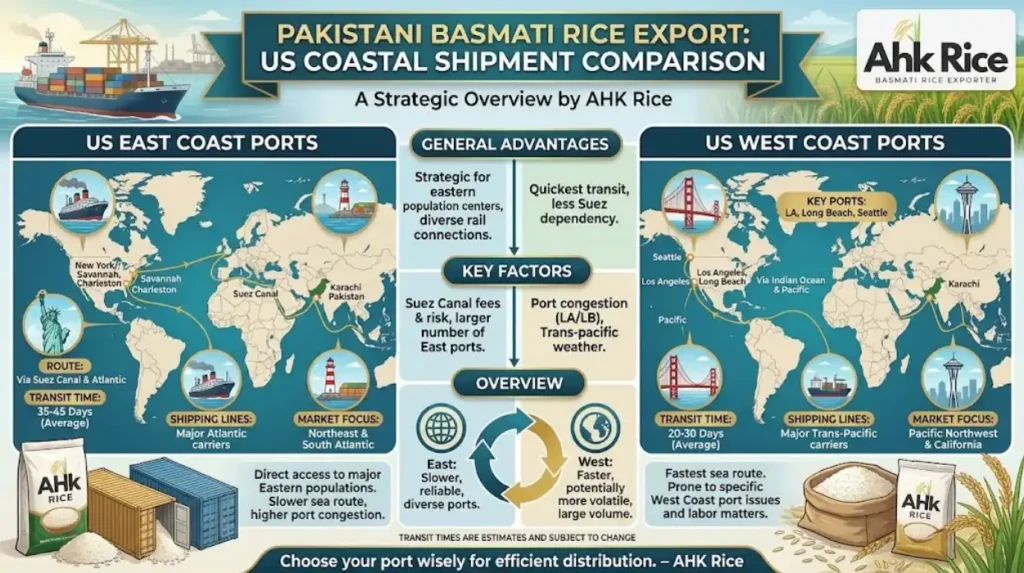
East Coast and West Coast importers evaluate similar rice quality and documentation requirements, but their shipping routes, port choices, inland transport arrangements, and delivery schedules differ. Freight quotations must identify the destination port, Incoterm, container type, and inland delivery scope.
East Coast: New York and New Jersey
The Port of New York and New Jersey serves importers supplying the northeastern United States and nearby distribution markets. Buyers should compare ocean freight, terminal charges, customs brokerage, and inland transport when choosing this gateway.
For Pakistani Basmati rice, 1121 and Super Kernel can suit premium retail and ethnic grocery distribution, while 1509 can serve buyers prioritizing commercial volume and price positioning. These are market-positioning considerations, not fixed rules for every importer.
West Coast: Los Angeles and Long Beach
The Ports of Los Angeles and Long Beach serve importers distributing cargo across California and other western markets. Buyers should evaluate ocean transit, port handling, container availability, and onward trucking or rail arrangements.
Retailers supplying California also need to assess applicable state requirements, including California Proposition 65 where relevant to their product and exposure circumstances. Compliance responsibilities depend on the actual product, exposure, and applicable law; a generic statement that rice is compliant does not establish compliance.
Price per metric ton and shelf-life comparison
There is no reliable universal price per metric ton for either region without a current shipment quotation. Rice grade, crop year, grain specifications, processing, broken percentage, moisture, packaging, order volume, freight, insurance, and Incoterm all influence the final price.
| Attribute | US East Coast | US West Coast |
|---|---|---|
| Common port options | New York and New Jersey | Los Angeles and Long Beach |
| Relevant buyer segments | Northeastern wholesalers, retailers, and foodservice distributors | California retailers, western distributors, and foodservice buyers |
| Grade selection | 1121, Super Kernel, or 1509 according to buyer requirements | 1121, Super Kernel, or 1509 according to buyer requirements |
| Price per MT | Obtain a route-specific quotation including applicable port and delivery costs | Obtain a route-specific quotation including applicable port and delivery costs |
| Shelf-life planning | Confirm the product’s validated shelf life and storage conditions | Confirm the product’s validated shelf life and storage conditions |
| Inland logistics | Depends on the final warehouse and delivery location | Depends on the final warehouse and delivery location |
Shelf life does not change simply because a container enters through a different US coast. It depends on the rice’s condition, processing, packaging, moisture control, storage temperature, and the manufacturer’s validated shelf-life specification. Importers should obtain a documented shelf-life statement and storage instructions for the specific product.
For a meaningful price comparison, request quotations on the same basis. Compare the same rice grade, packing weight, quantity, currency, and Incoterm. A FOB quotation should not be compared directly with a delivered warehouse price because the included services differ.
What are the advantages and disadvantages of each approach?
Floor loading reduces pallet expenditure and supports efficient cargo utilization, but it increases manual handling. Palletizing improves warehouse movement but consumes space and adds materials costs. Fumigation addresses specified pest risks but adds coordination, safety, and documentation responsibilities when treatment is required.
| Approach | Main advantage | Main disadvantage | Practical example |
|---|---|---|---|
| Floor loading | Efficient use of container space | More manual unloading | A wholesaler receives large bags at a warehouse with a trained unloading team |
| Palletizing | Faster forklift handling | Pallets reduce available cargo space | A retailer needs standardized pallet units for distribution |
| Hybrid loading | Balances cargo utilization and handling needs | More complex loading supervision | A distributor receives a mix of palletized and floor-loaded products |
| Fumigation when required | Addresses specified pest risks | Adds treatment and compliance coordination | An importer follows a documented treatment requirement |
| Preventive container inspection | Identifies visible contamination or damage before loading | Cannot eliminate every hidden risk | A loading team rejects a wet or damaged container before stuffing |
A common mistake is treating fumigation as a solution for poor container preparation. Fumigation does not dry wet packaging, repair torn bags, prevent condensation, or correct unstable stacking. Those risks require separate controls.
Another mistake is selecting pallets without checking the destination warehouse’s requirements. A pallet that fits the container may still exceed the receiving facility’s permitted height or weight. Importers should approve the pallet specification before the exporter begins packing.
What factors should buyers use to choose a container-loading plan?
Buyers should evaluate total landed cost, cargo protection, warehouse capabilities, regulatory requirements, packaging specifications, and shipment documentation together. The lowest ocean-freight or loading cost is not necessarily the lowest delivered cost when unloading, damage, delays, and compliance expenses are included.
The following decision framework links five common purchasing priorities to a practical loading strategy.
| Decision factor | Buyer requirement | Recommended approach | Main check before loading |
|---|---|---|---|
| Cost and cargo quantity | Maximize usable container space | Floor loading | Confirm payload, dimensions, and stacking plan |
| Warehouse efficiency | Rapid forklift unloading | Palletizing | Approve pallet dimensions, height, and weight |
| Mixed distribution needs | Balance capacity and handling | Hybrid loading | Approve the layout and unloading sequence |
| Phytosanitary compliance | Meet applicable pest-control requirements | Approved treatment when required | Verify entry conditions and required records |
| Cargo integrity | Reduce moisture, shifting, and packaging damage | Suitable container inspection, packaging, and restraint | Check container dryness, bag strength, and load stability |
Before shipment, the buyer and exporter should agree on the rice variety, crop year, grain length, broken percentage, moisture specification, packaging format, net weight, and quantity. The commercial invoice and packing list must accurately reflect the shipment.
The loading plan should identify the container number, seal number, bag count, net and gross weights, and loading date. The exporter should retain appropriate loading records and photographs when required by the buyer’s procedures.
For US imports, the importer and its customs broker should confirm applicable US Customs and Border Protection entry requirements, relevant US Department of Agriculture Animal and Plant Health Inspection Service requirements, and any Food and Drug Administration obligations. The exact requirements depend on the product and shipment circumstances.
AHK Rice supports buyers evaluating Pakistani Basmati sourcing, packaging, and export coordination. Importers can review its rice export services and shipment support when preparing a specification for a US-bound order.
How can importers reduce damage and delays before shipment?
Importers reduce shipment risk by approving specifications before production, inspecting the empty container, using suitable packaging and load restraint, and verifying documentation before dispatch. Early coordination between exporter, freight forwarder, customs broker, and treatment provider prevents avoidable corrections after cargo reaches the port.
A practical pre-shipment checklist includes these steps:
- Approve the rice specification. Confirm variety, crop year, grain length, broken percentage, moisture, packing size, and quality documentation.
- Inspect the empty container. Check for moisture, odours, holes, damaged flooring, contamination, and door defects.
- Approve the loading arrangement. Confirm floor loading, palletization, or a hybrid configuration based on receiving requirements.
- Protect the cargo. Use suitable packaging, stable stacking, and appropriate moisture protection and restraint.
- Verify pest-control requirements. Confirm whether treatment is required and identify the approved process and documentation.
- Reconcile shipment records. Check the invoice, packing list, bill of lading details, weights, container number, and seal number.
- Confirm US entry requirements. Ask the customs broker and relevant authorities to verify the requirements that apply to the specific shipment.
Container loading is only one part of the export process. A successful shipment also depends on consistent rice quality, accurate documents, compliant packaging, and a clear delivery arrangement. A documented plan gives the importer better control over cost, cargo condition, and receiving operations.
Frequently Asked Questions
Is fumigation mandatory for every Pakistani Basmati rice shipment to the USA?
No. Fumigation is not automatically mandatory for every rice shipment. Importers must verify the applicable USDA APHIS requirements, commodity-specific entry conditions, and any treatment instructions before dispatch. The required procedure depends on the shipment’s circumstances and relevant regulations.
Is floor loading better than palletizing for rice exports?
Floor loading generally offers better container-space utilization and lower pallet costs. Palletizing improves handling efficiency at warehouses equipped with forklifts. The better option depends on cargo volume, packaging, unloading facilities, and the buyer’s distribution requirements.
Which Pakistani Basmati varieties can AHK Rice supply to US importers?
AHK Rice supplies 1121, Super Kernel, and 1509 Pakistani Basmati rice. Buyers can select varieties according to grain specifications, processing requirements, packaging, and their target market. Final specifications should be confirmed before production and shipment.
Does palletizing reduce the quantity of rice loaded into a container?
Yes. Pallets occupy space and add weight, reducing the space or payload available for rice. The actual difference depends on pallet dimensions, bag sizes, stacking configuration, and the container’s permissible payload.
Does fumigation protect rice against moisture damage?
No. Fumigation addresses specified pest risks and does not replace moisture control. Exporters must inspect containers, protect packaging, use suitable loading practices, and follow appropriate storage procedures to reduce moisture-related damage.