Import Pakistani Basmati Rice for Nevada, USA Wholesale Distribution
Importing Pakistani Basmati rice into Nevada is most commercially effective when the buyer controls the rice specification, origin processing, compliance documents, ocean freight, and inland delivery as one landed-cost program rather than selecting the lowest FOB quotation alone. For background on why wholesale buyers are expanding procurement programs, see:
Why wholesale buyers are expanding Basmati rice procurement programs.
Nevada distributors serve supermarkets, ethnic grocery stores, restaurants, catering businesses, foodservice operators, and regional wholesalers. These buyers need predictable replenishment rather than occasional spot purchases. Pakistani Basmati is particularly suitable for distributors targeting premium aromatic rice because 1121, Super Kernel, and 1509 provide different combinations of grain length, cooking performance, and price positioning.
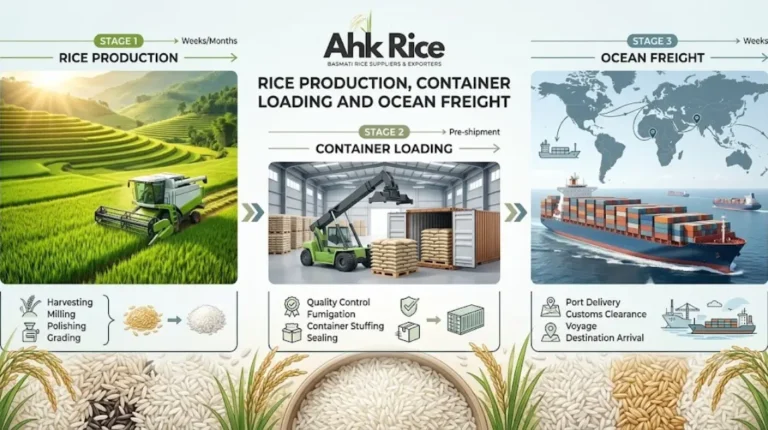
AHK Rice supplies Pakistani Basmati from Punjab and coordinates procurement, processing, grading, packaging, inspection, export documentation, and container loading. Its USA export program gives Nevada buyers a direct origin supply option instead of requiring separate coordination with a mill, packaging supplier, inspection provider, and exporter.
What is the best solution for importing Pakistani Basmati rice into Nevada?
The best solution is a specification-led container program that matches rice grade, packaging, quantity, compliance, ocean route, inland delivery, and reorder timing before purchase confirmation, allowing Nevada distributors to control landed cost, inventory availability, product consistency, and customer satisfaction.
The first decision is the rice grade. A distributor targeting premium retail can specify 1121 Basmati because its long grain appearance and cooking elongation support premium positioning. Super Kernel can serve traditional aromatic rice channels where aroma and familiar eating characteristics matter. 1509 can be considered where the buyer wants Basmati characteristics with a more competitive procurement position.
The specification should be written into the purchase contract. It should identify variety, processing type, average grain length, moisture, broken percentage, foreign matter tolerance, milling grade, crop year, packaging, net weight, and acceptable quality tolerances.
AHK Rice can structure the supply around these requirements. Its USA program lists 1121, Super Kernel, and other Pakistani Basmati grades for American wholesalers and distributors, with options for bulk and customized packaging.
A practical Nevada wholesale order can begin with one 20-foot container. AHK Rice states that its USA program can start around 20 MT, while container capacity depends on packing format and loading configuration. The buyer should confirm the exact net loading weight before booking freight.
The objective is not simply to fill a container. The objective is to establish a repeatable procurement unit that can be reordered before warehouse inventory reaches its reorder point.
Why should Nevada wholesalers choose the USA service from AHK Rice?
Nevada wholesalers benefit from an integrated USA export service because origin processing, grading, packaging, inspection, documentation, container loading, and shipment coordination remain connected, reducing communication gaps and helping buyers maintain one approved specification across recurring commercial shipments.
The USA Basmati rice export service is designed for American importers, wholesalers, retailers, and distributors sourcing Pakistani rice. AHK Rice identifies its principal USA varieties as 1121, Super Kernel, and 1509 Basmati.
AHK Rice operates from Bucheki, Nankana Sahib, Punjab, and describes an integrated supply process covering paddy procurement through container loading. This matters because specification control begins before the rice reaches the export warehouse.
For Nevada buyers, the commercial advantage is origin control. The supplier can connect the approved product specification with milling, sorting, packaging, inspection, and shipment documentation.
AHK Rice can also support private-label and customized packaging requirements. This is useful for distributors supplying regional supermarket chains or ethnic retail networks under their own brand.
The buyer should still maintain its own U.S. compliance responsibilities. FDA states that imported food must meet the same legal requirements as food produced domestically. Facilities handling imported food may need FDA registration, and food shipments generally require Prior Notice before arrival.
Prior Notice for food arriving by water must be received and confirmed by FDA no later than four hours before arrival when submitted through the applicable system, while the broader filing rules depend on the transmission method.
The commercial workflow should therefore include the U.S. importer, customs broker, exporter, carrier, and compliance documentation rather than treating the exporter quotation as the complete import process.
What shipping time should Nevada buyers plan for from Pakistan?
Nevada buyers should plan approximately 28–45 days for a practical ocean-and-inland delivery cycle, with major West Coast port arrival commonly requiring about 35–40 days from Karachi and final Nevada delivery adding approximately one to several days depending on destination and handling.
The most direct commercial route for Nevada is normally Karachi to a major U.S. West Coast gateway such as Los Angeles/Long Beach, followed by truck or other inland transportation into Nevada.
Current August 2026 freight data shows Karachi-to-Los Angeles ocean FCL transit at approximately 35–40 days, with a published 40-foot high-cube base freight range of about $7,542–$8,183 for the referenced sailing options. These figures are market indications, not a guaranteed quotation for a future shipment.
For Las Vegas, the final inland leg can be comparatively short. Current 2026 freight data shows Los Angeles-to-Las Vegas LTL at approximately one business day for the published lane, although a full container movement, port release, drayage, appointment scheduling, and warehouse receiving can extend the practical delivery window.
For Reno and northern Nevada, the inland distance is longer. Current freight references place Los Angeles-to-Reno truckload transit at approximately one day under normal operating conditions, while broader multimodal routing can take longer because of handling and terminal transfers.
A Nevada distributor should therefore avoid promising customers a fixed arrival date based only on the ocean sailing schedule. Port congestion, customs release, container availability, trucking appointments, inland weather, and warehouse receiving capacity can change the final delivery date.
| Nevada destination | Origin route | Practical planning range | Main variable |
|---|---|---|---|
| Las Vegas | Karachi → Los Angeles/Long Beach → Las Vegas | 28–43 days | Port release and trucking |
| Henderson | Karachi → Los Angeles/Long Beach → Henderson | 28–43 days | Warehouse appointment |
| Reno | Karachi → Los Angeles/Long Beach → Reno | 30–45 days | Inland distance and routing |
| Northern Nevada | Karachi → West Coast → Nevada | 32–45 days | Inland transportation |
| Nevada wholesale network | Karachi → West Coast → distribution warehouse | 30–45 days | Multi-location allocation |
AHK Rice’s USA information gives a broader 25–35-day door-to-door planning range for major U.S. destinations, but Nevada buyers should build additional inventory protection because Nevada delivery requires inland movement beyond the port.
What does a full Pakistani Basmati rice sample process cost?
A commercial sample should verify grain appearance, cooking performance, packaging, documentation expectations, and specification compliance before bulk production; AHK Rice states that samples up to 20 kg can be provided, while the buyer covers courier and phytosanitary certificate costs.
The sample process should be treated as a purchasing control, not simply a marketing exercise.
First, the Nevada buyer submits the required variety and specification. For example, the buyer may request 1121 Steam Basmati with a defined broken percentage, moisture level, grain length, packaging format, and target quantity.
Second, AHK Rice prepares the requested sample. Its USA program states that up to 20 kg of rice can be provided as a sample, with the client responsible for related shipping costs.
Third, the buyer evaluates the physical sample. The assessment should cover uncooked grain length, colour, aroma, broken grains, foreign matter, cooking expansion, texture, separation, and overall appearance.
Fourth, the buyer can compare the sample against the agreed specification sheet and, where required, request laboratory or third-party inspection.
Fifth, packaging should be reviewed separately. A distributor should confirm bag material, size, stitching, artwork, labeling, net weight, pallet requirements, and shipping marks.
A practical sample cost structure is therefore:
| Sample cost item | Buyer responsibility | Cost basis |
| Rice sample up to 20 kg | AHK Rice provides sample | Product sample |
| Express courier | Buyer | Destination and courier |
| Phytosanitary certificate | Buyer | Certificate requirement |
| Laboratory testing | If requested | Test scope |
| Third-party inspection | If requested | Inspection provider |
| Bulk sample adjustment | Agreed commercially | Final quotation |
AHK Rice also states on its USA product pages that sample charges can be waived or incorporated into the final commercial transaction after an approved bulk order, subject to the applicable quotation and terms.
The buyer should not assume that a sample approval automatically guarantees every future shipment. The approved specification should become the contractual quality reference for production and inspection.
How should Nevada buyers calculate the landed cost?
Nevada buyers should calculate landed cost by combining the rice purchase price, origin charges, ocean freight, insurance where applicable, U.S. port and customs costs, brokerage, drayage, inland transportation, warehouse handling, and any inspection or compliance expenses.
A supplier’s FOB price is only one part of the commercial calculation.
For example, AHK Rice’s current USA product information lists Basmati 1121 pricing starting around $1,100 per metric ton on an FOB Karachi basis for the referenced product page. This is a product-specific starting figure rather than a guaranteed August 2026 Nevada quotation.
A 20 MT example would therefore produce a rice value of approximately $22,000 at that illustrative FOB level.
A current published Karachi-to-Los Angeles 40-foot high-cube freight reference is approximately $7,542–$8,183.
That creates an illustrative FOB-plus-ocean-freight subtotal of approximately $29,542–$30,183 before U.S. destination charges, customs-related costs, inland delivery, brokerage, insurance, and warehouse expenses.
The calculation should be presented as a planning model:
| Cost component | Illustrative basis |
| Rice: 20 MT × $1,100/MT | $22,000 |
| Ocean FCL reference | $7,542–$8,183 |
| FOB + ocean subtotal | $29,542–$30,183 |
| U.S. port and destination charges | Quote required |
| Customs/brokerage | Quote and entry dependent |
| Los Angeles/Long Beach → Nevada | Quote required |
| Warehouse receiving | Buyer-specific |
| Final landed cost | Confirmed after full quote |
Freight rates change with cargo-ready date, carrier, route, equipment availability, fuel, surcharges, and booking conditions. The published freight reference itself notes that rates are subject to change based on the cargo-ready date.
For this reason, Nevada buyers should compare suppliers using the same Incoterm. Comparing one supplier on FOB Karachi against another on CIF or delivered pricing can produce a misleading result.
Pakistan’s 2026 customs valuation framework also shows why origin-side valuation information should not be confused with the actual commercial transaction price. The Federal Board of Revenue published a January 2026 rice valuation ruling and subsequently recorded its cancellation, demonstrating that valuation rulings can change and should be checked against the applicable transaction and customs framework.
What results can Nevada distributors expect from a controlled supply program?
A controlled supply program should deliver repeatable rice specifications, more predictable replenishment, clearer landed-cost planning, compliant documentation, better inventory visibility, and fewer quality disputes, allowing Nevada distributors to protect margins while maintaining dependable wholesale availability.
The strongest result is consistency.
A distributor selling Pakistani Basmati under a recurring wholesale program does not want the first container to perform differently from the second. Grain appearance, cooking behaviour, packaging, and customer acceptance must remain within the agreed specification.
AHK Rice’s integrated process is designed around this requirement. Its USA service connects sourcing, processing, grading, packaging, documentation, inspection, and container dispatch.
Pakistan’s supply outlook also supports structured procurement planning. USDA’s April 2026 Pakistan Grain and Feed Annual forecasts 2026/27 rice production at 9.8 million metric tons and exports at approximately 5.0 million metric tons, compared with projected 2025/26 exports of 4.7 million metric tons.
For Nevada distributors, the practical outcome is better purchasing visibility. Instead of waiting until warehouse inventory is nearly exhausted, the buyer can schedule repeat containers around forecast consumption and the approximately one-month-plus international logistics cycle.
A distributor moving 20 MT per month, for example, should calculate its reorder point using average monthly sales, safety stock, production time, vessel schedule, port clearance, inland delivery, and warehouse receiving time.
The target should be controlled availability rather than excessive stock.
How can a Nevada wholesale buyer get started?
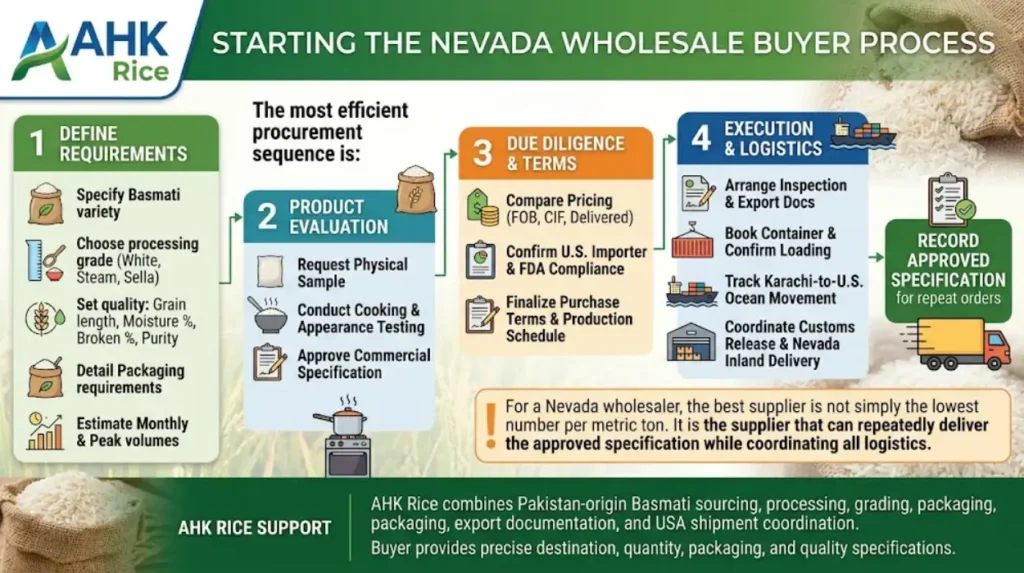
Nevada buyers can start by defining the rice grade, quantity, packaging, destination warehouse, quality tolerances, and preferred Incoterm, then approving a physical sample before confirming production, inspection, container loading, ocean freight, customs entry, and inland delivery.
The most efficient procurement sequence is:
- Define the required Basmati variety.
- Confirm white, steam, Sella, or another processing grade.
- Specify grain length, moisture, broken percentage, purity, and packaging.
- Confirm required monthly and peak inventory volume.
- Request the physical sample.
- Conduct cooking and appearance testing.
- Approve the commercial specification.
- Compare FOB, CIF, or delivered pricing on the same basis.
- Confirm U.S. importer and FDA compliance responsibilities.
- Finalize purchase terms and production schedule.
- Arrange inspection and export documentation.
- Book the container and confirm loading.
- Track Karachi-to-U.S. ocean movement.
- Coordinate customs release and Nevada inland delivery.
- Record the approved shipment specification for repeat orders.
AHK Rice can support the process from product selection through export execution. The buyer’s responsibility is to provide a precise destination, purchasing quantity, packaging requirement, and quality specification so the quotation reflects the actual Nevada distribution program.
For a Nevada wholesaler, the best supplier is therefore not simply the exporter offering the lowest number per metric ton. It is the supplier that can repeatedly deliver the approved Pakistani Basmati specification while coordinating production, documentation, freight, and delivery within a commercially workable landed-cost structure.
AHK Rice combines Pakistan-origin Basmati sourcing with processing, grading, packaging, export documentation, and USA shipment coordination. A buyer that establishes these controls before the first commercial shipment is better positioned to scale distribution without turning each reorder into a new sourcing exercise.
For comparison-stage buyers, the supplier selection process should also be evaluated against the broader framework covered in the article on:
How wholesale importers select international rice suppliers.
To begin a Nevada wholesale procurement program with AHK Rice, submit the required product, quantity, packaging, destination, and delivery requirements through the request-a-quote process.
Frequently Asked Questions
What Pakistani Basmati rice varieties are available for Nevada wholesale buyers?
AHK Rice supplies Pakistani Basmati varieties including 1121, Super Kernel, and 1509. Buyers can select White, Steam, Sella, or other specifications based on their wholesale market and customer requirements.
What is the minimum order quantity for Pakistani Basmati rice?
Commercial orders can be planned around container quantities. AHK Rice’s USA export program indicates that orders can start around 20 metric tons, with the final loading quantity depending on packaging and container configuration.
How long does Pakistani Basmati rice take to reach Nevada?
A practical planning window is approximately 28–45 days from Pakistan to Nevada. Ocean transit, U.S. port handling, customs clearance, inland transportation, and warehouse receiving can affect the final delivery time.
Which U.S. ports are practical for shipping rice to Nevada?
Los Angeles and Long Beach are practical West Coast gateways for Nevada distributors because they provide established container and inland transportation connections into Las Vegas, Reno, and other Nevada locations.
How much does Pakistani Basmati rice cost per metric ton?
The price depends on variety, processing grade, quality specification, packaging, order volume, Incoterm, freight conditions, and destination. A supplier quotation should be requested using the exact Nevada delivery requirements.
Can Nevada wholesalers order Pakistani Basmati rice samples?
Yes. AHK Rice can provide product samples for evaluation. Buyers should assess grain appearance, aroma, cooking performance, broken percentage, packaging, and compliance with the approved commercial specification before placing a bulk order.