How Do Wholesale Importers Select International Rice Suppliers?
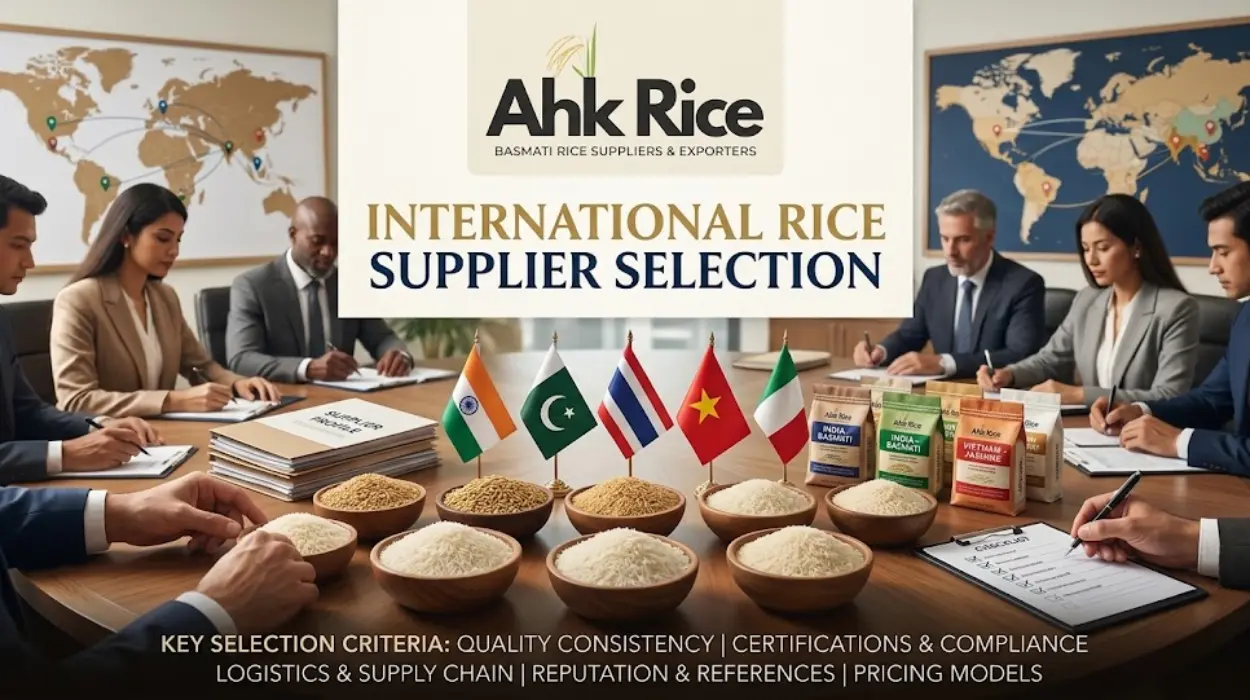
Wholesale importers select international rice suppliers by comparing specification consistency, landed cost, processing capability, certifications, documentation, shipment reliability, and market-specific grade performance rather than choosing the lowest FOB price. The strongest supplier is the one that can repeatedly meet the same commercial specification at the required volume.
The expansion of Basmati procurement programs makes supplier evaluation more important because importers are managing larger volumes, private-label requirements, changing freight costs, food regulations, and multiple distribution channels. Before comparing suppliers, buyers should understand the procurement forces explained in:
Why wholesale buyers are expanding Basmati rice procurement programs. A supplier evaluation should then convert those market requirements into measurable specifications, inspection procedures, and delivery conditions.
What are the available solutions for selecting an international rice supplier?
Wholesale importers have four practical supplier-selection approaches: direct mill sourcing, exporter-led procurement, trading-company sourcing, and multi-supplier procurement. Each approach provides a different balance of price control, quality control, documentation support, volume flexibility, and supply-chain risk.
Direct mill sourcing
Direct mill sourcing connects the importer with a rice processor that purchases paddy, mills, grades, sorts, packs, inspects, and loads export containers. This approach provides greater visibility into production and makes specification control easier.
The buyer can define grain length, broken percentage, moisture, foreign matter, packaging, crop year, milling degree, and processing method before signing the contract. It works well for wholesale programs that repeat the same specification throughout the year.
Exporter-led procurement
An established rice exporter manages sourcing, processing, quality control, documentation, freight coordination, and shipment preparation. This model reduces the operational workload for the importer.
It is suitable when the buyer wants one commercial contact while still requiring product specifications, pre-shipment inspection, customized packaging, and export documentation.
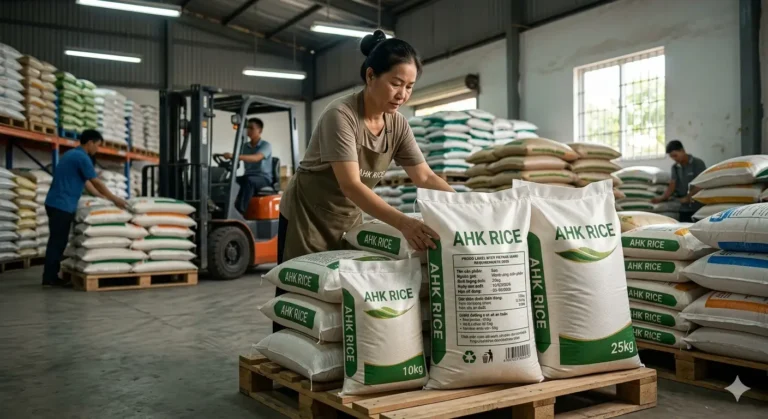
AHK Rice operates this type of integrated model from Punjab, supplying Pakistani 1121, Super Kernel, and 1509 varieties while managing processing, grading, sorting, packaging, and export procedures.
Trading-company sourcing
A trading company purchases rice from mills and resells it to international buyers. The model can provide access to multiple mills and origins.
Its main advantage is flexibility. Its main weakness is reduced visibility into the actual processing facility. The importer must therefore verify the producer, specification history, inspection records, and chain of custody.
Multi-supplier procurement
Large distributors can divide annual requirements between two or more qualified suppliers. This reduces dependence on one production source and protects replenishment schedules when one supplier experiences capacity constraints.
The disadvantage is specification drift. Two suppliers may use different interpretations of grain length, broken rice, moisture, polishing, or packaging. A common technical specification is essential.
How do different international rice supplier approaches compare?
Direct mills provide production visibility, exporters provide integrated execution, traders provide sourcing flexibility, and multi-supplier programs provide continuity. Importers should compare these models using measurable specifications instead of judging suppliers only by quoted price or company size.
| Attribute | Direct Mill | Exporter | Trading Company | Multi-Supplier Program |
|---|---|---|---|---|
| Product control | Very high | High | Medium | High with common specification |
| Price transparency | High | High | Medium | High after benchmarking |
| Documentation support | Medium | High | Medium | High |
| Custom packaging | High | High | Medium | High |
| Volume scalability | High | High | Medium | Very high |
| Supply continuity | Medium | High | Medium | Very high |
| Buyer management workload | High | Low | Medium | High |
The comparison shows why there is no universal supplier model. A restaurant distributor buying 50 metric tons per month has different requirements from a national wholesaler buying several hundred metric tons.
Supplier evaluation should therefore begin with the importer’s distribution model. The buyer needs to define monthly consumption, peak demand, target markets, package sizes, delivery ports, acceptable lead time, and required safety stock.
Price should then be compared against the same Incoterm. FOB Karachi, CFR, CIF, and delivered warehouse prices cannot be compared directly because freight, insurance, destination charges, and inland transportation are treated differently.
Which rice grades should importers compare for different market regions?
GCC buyers generally prioritize parboiled Basmati grades such as 1121 Sella and 1509 Sella for grain separation and traditional dishes, while North American wholesalers commonly evaluate 1121 White, 1121 Steam, Super Kernel, and selected 1509 grades for long grain appearance, aroma, cooking performance, and retail positioning.
GCC region: Saudi Arabia and UAE
The Gulf Cooperation Council, or GCC, is a six-country regional economic bloc that includes Saudi Arabia and the United Arab Emirates. Saudi and UAE importers commonly evaluate Basmati for biryani, kabsa, mandi, pilaf, foodservice, retail, and wholesale distribution.
1121 Sella is particularly useful where buyers want long, firm grains that remain separate after cooking. 1121 Steam provides a different processing profile while retaining the extra-long grain positioning. 1509 Sella provides another commercial option when buyers need long-grain performance with a different cost position.
For GCC procurement, importers should compare grain length, broken percentage, color, moisture, cooking elongation, aroma, and processing consistency. Packaging also matters because 5 kg, 10 kg, 25 kg, and 50 kg formats serve different distribution channels.
North America: United States
North American buyers evaluate Basmati through a combination of foodservice performance, retail presentation, regulatory compliance, and landed cost. 1121 White and 1121 Steam are strong candidates for premium long-grain positioning, while Super Kernel provides a traditional Pakistani Basmati profile.
For U.S. imports, the Food and Drug Administration (FDA) requires imported food to meet U.S. safety, sanitation, labeling, facility registration, and import requirements. Prior Notice is also required for covered food shipments before arrival.
That makes supplier documentation part of product selection. A rice supplier that provides a strong sample but cannot maintain compliant documentation creates operational risk.
For Nevada distributors, for example, the buyer should evaluate not only rice quality but also the supplier’s ability to support consistent shipments through the selected U.S. port and inland distribution network. A decision-stage resource on:
Importing Pakistani Basmati rice for Nevada wholesale distribution can be placed after the section discussing U.S. supplier requirements.
How do 2026 rice prices compare between the two regions?
FOB Karachi Basmati prices in August 2026 provide a useful origin benchmark, but GCC and U.S. buyers must add freight, insurance, port charges, customs costs, inland transportation, and other destination expenses before comparing their true landed cost per metric ton.
Current published August 2026 Pakistan export indications place 1121 Basmati Sella around $1,135–$1,175 per metric ton FOB Karachi, 1121 Steam around $1,160–$1,200, 1121 White around $1,165–$1,205, and Super Kernel around $1,165–$1,205.
Pakistan Customs’ 2026 valuation framework also lists reference export values of $1,175/MT for 1121 White/Sella and $1,225/MT for 1121 Steam. These are customs valuation references, not guaranteed commercial selling prices.
| Market region | Common grade focus | 2026 origin price reference | Shelf-life planning |
| Saudi Arabia | 1121 Sella, 1509 Sella, 1121 Steam | About $1,135–$1,200/MT FOB for 1121 grades | 18–24 months depending on processing and storage |
| UAE | 1121 Sella, 1121 Steam, Super Kernel | About $1,135–$1,205/MT FOB for premium Basmati | 18–24 months depending on packaging and storage |
| USA | 1121 White, 1121 Steam, Super Kernel | About $1,165–$1,205/MT FOB for listed premium grades | 18–24 months depending on product and conditions |
These figures should be treated as procurement benchmarks rather than fixed international market prices. Freight can change the delivered cost materially between Jebel Ali, Dammam, Los Angeles, Houston, Savannah, New York, or other destinations.
Shelf life also cannot be evaluated from the grade name alone. Packaging material, moisture control, warehouse temperature, humidity, pest protection, and storage conditions affect commercial shelf life. Importers should require the supplier to state the declared shelf life and storage conditions on the specification sheet.
Which supplier-selection method works best for different wholesale cases?
Direct mill sourcing works best for high-volume buyers requiring deep production visibility, integrated exporters suit importers seeking simpler execution, traders suit flexible sourcing needs, and multi-supplier programs work best when continuity matters more than administrative simplicity.
A regional wholesaler with predictable demand can use an integrated exporter and maintain one approved specification. The importer receives samples, approves the technical specification, confirms packaging, conducts pre-shipment inspection, and repeats the purchase order.
A national distributor with several warehouses should consider dual sourcing. The buyer can approve two suppliers against one specification and divide annual volume between them.
A private-label importer requires even tighter controls. The supplier must reproduce the same grain appearance, cooking performance, packaging dimensions, print quality, and documentation across every production cycle.
A price-sensitive importer may compare 1509 against 1121 rather than simply negotiating the 1121 price lower. This creates a product-level cost strategy. The buyer changes the grade to meet the target price while preserving acceptable cooking performance.
Pakistan’s 2026 rice outlook also supports the need to evaluate production capacity. USDA forecasts Pakistan’s 2026/27 rice production at approximately 9.8 million metric tons and exports at about 5.0 million metric tons, compared with projected 4.7 million tons of exports in 2025/26.
Higher export availability does not remove the need for supplier qualification. The importer still needs to know whether a supplier can process, inspect, pack, and ship the contracted volume consistently.
What are the pros and cons of each supplier-selection approach?
Every sourcing method involves a trade-off between control, convenience, flexibility, and continuity. Importers should choose the model that minimizes the most important operational risk instead of selecting the model with the lowest quoted procurement price.
Direct mill sourcing provides excellent visibility and can improve price transparency. It also requires more buyer involvement in production scheduling, inspection, documentation, and logistics.
Exporter-led sourcing reduces administrative workload. The exporter can coordinate multiple stages under one contract. The importer must still verify actual processing capacity and quality systems.
Trading companies can provide market access and supplier flexibility. Their additional commercial layer can reduce price transparency and make traceability more difficult.
Multi-supplier procurement protects against supply interruptions. It increases supplier-management work and creates a higher risk of specification differences.
For example, a distributor buying 500 MT annually may split volume between two approved exporters. Both suppliers must use the same grain-length tolerance, broken limit, moisture limit, packaging specification, inspection standard, and shipment documentation. Otherwise, the buyer may receive two commercially different products under the same product name.
What decision factors should wholesale importers use before approving a supplier?
Wholesale importers should score suppliers on product specifications, production capacity, quality assurance, regulatory compliance, commercial terms, logistics performance, and supply continuity. A weighted decision framework prevents one attractive price from hiding weaknesses elsewhere in the supply chain.
| Decision factor | What the importer should verify | Example evaluation |
| Product specification | Grain length, broken %, moisture, foreign matter, color, processing | Sample matches contract specification |
| Production capacity | Paddy sourcing, milling, sorting, packing, monthly export capability | Capacity covers peak shipment requirements |
| Quality assurance | Laboratory testing, inspection, traceability, corrective actions | Pre-shipment inspection available |
| Compliance | Export documents and destination-market requirements | U.S. supplier documentation supports FDA requirements |
| Commercial value | FOB/CIF price, MOQ, payment terms, packaging costs | Landed cost remains within target |
| Logistics | Port, vessel schedule, transit time, container planning | Shipment milestones are documented |
| Supply continuity | Repeat-order performance and contingency sourcing | Second approved production source available |
Quality assurance should include more than a certificate list. Importers should ask for recent laboratory reports, sample specifications, inspection procedures, packing details, and evidence that the commercial shipment will match the approved sample.
For U.S. programs, the Foreign Supplier Verification Program (FSVP) is also important. FSVP requires applicable U.S. importers to perform activities that verify foreign suppliers produce food in a manner that meets applicable U.S. safety requirements. FDA also requires food facilities to register where registration applies.
Pakistan’s export environment also changed during 2026. The Ministry of Commerce lists a January 2026 Drawback of Local Taxes and Levies for Rice Order and February 2026 notifications concerning rice export FOB values. These developments reinforce the importance of checking current export documentation and commercial terms before each procurement program.
How should importers build a final supplier score?
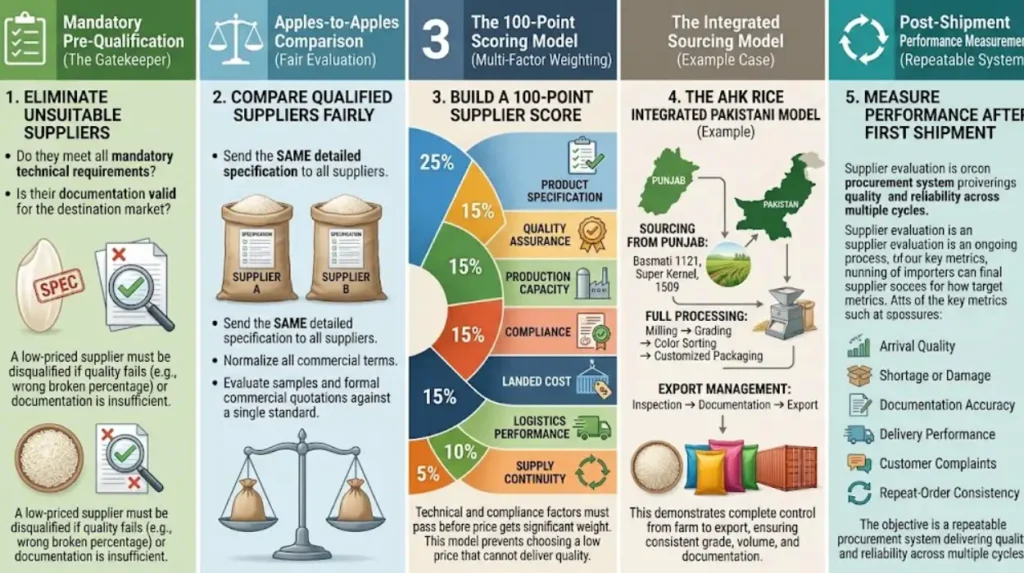
A final supplier score should combine specification compliance, landed cost, capacity, quality assurance, documentation, logistics, and continuity. A supplier should pass the mandatory technical and compliance requirements before commercial price receives significant weighting.
A practical evaluation can use a 100-point model. Product specification can receive 25 points, quality assurance 15, production capacity 15, compliance 15, landed cost 15, logistics 10, and supply continuity 5.
The importer should first eliminate suppliers that fail mandatory requirements. A low-priced supplier should not proceed if its rice fails the required broken percentage or if its documentation cannot support the destination market.
The remaining suppliers can then be compared using samples and commercial quotations. The same specification should be sent to every supplier. This creates an apples-to-apples comparison.
For a repeat wholesale program, the evaluation should continue after the first shipment. Buyers should measure arrival quality, shortage or damage, documentation accuracy, delivery performance, customer complaints, and repeat-order consistency.
The objective is not simply to find a supplier that can ship rice once. The objective is to establish a repeatable procurement system that delivers the required grade, volume, price, documentation, and delivery performance across multiple purchase cycles.
AHK Rice provides an example of an integrated Pakistani sourcing model, with Basmati 1121, Super Kernel, and 1509 supplied from Punjab and processing capabilities covering sourcing, milling, grading, color sorting, customized packaging, inspection, and export documentation.
For wholesale importers, the final supplier decision should therefore be based on measurable performance. Compare the specification first, normalize the commercial terms, verify compliance, test the sample, confirm production capacity, and then evaluate the landed cost. This sequence turns supplier selection from a price comparison into a controlled international procurement decision.
Frequently Asked Questions
What factors should wholesale importers consider when selecting a rice supplier?
Wholesale importers should evaluate rice specifications, quality consistency, production capacity, certifications, regulatory compliance, pricing, packaging, logistics, documentation, payment terms, and supply continuity.
Which Pakistani Basmati rice grades are commonly considered by international importers?
Common Pakistani Basmati grades include 1121 White, 1121 Steam, 1121 Sella, Super Kernel, 1509 Steam, and 1509 Sella. The appropriate grade depends on the destination market and customer requirements.
How do importers compare rice suppliers on price?
Importers should compare equivalent specifications and calculate landed cost rather than comparing FOB quotations alone. Freight, insurance, customs charges, port fees, inland transportation, packaging, and other destination costs affect the final price per metric ton.
Why is production capacity important when choosing an international rice supplier?
Production capacity determines whether a supplier can consistently process, grade, pack, inspect, and ship the required volume during peak demand. Buyers should verify capacity against planned monthly and peak shipment requirements.
How can wholesale buyers verify rice quality before placing an order?
Buyers can request representative samples, product specifications, laboratory reports, inspection records, and pre-shipment inspection. The approved sample and specification should become the quality reference for the commercial shipment.