Iraq Basmati Rice Import: A Huge Opportunity Pakistani Exporters Are Missing
Iraq imports over 1.2 million tons of rice annually, and basmati demand from Pakistan is structurally under-supplied. Here is why: Iraq depends on imported rice for nearly 100% of its consumption, while Pakistani exporters still prioritize UAE, Saudi Arabia, and EU markets instead of long-term Iraqi contracts backed by stable institutional buyers.
What is Iraq basmati rice import opportunity Pakistani exporters missing?
Iraq basmati rice import opportunity refers to the sustained demand from Iraq for long grain aromatic rice, primarily sourced from Pakistan, where exporters are under-penetrating a high-volume, price-stable market with government and wholesale procurement channels.
Iraq rice consumption depends on imports due to limited domestic cultivation. Iraq does not produce basmati at scale, so importers source rice from Asia.
Pakistan holds a natural advantage due to aromatic basmati varieties cultivated in Punjab. Pakistan cultivates 1121, 1509, and Super Kernel basmati under irrigated plains.
Pakistan basmati Iraq trade remains under-optimized despite geographic proximity and freight advantage.
Exporters miss Iraq because focus stays on premium Gulf retail markets instead of institutional Iraqi tenders and wholesale distributors.
With the opportunity defined, the next section explains how Iraq rice import market operates structurally.
How does Iraq rice import market work?
Iraq rice import market operates through government allocation systems, private wholesale distributors, and food subsidy channels that collectively control import licensing, pricing, and bulk distribution across urban and rural consumption centers.
Iraq rice import market depends on centralized procurement through state-linked food programs.
Government entities inspect, certify, and release import quotas for staple commodities like rice.
Private importers in Baghdad and Basra distribute rice into wholesale hubs.
Retail chains and local traders repackage bulk rice for household consumption.
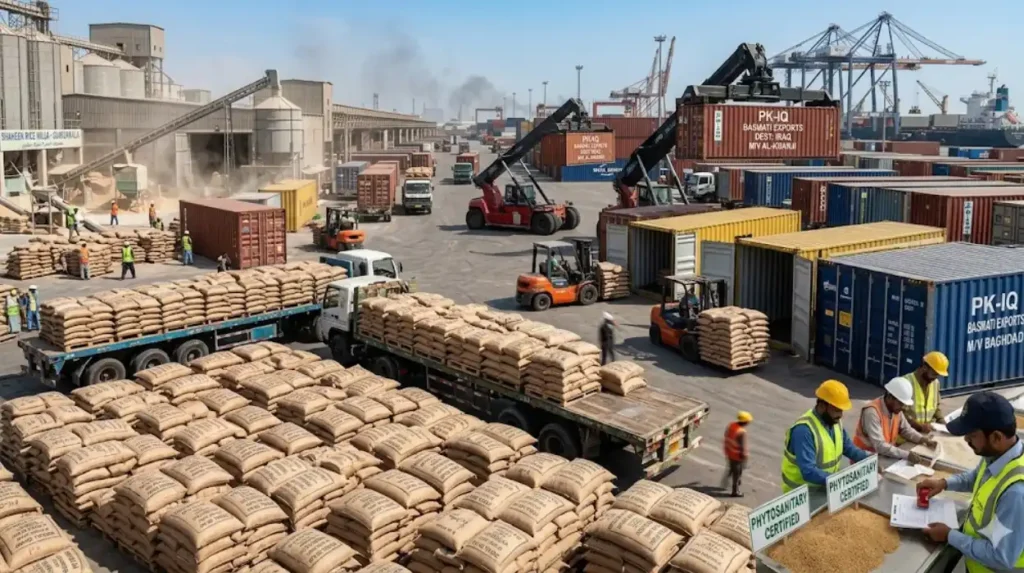
Import flows follow a structured logistics chain:
- Load rice in 25–50 kg PP or jute bags
- Ship containers via Karachi ports
- Clear customs through Iraqi import documentation
- Dispatch to Baghdad distribution warehouses
- Sort by grade and retail packaging
Market demand increases during Ramadan and winter consumption cycles.
With the market structure clear, the next section explains how Pakistan integrates into this trade flow.
What are key components of Pakistan basmati Iraq trade flow?
Pakistan basmati Iraq trade flow consists of cultivation in Punjab, milling and grading in industrial rice hubs, export certification compliance, containerized shipping, and wholesale distribution in Iraqi import centers.
Trade begins in rice-growing districts of Punjab where farmers cultivate basmati under controlled irrigation.
Processing mills in Sialkot, Gujranwala, and Lahore dehusk, polish, and grade rice.
Processing sequence includes:
- Clean paddy removal of dust and foreign material
- De-husk separation of rice hull from grain
- Parboil heat treatment for Golden Sella production
- Dry moisture stabilization for storage control
- Polish surface refinement for uniform appearance
- Sort optical separation of broken grains
- Grade classification by length and purity
Exporters inspect and certify quality under phytosanitary standards before shipment.
Containers load at Karachi ports for maritime delivery into Iraqi logistics hubs.
With trade flow established, the next section explains which grades dominate Iraqi wholesale demand.
What basmati rice grades Iraqi wholesale market preference?
Iraqi wholesale market prefers long grain 1121 varieties, followed by 1509 and Super Kernel, with Golden Sella dominating institutional catering due to longer shelf stability and cooking consistency.
Iraq basmati rice import preferences focus on consistency and storage durability.
AHK Rice supplies multiple basmati grades processed for export markets including Iraq.
1121 Steam Basmati Rice
Grain length: 8.30–8.40 mm
1121 Steam delivers soft texture and aroma retention after cooking.
Restaurants prefer Steam for plated rice dishes requiring fragrance intensity.
1121 Golden Sella Basmati Rice
Grain length: 8.05–8.30 mm
Golden Sella undergoes parboiling before milling.
Parboiling sequence includes:
- Soak paddy under controlled water temperature
- Steam under high-pressure heat treatment
- Dry grains to stable moisture level
- Mill hull while preserving nutrient layer
- Polish for golden uniform appearance
Golden Sella lasts longer in storage compared to Steam.
In 40°C Iraqi warehouses, Golden Sella maintains quality for 18 months while Steam lasts 12 months.
1509 Basmati Rice
Grain length: 8.40–8.45 mm
1509 provides higher yield per kilogram and lower market price.
Wholesale importers use 1509 for bulk food distribution programs.
Super Kernel Basmati Rice
Grain length: 7.80–8.00 mm
Super Kernel delivers compact grain structure and consistent cooking expansion.
Retail markets prefer Super Kernel for household consumption.
For structured comparison of basmati grades used in Iraq wholesale trade.
With grades defined, the next section explains why Iraq presents strong export benefits.
What are benefits of supplying basmati rice to Iraq?
Supplying basmati rice to Iraq provides stable institutional demand, lower competition from premium markets, predictable bulk orders, and long-term distributor contracts driven by staple food security needs.
Iraq maintains consistent rice consumption due to limited domestic cereal production.
Government import systems ensure annual procurement stability.
Benefits include:
- Stable demand from food subsidy programs
- High-volume container shipments per contract
- Lower marketing cost compared to retail markets
- Long-term distributor relationships
- Reduced price volatility due to staple demand
Pakistani exporters gain logistical advantage due to shorter shipping routes compared to Southeast Asia.
Demand remains unaffected by luxury consumption cycles, unlike Gulf retail markets.
With benefits established, the next section explains real-world use cases in Iraq.
What are use cases of basmati rice in Iraqi food industry?
Basmati rice in Iraq is used in institutional catering, household consumption, restaurant biryani preparation, and government food distribution programs requiring high-volume, standardized grain quality.
Iraqi cuisine integrates rice as a daily staple across urban and rural diets.
Use cases include:
- Institutional catering for schools and hospitals
- Household meals prepared with stews and meats
- Restaurant biryani and pilaf preparation
- Government ration distribution programs
- Event catering for weddings and gatherings
Golden Sella dominates institutional kitchens due to extended shelf stability.
Steam basmati dominates restaurant kitchens due to aromatic intensity.
Super Kernel serves middle-income retail consumption segments.
With use cases defined, the next section addresses misconceptions limiting export growth.
What common problems or misconceptions exist in Iraq rice trade?
Common misconceptions include assuming Iraq prefers low-quality rice, underestimating institutional procurement size, and overestimating competition from non-basmati suppliers in long-grain categories.
Iraq rice import market is frequently misclassified as price-only driven.
Reality shows structured preference for grain quality consistency and aroma retention.
Key misconceptions include:
- Misconception that Iraq only buys cheapest rice
- Misconception that basmati demand is seasonal only
- Misconception that logistics barriers limit Pakistani exports
- Misconception that Gulf markets are higher priority than Iraq
Reality shows Iraq maintains year-round import cycles with peak institutional procurement phases.
Pakistani exporters lose market share by focusing on retail branding instead of wholesale contracts.
Correct positioning requires understanding grading, storage behavior, and institutional procurement cycles.
With misconceptions clarified, the opportunity structure becomes measurable and actionable.
Frequently Asked Question
What makes Iraq a strong basmati rice import market?
Iraq imports over 1.2 million tons of rice annually due to limited local production. The market depends fully on imported long grain rice, creating stable demand for Pakistani basmati suppliers.
Which basmati rice grades are most demanded in Iraq?
Iraq prefers 1121 Steam, 1121 Golden Sella, 1509, and Super Kernel basmati. Golden Sella dominates institutional supply due to longer shelf life, while Steam is preferred in restaurants.
Why is Pakistan important for Iraq rice supply?
Pakistan provides aromatic basmati varieties grown in Punjab with strong milling infrastructure. Its proximity reduces shipping time and cost compared to Southeast Asian suppliers.
How is basmati rice processed for Iraq exports?
Rice is cultivated, then milled through de-husking, polishing, grading, and sorting. It is then certified, packed in bulk bags, and shipped through Karachi ports to Iraqi import hubs.
What is the main challenge in Iraq rice export market?
The main challenge is low exporter focus on Iraq compared to Gulf countries. Many suppliers ignore institutional contracts in Iraq that require consistent quality and long-term supply capability.