Is Pakistan 1121 Basmati Rice the Longest Grain Rice Imported into Saudi Arabia?
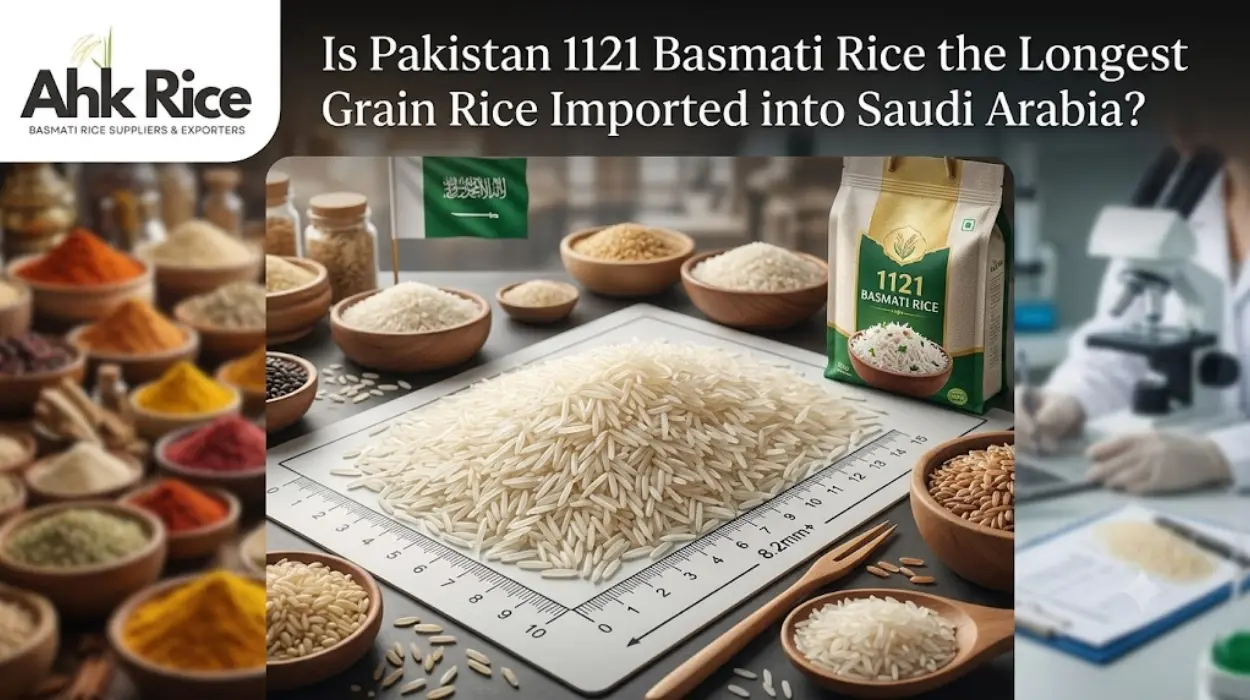
Yes. Pakistan 1121 Basmati Rice is the longest grain rice regularly imported into Saudi Arabia, with an average pre-cooked grain length of 8.30–8.50 mm and an average cooked grain length exceeding 20 mm. Saudi importers source 1121 Basmati because it delivers exceptional grain elongation, premium presentation, and consistent cooking performance across retail and foodservice sectors.
Pakistan 1121 Basmati Rice dominates the premium long-grain segment in Saudi Arabia. The variety originated from Basmati breeding programs in Punjab and became the benchmark for extra-long grain rice exports. Saudi consumers recognize 1121 Basmati through its elongated appearance, distinct aroma, and high cooking expansion ratio.
Saudi Arabia remains one of the largest import destinations for Pakistani Basmati rice because domestic rice cultivation is limited by water availability and climate conditions. The country relies on imports from Pakistan and India to satisfy demand for premium rice used in kabsa, mandi, biryani, and large-scale catering operations (source: Saudi General Authority for Statistics, 2025).
Rice traders often compare Pakistani 1121 with Indian Pusa varieties when evaluating grain dimensions and market suitability. Understanding the characteristics of 1121 requires examining its cultivation, processing, grades, export specifications, and import demand.
What Is Pakistan 1121 Basmati Rice?
Pakistan 1121 Basmati Rice is an extra-long grain aromatic rice variety with a grain length of 8.30–8.50 mm, cultivated mainly in Punjab and exported extensively to Saudi Arabia, the UAE, Iraq, Oman, and other Gulf markets.
Pakistan 1121 Basmati Rice belongs to the Basmati rice family. Basmati refers to aromatic long-grain rice varieties cultivated in specific regions of the Indo-Gangetic plains. The word “Basmati” traditionally describes rice known for fragrance, elongation, and slender grain structure.
1121 Basmati differs from traditional Basmati varieties because it produces significantly longer grains. The variety gained commercial importance due to its ability to elongate during cooking while maintaining grain separation.
Punjab serves as the primary cultivation zone for Pakistani 1121 Basmati. Major growing districts include Gujranwala, Hafizabad, Sheikhupura, Narowal, Sialkot, and Nankana Sahib. These regions provide fertile alluvial soils, irrigation infrastructure, and climatic conditions suitable for Basmati cultivation.
Saudi Arabian importers prefer 1121 because visual grain appearance strongly influences consumer purchasing decisions. Longer grains create a premium perception in retail packaging and prepared dishes.
With the definition of 1121 Basmati established, the next question is how this rice reaches export quality standards.
How Does Pakistan 1121 Basmati Rice Move from Farm to Export Market?
Pakistan 1121 Basmati Rice passes through 9 processing stages: harvesting, drying, cleaning, dehusking, polishing, grading, sorting, testing, and packaging before export shipment.
Rice quality depends on controlled processing. Each stage affects grain appearance, breakage percentage, moisture content, and export compliance.
How Is 1121 Basmati Cultivated?
1121 Basmati farmers cultivate seedlings during the summer season. Transplanting normally occurs between June and July in Punjab’s irrigated rice-growing regions.
1121 Basmati plants mature over approximately 135 to 145 days. Farmers harvest the crop during October and November when grain moisture reaches harvest-ready levels.
Controlled irrigation improves grain development. Proper field management also reduces disease pressure and maintains grain uniformity.
What Are the Main Processing Steps?
Export-quality rice follows a structured processing sequence.
- Harvest the mature paddy.
- Dry the harvested paddy.
- Clean foreign materials.
- Dehusk the paddy grain.
- Polish the rice kernels.
- Grade by size and quality.
- Sort using optical technology.
- Test quality parameters.
- Package for shipment.
Modern rice mills use computerized sorting systems. These systems remove discolored grains, immature kernels, and foreign particles.
Quality control teams inspect every production lot. Testing verifies moisture, purity, grain length, broken percentage, and contamination levels.
With the processing workflow explained, the next question concerns the different grades available in international trade.
What Grades of Pakistan 1121 Basmati Rice Are Available?
Pakistan exports 1121 Basmati Rice in white, steam, golden sella, and creamy sella grades with multiple quality specifications based on grain purity and broken percentage.
Different markets require different processing grades. Each grade serves a specific buyer segment.
1121 White Basmati Rice
1121 White Basmati Rice undergoes milling and polishing without parboiling.
The grade provides a bright appearance and delicate cooking texture. Retail consumers often prefer white rice for home cooking applications.
Typical specifications include:
| Attribute | Specification |
|---|---|
| Grain Length | 8.30–8.50 mm |
| Moisture | 12–13% |
| Broken Rice | 1–5% |
| Purity | 95–100% |
1121 Steam Basmati Rice
1121 Steam Basmati Rice receives controlled steam treatment before milling.
Steam processing strengthens grain structure and improves cooking stability. The grade remains popular among foodservice operators requiring consistent performance.
1121 Golden Sella Basmati Rice
1121 Golden Sella Basmati Rice undergoes parboiling before milling.
Parboiling transfers nutrients from the bran layer into the grain. The process also increases grain strength and reduces breakage.
Golden Sella lasts longer than Steam. In a 40°C warehouse environment common in Gulf countries, Golden Sella maintains commercial quality for approximately 18 months. Steam grades generally perform best within 12 months under similar storage conditions.
1121 Creamy Sella Basmati Rice
1121 Creamy Sella Basmati Rice follows a lighter parboiling process.
The grade combines cooking stability with a lighter color profile. Middle Eastern importers frequently select Creamy Sella for premium catering operations.
With the available grades explained, the next question focuses on why Saudi Arabia imports large volumes of 1121 Basmati.
Why Do Saudi Arabian Importers Prefer Pakistan 1121 Basmati Rice?
Saudi buyers prefer 1121 Basmati because of its 20+ mm cooked grain length, strong elongation ratio, aromatic profile, and suitability for traditional rice dishes.
Saudi Arabia represents one of the world’s largest rice importing markets. Population growth and foodservice expansion continue driving demand (source: USDA Grain and Feed Annual Report, 2025).
Grain Appearance Matters
1121 Basmati creates visual value. Long grains enhance the presentation of kabsa, mandi, and biryani dishes.
Restaurant operators prioritize grain separation because customers associate distinct grains with premium quality.
Cooking Performance Matters
1121 Basmati delivers high elongation after cooking.
Many premium lots exceed a 2.3 to 2.5 elongation ratio. A grain measuring 8.4 mm before cooking often exceeds 20 mm after cooking.
Aroma Matters
Basmati rice contains naturally occurring aromatic compounds.
The fragrance differentiates Basmati from ordinary long-grain rice varieties. Saudi consumers often identify quality through aroma before tasting.
Supply Consistency Matters
Pakistan exports significant volumes of Basmati rice annually to Gulf markets (source: REAP export statistics, December 2025).
Established trade routes support regular shipments to Saudi ports including Jeddah Islamic Port and King Abdulaziz Port.
With Saudi demand explained, the next question concerns certifications and compliance requirements.
What Certifications Apply to Pakistan 1121 Basmati Rice Exports?
Exported 1121 Basmati Rice commonly requires phytosanitary certification, quality inspection, food safety compliance, and country-specific import documentation.
International rice trade depends on regulatory compliance. Importers require documentation that verifies product safety and origin.

Which Export Documents Are Required?
Rice exporters typically prepare:
- Phytosanitary Certificate
- Certificate of Origin
- Commercial Invoice
- Packing List
- Bill of Lading
- Fumigation Certificate
- Health Certificate
- Quality Inspection Report
Saudi authorities inspect documentation before customs clearance.
Which Food Safety Standards Apply?
Rice mills frequently operate under internationally recognized systems.
Common certifications include:
- ISO 22000
- HACCP
- BRCGS
- Halal Certification
- SGS Inspection Programs
Food safety standards improve traceability and reduce compliance risks during international trade.
With certification requirements covered, the next question addresses the advantages associated with this variety.
What Benefits Make Pakistan 1121 Basmati Rice Different from Other Rice Varieties?
The primary benefits are extra-long grain length, superior elongation, aroma retention, cooking stability, and strong international market acceptance.
1121 Basmati occupies a premium position because multiple quality characteristics combine within one variety.
Grain Length Advantage
Most conventional long-grain rice varieties measure between 6.5 mm and 7.5 mm.
1121 Basmati regularly exceeds 8.3 mm. This difference creates a visible distinction in retail packaging and cooked dishes.
Elongation Advantage
1121 Basmati expands lengthwise rather than widthwise during cooking.
The grain remains slender after preparation. Premium foodservice operations value this characteristic because plate presentation remains attractive.
Market Acceptance Advantage
1121 Basmati has established demand across Saudi Arabia, the UAE, Kuwait, Qatar, Bahrain, Iraq, the United Kingdom, and Europe.
Wide acceptance reduces sourcing uncertainty for international buyers.
With the benefits clarified, the next question addresses common misconceptions surrounding grain length claims.
Is Every Long Grain Rice Imported into Saudi Arabia Longer Than 1121 Basmati?
No. Most imported long-grain rice varieties are shorter than Pakistan 1121 Basmati, although traders often confuse grain length classifications and cooking elongation measurements.
Rice traders evaluating both varieties should examine actual grain measurements, purity levels, elongation ratios, and market preferences rather than relying solely on variety names. Readers seeking a detailed breakdown of grain dimensions and commercial specifications can review our analysis comparing Pakistani and Indian long-grain varieties in Pakistan 1121 and Indian Pusa rice comparisons for Saudi importers.
Several rice varieties compete within Saudi Arabia’s premium segment.
Common Misconception: Pusa Rice Is Longer
Indian Pusa varieties are frequently compared with Pakistani 1121 Basmati.
Some Pusa grades achieve comparable dimensions. However, commercial export specifications generally place premium Pakistani 1121 among the longest consistently traded rice varieties entering Saudi Arabia.
Rice traders evaluating both varieties should examine actual grain measurements, purity levels, elongation ratios, and market preferences rather than relying solely on variety names.
Common Misconception: Longer Grain Means Better Rice
Grain length represents one quality parameter.
Buyers also evaluate:
- Aroma
- Purity
- Moisture
- Broken percentage
- Cooking performance
- Shelf life
A longer grain does not automatically guarantee superior market acceptance.
Common Misconception: All 1121 Rice Is Identical
Rice quality varies according to cultivation conditions, milling standards, storage practices, and grading specifications.
A 1% broken premium lot differs significantly from a 5% broken commercial lot. Buyers should inspect complete specifications before procurement.
The comparison between Pakistani 1121 and Indian Pusa varieties provides deeper insight into grain length differences and trade preferences.
Frequently Asked Questions
Is Pakistan 1121 Basmati Rice longer than Indian Pusa rice?
Pakistan 1121 Basmati Rice is generally considered one of the longest grain rice varieties traded internationally. Premium export specifications typically range from 8.30 mm to 8.50 mm before cooking, while cooked grains often exceed 20 mm in length. Actual dimensions vary according to grade, crop season, and milling standards.
Why is 1121 Basmati Rice popular in Saudi Arabia?
Saudi consumers prefer 1121 Basmati Rice because of its extra-long grain appearance, natural aroma, and strong cooking performance. The variety performs well in traditional dishes such as kabsa, mandi, and biryani, where grain separation and elongation are important quality attributes.
What are the main grades of Pakistan 1121 Basmati Rice?
Pakistan exports 1121 Basmati Rice in several processing grades, including White Basmati Rice, Steam Basmati Rice, Golden Sella Basmati Rice, and Creamy Sella Basmati Rice. Each grade offers different characteristics related to color, texture, shelf life, and cooking behavior.
Which countries import Pakistan 1121 Basmati Rice?
Major importers include Saudi Arabia, the United Arab Emirates, Iraq, Oman, Kuwait, Qatar, Bahrain, the United Kingdom, and several European countries. Gulf markets remain among the largest destinations due to strong demand for premium long-grain aromatic rice.
What certifications are required for exporting 1121 Basmati Rice?
Export shipments commonly require a Phytosanitary Certificate, Certificate of Origin, Commercial Invoice, Packing List, and Bill of Lading. Many rice processors also maintain certifications such as ISO 22000, HACCP, Halal, and BRCGS to meet international food safety requirements.